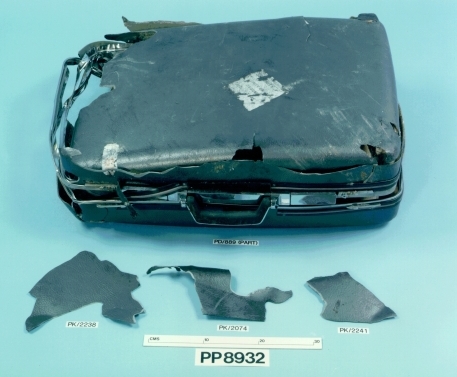
From the photo all I'd be willing to say is that the suitcase looks like it's been bounced off something solid from quite high up.
Since we know
exactly how high up, I suspect it wasn't as solid as all that. Probably some patch of pond-snail-and-fluke-ridden "pasture". God knows there's enough of that around there.
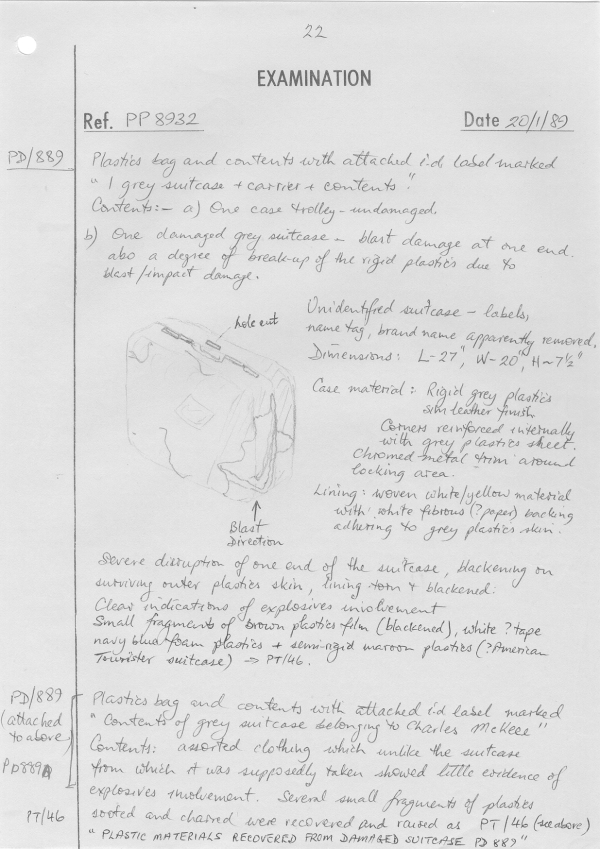
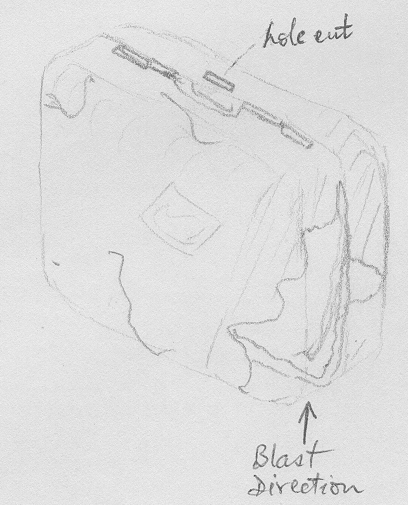
The only person saying that it's been explosion damaged is Hayes, and from his little drawing of blast damage direction I've assumed that this case ( PD889 ) is one of those stacked along the back ie NOT the other case Bedford saw.
Look at it this way. We know it was one of the six legitimate Heathrow interline suitcases. It was in the row at the back, unless it was moved down to the front to become the right-hand Bedford suitcase. We don't think it was that suitcase, because of the pattern of damage, so we agree it was in the row at the back.
We know it was one of the group of three off the Larnaca flight. Those are the three that arrived first, after Carlsson's early-arrival case. So the likelihood is, that suitcase was sitting on its hinge end, behind the bomb suitcase, and end-on to it.
I find it next to impossible to see how that damage as sketched by Hayes is
not blast damage. It's in exactly the position you'd expect such a case to be damaged by the explosion. Which is why, idiot though he undoubtedly is, I see no reason to disbelieve him.
The real anomaly is McKee's other case, PD/120. It's recorded as showing no explosion damage at all, though when they tested it, there was explosives contamination. It should also have been close enough to the bomb suitcase to have shown roughly similar damage to PD/889. However, the lack of damage would suggest it was actually the extreme right-hand one in the row. Where one of Bernstein's cases should have been.
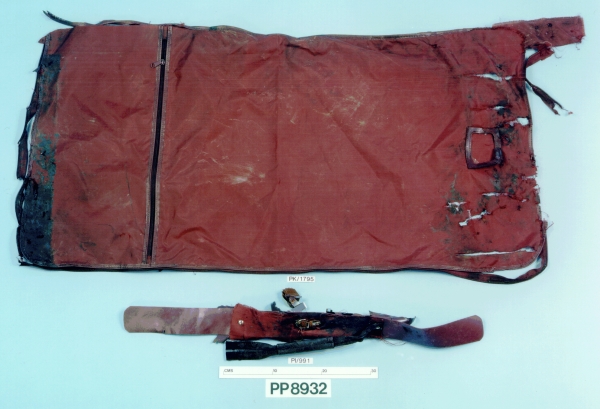
One of Bernstein's cases, in contrast, must have been pretty much right behind the bomb suitcase - I'd say between Carlsson's case and PD/889 - because the lock of the bomb suitcase was blasted into it. It's as if PD/120 and that Bernstein case (I still don't know if it was the suit carrier or the checked holdall) switched places.
I can't entirely explain it, but it's one more thing that suggests someone was playing silly buggers with the cases in the row at the back, after Bedford positioned them but before Sidhu loaded the Frankfurt luggage.
Think about something else. Hayes apparently drew that sketch on 20th January 1989. It looks like a slam-dunk demonstration of a bottom-layer explosion. The case is even sitting upright in the sketch, in the way it would have been sitting in the container, rather than flat as one might imagine it being examined (cf. the photograph). Now I know Hayes also put the height of the explosion at 18 inches in a memo dated 16th January, so it's all a bit unclear, but I wonder if this was an honest assessment at the time, that had to be massively fudged later? (Never mind that big hole in the bottom, look at this suspiciously neat little hole on the top....)
On a different note, that's an interesting little nugget the SCCRC dug out relating to CIA ( or others ) interference in the evidence chain, specifically to PD 889. The two cops who were asked to 'retrieve' items remember who asked them to ( Orr ), that they did so and even had some vague recollection of what was retrieved ( also that there was no log kept of this ). Orr, on the other hand, denies all knowledge ( over two interviews ) of such a request or thing happening.
I know it was a very big investigation n all that, but securing sensitive intelligence docs for foreign powers obviously happens so regularly in Scotland as to be unremarkable.
Don't start me. "Special relationship" is the polite term. "Poodle" is another. "Extraordinary rendition" is a third.
Rolfe.