• Security incident: ISF was recently accessed by intruders. Please change your password, and change it anywhere else you used it. Read more

NIST blew WTC7 Stage 1 analysis

I beg to differ with your last point. I agree that NIST did not, in my opinion, blow the stage 1 analysis significantly, although I do believe stage 1 should have come after a stage 0 covering the interior collapse under the penthouse. However...

Note that NIST Stage 1 refers to “the descent of the north face”. In terms of calculating Stage 1 fall acceleration, “Stage 0” data, the interior collapse, is immaterial.

In my opinion the definitely blew stage 2 significantly in stating 8 stories of collapse at gravitiational acceleration. They cannot claim it had constant acceleration of g, and in reinforcing the constant freefall claim they give an air of repectibility to those claims by the CT crowd, on one of the key tenets of their faith.
Some CTs believe that the initial fall, from still to FFA, was at FFA. This is wrong as NIST, Chandler, femr2 have shown for Stage 1.

Some CT’s believe that any period of FFA must = demolition. This is also wrong, as the columns first buckled and resisted, with acceleration at less than FFA, then the splices failed, then without support the columns (only one point was measured) fell unresisted at or about FFA. There are pictures of buckled exterior wall columns.

If some CT’s believe that any period of > FFA must = demolition, they would be wrong because the preceding collapse of the interior attached beams could have added to the falling acceleration of the north wall. There's no right possible CD explanation for >FFA.

There are many ways to be wrong, as CTs have proven. The rationals can’t control what CTs find a respectably wrong claim.

Re: Stage 2. At, Greater, Less than FFA- (I believe this is right, but could use some verification/vetting.)

The pixel measurements (displacement, time) from a video of the distant fall of the North wall (measured at one point) of WTC7 contain measurement margin of error. This margin of error is compounded when calculating velocity and additionally increased when velocity is used to calculate acceleration. Smoothing interpolated-subpixel iterative curve algorithms might add to this ME, I don’t know.

A plot of say, one or two standard deviations curves from the acceleration curve produced would show whether for Stage 2, acceleration 1) At FFA or 2) Greater than FFA or 3) Less Than FFA are within the SD curves. If these acceleration curves are within the standard deviations, it may not be possible to confidently determine which acceleration curve (1),2),3)) is right.

In any case this would be a conclusion without consequence, as fires caused the collapse of WTC7.
 
Last edited:
Note that NIST Stage 1 refers to “the descent of the north face”. In terms of calculating Stage 1 fall acceleration, “Stage 0” data, the interior collapse, is immaterial.

Some CTs believe that the initial fall, from still to FFA, was at FFA. This is wrong as NIST, Chandler, femr2 have shown for Stage 1.

Some CT’s believe that any period of FFA must = demolition. This is also wrong, as the columns first buckled and resisted, with acceleration at less than FFA, then the splices failed, then without support the columns (only one point was measured) fell unresisted at or about FFA. There are pictures of buckled exterior wall columns.

If some CT’s believe that any period of > FFA must = demolition, they would be wrong because the preceding collapse of the interior attached beams could have added to the falling acceleration of the north wall. There's no right possible CD explanation for >FFA.

There are many ways to be wrong, as CTs have proven. The rationals can’t control what CTs find a respectably wrong claim.

Re: Stage 2. At, Greater, Less than FFA- (I believe this is right, but could use some verification/vetting.)

The pixel measurements (displacement, time) from a video of the distant fall of the North wall (measured at one point) of WTC7 contain measurement margin of error. This margin of error is compounded when calculating velocity and additionally increased when velocity is used to calculate acceleration. Smoothing interpolated-subpixel iterative curve algorithms might add to this ME, I don’t know.

A plot of say, one or two standard deviations curves from the acceleration curve produced would show whether for Stage 2, acceleration 1) At FFA or 2) Greater than FFA or 3) Less Than FFA are within the SD curves. If these acceleration curves are within the standard deviations, it may not be possible to confidently determine which acceleration curve (1),2),3)) is right.

In any case this would be a conclusion without consequence, as fires caused the collapse of WTC7.

I actually agree with all of what you are saying - the stage 2 acceleration cannot be exactly determined at any point and may very well exceed g, and also that it is without consequence because it can all still be explained by the fire initiated collapse. My gripe was that NIST did not point that out in the summary you quoted.

And as Oz pointed out, this is a sidebar from the main point.
 
This is wrong, there are 3 stages. NIST describes the three stages
The disconnect you may not be aware of is that you are only saying "there are three stages"...because NIST described three stages. If NIST had defined 6 stages, I have no doubt you'd be stating there were 6 stages.

NIST WTC7 FINAL - 1A Report (Final November 2008)
SUMMARY
A more detailed analysis of the descent of the north face found three stages: (1) a slow descent with acceleration less than that of gravity that corresponded to the buckling of the exterior columns at the lower floors


I prefer the actual report text...

In Stage 1, the descent was slow and the acceleration was less than that of gravity. This stage corresponds to the initial buckling of the exterior columns in the lower stories of the north face, as seen in Figure 12–62. By 1.75 s, the north face had descended approximately 7 ft.

The additional detail provides information required to determine the extent to which NIST was, or was not, correct in their "stage 1 analysis".

Did “NIST blew WTC7 Stage 1 analysis” in two parts.
It's really not that simplistic I'm afraid. You're framing the issue with your personal bias.

Is NIST’s conclusion right? “Stage 1 – acceleration less than that of gravity”. This is a binary question.
There's more to "stage 1" than that. I'll perhaps list the number of issues and errors which relate to "stage 1". That includes what is "stage 1".

The answer is yes. NIST, Chandler, femr2 all agree the first stage had an acceleration less than that of gravity. NIST is right.
I agree that an early portion of descent "had an acceleration less than that of gravity", but that does not really touch the numerous problems with their analysis...as-in "did they mess up the analysis", or... "did they blow the analysis".

Do NIST’s approximated measurements and mathematical model produce the most accurate output data possible? This is a statistics question. Most likely not. It is possible more accurate output data can be produced.
It's not just accuracy. What NISTs data actually "is" can be shown to be severely flawed.
 
In my opinion the definitely blew stage 2 significantly in stating 8 stories of collapse at gravitiational acceleration. They cannot claim it had constant acceleration of g, and in reinforcing the constant freefall claim they give an air of repectibility to those claims by the CT crowd, on one of the key tenets of their faith.

A very poor set of decisions from NIST to firstly define the three stages, and then to state them in the way they did. The silly stage 2 conclusions are borne primarily from them replicating Chandler's poor methods...a linear regression from low fidelity velocity data...shoe-horning themselves into stating a constant "32.196 ft/s^2" for a significant period of time. 32.196 indeed :(
 
The disconnect you may not be aware of is that you are only saying "there are three stages"...because NIST described three stages.
NIST- Less than FFA, At FFA, Less than FFA. Count them. How many does femr2 count.

If NIST had defined 6 stages, I have no doubt you'd be stating there were 6 stages.
I can tell femr2 made this up. femr2 has no way of knowing what I would be stating.

I prefer the actual report text...

In Stage 1, the descent was slow and the acceleration was less than that of gravity. This stage corresponds to the initial buckling of the exterior columns in the lower stories of the north face, as seen in Figure 12–62. By 1.75 s, the north face had descended approximately 7 ft.

The additional detail provides information required to determine the extent to which NIST was, or was not, correct in their "stage 1 analysis".
NIST Stage 1 <FFA is correct/right. The numbers are ME statistics as I have explained.

It's really not that simplistic I'm afraid. You're framing the issue with your personal bias.
femr2 will needlessly complicate/fog it. My personal bias is reason.

There's more to "stage 1" than that. I'll perhaps list the number of issues and errors which relate to "stage 1". That includes what is "stage 1".
This requires an explanation.

I agree that an early portion of descent "had an acceleration less than that of gravity", but that does not really touch the numerous problems with their analysis...as-in "did they mess up the analysis", or... "did they blow the analysis".
femr2 chooses not to understand my post. femr2 is framing the issue with his personal bias.

It's not just accuracy. What NISTs data actually "is" can be shown to be severely flawed.
This requires an explanation.
 
Note that NIST Stage 1 refers to “the descent of the north face”.
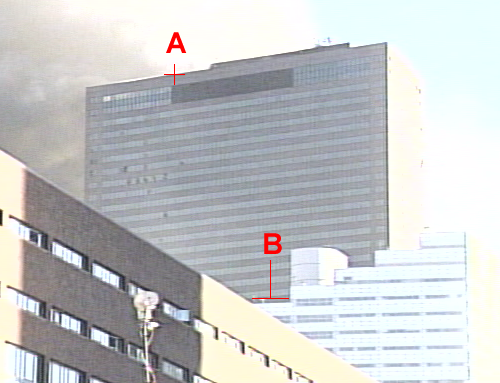
Indeed, even though they only traced a (badly chosen, wandering, spliced) point on the Eastern side of the roofline. A splice between these points...
516330913.png


NIST should not have applied the extracted behaviour to the entire North face. It is also clear that "the North face" was still connected to the greater part of the rest of the building.

[/I]In terms of calculating Stage 1 fall acceleration, “Stage 0” data, the interior collapse, is immaterial.
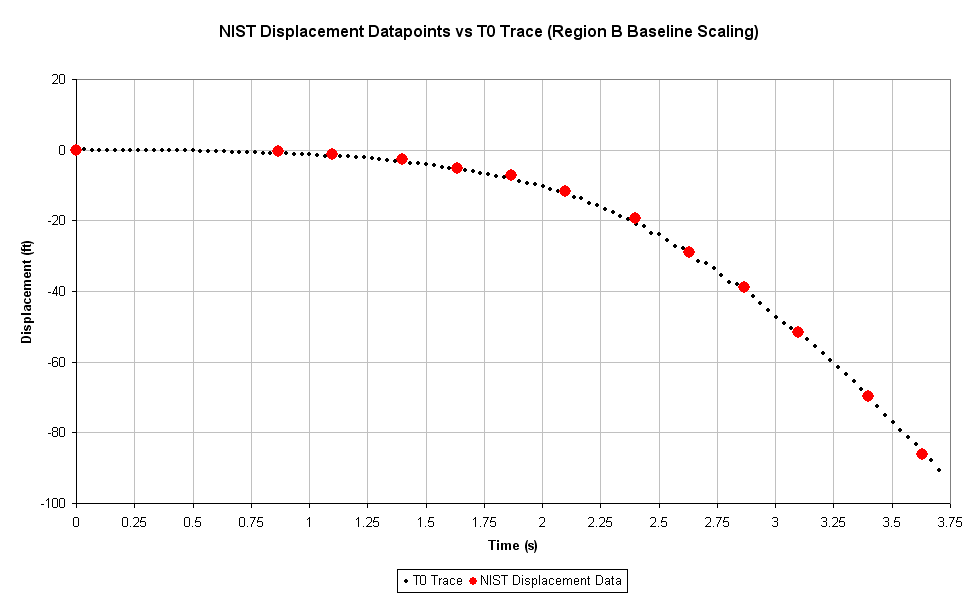
However, not only is the NIST data affected by their choice of trace location (which they incorrectly interpreted early primary N-S motion as vertical), but it can be shown that their T0 is wrong in numerous ways.

There are many ways to be wrong
NIST stage 1 analysis contains a multitude of "wrong". That a simplistic (and rather obvious) conclusion is kinda correct (though not for a "correct" period of time) does not mean the analysis itself was "correct". The analysis was pretty darn poor.

it may not be possible to confidently determine which acceleration curve (1),2),3)) is right.
Of more confidence is the trend. There is of cource an amount of error in magnitude.
 
NIST- Less than FFA, At FFA, Less than FFA. Count them. How many does femr2 count.
Illustrating my point elegantly.

I don't think staging the acceleration trend is a great idea, but if held at gunpoint I'd suggest...hmmm...5 or 6.

NONE of which would include the stupid "AT" FFA nonsense.

I can tell femr2 made this up. femr2 has no way of knowing what I would be stating.
You've elegantly confirmed it above :rolleyes:

NIST Stage 1 <FFA is correct/right.
NIST Stage 1 analysis is crap. IMO...blown... for the many reasons I've listed earlier in this thread. The exact scope of blown/not blown is of course ill-defined by the OP, and so endless argument about that is fairly pointless.

femr2 will needlessly complicate/fog it. My personal bias is reason.
Nope. The problem is that you are discussing a stage 1 "conclusion", NOT the stage 1 "analysis". This thread does not ask "did NIST blow stage 1 conclusions"

This requires an explanation.
I suggest you re-read the thread. It's not too long.

femr2 chooses not to understand my post. femr2 is framing the issue with his personal bias.
Incorrect. I am able to read the thread title, which does not ask "did NIST blow stage 1 conclusions".

This requires an explanation.
Again, I suggest you re-read the thread. If you are still confused, I'll gladly repeat the rather lengthy series of problems and errors which the NIST stage 1 ANALYSIS suffers from.
 
Last edited:
Whilst I'm at it...

In terms of calculating Stage 1 fall acceleration, “Stage 0” data, the interior collapse, is immaterial.
That depends how you choose to define any "stages".

NIST chose to begin their analysis at their defined T0, a value a couple of minutes after motion of the building became detectable, and a second or so before the location they chose to begin tracing from entered into (larger scale) primarily veretical motion.

Again, you are "accepting" the NIST framing.

Some CTs believe that the initial fall, from still to FFA, was at FFA. This is wrong as NIST, Chandler, femr2 have shown for Stage 1.
A point irrelevant to this thread.

Some CT’s believe that any period of FFA must = demolition.
Again, a point irrelevant to this thread...unless to highlight why NIST's decision to affirm "2.25s of freefall" was a really bad idea.

This is also wrong, as the columns first buckled and resisted, with acceleration at less than FFA, then the splices failed, then without support the columns (only one point was measured) fell unresisted at or about FFA.
A description which completely ignores connectivity of "the columns" to the "rest of the building"...

If some CT’s believe that any period of > FFA must = demolition, they would be wrong because the preceding collapse of the interior attached beams could have added to the falling acceleration of the north wall.
...whilst here you allude to >FFA due to such connectivity. Inconsistency :(

There's no right possible CD explanation for >FFA.
Incorrect. Exactly the same explanation as for non-CD.
 
I assume the question you mean is that one just above, yes ?

If so, I'm not sure what you mean. tfk has been practically non-existant within this thread, despite him starting it and making a number of rather bold (and rude of course) claims and unsupported assertions across multiple threads.

I've provided quite detailed critique of the NIST tracing techniques, including those parts relevant to "Stage 1", and have framed why I assert not only that "NIST stage 1" is "crap", but also how and why I assert they "blew it"....
I am familiar with your assertions as to "NIST stage 1" is "crap". I have been
trying to learn Major_Tom's position on the OP.

...I'm not a fan of that word. The "royal 'we'" is fine, but does not occur very often at all.
My slip there - please insert "I" at the offending location. :o :o

Remainder of your points in subsequent posts seem to be OK to me.
The exact scope of blown/not blown is of course ill-defined by the OP, and so endless argument about that is fairly pointless...
Yes debate is quite likely pointless but I am interested in what M_T sees as the extent of error needed to qualify as the emotive "blown" (or "blew").
 
Last edited:
femr2
It's really not that simplistic I'm afraid. You're framing the issue with your personal bias.
It’s simple, not simplistic. My bias is reason.

Indeed, even though they only traced a (badly chosen, wandering, spliced) point on the Eastern side of the roofline. A splice between these points...
516330913.png


NIST should not have applied the extracted behaviour to the entire North face. It is also clear that "the North face" was still connected to the greater part of the rest of the building.


However, not only is the NIST data affected by their choice of trace location (which they incorrectly interpreted early primary N-S motion as vertical), but it can be shown that their T0 is wrong in numerous ways.

NIST stage 1 analysis contains a multitude of "wrong". That a simplistic (and rather obvious) conclusion is kinda correct (though not for a "correct" period of time) does not mean the analysis itself was "correct". The analysis was pretty darn poor.

Of more confidence is the trend. There is of cource an amount of error in magnitude.


Illustrating my point elegantly.

I don't think staging the acceleration trend is a great idea, but if held at gunpoint I'd suggest...hmmm...5 or 6.

NONE of which would include the stupid "AT" FFA nonsense.

You've elegantly confirmed it above :rolleyes:

NIST Stage 1 analysis is crap. IMO...blown... for the many reasons I've listed earlier in this thread. The exact scope of blown/not blown is of course ill-defined by the OP, and so endless argument about that is fairly pointless.

Nope. The problem is that you are discussing a stage 1 "conclusion", NOT the stage 1 "analysis". This thread does not ask "did NIST blow stage 1 conclusions"

I suggest you re-read the thread. It's not too long.

Incorrect. I am able to read the thread title, which does not ask "did NIST blow stage 1 conclusions".

Again, I suggest you re-read the thread. If you are still confused, I'll gladly repeat the rather lengthy series of problems and errors which the NIST stage 1 ANALYSIS suffers from.


Whilst I'm at it...

That depends how you choose to define any "stages".

NIST chose to begin their analysis at their defined T0, a value a couple of minutes after motion of the building became detectable, and a second or so before the location they chose to begin tracing from entered into (larger scale) primarily veretical motion.

Again, you are "accepting" the NIST framing.

A point irrelevant to this thread.

Again, a point irrelevant to this thread...unless to highlight why NIST's decision to affirm "2.25s of freefall" was a really bad idea.

A description which completely ignores connectivity of "the columns" to the "rest of the building"...

...whilst here you allude to >FFA due to such connectivity. Inconsistency :(

Incorrect. Exactly the same explanation as for non-CD.

Must have struck a couple of nerves.
 
.......
NIST Stage 1 analysis is crap. IMO...blown... for the many reasons I've listed earlier in this thread. The exact scope of blown/not blown is of course ill-defined by the OP, and so endless argument about that is fairly pointless.

.....
I've provided quite detailed critique of the NIST tracing techniques, including those parts relevant to "Stage 1", and have framed why I assert not only that "NIST stage 1" is "crap", but also how and why I assert they "blew it".

Femr2’s Camera2 video selection (distance to WTC 7 ~21,000 feet)


NIST camera 3 video selection (distance to WTC 7 ~7,000 feet)


Compared to NIST’s selection, femr2’s significantly lower resolution video, largely due to atmospheric refraction is, as he uses the term, “crap”, as is the subsequent point tracking and analysis derived from it.

What femr2's WTC 7 Camera 2 NW corner tracking point looks like:
880831943.gif


http://femr2.ucoz.com/_ph/7/2/880831943.gif

The collapse of WTC 7 was a fire-induced progressive collapse.
 
Last edited:
It’s simple, not simplistic.
I chose the word carefully..."Treating complex issues and problems as if they were much simpler than they really are".

Must have struck a couple of nerves.
LOL. Your MANY errors required response. Don't make so many errors and I won't have to spend my precious time correcting you.
 
Last edited:
As an added bonus, even the trace data extracted from the Dan Rather footage is far superior to that provided by NIST
As an example...


...which is a zoomed view of the full trace...


Note the ~+/-0.2 pixel variance.

If you want to have a look at how per-frame and the NIST traces stack up, have a look at this replicated NIST trace (from their exact T0) compared to the NIST data...


(Note the source discussion before "going off on one :) )

I have detailed the issues with the NIST vertical trace many times...


None of what you're actually (attempting to be) discussing has much to do with this thread, and should really be over on "femr2 video data analysis" thread.
 
Nope.

ROFL. I've used both Dan Rather AND Cam#3 footage for tracing.

Deary me. It seems you're suggesting that the Dan Rather viewpoint is not as clear as the Cam#3 viewpoint, and if so...you'd be quite right. However, as you know, I use both Dan Rather AND Cam#3 viewpoints...using the very best quality versions of BOTH.

Really doesn't. Digging yourself in deeper.

Again..ROFL. Both sets of footage have been traced. As an added bonus, even the trace data extracted from the Dan Rather footage is far superior to that provided by NIST :jaw-dropp
Thank you. Then I'm wrong about femr2 not using Cam#3 for trace data

You really aren't doing a good job of obfuscating your prior (recent) series of silly errors, discussed...
Here --- No, I'm right here
...and...
Here --- No, I'm right here.

----

Did “NIST blew WTC7 Stage 1 analysis” in two parts.
1. Is NIST’s conclusion right? “Stage 1 – acceleration less than that of gravity”. This is a binary question. The answer is yes. NIST, Chandler, femr2 all agree the first stage had an acceleration less than that of gravity. NIST is right.
2. Do NIST’s approximated measurements and mathematical model produce the most accurate output data possible? This is a statistics question. Most likely not. It is possible more accurate output data can be produced.

From my current understanding of the purpose of the NIST investigation, I can see nothing of significance wrong with the NIST record of events with any of the collapsed WTC structures.
 
Last edited:
Here --- No, I'm right here
...and...
Here --- No, I'm right here.
Again, you don't seem able to see where your disconnect is occuring...

The main problem is that you are discussing a stage 1 "conclusion", NOT the stage 1 "analysis". This thread does not ask "did NIST blow stage 1 conclusions".

A fairly lengthy list of issues and errors within the NIST stage 1 analysis is linked in my previous post.

Within the linked posts you've repeatedly appended a rather pointless "no, I'm right here" to, I detail a number of issues and errors with your statements. I suggest you address each individually.
 
Last edited:
Again, you don't seem able to see where your disconnect is occuring...

The main problem is that you are discussing a stage 1 "conclusion", NOT the stage 1 "analysis". This thread does not ask "did NIST blow stage 1 conclusions".
thumbup.gif


Spot on - it's the wrong topic.

And the disconnects are quite obvious.

I suggest back off - ask "What are we discussing" - make sure it is a technical topic - and the topic identified in the OP -- and ensure it is not "Disparage femr2 at any cost to logic or truth" -- and ditto "Disparage femr2's work at any..."

I use a tape measure (and rulers and a laser measurer) in a lot of work that I do. If I am discussing the accuracy of the measuring tools that is what I discuss. Even if I despise the politics of the owner of the person who designed the laser measure it doesn't change the accuracy of the tool.

And the tool does not become inaccurate no matter how much mud people throw at the designer or manufacturer.

Funny that is taken for granted in the 'real world' but doesn't seem to apply in forums....
scratch.gif
 
Again, you don't seem able to see where your disconnect is occuring...

The main problem is that you are discussing a stage 1 "conclusion", NOT the stage 1 "analysis". This thread does not ask "did NIST blow stage 1 conclusions".
femr2 agrees NIST's stage 1 conclusion is right. I addressed both conclusion and analysis. See point 2 above.

A fairly lengthy list of issues and errors within the NIST stage 1 analysis is linked in my previous post.
Yes, it is lengthy. It is likely I won't have the time to spend reviewing and researching them, as they don't affect the conclusion that the collapse of WTC 7 was a fire-induced progressive collapse. As for the analysis of the data and their accuracy, this is a statistics question that others can best answer.

Within the linked posts you've repeatedly appended a rather pointless "no, I'm right here" to, I detail a number of issues and errors with your statements. I suggest you address each individually.
I checked each and believe they are right, or I would have said "I'm wrong here". I don't know if I will revisit them as it has no effect on NIST's conclusions.

Does femr2's measurements and mathematical model produce the most accurate output data possible? This is a statistics question. Most likely not.
 
Last edited:
I suggest back off - ask "What are we discussing"
I do tryyyy :)

I'd imagine most discussion going forward can be handled with links to what's already been said...so that should calm things.

ETA: BA's previous response would seem to "end" the matter, however I view such a response.
 
Last edited:
femr2 agrees NIST's stage 1 conclusion is right.
At the risk of repeating myself, yet again, I don't agree with that statement.

I agree that, for early post-release motion, "the acceleration was less than that of gravity"... hardly a conclusion which required any analysis.

However, I don't agree with... their timings, T0, application to entire North face, trace method, trace location, source video treatment, sample frequency, static point motion treatment, interpretation of motion direction, use of linear regression to determine acceleration metrics, staging selection, etc...

I addressed both conclusion and analysis. See point 2 above.
The topic focus is the analysis itself. All you've suggested is that it could have been more accurate. Again, I have provided a lengthy list of issues and errors with the analysis, most of which have nothing to do with accuracy but more relevancy. You have absolutely no interest in actually discussing the thread topic, as you allude to below.

Yes, it is lengthy. It is likely I won't have the time to spend reviewing and researching them
Then I suggest you don't waste your time feigning interest in discussion of the actual thread topic.

I checked each and believe they are right, or I would have said "I'm wrong here".
You are of course entitled to believe whatever you please, no matter how many times your errors are carefully and clearly explained to you.

I don't know if I will revisit them
Hmm. They are not going away, but I have no need to keep repeating the problems to you, as you no doubt already know what they are.
 
All this talk is hilarious. It's patently obvious that aircraft damage and-or fire felled the twin towers, and twin towers + fire felled every other building. NIST picking is just a stupid hobby for people who think they're smart.
 

ISF - Join now!

Every member here is approved by hand. No bots, no spam, just people who care about evidence and honest debate.

Membership is free!

Create your free account

Back
Top Bottom