• Quick note - the problem with Youtube videos not embedding on the forum appears to have been fixed, thanks to ZiprHead. If you do still see problems let me know.

Merged Thread to Discuss The Excellent Analysis of Jones latest paper

All due respect Mr.spanx but, do your own research.contact him and ask. He's not that hard to find. http://911blogger.com/news/2012-11-30/chemical-engineer-mark-basile-conduct-new-nano-thermite-study
It seems to me Mr Basile is a very good man, very experienced in his field. a material scientist who expresses wonder at primer paint igniting in a thermitic reaction producing molten iron.
He is asking for anyone able to substantively help to do so. The more the merrier.

Time to step up Mister Oystein.

I already have. If you look at their donation page the information is there.

For all I know the job could be done by Harrit ?
 
All due respect Mr.spanx but, do your own research.contact him and ask. He's not that hard to find. http://911blogger.com/news/2012-11-30/chemical-engineer-mark-basile-conduct-new-nano-thermite-study
It seems to me Mr Basile is a very good man, very experienced in his field. a material scientist who expresses wonder at primer paint igniting in a thermitic reaction producing molten iron.
He is asking for anyone able to substantively help to do so. The more the merrier.

Time to step up Mister Oystein.

I don't see your name on the list...
 
And justice grinds mighty fine.

Its not me needed for this, mister. I would just get in the way. You have expertize. Mr Basile is calling for 'expertize' to help in the study. There are ten thousand of me for every one of you, able to penetrate the chemical matrix to find what pulverized 300 acres of concrete into fine powder and melted so much STEEL. And for every one thousand of you, there is only one Mark Basile willing to put it on the line - has the intuition or balls to see the NEED.
One thing for certain, portent of biblical persuasion; it is IN the DUST.
 
The wheels of justice turn slowly, but grind exceedingly fine. LOL, E=mgh?

Jones paper proves you can publish anything, claim thermite, CD or inside job, and fringe conspiracy theorists will make potents of biblical persuasion. God did it? God influenced 911 truth to lie? WWJD

And justice grinds mighty fine. Why the silly title? It is ironic. You believe in lies, and should be skeptical about the crazy claims you support.

Mr Basile is calling for 'expertize' to help in the study.
There is no need for someone who is spreading lies to need expertise, it is called lying, and it is the main technique used by 911 truth.


There are ten thousand of me for every one of you,
Please list the ten thousand of "yous", who were fooled by the fake termite paper.


able to penetrate the chemical matrix to find what pulverized 300 acres of concrete into fine powder
300 acres?

Most the dust was insulation and wall board. E=mgh was released in a gravity collapse, and that is the energy that crushed ceiling tiles, wallboard, insulation, and concrete.

and melted so much STEEL.
There was no melted steel. Did Jones fool you with that lie too? His paper is bad enough, but the melted steel? Where is this melted steel? Show us some melted steel.


And for every one thousand of you, there is only one Mark Basile willing to put it on the line - has the intuition or balls to see the NEED.
The need to waste time spreading lies about 911? What a great goal, spreading lies and misleading people. Wow, no wonder there is only one, it is such a great goal.


One thing for certain, portent of biblical persuasion; it is IN the DUST.

Now you think god has the answers in the dust, waiting for you and your religion of 911 woo. You could look at your movement as a religion, it is based on faith.

The dust is portent of gravitational persuasion. Case closed; Physics wins again. Jones went on after his paper, how the ceiling tiles in the WTC were radio controlled thermite "bomb". Wow. Someone needs help.
 
Its not me needed for this, mister. I would just get in the way. You have expertize. Mr Basile is calling for 'expertize' to help in the study. There are ten thousand of me for every one of you, able to penetrate the chemical matrix to find what pulverized 300 acres of concrete into fine powder and melted so much STEEL. And for every one thousand of you, there is only one Mark Basile willing to put it on the line - has the intuition or balls to see the NEED.
One thing for certain, portent of biblical persuasion; it is IN the DUST.

Let's face it Remo, the only truthers left standing have a financial interest. Every corner you turn there is a begging banner.

As for the tens of thousands army of truthers :confused: you are wrong. You will find there are only a few dick lickers left.

Anyway enjoy your day and roll a big fat one for me ;)
 
Its not me needed for this, mister. I would just get in the way.
But your money would be greatly appreciated

You have expertize. Mr Basile is calling for 'expertize' to help in the study.
We'll see if he accepts it.

There are ten thousand of me for every one of you,
Not true. A few thousand total willing to at least fill out an internet form.
Look here: In that thread, I am monitoring 6 petitions truthers have opened on several websites. After runnung an average of 7 months, they have now 5101 signatures between them. Many of those will be counted doubly or triply as some truthers will sign two or more of them.

The AE911Truth Facebook page has almost 100,000 likes - probably the highest number you can find these days anywhere. Are these 100,000 "like you", remo? Or rather - are you "like them"? Is all you do to change the world click "like" on Facebook?

able to penetrate the chemical matrix to find what pulverized 300 acres of concrete into fine powder
No chemical matrix needed - gravity was sufficient, as has been shown years ago. Are you ever going to catch up? All the material in the tower fell from an average height of 180 meters. Drop wall board from 180 meters, drop slabs of light-weight concrete from 180 meters - wouldn't you expect to turn some of it to dust? Multiply by mass of total concrete and gypsum, and you are there.

and melted so much STEEL.
How much? Got evidence? Anything? No.

And for every one thousand of you, there is only one Mark Basile willing to put it on the line - has the intuition or balls to see the NEED.
Except he is now off the line :D
Basile ran a few incomplete tests, with no protocol, and has no conclusion. Never wrote up the results, never published anything. After more than 2 years. Where is is data, remo? Where is his discussion?

One thing for certain, portent of biblical persuasion; it is IN the DUST.
And you would know this how? You have faith of biblical proportions, that is all. You are obviously totally incapable of arguing the claims you push on this board, or why else do you never ever answer any questions about them?
 
300 acres of concrete

Where are you getting 300 acres from? The towers themselves where about 208' x 208'. That gives us 43,264 sq ft. An acre is 43,560 sq ft.

Even if we took each floor (220 total) to be concrete all the way across (including filling the elevator shafts in the core), you still only get 218 acres.
 
aneta.org, and with it the above sites, is back online.
We had to turn them back on Gage's donations were going down.

With the Internet we are able to see nuts on 911 issues every day. Following sources and additional material on the web pages above you can find nuts who can't think rationally.
http://aneta.org/911Experiments_com/FallingConcrete/index.htm
Jones' thermite madness has attracted other nuts who do science experiments, but can't do E=mgh. Poor nuts, who can tell them the dust was wallboard, ceiling tiles, insulation and concrete? Like the lie about thermite, these nuts on 911 pick some crazy part of 911 which baffles them, and they drop concrete from low altitude and proclaim no dust. Or worse, no dust, look thermite did it.

Chris Mohr's site is filled with crazy claims from nuts on 911. Niels Harrit is so crazy, I think he can find thermite in the earth's crust. Adam Taylor, Chris Sarns, or Rick Shaddock thinks the thermite was planted in the buildings before 911, they have to support the failed paper to satisfy their fantasy. Ignore 19 terrorists, go with thermite. Why are they unable to break this news? Fantasy.
 
Last edited:
Re: DSC test by Farrer in Harrit e.al.:


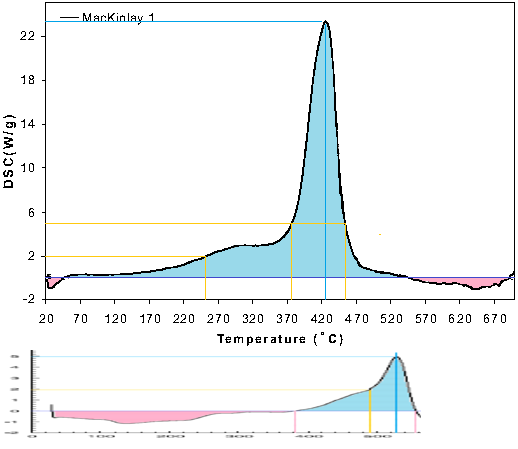
Here is a link to their Fig. 19 - which shows DSC traces of four red-gray chips heated at a rate of 10 C°/min (or 6 s/C°). Each of them reacts exothermally, with different power peaks and energy density, but the peaks at least occur at about the same temperature, between ca. 420 and 445 °C:
http://i1088.photobucket.com/albums...ticMaterial/ActiveThermiticMaterial_Fig19.jpg

Later, in Fig. 29, they compare one of these curves, the blue one with the lowest peak at the highest temperature, with a DSC trace obtained by Tillotson, Gash e.al. from actual nano-thermite - Fig. 3 in this paper.


I am now going to compare Tillotson's reaction profile with the black curve in Harrit e.al., which has the highest peak at the lowerst temperature. I erased the other three curves, inserted a horizontal line at 0 W/g, and shaded the area below that line baby pink (endotherm reaction) and above the line baby blue (exotherm reaction).
I did the same with Fig. 3 of Tillotson e.al., and stretched that figure such that its x- and y-axes have the same scale as Fig 19. by Harrit e.al.

Now we can compare them:

HarritFig19-1_vs_TG_Fig3.png


Again, both curves are plotted to the same scale. It is obvious that the curves display a lot of differences:
  • T&G observe an endotherm up to 380°C, Harrit is exotherm from 50° on.
  • Harrit peaks at 435°C, T&G at 530°C - a difference of >100°C.
  • Harrit's peak is almost 5 times as high as T&G's
  • Harrit's curve has a much larger blue area.
I have approximated the blue areas with a few triangles and reactangles to crudely estimate their size (I excluded the pink exotherms):

T&G's curve covers approx. 311 W/g/C°. Applying (multiplying) the heating rate of 6 s/C°, this number is equivalent to 1,866 Ws/g, or approx. 1.8-1.9 kJ/g (T&G say, in their paper, that they measured 1.5 kJ/g - perhaps my crude approximation is off by 20%, or they subtracted some of the endotherm region)

Now notice that T&G peak at 5 W/g - Harrit exceeds 5 W/g from approx. 380°C to approx. 455°C, a duration of 7.5 minutes! I measured the area under the graph within that interval using the same method as before, and found that during this peak power alone, energy released was approx. 6.8 kJ/g. That is 3.6 times the total energy release of T&G's actual thermite, and almost twice the theoretical maximum of thermite.

This proves that even during the peak of the reaction, most of the energy released, if not all, MUST come from a reaction other than the thermite reaction.

Add to this the energy released long before the peak, from 50 °C to 380°C, i.e. long before even a nanothermite reaction could be expected to occur at all: That area is equivalent to more than 2.6 kJ/g - more than the entire reaction observed when T&G burned real thermite.
Harrit e.al. report a total energy density for that specimen of 7.5 kJ/g, so I suspect they subtracted the negative (endotherm) area completely.

There is no proof at all in the DSC trace data of Harrit e.all. that a thermite reaction occurred. They offer no explanation why it should occur at a temperature 100 °C and more below their references at LLNL.
 
Hi Oystein

Very interesting and visually clear comparison. I hope you have patience for my "beginner" questions.

1. Harrit's test shows twice the energy of thermite, right? I probably do not understand the concept of energy, but here goes: Is more energy not the same as "more powerful", meaning that Harrit's "nanothermite" is some sort of "superthermite"?

2. Is it possible to reach higher energy levels from a "normal" burning than a thermite reaction? I thought that a thermite reaction needed to be exceptionally energetic in order to melt steel or be used to weld steel. What am I missing here?

3. Both T&G and Harrit's experiment reach only temperatures far below the melting point of steel. How is that possible? Can you weld steel at temperatures lower than the melting point of iron? I always thought that thermite would reach temperatures in the thousands. Is the low temperature due to a very short time span of the experiment in the sense that we only see the beginning of the process? So if it were to continue the temperature would rise into the thousands?

Kind regards
Steen
 
Hi Oystein

Very interesting and visually clear comparison. I hope you have patience for my "beginner" questions.

1. Harrit's test shows twice the energy of thermite, right? I probably do not understand the concept of energy, but here goes: Is more energy not the same as "more powerful", meaning that Harrit's "nanothermite" is some sort of "superthermite"?

No, it indicates that it can't be thermite. Because thermite has to contain the oxidiser it is heavier for a giver output energy than a pure fuel source that uses an external oxidiser. You can think of it as similar to a rocket vs a jet. If you have 1 tonne of jet fuel and burn it with atmospheric oxygen you'll get more energy out than a rocket that has a combined fuel/oxidiser weight of 1 tonne.
 
Hi Reactor Drone

Thanks for that explanation.

So Harrit's results indicate that his specimen uses an external oxygen source and thus it is not a thermite reaction, but something else, for example an oxidation, right?

That would make sense.

Kindly,
Steen
 
1. Harrit's test shows twice the energy of thermite, right? I probably do not understand the concept of energy, but here goes: Is more energy not the same as "more powerful", meaning that Harrit's "nanothermite" is some sort of "superthermite"?

A chemical reaction only releases a certain amount of energy. The released energy is a constant for a given chemical reaction. In our case, the released energy exceeds the theoretical energy release of the thermite reaction (2Al + Fe2O3 -> 2 Fe + Al2O3), so the released energy cannot only be the result of the thermite reaction.

2. Is it possible to reach higher energy levels from a "normal" burning than a thermite reaction? I thought that a thermite reaction needed to be exceptionally energetic in order to melt steel or be used to weld steel. What am I missing here?

If the "energy level" is the same than "released energy", then yes, the energy release of a normal combustion exceeds the energy release of the thermite reaction by large. Truthers often try to fool the people, as they focus solely on the reached temperature. They claim, that the thermite reaction reaches higher temperatures than a combustion and is therefore more energetic.

3. Both T&G and Harrit's experiment reach only temperatures far below the melting point of steel. How is that possible? Can you weld steel at temperatures lower than the melting point of iron? I always thought that thermite would reach temperatures in the thousands. Is the low temperature due to a very short time span of the experiment in the sense that we only see the beginning of the process? So if it were to continue the temperature would rise into the thousands?

Kind regards
Steen

I think you are confusing some points a little bit. During a DSC experiment the temperature is increased and the heat flux from or into the studied object is recorded. You may record if energy is released (exothermic reaction) or consumed (endothermic reaction), the amount of the released/consumed energy and the temperuture of the occuring reaction, but not the temperature of the studied object.

Hi Reactor Drone

Thanks for that explanation.

So Harrit's results indicate that his specimen uses an external oxygen source and thus it is not a thermite reaction, but something else, for example an oxidation, right?

Totally correct and it should always be recalled that Harrit conducted the DSC experiments in a stream of air!
 
Last edited:
Hi Africanus

Thansk for a very precise and pedagogical answer.

Just to make sure I understand your point (and my own confusement) in question 3:

A DSC experiment measures the ignition temperature by gradually incresing temperature of the specimen until ignition sets in. It does not measure the temperature of the reaction itself thta follows (which might be much higher, e.g. the melting point of iron), is that correct?

Kindly,
Steen
 
Hi Oystein

Very interesting and visually clear comparison. I hope you have patience for my "beginner" questions.

1. Harrit's test shows twice the energy of thermite, right? I probably do not understand the concept of energy, but here goes: Is more energy not the same as "more powerful", meaning that Harrit's "nanothermite" is some sort of "superthermite"?

2. Is it possible to reach higher energy levels from a "normal" burning than a thermite reaction? I thought that a thermite reaction needed to be exceptionally energetic in order to melt steel or be used to weld steel. What am I missing here?

3. Both T&G and Harrit's experiment reach only temperatures far below the melting point of steel. How is that possible? Can you weld steel at temperatures lower than the melting point of iron? I always thought that thermite would reach temperatures in the thousands. Is the low temperature due to a very short time span of the experiment in the sense that we only see the beginning of the process? So if it were to continue the temperature would rise into the thousands?

Kind regards
Steen

Hi Steen,

ooh yeah, you are missing a lot, and it so happens it is what Harrit and Jones pretend to miss as well - except they are professors in the natural sciences and must be expected to know better, whereas you are not.

Where to begin?

First, the difference between "energy" and "power".
Energy is the potential to do "work". For example, If you have a lake and and a dam, and a turbine in the dam, then the lake stores a certain amount of "potential energy", by way of being filled to a certain hight with a certain mass of water. This energy is a constant number as long as the water content remains the same.

Now you can release the water through the turbine and do "work", for example grind coffee. Or, more conventionally, turn the potential energy to electrical energy, which does work elsewhere (heat coffee, run TVs...). You can release that energy slowly, by letting the water just trickle out of the lake, or rapidly, by rushing large amounts of water through. If you do is slowly, say it takes a month to empty the lake, "power" is low, and if you do it quickly, say, in a day, "power" is high.
So we learn: Power is how much energy you release in a given amount of time.

Now you could have two lakes: One stores twice the energy of the other, but still work at less power, because you release the water from the smaller lake faster.

It's the same with chemical reactions: If you have two reactions, one can release more energy, and the other more power, simply because one occurs faster than the other. For example, body fat a lot of energy, but you metabolize it slowly, and thus with relatively little power. This reaction of "burning" reaches only a temperature of <40 °C. If however you set fire to a glass of cask-strength rum, it will burn with a hot flame and with much more power.
Body fat contains 38 kJ of energy per gram (that's the energy density)
Cask-strength rum (56 vol-% ethanol) contains only about 15 kJ/g

So rum has less energy per gram, but more power per gram, when burned in the open, compared to fat metabolism.


Thermite has only 4 kJ/g.
Epoxy has 25 kJ/g
Wood has 18 kJ/g
Even your body, because if contains body fat and other energetic organic substances, such as meat, has, on average, around 8 kJ/g - even though it consists mostly of water!

These energy densities are maximum values - the best that can happen in theory, and it is physically impossible for these reactions to release more energy. It is possible though that they release less energy, for example because they don't run to completion (some fuel remains unburned, or oxidation isn't complete), or because your substance isn't pure and contains stuff that doesn't react.
(In fact, Harrit e.al. point out that their four test results differ because all four chips contained varying proportions of the gray layer, which is probably inert, or "dead weight")

So you see, thermite is actually one of the least "energetic" stuffs around.
BUT it can be more powerful - when you make it burn really fast, and that is much of the point of nano-thermite: Because the ingredients are so fine, they can react extremely fast, and release all their energy in a very short time. That is part of the reason why (nano-) thermite gets so hot.
On the other hand, your thermite is spent after a very short time - and that's why it is total nonsense when truthers believe that thermite could explain why the debris piles were hot for weeks! Either thermite burns fast, then it could not heat stuff for weeks; or, if it burns for weeks, it burns with VERY little power, and is, at any rate, much worse at keeping the rubble hot than even burning human remains!


Another reason, the main reason actually, why thermite reaches extreme temperatures is that all its ingredients and, more importantly, it's reaction products, have high boiling points: Nothing turns to gas. When you burn organics (fat, epoxy, ethanol...), many reaction products are gasses. Gasses have a habit of rapidly taking away a lot of the energy that is released. Because increasing temperature is just one way that the chemical energy of a reaction does "work" - expanding volume is another, and those two targets for the energy to go to rival each other when gasses are created. So creating gasses tends to limit the temperature that is reached. This is no problem for thermite - the products, iron and aluminium oxide, turn to gas only at extreme temperatures, and so most of the energy release goes into heating them, and little into expanding them.


In the DSC experiment, temperature is tightly controlled. You usually have a probe that is tiny compared to the crucible it is places upon. It is difficult for the solid parts of the probe to attain a temperature much higher than that of the crucible it lays on. The DSC adds heat (energy, electric) to the crucible and measures the resulting temperature. When temperature rises because of a reaction on the crucible, the device feeds in less electrical energy, to keep the temperature rise constant at, say, 10 °C per minute. Through this temperature control, you also control reaction speed.

Harrit, farrer etc, like to claim that a narrow, steep peak in the DSC trace means a very rapid reaction, but that isn't true at all! Like I wrote in my earlier post: the peak that looks steep and dramatic from 380°C to approx. 455°C actually represents a reaction that tool 7.5 minutes! We are talking about tiny specimens that weigh much less than a microgram, and they react over the course of many many minutes in the DSC., In fact, heating it from 20°C to 700°C takes 68 minutes - more than an hour! Nothing is rapid there.


With all that said, now short answers:

1. No, more energy does not necessarily mean more "powerful". The power is dependent on haw fast the reaction occurs. It is correct though that you could "enhance" the energy content of a thermite preparation by mixing it with substances that have a higher energy density - for example organic substances. But once you find that most of the energy release must come from stuff other than thermite, you couldn't call the composite "thermitic in nature". Also, as organics release gas when heated, these composites are again limited in temperature - you couldn't melt steel with a composite that's, say, 70% organic and 20% thermite.

2. It's not the "energy" in thermite that enables it to reach extreme temperatures, but the fact that it burns rapidly and doesn't expand much as a gas - in other words, the energy it releases, although relatively low absolutely, is very concentrated in time and space, and thus, for a very short time and in a very limited volume, you get to melt steel.

3. The low temperature (up to 600-700 °C ) shown in the DSC results is mostly a property of the DSC device controlling temperature tightly, which in turn controls (to some extent) the speed at which reactions take place. Also, these temperatures are not how hot the reaction products get, but how hot the DSC device makes the crucible.
In "the wild", the same reaction could reach a higher, or a lower, temperature than the DSC does. Also, it may run much faster "in the wild" than in that controlled environment.
T&G by the way point out explicitly that the DSC profile cannot be taken as an indication for reaction speed, and that other types of experiment would have to be done to measure that.

 
Greetings.

As a newcomer (ok, lurked here for years)on these forums, I would like to ask a simple question focusing entirely on the chemican reaction/burn regarding thermite. Is there a way, chemically, to enhance the energyyeld of thermite/thermate/nanothermite in any way beyond 4 KJ/g? :)
 
Greetings.

As a newcomer (ok, lurked here for years)on these forums, I would like to ask a simple question focusing entirely on the chemican reaction/burn regarding thermite. Is there a way, chemically, to enhance the energyyeld of thermite/thermate/nanothermite in any way beyond 4 KJ/g? :)

No. Period. That figure is dictated by the chemical bonds; it is the absolute maximum possible.

If you include some other substance that has its own chemical or physical reaction, you can get more energy out of the compound, but it's not the aluminum/iron oxide redox that's providing that additional energy.
 

Back
Top Bottom