• Security incident: ISF was recently accessed by intruders. Please change your password, and change it anywhere else you used it. Read more

Pilots fear threats from chem-trailers

In addition to that, it might not just cannot be a chemtrailer. ..residual stuff cropped..
.
ftfy.
There are NO, that is NONE, NADA, ZERO, ZIP chemtrailers. Of any kind. Anywhere. Anytime. Ever.
 
...

While it is a recoverable situation, the recovery success rate for take-off engine failure after V2 is not high.
.
It is pretty close to 100%. It's part of the certification program to prove the plane can continue the takeoff with an engine failure. That's the reason for the monster motors on the large twins.
We did many such tests on the Tristar, cutting a wing motor OFF at V2 and taking off every time!
The compressor stall when the fuel and ignition switch for that motor was cut was impressively noisy! The Rolls Royce people on board would cringe. :)
 
You don’t think pilots train for this possibility?

Of course they do. Unfortunately the procedure is:

1. Slam on the brakes.
2. Engage braking boost pumps.
3. Pray.

Rejected takeoffs mean hitting post-runway clutter at phenomenal speeds. Fuselages are flimsy.

And what commercial airliner is not able to maintain flight on one engine?

All of them. However, none many of them can't climb fully loaded on one engine. If you lose an engine at or near V2, you're going to have a Bad Day.
 
Last edited:
.We did many such tests on the Tristar, cutting a wing motor OFF at V2 and taking off every time!

I have nothing but respect for the Tristar. Amazing airplane, and you were fortunate to be involved.

However three engines are definitely better than two. Last I check the OEI climb gradients for two-engine large airframes, initial takeoff gradient was 0.0%. Once you get the gear up, you can expect a positive gradient. For three engines there's a positive initial climb gradient with one engine inoperative, but I don't recall off the top of my head what it is. Enough, though.
 
we are not necessarily talking simple engine out either, it may well include high speed objects exiting the nacelle with attendant threat to control surfaces, hydralics, fuel tanks/lines, and landing gear
 
we are not necessarily talking simple engine out either, it may well include high speed objects exiting the nacelle with attendant threat to control surfaces, hydralics, fuel tanks/lines, and landing gear

True, but regulations are more stringent now about how such engine failures must be contained. Rotor bursts naturally fail the engine, but don't as often fail nearby structures and systems.

Hydraulics now have check valves to prevent hydraulic exsanguination in all the systems. Control surfaces can sustain surprising deficits while retaining flight control (but at low airspeed this is less effective). Fuel systems and other fluid lines are often armored near the engines. Landing gear tend to be outside the rotor burst plane and debris ejection cones, but there's still a danger.
 
LA's "Intercontinental Airport" proposed for Palmdale can't happen because the density altitude goes way up there in the summer time, and the planes would have to offload fuel... and not fly as far, or offload passengers, and not make as much money.
We used a two-seat Grumman Cougar for the chase plane on the ES-3A. This plane was runway length limited at Palmdale in the summertime! With 12,000 feet available!
One of our engine-fail tests at Edwards, the FAA pilot anticipated the motor cut, and began the correction, then took it out, just as the FTE did cut the motor! Funny thing, McDonnell-Douglas was testing there too that day, and had set up their weather station right next to the East-West runway, the 15,000 footer that we used. The doesydo the Tristar went through with the premature correction, the motor cut and the real correction got us off into the sideways, just in time to blow dust all over the McDaccers... :p
The big Boeings are sometimes here for test purposes.
The only crash after V2 and motor fail I recall was the DC-10 at Chicago, when the motor fell off the airplane! The pilots attempted to maintain the noise-abatement flight profile, which was possible with two motors, but the leading edge slats on the left wing retracted when the motor fell off, losing a major portion of the lift on that side, at the same time the motor on the right wing was pushing and rolling the airplane to the left. Not a prayer for a recovery.
I don't recall any Tristar accidents that weren't pilot problems. Or, like the Saudi plane that burned after landing, procedural problems.
 
You don’t think pilots train for this possibility?

Yes they do, It doesn't mean they will be successful.

Pilots train to ditch at sea too, and we even go through the routine in the passenger's safety briefing. What is the survival rate for a passenger airline ditching at sea.... almost zero.

And what commercial airliner is not able to maintain flight on one engine?

There is a difference between an engine failure in cruise flight, and an engine failure on take-off. Ask ANY airline pilot. The difference is enormous

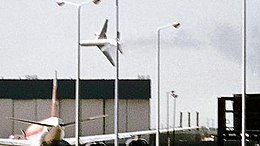
Here's one that couldn't

260px-Aa191_ohare.jpg


Port engine fell off, and leading edge slats jammed in retract due to hydraulic failure


There are NO, that is NONE, NADA, ZERO, ZIP chemtrailers. Of any kind. Anywhere. Anytime. Ever.

I agree, but you misread my post. I was referring to the people who believe in the existence of chem-trails.

.
It is pretty close to 100%. It's part of the certification program to prove the plane can continue the takeoff with an engine failure. That's the reason for the monster motors on the large twins.
We did many such tests on the Tristar, cutting a wing motor OFF at V2 and taking off every time!
The compressor stall when the fuel and ignition switch for that motor was cut was impressively noisy! The Rolls Royce people on board would cringe. :)

First of all, you are talking about an L1011, right? ... three engines. Engine failure results in 33% loss of thrust, and more importantly, there is "centre thrust" from the tail engine. In a 737, there is 50% loss of thrust, and ALL 100% of the remaining thrust is coming from one side. The transverse power loading of a port or starboard engine failure is much less in an L1011, and non-existent in a tail engine failure


Of course they do. Unfortunately the procedure is:

1. Slam on the brakes.
2. Engage braking boost pumps.
3. Pray.

Rejected takeoffs mean hitting post-runway clutter at phenomenal speeds. Fuselages are flimsy.

Assuming of course, that it doesn't happen on climb-out. As David Gunson once said "slamming on the brakes doesn't do much.... stops the wheels spinning in the wheel-wells, that's about all"
 
Last edited:
Of course they do. Unfortunately the procedure is:

1. Slam on the brakes.
2. Engage braking boost pumps.
3. Pray.

Rejected takeoffs mean hitting post-runway clutter at phenomenal speeds. Fuselages are flimsy.


All of them. However, none many of them can't climb fully loaded on one engine. If you lose an engine at or near V2, you're going to have a Bad Day.

I think I get a t-shirt on this one. All transport category multi-engines can climb on one engine at max certificated gross take off weight after the loss of an engine (unless there's an exception in the regs that I missed). Light twins, on the other hand are not so certificated.
 
I think I get a t-shirt on this one. All transport category multi-engines can climb on one engine at max certificated gross take off weight after the loss of an engine (unless there's an exception in the regs that I missed). Light twins, on the other hand are not so certificated.

Can they climb on one engine? Yes, in all likelihood they can.

Are they easy to control with all the thrust being generated from one side only, and a considerable distance away from the central axis?
 
I'm not type-rated in anything (I'm a single-/multi-engine instructor in props), but from my conversations with all of my airline-pilot friends, they're not unmanageable, and there's a lot of emphasis put on a catastrophic engine failure right at rotation, where the plane is most vulnerable. The accident at O'Hare is one of the scenarios studied.

I've seen the manual for a 737, and it covers things like the crosswind limitations for takeoff, because that affects the yaw moment caused by an engine failure, which is counteracted by rudder authority.

Don't forget, anything with a turboprop and above, and especially swept-wing jets, have yaw dampers that will assist the crew in keeping the plane from yawning into the dead engine (and the resultant coupled-roll). They do train to handle the situation manually, and I'm not saying its not without hazards, but loss of an engine is not necessarily an instant disaster.

Now, for a light twin, which is not certificated to climb on one engine and with all the drag from a windmilling prop and gear hanging out just after takeoff? Not good. My takeoff brief is simple: "If we lose one and the gear's still, down, both throttles and mixtures go to idle-cutoff, we pitch for best glide, and land straight ahead, trying to avoid obstacles."
 
Reading this thread it appears that there are a number of people dismissive of the threat. The suggestion is that chem-trailers wouldn't know their RPGs from their elbows and on the whole I'm inclined to agree. But the threat is not from vinegar warriors. As someone already mentioned there is "cross pollination" of CTs among various groups. The general feeling for many (most?) CTists is that "THEY" are doing "SOMETHING" and that the "SOMETHING" is "BAD". This worldview makes it easy for some quite frighteningly deranged people to get some quite frightening ideas about what must be done.

I'm not concerned about suburban teens who found a Facebook page. I'm concerned about survivalist militia types who are already stockpiling food and military weapons in anticipation of the government cull of the population latching onto the idea that commercial airliners are spraying deadly chemicals and deciding to do something about it. Chemtrails are an unutterably stupid thing to believe in, but so are FEMA death camps.
 
...
Here's one that couldn't

[qimg]http://upload.wikimedia.org/wikipedia/en/thumb/5/53/Aa191_ohare.jpg/260px-Aa191_ohare.jpg[/qimg]

Port engine fell off, and leading edge slats jammed in retract due to hydraulic failure

...
[/I]
.
On the DC-10, the leading edge slats were pulled out by a cable. The motor falling off broke the cable, and the slats retracted.
 
I think I get a t-shirt on this one.

You may. After recalling that transport-class aircraft can have more than two engines :D , I went back and edited my original post. I designed for Boeing, which mostly means twins. After more careful thought I stepped back.

Further, I neglected to consider regional jets, which have impressive thrust and can probably sustain nominal climb rates on one engine.

All transport category multi-engines can climb on one engine at max certificated gross take off weight after the loss of an engine (unless there's an exception in the regs that I missed).

You have to read the regs carefully, especially where it discusses which takeoff stage the requirements apply to. FAR part 25 requires a gear-down, full thrust climb gradient that is merely "positive." How positive in practice depends on the design and loadout. My recollection from the medium-sized Boeing airframes is first-stage OEI gradient disappointingly less than 1%. I know the new 787 improves on that significantly, and I'll defer to practical experience on the other airframes. Getting to a point where you can retract the gear is paramount. See below.

Before you rotation, you have options. After you lift off, you have options. Right at rotation is where FAR part 25 basically just says, "Do your best, at pilot's discretion."

Are they easy to control with all the thrust being generated from one side only, and a considerable distance away from the central axis?

Not a problem. Boeing twins have the engines mounted as inboard as possible so that off-axis thrust is well within the aerodynamic yaw control capability, even with one engine at takeoff thrust, the other at flight idle or inoperative, and airspeed at merely VLOF (i.e., where rudder effectiveness is diminished compared to cruise or climb flight).

Don't forget, anything with a turboprop and above, and especially swept-wing jets, have yaw dampers that will assist the crew in keeping the plane from yawning into the dead engine (and the resultant coupled-roll).

[makes the elongated "eeeehhhhh" noise one makes when wondering how true something really is]

In Boeing control systems the yaw damper inputs are limited to a fraction of available blowdown. This is to prevent automatic rudder overcontrol. Basically the yaw damper will provide immediate reaction to uncommanded yaw, but a successful recovery will require pilot rudder commands to achieve an effective yaw correction rate.

Yaw-damping in modern FCCs is based around detecting and correcting cycles, such as in Dutch rolls, so as not to interfere with pilot sensitivity. As such, strict yaw-damping is often tied into the roll channel as well and may not activate immediately until a roll develops (i.e., the wing with the dead engine will drop). That said, yaw control in FCCs also includes yaw-stability controllers that provide yaw-only corrects, even if you don't classify it under yaw-damping for cyclical motion (as it was in the old days). And keep in mind that a big ol' vertical stabilizer is there to give you corrective yaw moments passively!

My takeoff brief is simple: "If we lose one and the gear's still, down, both throttles and mixtures go to idle-cutoff, we pitch for best glide, and land straight ahead, trying to avoid obstacles."

My first activity at Boeing was on braking systems. Back in college I designed, among other things, field-replaceable and -manufactured brake components for small defense airframes. When confronted with the awesome robustness of large airframe brakes, I asked for the rationale and was told that accelerate-stop distance (runway distance required to accelerate to VLOF, then brake to a full stop) was the dominating design factor since OEI accelerate-go performance (horizontal distance required to take off and climb to 50 feet, i.e., to clear any field clutter) was disappointing. The intended pilot response to sudden engine failure after rotation but prior to liftoff was a rejected takeoff, albeit incurring a (literally) flaming mass of brake assembly at the end. What operators might instead train their pilots to do based on operational experience is something I can't speak authoritatively about, so distribute T-shirts as appropriate.

Again, that's for twins and especially twins that aren't the 787. I helped design that airframe, and I'm immensely proud of its low-airspeed lift performance.

I can't heap enough praise on the L-1011. Lockheed did a wonderful job. But it does have three engines...

And for the 747 the response is: (mock English accent added for exaggerated nonchalance) "Oh dear, we seem to have lost an engine. Do make a note of it, Nigel." Okay, maybe not, but you get the idea. FAR part 25 for first-phrase climb on a 4-engine OEI is essentially nominal climb.

 
...
I can't heap enough praise on the L-1011. Lockheed did a wonderful job. But it does have three engines...

...
.
And the wing engines were further away from the cabin, reducing cabin noise, because of the full length rudder.
The four hydraulic systems were also "overkill"... except when three had failed. :)
 
.And the wing engines were further away from the cabin, reducing cabin noise, because of the full length rudder.

Making it a joy for passengers. I was privileged to fly on of the last Tristars that Delta Air Lines had in service, on a transcontinental flight. Smooth, quiet, and with a plethora of headroom.

My good friend, now retired, was a senior cabin attendant for Eastern. He and I built him an L-1011 model that he displays in his study.

The four hydraulic systems were also "overkill"... except when three had failed. :)

You laugh, but that's one more than the DC-10. The L-1011 had a pretty enviable safety record.
 
On an early commercial flight, a TWA Tristar had fan blades come off the #1 motor. This caused the hydraulic pump on that motor to fail. One of the blades went through the galley, and hit the hydraulic pump on the right wing motor.
System 2 failed.
Another blade went into the leading edge at the wing root and hit the slat drive motor, failing system 3.
The aft motor has two hydraulic pumps... :) System 4 was able to control the airplane!
There were four massive rams working the horizontal slab, any one of which was powerful enough to move the slab. Three of us were sitting underneath the slab inside the aft fuselage with our backs against the bottom of the slab discussing where to place a video camera to observe the airflow around a part that had failed in service, creating a mist of Skydrol which ignited, and left all kinds of smoke marks around the aft end of that plane... incidentally showing us where there could be seals placed to lower the air leakage in the horizontal and the vertical, improving the drag.. when some mechanic in the cockpit reached under the "NO HYDRO" sign and turned the hydraulics on. The slab moved a bit, and all three of us got out the foot square access door at the same time! :)
 
There is a difference between an engine failure in cruise flight, and an engine failure on take-off. Ask ANY airline pilot. The difference is enormous

Here's one that couldn't

[qimg]http://upload.wikimedia.org/wikipedia/en/thumb/5/53/Aa191_ohare.jpg/260px-Aa191_ohare.jpg[/qimg]

Port engine fell off, and leading edge slats jammed in retract due to hydraulic failure

Whoa there big boy. Put those goal posts back. What started out as a conversation about whether or not a commercial airliner could maintain a climb attitude after experiencing a power failure at V2 has evolved into a catastrophic complete separation of the engine and pylon from the airframe. The separation took out vital electrical circuits and resulted in the loss if the number 1 hydraulic system.

This caused the outboard wing slats to retract due to air pressure against them. The slat retraction caused the stall speed of the left wing to rise above the airspeed of the aircraft and the left wing stalled. The stall caused the aircraft to enter a roll to the left which was not recovered from.
 
what I am getting, from the parts of this technical discussion which I can follow, is that modern twins can still climb out even with a catatrophic engine loss, that blade fragmentation is likely to be contained, and a return to airfield is quite possible , with the attendant requirement that the pilots perform well in a very high stress, high workload situation.
That however might count as a 'win' in the mind of a loony chemtrail believer as it stops a flight. I believe that I can say that the aircraft and souls on board would be in definite danger.
correct?
 

ISF - Join now!

Every member here is approved by hand. No bots, no spam, just people who care about evidence and honest debate.

Membership is free!

Create your free account

Back
Top Bottom