The 'real' reality? a 'lesser copy'? This in the same post you call Pixy's 'philosophy' unscientific? gah! now I have to borrow another irony meter...
I am perfectly willing to consider the computationalist ideas. In fact, I did, and I found that they are lacking in certain regards, especially as to how the experience of perception is thought about, which is to say, it is not thought about.
You must have missed that section... but surely you remember what we've all been discussing here for the past few weeks? You know, accounting for the experience of perception?
There is a truth in that piggy used the term so I did. I am a fan of piggy's writing. He defined comp.lit in a previous set of posts, as well as the neurobio position. So, if you guys get together (dlorde, PixyMisa, rocketdodger, et. al) and give your position a name I will use it without reservation.
This is what I'm talking about -- it isn't just the position of the people here, it is the accepted position of the field of neuroscience. There is no qualitative difference between what piggy calls "comp.lit" and "neurobio."
If you want to reject that a few hundred transistors can be conscious, that is fine. That has nothing to do with the "computational model." The computational model is simply that any definition of consciousness based on reality ( regardless of what exactly your definition happens to be ) will be computational in nature.
What piggy is trying to do is use the fact that most neuroscience researchers don't explicitly say "yes, a gigantic system of buckets and pulleys and ropes that is turing equivalent could be conscious if it was running an unimaginably complex algorithm" as somehow evidence that they don't actually support that position. Well, that is just rhetoric from piggy -- if a person doesn't say "I don't support X" and they never say anything that is inconsistent with X, you can't just claim willy-nilly that they don't support X.
The only reason we are even talking about turing machines is because people like piggy come in and say "you realize that the computational model, if taken to its full logical conclusion, implies that a system of buckets and ropes and pulleys could be conscious, don't you?"
Yeah, and modern physics tells us that we are all just a bunch of particles. So what? I don't let the fact that in reality I'm just a huge swarm of particles somehow poison every other thought I have with nihilistic negativity, neither should anyone let the fact that all research suggests consciousness stems from computation somehow devalue consciousness.
I am sorry, I can not agree with the above. There is the (normal) experience of the perception of red. There is no experience of experience of... It does not work the same way that thinking about thinking about thinking ... works. So in the list above there is only 1. and 2., as far as I can tell.
Yeah but there is definitely a difference. When I focus on a red object and admire how red it is, I am fully aware of my experiencing red. When I drive by a red car on the way home and I don't even pay attention to it, I am not aware of that experience, and I would say since I am not aware of the experience I am not actually even having the experience.
Your notion of redness doesn't seem to account for such cases.
It is "hard" because there is a qualitative difference in your experience of the red frowny face between when you are just typing a response and when you actually look down and see that it is a red frowny face.
If you want to say that you are simultaneously "experiencing" all the colors on your screen, then what is your term for what happens when you actually become aware of one of those colors by focusing on that pixel and saying to yourself "ah, that is red?"
Nope, the EM field is infinite in magnitude when considered a wave/field. Unless you apply a materialistic philosophy to it and ignore the wave properties.
Ah the Merc meister, I think he would use the word reification somewhere here for how we have an 'experience' that is something other than the physical processes.
The only reason we are even talking about turing machines is because people like piggy come in and say "you realize that the computational model, if taken to its full logical conclusion, implies that a system of buckets and ropes and pulleys could be conscious, don't you?"
"The idea of chemical reactions is part of the abstract model called Chemistry."
This is why I have certain people on Ignore.
Excuse me, but bombs explode due to chemical reactions, as do cars move. And lights burn (power generation), my gosh we can't even eat many foods without chemical reactions to heat.
This is more stupid Kantian metaspace ignorance. The models of chemical reactions are accurate to an amazing degree. The processes in reality are what they are, but the models approximate them quite well.
Ah the Merc meister, I think he would use the word reification somewhere here for how we have an 'experience' that is something other than the physical processes.
Ah the Merc meister, I think he would use the word reification somewhere here for how we have an 'experience' that is something other than the physical processes.
Superficially, yes; but perhaps it's easier to (wrongly) dismiss the sensation of pain as a reaction to the sudden autonomic arousal it elicits. With colour, there is little autonomic response (although red has some arousal potential). Consequently, there's little to pin the sensation on - and the idea that the sensation of red is the existence of particular activation/coding vectors across the colour opponent neurons in the primary visual pathways seems hard for some people to accept, but the use of such an understanding to predict and empirically demonstrate chimerical, self-luminous, and hyperbolic colours from outside the normal colour spindle is surely compelling. As Churchland says:
Apparent ‘‘explanatory gaps’’ are with us always and everywhere. Since we are not omniscient, we should positively expect them. And here, as elsewhere, apparent (I repeat, apparent) qualitative ‘‘simples’’ present an especially obvious challenge to our feeble imaginations. But whether an apparent gap represents a mere gap in our current understanding and imaginative powers, or an objective gap in the ontological structure of reality, is always and ever an empirical question—to be decided by unfolding science, and not by pre-emptive and dubious arguments a priori. In light of the H–J network’s unexpectedly splendid predictive and explanatory performance across (indeed, beyond) the entire range of possible colors, the default presumption of some special, non-physical ontological status for our subjective color experiences has just evaporated. Our subjective color experiences—the chimerical ones included— are just one more subtle dimension of the labyrinthine material world. They are activation vectors across three kinds of opponency-driven neurons. This should occasion neither horror nor despair. For, while we now know these phenomenological roses by new and more illuminating names, they present as sweetly as ever.
Perhaps even more sweetly, for we now appreciate why they behave as they do.
1) Perception of red
2) Experience of perception of red
3) Experience of experience of perception of red
4) Experience of experience of experience of perception of red
5) Experience of experience of experience of perception of experience of perception of red
.
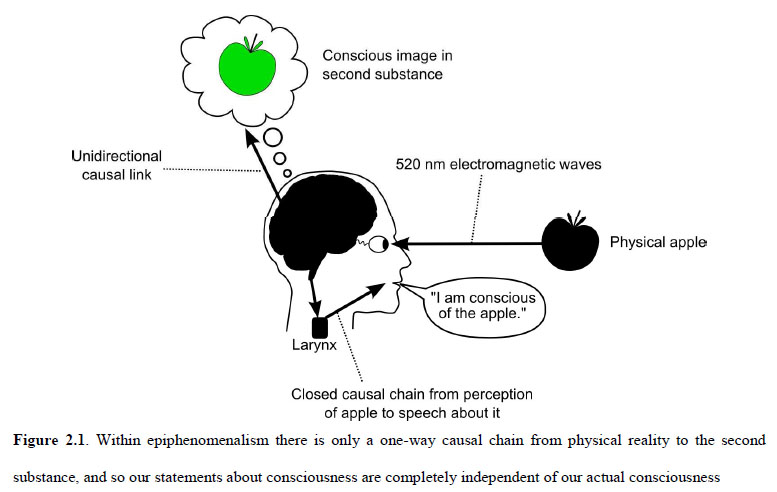
I am a little uncomfortable with the picture in post #1 (below) because it suggests the quale for the apple's color is one-directional (how do we know we the quale is there?)
So, since all measurable brain activity is literally data processing, dualist arguments must go this way:
1) Apple produces image, decoded in the brain by data processing, ultimately producing, somehow, the red quale, the physics of which we can only guess.
2) The red quale is, somehow, detected by the brain, converted back to data processing, and reported to the world by voice or keyboard.
I've not heard dualists discuss #2.
My problem is that I firmly believe the brain evolved from the brain of barely conscious (most likely unconscious) wormy creatures, so we also need to answer:
1) How and when qualia evolved in a data processing machine.
2) How it helped creatures survive (or how qualia helped spread the genes that are responsible for the machinery of qualia AND its detection)
Since the brain's continuing production (and detection) of qualia must consume energy, dualists need to discuss the evolution of qualia, and its reproductive advantage over mere data processing.
PS: I've tried to learn as much as I can about the dualist POV from David Chalmers' videos, and he always has that smug smile that gives me an internal subjective experience like having my eyeballs pierced by 12 inch stainless steel spikes. It's kind of a mechanical grin, suggesting artifice. Dennett's spirit is warm and cuddly. (Oh, the irony!)
Man steenkh, I can tell you have fallen for the computationalist ideas but I still like your style for some reason. It is more honest and less full of assumptions or something.
The existence of the experience of sensation is a self-evident fact. This fact does not depend in any way on any other idea for its support. The various hypothesis out there about how the experience of sensation work must only have the requirements of internal consistency as well as to make predictions about what will be experienced and under what conditions that turn out to be correct to some relevant level of detail.
For the data processing type hypothesis I do not see at what point something is predicted to be experienced. Will it be experienced after 10,000 computations, or 20,000? More? One computation?
How does one determine if something counts as a computation that leads to experience of sensation? Is the computing done by your liver less important than the computing done by your brain ... why? These questions do not put me at ease with the computationalist type ideas.
Compare the above with CEMI, as an example. In this hypothesis, the EM field inside your brain is directly related to experiencing sensation. This is testable. Change the field and see what happens. There is a point in CEMI when experience of sensation occurs and it is clear where that point is.
It simply does not make sense to think that computation or data processing leads to experience of sensation. Data processing can quite concievably control what will be experienced as far as input to a system that then is conscious. However, to think that data processing causes experience of sensation does not make sense. Let me explain further, why.
There exist multiple ways to create logic gates in various physical systems. This should tell us that computation is something apart from physics. We do not have any right therefore to talk about computation outside the strict terms of computation itself, or how the computation is enabled by a given physical system.
The idea that computation is an essential part of how consciousness works butts up against the above. There is also the fact that computation is ubiquitous in nature, so why the special pleading for computation in the brain causing consciousness? If you said to me the brain controls the rest of the body through computation, sure. If you say computation gives rise to the experience of sensation, sorry, there just is no evidence for such a connection.
Obviously, a lot happens when you perceive "red": You might note a specific hue which might or might not be represented as a property to the general data structure in the brain for "red" which is now attached to the data structure of whatever object you were looking at.
The brain knows that the group of neurons where the red object was registered is connected to the visual system, which is why when you think about it, a picture forms in your mind, which is another complex data structure that the brain works with.
If you think about something and a picture forms in your mind then you are using your imagination. Imagination involves as its primary aspect experience of sensation, not a complex data structure.
Whether you are a baby or can recognize red as a concept, there is no good reason to expect that the experience of the sensation of red is different. Babies have the same kinds of rods and cones, etc. etc.
I cannot see that there is more to "red" that cannot be explained by your own recursive thinking about your experience, and possibly following links to old memories connected to "red". Rocketdodger described this very well, although you dismissed his idea, but I do not think you took the effort to understand it, which is a pity.
You do not explain experience of sensation, it is just a fact of life. I dismissed Rocketdodger's experiencing experiencing... because it does not make sense. Experience of sensation is unitary and atomic (at least in a non-altered state of consciousness). You do not experience experiencing sensation, or any other more recursive statement. There is nothing outside of experience for it to experience itself.
If you did think seriously about it, perhaps you could explain more detailed what it is by the experience of "red" that cannot be described by being aware that you are seeing red?
Being aware is asking for too much. Awareness is needed to answer questions about what experience of sensation is being had or has been had, but there is no need to be aware of every aspect of your consciousness for all sorts of sensations to be there. Talking about being aware of red is just another way to make a topic about experiencing sensation into other more abstract ideas.
See, this is especially ironic after you called Pixy's dismissal of Zeuzzz' nonsense "unscientific". Skepticism puts everything under the microscope, even "common sense" or "self-evident" ideas. And studying experience has led to things we never considered before, such as decisions being taken by our brain before we're aware of them, split personalities in people with severed corpus callosum, etc. If we just took it for granted, we wouldn't know half as much about consciousness as we know now. That's, if we followed your approach to it. And you still think we're the ones beign unscientific ?
So where do the experiences of sensations that are used make up 'the imagined' come from? Could it be memory, the storage of the experience of sensation? how do you imagine that is done?
You do not experience experiencing sensation, or any other more recursive statement.
"The idea of chemical reactions is part of the abstract model called Chemistry."
This is why I have certain people on Ignore.
Excuse me, but bombs explode due to chemical reactions, as do cars move. And lights burn (power generation), my gosh we can't even eat many foods without chemical reactions to heat.
This is more stupid Kantian metaspace ignorance. The models of chemical reactions are accurate to an amazing degree. The processes in reality are what they are, but the models approximate them quite well.
Before you put me on ignore note that a model is not the same as the thing itself (even if people like to talk that way). Can we even know the thing in itself, or do we really only ever know of the experiences associated with them? This is not Kantian metaphysics, it is just a recognition that experience of sensation is primary to what and how we know about things (aside from the abstract mind of course).
The things you take as real, as absolutely given, to me are provisional models waiting to be falsified. A chair is not a thing to me (an abstract thing 'out there') but a concept related to a series of sensations. I can understand the other way of thinking about chairs, and even use it quite often (the model of the chair 'out there'). It is just that there is another mode of thinking about a chair -- in terms of the sensations associated with it -- which is also just as legitimate a way to consider a chair as the abstract "thing in the world" way is. The other way of thinking about a chair I am not even sure comp.lit can seem to understand, unfortunately.
This way of thinking about physical things in terms of the sensations they produce requires a mind-shift (I have argued at length with my roommate to explain this shift and finally he recently got it, although he likes to relate it to Existentialism for some reason, even though it really is just Empiricism). The shift is from mental abstraction (living in abstract model world as happens with Hard-AI proponents) to thinking in terms of perception. It says that the naturalistic world-view we have is a model. A well established model, but still a model (in several places they have the poorly designed model of unseen spirirts... who knows, science in the future may make the way we look at things now seem as antiquaited as unseen spirits do to us now, you have to be at least open to the possibility).
The mind-set of PixyMisa is fine if you want to think about science as it has traditionally been done, but it does not quite work when applied to studying p-consciousness (p is for phenomenal PixyMisa). The reason is that when thinking in terms of abstract pictures you imagine yourself in systems in such a way that your sensation is not important to figuring out how those systems operate. It does not matter that I am seeing when thinking about a physics problem, as an example (aka, the physics problem should never depend on my own particular sensations, it should only depend on the system at hand).
When it comes to p-consciousness versus m-consciousness (m for model, PixyMisa's version of consciousness, which is internally consistent, so I have no problem with it) the m-consiousness is insensible. Sensation as a consideration is just not needed in m, but it is needed for p.
Step outside of your abstractions for a minute and consider experience of sensation as a topic in and of itself. Then you will know what me, piggy and perhaps a few other posters have been talking about. Or not, go back into your dimly lit cave of abstraction (I understand, I like the ambience in there too). Your choice.
"What interesting questions, my young apprentice. I will answer them in time, but not right now. Right now, you are not ready for these answers, and there is much I must first teach you..."
"What interesting questions, my young apprentice. I will answer them in time, but not right now. Right now, you are not ready for these answers, and there is much I must first teach you..."
Yeah, well, for me it is just a matter of time, in that it takes a while to respond to each post. I do not want to give the impression of master to paduan learner or something either.
Yeah, well, for me it is just a matter of time, in that it takes a while to respond to each post. I do not want to give the impression of master to paduan learner or something either.
This site uses cookies to help personalise content, tailor your experience and to keep you logged in if you register.
By continuing to use this site, you are consenting to our use of cookies.


 gah! now I have to borrow another irony meter...


 of qualia AND its detection)