Richard Gage Blueprint for Truth Rebuttals on YouTube by Chris Mohr

Status
Not open for further replies.
Bollocks. Basic high school physics says that, unless you've analysed and understood the measurement error of the individual points, you can't tell what level of detail in the data is a genuine measurement and what part is that inaccuracy. As usual, C7 is starting from a conclusion and reasoning backwards to an unfounded interpretation of the data. If he weren't, he'd be able to state the width of the error bar on each point, which he won't because he can't.

Dave

Give him some slack :p

Every other one of his pet theories has been slapped around like a red headed step child. His "free fall" issue is the only one with fuzzy enough data to survive. :D

And of course he will continue to ignore the fact that even with "free fall" it does nothing to advance his absurd claim of explosive devices.
 
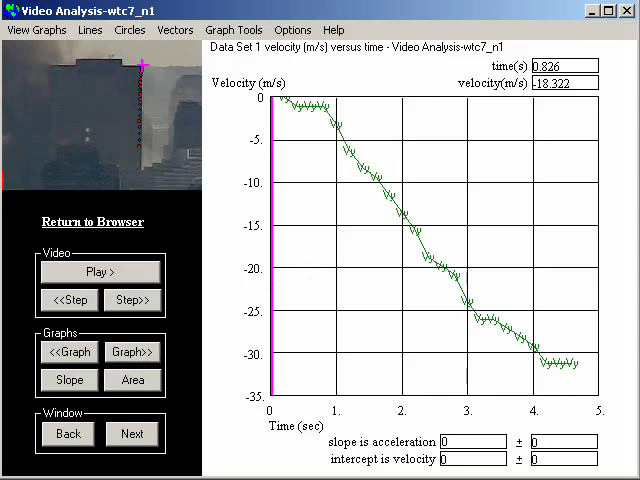
The software computes the average and draws the line.
It's a best fit, not the average as such. It's still a straight line placed over a wiggly one.

You do not create new accuracy that was not there in the first place by placing a straight line over the top of a wiggly one.

You can eliminate some noise using a variety of techniques, but you cannot remove it all.

All a best-fit linear regression gives you is an estimated average between two points in time.

All manner of real variation can occur during that time.

It is designed to compute the velocity of objects in a video and that's the way it's done.
lol. It uses a simple symmetric difference calculation to derive to velocity.

Derivation can be performed in a number of ways.

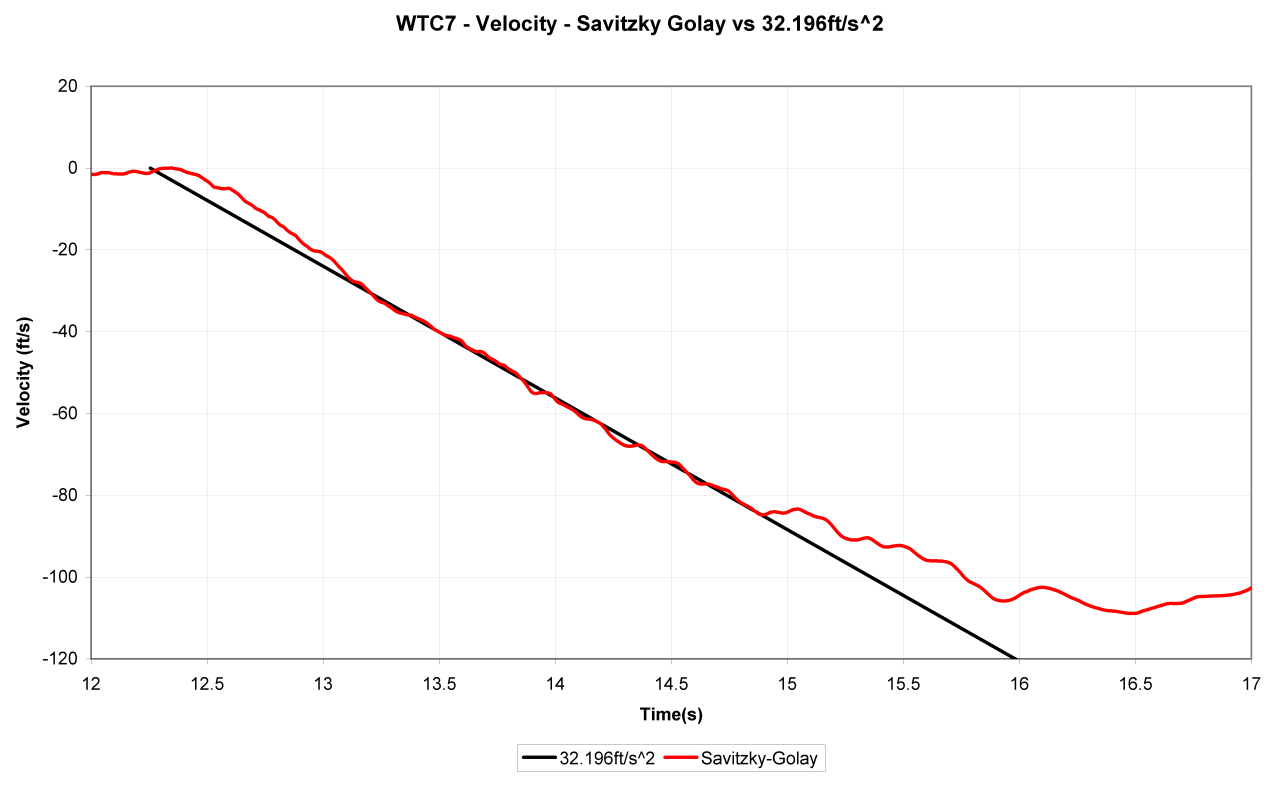
The Savitzky-Golay smoothing method I use performs a mathematical differentiation of each curve fit function (which is very handy). There is one curve fit per sample. Hundreds of 'em.

In the debate, Dave acknowledged "there was a 2 er 1 3/4 second period of FFA of this outer shell". He's probably referring to your graph and he understands that it confirms at least 1.75s of FFA.
Why don't you ask him, rather than guess ?

I have no great issue with folk suggesting ~1.75s of ~FFA during which the NW corner descended ~83ft.

Not one "~" is optional.

Your data points are closer to the free fall line than Chandlers or NIST's.
Correct in places. In others further away.

Nice work.
You're welcome. I do suggest you start listening to the interpretations that do not fit your chosen and preferred outcome.

Since data taken from a video is imprecise
Correct, though for many different reasons. ALL measurement is imprecise. Many other noise sources exist.

a straight line thru the average of the data points is the logical scientific conclusion.
Incorrect. That's simply an average, not a conclusion. An approximation.

That is the accepted way it is done.
An accepted way, sure. However, that's by folk who have no problem stating APPROXIMATELY, AVERAGE, ...

You do have a problem with that, but it's YOUR problem.

Add the approximation qualifiers and you'll be fine.

Your interpretation that WTC 7 was varying around FFA is wrong.
ROFL. Nonsense.

You actually think that a non-spherical object outside of a vacuum will "fall" AT FFA on the surface of this planet ?

Did you know an apple dropped from the roof would take >8s to hit the ground (In a vacuum it would be <6s) :)


You have NO WAY to determine acceleration with any more accuracy than I do. You can estimate. About FFA for a bit. Around FFA for a bit. Roughly FFA for a bit. Some >g

 
You used the same data for your acceleration and velocity graphs
Same source data, yes.

but got completely different results.
Incorrect.

If you wish to claim that I am wrong, point to where I am wrong.
I have told you numerous times already. You cannot correctly determine subtle acceleration behaviour from a velocity graph. Especially when you are looking at smoothed plots.
 
On chrismohr911.com, I have finished all 44 of my first points in the re-re-rebuttal section except for some links. Am open to suggestions on any corrections there. Thanks, Chris
 
Give him some slack :p

Every other one of his pet theories has been slapped around like a red headed step child. His "free fall" issue is the only one with fuzzy enough data to survive. :D

And of course he will continue to ignore the fact that even with "free fall" it does nothing to advance his absurd claim of explosive devices.

Experimental, top secret military explosives which were somehow developed in secret.

Literally every time he has advanced his actual theory, he gets spanked. Hence sticking to the minutae, where he is merely less obviously wrong.
 
C7 said:
You used the same data for your acceleration and velocity graphs
Same source data, yes.
C7 said:
but got completely different results.
Incorrect.
??? This is not "subtle acceleration behavior", these results are entirely different.

On your acceleration graph, you have
~0.8s of acceleration from zero to FFA
Then ~1 s of >g.
Then 0.5s of g or >g ???
Then <g

But on your velocity graph you have
~0.1s to 0.2s of acceleration from zero to FFA
Then ~0.4s of FFA
Then ~0.3s of >g
Then ~1.75s of g
Then <g
 
It's a best fit, not the average as such. It's still a straight line placed over a wiggly one.
The wiggly line is a figment of your imagination, a deliberate misinterpretation of the data. The data points are not accurate because they are taken from a video and you know it.

C7 said:
It is designed to compute the velocity of objects in a video and that's the way it's done.
It uses a simple symmetric difference calculation to derive to velocity.
This is very simple high school physics.

C7 said:
In the debate, Dave acknowledged "there was a 2 er 1 3/4 second period of FFA of this outer shell". He's probably referring to your graph and he understands that it confirms at least 1.75s of FFA.
Why don't you ask him, rather than guess ?
You ignored the point which is: He acknowledges FFA for 1.75s.

Not one "~" is optional.
Only in the denoir choir. The deviation from FFA is to small to be considered. That's why NIST said "at gravitational acceleration" and Chandler said "indistinguishable from FFA".

I do suggest you start listening to the interpretations that do not fit your chosen and preferred outcome.
Speak for yourself. I am just repeating what NIST and Chandler said. They know what they are talking about and you don't.

C7 said:
Your interpretation that WTC 7 was varying around FFA is wrong.
ROFL. Nonsense.
OK. Your interpretation that WTC 7 was varying around FFA is nonsense.
 
Last edited:
The wiggly line is a figment of your imagination
Incorrect.

a deliberate misinterpretation of the data.
It is the data on a graph.

The data points are not accurate because they are taken from a video and you know it.
I do indeed, however, noise doesn't dictate trend.

This is very simple high school physics.
The mathematics, sure.

You ignored the point which is: He acknowledges FFA for 1.75s.
He omitted an approximation qualifier. I'll have a word.

The deviation from FFA is to small to be considered.
Incorrect. There WAS deviation, therefore you MUST state as approximate, NOT at.

That's why NIST said "at gravitational acceleration"
Quote mine. The context is clear, and I've told you many times. Your continued use of such simply highlights that either you're too stupid to realise that repeating the words as explicit fact on their own is erronious, or you do understand and do it deliberately. Either way, shame on you.

and Chandler said "indistinguishable from FFA".
Which he shouldn't have...
117268871.png

...and anyway, that's not AT, which is what YOU keep saying :rolleyes:

I am just repeating what NIST and Chandler said.
Not really.
 
That is your interpretation of the plots. That has very little to do with the results. Your interpretation is rather flawed.
Interpret?
0.8s is quite different from 0.1 or 0.2s etc.
How do you interpret the data? Give numbers please.
Say what each part is and how long it lasted as I have done.

You have stated that the >g lasted ~1s but you have also said that it was ~0.5s. Indeed, that is close to what your graphs show. You cannot have two different sets of results from one set of data.
 
Interpret?
Yes.

How do you interpret the data? Give numbers please.
Have done, several times...


My acceleration graph shows:

a) Rapid increase in acceleration from release to somewhat over-g in approximately 1s.

At the end of this period, the NW corner had descended ~9ft

b) Slow reduction in acceleration to approximately g over approximately 1.5s.

At the end of this period, the NW corner had descended ~83ft

c) More rapid reduction in acceleration to roughly constant velocity over approximately 2s.

At the end of this period, the NW corner had descended ~270ft


If you use the velocity graph...

...you'll obviously miss some profile shape detail, but you could say...

~1.75s at ~FFA (and I'd not complain too much)

I'd be okay with... ~1.75s of ~FFA, of which >~0.5s is over-g ... for the NW corner.
 
C7 said:
The deviation from FFA is to small to be considered.
Incorrect. There WAS deviation, therefore you MUST state as approximate, NOT at.
I must? Who put you in charge?
NIST didn't, Chandler didn't, and neither does anyone outside the denoir choir.

Talk to yourself much?
"approximately" "estimation" "equivalent" [ignore the conclusion of "at gravitational acceleration" after the qualifiers about the data]
Quote mine. The context is clear, and I've told you many times. Your continued use of such simply highlights that either you're too stupid to realize that repeating the words as explicit fact on their own is erroneous, or you do understand and do it deliberately. Either way, shame on you. :mad:

C7 said:
and Chandler said "indistinguishable from FFA".
Which he shouldn't have...
Who are you to say? He has a BS in physics, a masters degree in math, a masters degree in teaching and 20 to 30 years of experience. You are an anonymous poster with nothing but a lot of bombastic babble and denial.
 
Last edited:
Yes.
Have done, several times...
Acceleration graph
a. release to somewhat over-g in approximately 1s.
b. reduction in acceleration to approximately g over approximately 1.5s.
c. reduction in acceleration to [<g]
There is NO ~1.75s of ~FFA

Velocity graph
You don't give values for:
a. ?
b. ?
c. ?
Just:
~1.75s at ~FFA

Same data - 2 entirely different results.
 
Last edited:
The software computes the average and draws the line. It is designed to compute the velocity of objects in a video and that's the way it's done.

I realise that there's little point trying to push back the vast Sahara of ignorance that blankets C7's understanding of this topic, but as usual that statement is such a colossal over-simplification that it's reduced to an absurdity. The purpose of a straight line fit is to determine a rate of change over a period of time based on the assumption that the said rate of change is constant over that period of time. C7's insistence that the straight line fit proves that the acceleration was constant over the time covered by the fit is classic circular reasoning.

Dave
 
The purpose of a straight line fit is to determine a rate of change over a period of time based on the assumption that the said rate of change is constant over that period of time. C7's insistence that the straight line fit proves that the acceleration was constant over the time covered by the fit is classic circular reasoning.
My insistence? No. That is NIST and Chandler's conclusion.
 
My insistence? No. That is NIST and Chandler's conclusion.

Chandler is an idiot, so I care very little what he concludes. I would suggest you post the exact wording of what you imagine to be NIST's conclusion, so that I can explain to you which bit you don't understand. And make sure you get the wording right, because someone's sure to notice if you change it.

Dave
 
I would suggest you post the exact wording of what you imagine to be NIST's conclusion

======
Figure 12–76 presents a plot of the downward displacement data shown as solid circles. A curve fit is also plotted with these data as a solid line. A function of the form z(t) = A{1 – exp[–(t/λ)k]} was selected because it is flexible and well-behaved, and because it satisfies the initial conditions of zero displacement, zero velocity, and zero acceleration. The constants A, λ, and k were determined using least squares fitting. The fitted displacement function was differentiated to estimate the downward velocity as a function of time, shown as a solid curve in Figure 12–77. Velocity data points (solid circles) were also determined from the displacement data using a central difference approximation1. The slope of the velocity curve is approximately constant between about 1.75 s and 4.0 s. To estimate the downward acceleration2 during this stage, a straight line was fit to the open-circled velocity data points using linear regression (shown as a straight line in Figure 12–77). The slope of the straight line, which represents a constant acceleration, was found to be 32.2 ft/s2 (with a coefficient of regression R2 = 0.991), equivalent to the acceleration of gravity g. Note that this line closely matches the velocity curve between about 1.75 s and 4.0 s.

For discussion purposes, three stages were defined
======
 
Last edited:
Everyone must (include approximate qualifiers when discussing WTC7 acceleration metrics).

NIST didn't
Incorrect.

Chandler didn't
Incorrect.

"approximately" "estimation" "equivalent"
Correct.

[ignore the conclusion of "at gravitational acceleration" after the qualifiers about the data]
Incorrect. Simply ensure the qualifiers are included (or preface simplified summary with such)
 
Status
Not open for further replies.

Back
Top Bottom