Richard Gage Blueprint for Truth Rebuttals on YouTube by Chris Mohr

Status
Not open for further replies.
When proven wrong, you just leave rather than admit you are wrong. That's the JREF way.

<Useless drivel that have been spewed over and over and over, removed>

Why don't you get off the man's nuts. He's done more research and actual work in the 1+ year that he's been working on this, than any of you 911 Truthers have done since 2004 COMBINED!!

He has done days and days of REAL research ( not YouTube watching) speaking with REAL, ACTUAL experts, AND commissioned a PEER REVIEWED STUDY of YOUR BS thermite.

What have you done? Oh, right, YouTube and MS PaintFire.

So, how about you get off the man's nuts, tell him thank you for the Millette study, and go back to carpentry and let the actual adults talk. :mad:
 
Last edited:
When proven wrong, you just leave rather than admit you are wrong.
You have many, many admissions to make. I suggest you begin.

femr2's graph shows 2.5 s of FFA
Yet again, incorrect.


My acceleration graph shows:

a) Rapid increase in acceleration from release to somewhat over-g in approximately 1s.

At the end of this period, the NW corner had descended ~9ft

b) Slow reduction in acceleration to approximately g over approximately 1.5s.

At the end of this period, the NW corner had descended ~83ft

c) More rapid reduction in acceleration to roughly constant velocity over approximately 2s.

At the end of this period, the NW corner had descended ~270ft


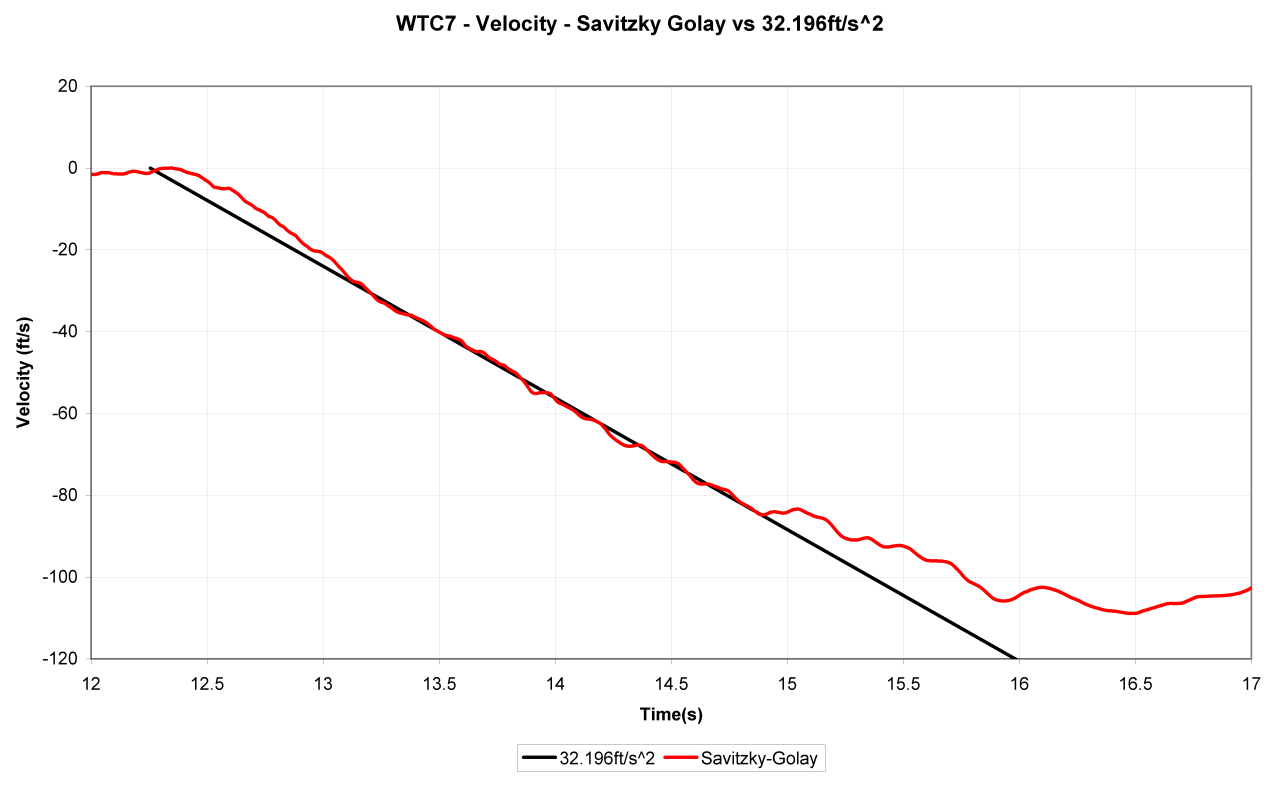
If you use the velocity graph...

...you'll obviously miss some profile shape detail, but you could say...

~1.75s at ~FFA (and I'd not complain too much)

FFA or >FFA is only possible if ALL the supporting structure is REMOVED.
Incorrect.

Your >< >< g-string has been disproven
Incorrect.

we now have a third conformation of 2+ s of FFA.
Incorrect.

I'd be okay with... ~1.75s of ~FFA, of which >~0.5s is over-g ... for the NW corner.
 
Last edited:
When proven wrong, you just leave rather than admit you are wrong. That's the JREF way.

FEMR's graph shows 2.5 s of FFA [and momentarily >g, if you want to believe that] FFA or >FFA is only possible if ALL the supporting structure is REMOVED.

Your >< >< g-string has been disproven and we now have a third conformation of 2+ s of FFA.
Ah, the Alex Jones "the biggest blowhard wins the debate" ploy!

I've never seen it more pathetically executed, Christopher7!

Your mama must be darn proud, son.
 
http://femr2.ucoz.com/_ph/7/2/5930538.jpg

My acceleration graph shows:

a) Rapid increase in acceleration from release to somewhat over-g in approximately 1s.

At the end of this period, the NW corner had descended ~9ft

b) Slow reduction in acceleration to approximately g over approximately 1.5s.

At the end of this period, the NW corner had descended ~83ft

c) More rapid reduction in acceleration to roughly constant velocity over approximately 2s.

At the end of this period, the NW corner had descended ~270ft
That graph exaggerates the amount of >g. The velocity graph is better because it can be compered to the NIST and Chandler graphs.


If you use the velocity graph...
http://femr2.ucoz.com/_ph/7/2/135024800.jpg
...you'll obviously miss some profile shape detail, but you could say...

~1.75s at ~FFA (and I'd not complain too much)


I'd be okay with... ~1.75s of ~FFA, of which >~0.5s is over-g ... for the NW corner.
:confused: Where?

I added the second line parallel to FFA line. [all times ~]
That part of the descent is FFA. 0.6s - 12.4 to 13s
Could be interpreted as 0.4s -12.4 to 12.8s

Then there is 0.1s of >g - 13 to 13.1s
Could be interpreted as 0.3s -12.8 to 13.1

There is 1.8s of FFA between the two vertical lines - 13.1 to 14.9
Could be interpreted as 1.75s

A total of 2.5s with a moment of >g that I would attribute to a slight movement of the camera, several miles away.
 
That graph exaggerates the amount of >g. The velocity graph is better because it can be compered to the NIST and Chandler graphs.


[qimg]http://img515.imageshack.us/img515/2535/femr5e.jpg[/qimg]

:confused: Where?

I added the second line parallel to FFA line. [all times ~]
That part of the descent is FFA. 0.6s - 12.4 to 13s
Could be interpreted as 0.4s -12.4 to 12.8s

Then there is 0.1s of >g - 13 to 13.1s
Could be interpreted as 0.3s -12.8 to 13.1

There is 1.8s of FFA between the two vertical lines - 13.1 to 14.9
Could be interpreted as 1.75s

A total of 2.5s with a moment of >g that I would attribute to a slight movement of the camera, several miles away.
… and "Could be interpreted" is not equals, so you cannot validly claim it shows exactly FFA, only that it shows acceleration somewhere around g.

…and internal collapse forces applied to the external wall mean an acceleration of g can occur in the presence of remaining resistance to collapse by the exterior structure.
 
That graph exaggerates the amount of >g. The velocity graph is better because it can be compered to the NIST and Chandler graphs.
Well, you still don't get why the acceleration graph, which is mathematically derived from the S-G velocity funtion, is superior when discussiong the acceleration implicit to the S-G velocity graph, but never mind. You are not a math-person, I think *sigh*

[qimg]http://img515.imageshack.us/img515/2535/femr5e.jpg[/qimg]

:confused: Where?

I added the second line parallel to FFA line. [all times ~]
That part of the descent is FFA. 0.6s - 12.4 to 13s
This line is obviously not a good linear fit to the velocity curve in that onterval. Any conclusions you wish to draw from that line are thus bonkers.

In the velocity graph, as you posted it, v is 4.9 ft/s at 12.6 seconds, and 25.6 ft/s at 13.1 s.

So over an interval of 0.5 seconds (+/- 0.01 s, from pixel resoltion of the as-is graph) I get a delta-v of 20.6 ft/s (+/- 0.4 ft/s).

That's an AVERAGE acceleration of 41.2 ft/s2 (considering margin of error of measuring pixels: anywhere between and 39.6 and 42.9 ft/s2). Standard gravity is 32.174 ft/s2.

Can you explain that? What did I do wrong when I computes the average over a significant period?

(Gauging the curve, it slopes steeper than your black lines throughought most of that interval: At beginning for at least 0.1 s, at the end for at lest 0.1 s, and from 12.83 to 12.94 s again for slightly more than 0.1 s. Only at just before 13 s, there is a short period with less than g)

There is 1.8s of FFA between the two vertical lines - 13.1 to 14.9
Could be interpreted as 1.75s
Yep, and this jives wonderfully with what femr2 said:
"I'd be okay with... ~1.75s of ~FFA, of which >~0.5s is over-g ... for the NW corner. "​


A total of 2.5s with a moment of >g that I would attribute to a slight movement of the camera, several miles away.
What can be asserted without evidence can be dismissed without evidence.

Where is your evidence that this camera movement happened AND was not already accounted for by femr2's method? Remember: He DID account for camera movement!

 
Hi gang,
I have so far gone through the first 90 pages of this thread and found an incredible array of links and info for my chrismohr911.com re-re-rebuttal blog with Rick at AE911Truth. They have agreed not to change what appears in their upper-right box (their re-rebuttal) so we can respond in our box #3 without them changing things to make our responses seem off-point. They will then get a final comment in box #4 on the bottom right. So I still have another 55 pages or so to go. Onward!
 
Hi gang,
I have so far gone through the first 90 pages of this thread and found an incredible array of links and info for my chrismohr911.com re-re-rebuttal blog with Rick at AE911Truth. They have agreed not to change what appears in their upper-right box (their re-rebuttal) so we can respond in our box #3 without them changing things to make our responses seem off-point. They will then get a final comment in box #4 on the bottom right. So I still have another 55 pages or so to go. Onward!
Do you understand now that steel columns do not snap like sticks or will you continue decimating that disinformation?

Do you understand yet that the data points are not exact?

Will you concede that FEMR's graphs do NOT go from >g to <g to > g to <g as per tfk's blue lines, or will you keep decimating that disinformation?

Will you acknowledge that FEMR's graph shows FFA [or >FFA if you want to believe that] for at about 2.3s [12.6s to 13.9s] or will you continue to question/obfuscate the fact that WTC 7 fell at FFA for ~2.25s as measured at two places.?

Will you continue to use a baseless speculation about leverage that requires a large weight to suddenly come into being?

Will you continue to talk about a possible leverage event with no data to suggest such a leverage event could occur in WTC 7?
 
Do you understand now that steel columns do not snap like sticks or will you continue decimating that disinformation?

Do you understand yet that the data points are not exact?

Will you concede that FEMR's graphs do NOT go from >g to <g to > g to <g as per tfk's blue lines, or will you keep decimating that disinformation?

Will you acknowledge that FEMR's graph shows FFA [or >FFA if you want to believe that] for at about 2.3s [12.6s to 13.9s] or will you continue to question/obfuscate the fact that WTC 7 fell at FFA for ~2.25s as measured at two places.?

Will you continue to use a baseless speculation about leverage that requires a large weight to suddenly come into being?

Will you continue to talk about a possible leverage event with no data to suggest such a leverage event could occur in WTC 7?
You really don't read/understand what other people post.


I've got to say, femr2 did his best to explain it.

:eek:
 
Last edited:
Will you acknowledge that FEMR's graph shows FFA [or >FFA if you want to believe that] for at about 2.3s [12.6s to 13.9s] or will you continue to question/obfuscate the fact that WTC 7 fell at FFA for ~2.25s as measured at two places.?
"About" is not "equals"

Will you continue to use a baseless speculation about leverage that requires a large weight to suddenly come into being?
The interior of the building is a pretty large weight. It's already there.

Will you continue to talk about a possible leverage event with no data to suggest such a leverage event could occur in WTC 7?
The penthouse and surrounding area collapsed first. Therefore the leverage HAS to exist because the interior is connected to the exterior.

Got some more lies? Bring 'em on!
 
Do you understand now that steel columns do not snap like sticks or will you continue decimating that disinformation?

Do you understand yet that the data points are not exact?

Will you concede that FEMR's graphs do NOT go from >g to <g to > g to <g as per tfk's blue lines, or will you keep decimating that disinformation?

Will you acknowledge that FEMR's graph shows FFA [or >FFA if you want to believe that] for at about 2.3s [12.6s to 13.9s] or will you continue to question/obfuscate the fact that WTC 7 fell at FFA for ~2.25s as measured at two places.?

Will you continue to use a baseless speculation about leverage that requires a large weight to suddenly come into being?

Will you continue to talk about a possible leverage event with no data to suggest such a leverage event could occur in WTC 7?

What is that?

Huh?

Is that a very tiny dog I hear yapping???
 
C7 said:
Will you acknowledge that FEMR's graph shows FFA [or >FFA if you want to believe that] for at about 2.3s [12.6s to 13.9s] or will you continue to question/obfuscate the fact that WTC 7 fell at FFA for ~2.25s as measured at two places.?
"About" is not "equals"
FEMR's velocity graph has at least 2.25s of FFA [or greater than FFA if you want to believe that].

The interior of the building is a pretty large weight. It's already there.
The weight was more or less evenly distributed. The lever requires a large added weight near the exterior wall at the NE corner and the interior columns to come in contact with resistance. That's a fanciful idea. The lever action would have to overcome the resistance of the exterior columns when they had descended a few feet and still had most of their resistance.

Chris,
Before using a highly speculative and unlikely scenario, especially in a rebuttal, it is necessary to do calculations to show the feasibility of that scenario. Otherwise you are using baseless supposition to refute science. i.e. FFA means zero resistance, no supporting structure.


The penthouse and surrounding area collapsed first. Therefore the leverage HAS to exist because the interior is connected to the exterior.
The east penthouse was at the other end of the building. The interior connected to the exterior just pulls down, it does not create a lever.
 
Last edited:
...
Chris,
Before using a highly speculative and unlikely scenario, especially in a rebuttal, it is necessary to do calculations to show the feasibility of that scenario. Otherwise you are using baseless supposition to refute science. i.e. FFA means zero resistance, no supporting structure.

Wrong. The highlighted portion is simply wrong. How many times must we make this point?


The east penthouse was at the other end of the building. The interior connected to the exterior just pulls down, it does not create a lever.

Jeez, if "steel structures" were as strong as truthers say they are, doesn't it stand to reason that if one part fails, it WILL pull on attached parts (i.e. the entire structure. Moment frames, y'know!)?

You are entitled to your own opinions, but not to your own physics. Go kick a brick, and see if it hurts!
 
"About" is not "equals"

The interior of the building is a pretty large weight. It's already there.

The penthouse and surrounding area collapsed first. Therefore the leverage HAS to exist because the interior is connected to the exterior.

Got some more lies? Bring 'em on!

Absolutely, the perimeter is responding to the core:


bowingnorthface2.gif


But, to be consistent, you will also have to admit that contradicts the NIST conception of collapse initiation. Here are the 2 models they present:


youtube video link:

http://www.youtube.com/watch?v=TNEKtvB80us&feature=player_embedded

of which they say, and I am not kidding: “the global collapse analyses matched the observed behavior reasonably well.”

Direct quote.

There is a lot of blame to go around. There is no point focusing only on C7.
 
Last edited:
"Blame"

LOL

As if anybody involved gives a **** about what internet champions think. The report is done, published, and currently used by architects and engineers WORLDWIDE to make safer buildings.
 
Do you understand now that steel columns do not snap like sticks or will you continue decimating that disinformation?

Do you understand yet that the data points are not exact?

Will you concede that FEMR's graphs do NOT go from >g to <g to > g to <g as per tfk's blue lines, or will you keep decimating that disinformation?

Will you acknowledge that FEMR's graph shows FFA [or >FFA if you want to believe that] for at about 2.3s [12.6s to 13.9s] or will you continue to question/obfuscate the fact that WTC 7 fell at FFA for ~2.25s as measured at two places.?

Will you continue to use a baseless speculation about leverage that requires a large weight to suddenly come into being?

Will you continue to talk about a possible leverage event with no data to suggest such a leverage event could occur in WTC 7?
Since C7's strategy appears to be to keep repeating the same things I disagree with over and over until I stop responding and then accusing me of ignoring "major points": just so everyone knows, (lurkers, visitors, interested parties, etc), I have dealt with all these inaccuracies of C7 before, repeatedly. We disagree but I am "ignoring" these points only in the sense that having gone through each one multiple times, I'm not bothering to answer them yet again. For verification look through all 5500 posts here and you'll see I and others deal with his angry, aggressive assertions and accusations repeatedly. I just don't want C7 to proclaim victory solely on the basis of having spouted his beliefs longer than I had the energy to respond to him. I got hoarse first, that's all.
 
But, to be consistent, you will also have to admit that contradicts the NIST conception of collapse initiation. Here are the 2 models they present:


youtube video link:

http://www.youtube.com/watch?v=TNEKtvB80us&feature=player_embedded

of which they say, and I am not kidding: “the global collapse analyses matched the observed behavior reasonably well.”

Direct quote.

There is a lot of blame to go around. There is no point focusing only on C7.
NIST conception of collapse initiation, or collapse progression?

If NIST posts here, I'll promise to focus on them too. Anyone else you want me to correct? Bill Clinton? Dan Quayle? Bazant? Popular Mechanics? Albert Eintein? The College Board of Examination? Cracked?
 
Status
Not open for further replies.

Back
Top Bottom