• Quick note - the problem with Youtube videos not embedding on the forum appears to have been fixed, thanks to ZiprHead. If you do still see problems let me know.

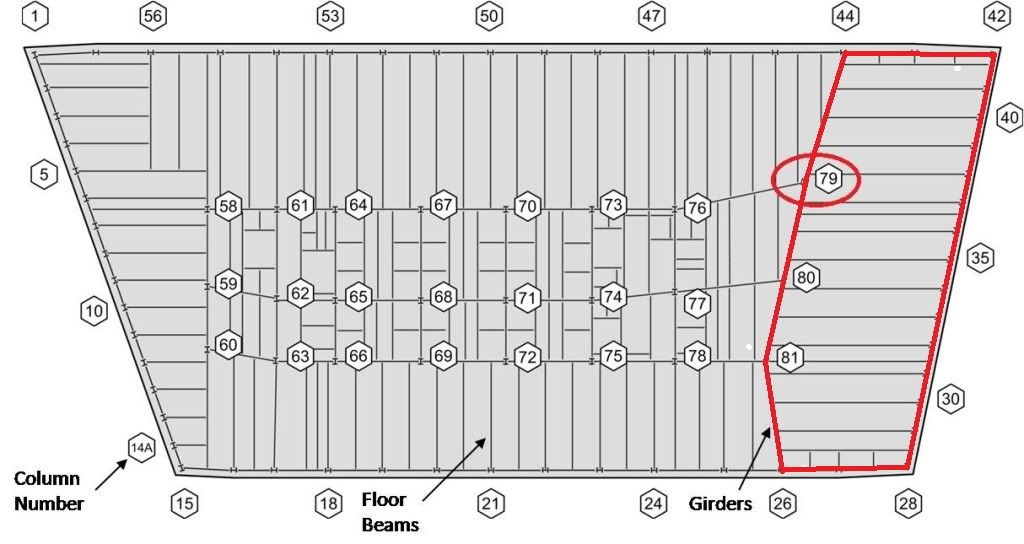
WTC7 and the girder walk-off between column 79 and 44

Status
Not open for further replies.
Asking me to speculate is a diversion from the fact that NIST's own data proves that the beams did not push the girder off its seat to trigger the collapse and therefore their hypothesis does not explain the collapse of WTC 7.

The other non-responses prove conclusively that when faced with a fact they cannot refute, the denoir choir tries to change the subject or just insults the messenger.

No,

What I'm saying is that your 5.18 inch expansion of the floorbeam could push the girder more than 5.5 inch, depending on the place of the fulcrum where that part of the girder pivots around. Basic triangles.
 
No,

What I'm saying is that your 5.18 inch expansion of the floorbeam could push the girder more than 5.5 inch, depending on the place of the fulcrum where that part of the girder pivots around. Basic triangles.
No. The beam was pushing straight on. There was no fulcrum or NIST would have included that in their hypothesis.

You forgetting that NIST lied about the width of the seat and omitted the stiffeners. The beam would sag long before expanding enough to push the girder off its seat.
 
No. The beam was pushing straight on. There was no fulcrum or NIST would have included that in their hypothesis.

You forgetting that NIST lied about the width of the seat and omitted the stiffeners. The beam would sag long before expanding enough to push the girder off its seat.

5.18 inch over it's entire length? Even with the various floorbeams being of different length?
 
Last edited:
5.18 inch over it's entire length? Even with the various floorbeams being of different length?
That was the longest floor beam [closest to column 79]. The others were a little shorter.

e1213beamlength.jpg


The floor beams in the NE region of floor 13 did not exceed 600oC.
See: NCSTAR 1-9 Table 10-1

Ambient temperature is 22
oC (72oF).
So the maximum possible increase in temperature would be 578
oC.

The floor beam closest to column 79 was 53 feet 4 inches (640 inches).

Using the formula on pg 343-344 of NCSTAR 1-9

0.000014 x 578 x 640 = 5.18 in.


The bearing seat at Column 79 was 11 in. wide. Thus, when the girder end at Column 79 had been pushed laterally at least 5.5 in., it was no longer supported by the bearing seat.

NCSTAR 1-9 pg 527


Using NIST's own data, the girder did not walk-off the seat.
 
No,

What I'm saying is that your 5.18 inch expansion of the floorbeam could push the girder more than 5.5 inch, depending on the place of the fulcrum where that part of the girder pivots around. Basic triangles.

One thing to consider......C7 will jump to the summary report NCSTAR 1A (130 pages including recommendations) while ignoring everything included in the full report (730 pages) when needed to fit his religious agenda.

In the meantime......the girder, in the simulations, lost its bolted connections at both ends. At the perimeter bearing, the seat was on the web, so the movement of that end was limited by the column flanges. At the interior column, the seat was on the flange, so that end had much more freedom of movement.

NIST identifies several factors that are in play for the failure as I have previously posted including the movement of the column to the east.
Everything that doesn't fit their agenda is ignored by the troofers. :rolleyes:
 
That was the longest floor beam [closest to column 79]. The others were a little shorter.

[qimg]http://img407.imageshack.us/img407/9095/e1213beamlength.jpg[/qimg]

The floor beams in the NE region of floor 13 did not exceed 600oC.
See: NCSTAR 1-9 Table 10-1

Ambient temperature is 22
oC (72oF).
So the maximum possible increase in temperature would be 578
oC.

The floor beam closest to column 79 was 53 feet 4 inches (640 inches).

Using the formula on pg 343-344 of NCSTAR 1-9

0.000014 x 578 x 640 = 5.18 in.


The bearing seat at Column 79 was 11 in. wide. Thus, when the girder end at Column 79 had been pushed laterally at least 5.5 in., it was no longer supported by the bearing seat.

NCSTAR 1-9 pg 527


Using NIST's own data, the girder did not walk-off the seat.

We're talking about K3004, right? I can't read the numbers very clearly on my monitor, but it looks like it is a bit longer than 53 foot and 4 inches. But that could also be, because I'm more used to metric measures.
What if the girder stays fixed on the upper attachment (near the wall, where iit would be the coolest). In that case the other end of the girder would move more than 5.18 inches.
In fact that end would also move more than 5.18 inch even if the entire girder was moved aside by all the floor beams. Just because the other floorbeams are shorter and/or in 'cooler' areas of the burning floor and thus would move 'their' part of the girder for shorter distances.
 
One thing to consider......C7 will jump to the summary report NCSTAR 1A (130 pages including recommendations) while ignoring everything included in the full report (730 pages) when needed to fit his religious agenda.
I take the info from where NIST put it in their report. Religious is the devotion of JREFers to NIST, as if they were infallible.

In the meantime......the girder, in the simulations, lost its bolted connections at both ends. At the perimeter bearing, the seat was on the web, so the movement of that end was limited by the column flanges. At the interior column, the seat was on the flange, so that end had much more freedom of movement.
True, but thermal expansion would put even more of the girder over the support plate.

NIST identifies several factors that are in play for the failure as I have previously posted including the movement of the column to the east.
Where does NIST say that?
 
You forgetting that NIST lied about the width of the seat and omitted the stiffeners.
You have not proved that NIST lied about the width of the seat. I've shown how in NIST's drawings that represent the simulation the seat is larger than the 11.5" flange. More likely there's a mistake in the text about the width of the seat, but your agenda is defaming NIST by claiming they lied, which turns you into the actual liar here.

Religious is the devotion of JREFers to NIST, as if they were infallible.
:i:
It's you who's taking their words as if they couldn't make a mistake when stating the width of the seat. Therefore it's you who takes their statements as infallible to support your claim that they lie. No, they can make (and are known to have made) mistakes.
 
But it can't so your attempt to double talk around the fact that the NIST report is a fraud and a farce has failed.

Using NIST's own data, the girder did not walk-off the seat.

You keep using those words. I do not think they mean what you think they mean.

NIST ran a complex 3d analysis. Doing a simple 1D back-of-the-envelope calculation doesn't disprove their analysis. Rather, your calculation supports the NIST claim, given how much thermal expansion is responsible for the "push".
 
That was the longest floor beam [closest to column 79]. The others were a little shorter.

[qimg]http://img407.imageshack.us/img407/9095/e1213beamlength.jpg[/qimg]

The floor beams in the NE region of floor 13 did not exceed 600oC.
See: NCSTAR 1-9 Table 10-1

Ambient temperature is 22
oC (72oF).
So the maximum possible increase in temperature would be 578
oC.

The floor beam closest to column 79 was 53 feet 4 inches (640 inches).

Using the formula on pg 343-344 of NCSTAR 1-9

0.000014 x 578 x 640 = 5.18 in.


The bearing seat at Column 79 was 11 in. wide. Thus, when the girder end at Column 79 had been pushed laterally at least 5.5 in., it was no longer supported by the bearing seat.

NCSTAR 1-9 pg 527


Using NIST's own data, the girder did not walk-off the seat.

If the thing moved one inch, it was **********. Why can't you understand that? I assume you don't have to diagnose/repair many catastrophic cabinet failures. :D
 
You keep using those words. I do not think they mean what you think they mean.

NIST ran a complex 3d analysis. Doing a simple 1D back-of-the-envelope calculation doesn't disprove their analysis. Rather, your calculation supports the NIST claim, given how much thermal expansion is responsible for the "push".

Besides, his calculations are in error (big surprise there right?)

His claim....
You haven't been paying attention.

NIST did not explain the collapse.
Their own data proves that the beams did not push the girder off its seat.

The floor beams in the NE region of floor 13 did not exceed 600oC.
See: NCSTAR 1-9 Table 10-1

Ambient temperature is 22
oC (72oF).
So the maximum possible increase in temperature would be 578
oC.

The floor beam closest to column 79 was 53 feet 4 inches (640 inches).

Using the formula on pg 343-344 of NCSTAR 1-9

0.000014 x 578 x 640 = 5.18 in.


The bearing seat at Column 79 was 11 in. wide. Thus, when the girder end at Column 79 had been pushed laterally at least 5.5 in., it was no longer supported by the bearing seat.

NCSTAR 1-9 pg 527


And here is the error. He claims that the beams attached to the girder connecting col 79 to 44 did not exceed 600C based on table 10-1 of the NCSTAR. That table (on page 456) indicates the floor beams that exceeded 600C as Fl 12 E-S, Fl 13 E, SE, Fl 14 E,S

Because of troofer blinders, he believes that excluded the NE corner of the structure (as opposed to E meaning the entire east end of the building.)

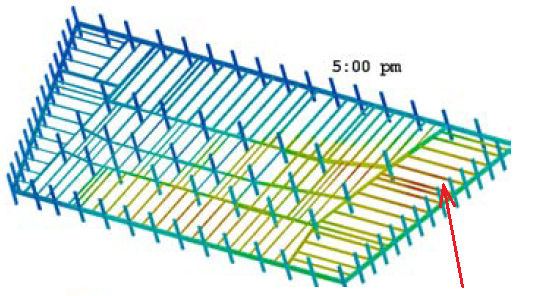
Now, for the real facts glossed over by C7. One needs to look at Figure 10-19 (on page 412) This figure shows the beam temperatures at various intervals of the Case A simulation. At the 5:00 pm mark, the figure clearly indicates the beams temperatures of several of the floor beams connected to the girder in question to have exceeded 675C.

Just another occasion of C7 taking a swing and missing by a mile. :rolleyes:
 
Besides, his calculations are in error (big surprise there right?)

His claim....


And here is the error. He claims that the beams attached to the girder connecting col 79 to 44 did not exceed 600C based on table 10-1 of the NCSTAR. That table (on page 456) indicates the floor beams that exceeded 600C as Fl 12 E-S, Fl 13 E, SE, Fl 14 E,S

Because of troofer blinders, he believes that excluded the NE corner of the structure (as opposed to E meaning the entire east end of the building.)

Now, for the real facts glossed over by C7. One needs to look at Figure 10-19 (on page 412) This figure shows the beam temperatures at various intervals of the Case A simulation. At the 5:00 pm mark, the figure clearly indicates the beams temperatures of several of the floor beams connected to the girder in question to have exceeded 675C.

Just another occasion of C7 taking a swing and missing by a mile didn't even have a bat. :rolleyes:

Wow, imagine that. Sarns gets all flustered, blah blah blah, you're all wrong, blah blah blah, shows some basic math, and GETS THE INPUTS WRONG!!

Oh, and I fixed your last sentence for you :D
 
Wow, imagine that. Sarns gets all flustered, blah blah blah, you're all wrong, blah blah blah, shows some basic math, and GETS THE INPUTS WRONG!!

Oh, and I fixed your last sentence for you :D

Page 396 of NCSTAR (Vol 2)

Floor 12
Figure 10-16 shows that the intense fire on this floor resulted in the most sever hating of a floor slab. Peak temperatures reached over 675C on much of the east side and the east portion of the south side of the floor. These temperatures remained high for about 2h. Figure 10-17 shows that the floor beams, heated by the fire on the 11th floor below, reached similar temperatures in these same locations
Floor 13
Figure 10-18 shows the severe heating of the top of the 13th floor slab. The temperature pattern was similar to that on the 12th floor slab one-half hour earlier, as expected from the manner in which the 13th floor fire was simulated.......

I think it is obvious who the fraud is.
 
We're talking about K3004, right?
Right

I can't read the numbers very clearly on my monitor, but it looks like it is a bit longer than 53 foot and 4 inches.
The beam is 53' 4 11/16" The drawing shows the distance from center to center of the girders - 53' 8 11/16". There is a space on either end of the beam. The fin connection makes up the difference. See NCSTAR 1A pg 25.

What if the girder stays fixed on the upper attachment (near the wall, where iit would be the coolest). In that case the other end of the girder would move more than 5.18 inches.
According to NIST, all the bolts had failed. See NCSTAR 1-9 Vol.2 pg 482, last paragraph.

In fact that end would also move more than 5.18 inch even if the entire girder was moved aside by all the floor beams.
On the column 79 end the girder would move as far as the beam pushed it, no more, no less. At the column 44 end the girder could only move about 1/2" before it came up against the column flange.

Just because the other floorbeams are shorter and/or in 'cooler' areas of the burning floor and thus would move 'their' part of the girder for shorter distances.
They could not stretch the floor beam closest to column 79. The girder could only move as much as that floor beam expanded. The other beams would bow or bend the girder.
 
And here is the error. He claims that the beams attached to the girder connecting col 79 to 44 did not exceed 600C based on table 10-1 of the NCSTAR. That table (on page 456) indicates the floor beams that exceeded 600C as Fl 12 E-S, Fl 13 E, SE, Fl 14 E,S

Because of troofer blinders, he believes that excluded the NE corner of the structure (as opposed to E meaning the entire east end of the building.)
Actually it's your denier blinder. Table 10-1 designates NE, E and SE. Note floor 8.

table101beamsgreatertha.jpg


Now, for the real facts glossed over by C7. One needs to look at Figure 10-19 (on page 412) This figure shows the beam temperatures at various intervals of the Case A simulation. At the 5:00 pm mark, the figure clearly indicates the beams temperatures of several of the floor beams connected to the girder in question to have exceeded 675C.
That is in conflict with Table 10-1.
 
Last edited:
Actually it's your denier blinder. Table 10-1 designates SE, E and NE. Note floor 8.

[qimg]http://img715.imageshack.us/img715/3423/table101beamsgreatertha.jpg[/qimg]

That is in conflict with Table 10-1.

So you're making our own interpretation of what S, E, SE, etc. means instead of looking at the diagrams along with that table?

Here's the calculated floor beam temperatures at 5:00 pm. The color scale is right below it. What color is the beam that the red arrow is pointing at?
floor_13_beam_temp.png

temp_gauge.png


On another note, wouldn't the "cooler" floor beams further north of the beam in question create a type of "fulcrum" or "pivot point" that erwinl is speaking of?
 
Last edited:
So you're making our own interpretation of what S, E, SE, etc. means instead of looking at the diagrams along with that table?

That is the only way he can fit the story to his religious belief. He has been exposed as a fraud once again. No amount of tap dancing will change that.

Here's the calculated floor beam temperatures at 5:00 pm. The color scale is right below it. What color is the beam that the red arrow is pointing at?
[qimg]http://i238.photobucket.com/albums/ff290/gamolon/floor_13_beam_temp.png[/qimg]
[qimg]http://i238.photobucket.com/albums/ff290/gamolon/temp_gauge.png[/qimg]

On another note, wouldn't the "cooler" floor beams further north of the beam in question create a type of "fulcrum" or "pivot point" that erwinl is speaking of?
 
After looking at the designation in that table and the actual temperature diagrams, it seems to me NIST is referring to the E (East) area as the area in red below.
WTC1_1_east_section.jpg
 
So you're making our own interpretation of what S, E, SE, etc. means instead of looking at the diagrams along with that table?
They would not list E,SE for floor 13 if E covered the whole east end.

Here's the calculated floor beam temperatures at 5:00 pm. The color scale is right below it. What color is the beam that the red arrow is pointing at?
What part of "That is in conflict with Table 10-1." don't you understand?

On another note, wouldn't the "cooler" floor beams further north of the beam in question create a type of "fulcrum" or "pivot point" that erwinl is speaking of?
What part of "you can't stretch a steel beam" don't you understand?
 
Status
Not open for further replies.

Back
Top Bottom