Richard Gage Blueprint for Truth Rebuttals on YouTube by Chris Mohr

Status
Not open for further replies.
No idea what effect [a different trajectory] may have had.
Maybe you didn't see the buildings fall then. I did.
We are quite clearly discussing the effect of a different impact trajectory upon the NIST simulation. A specious reply. Poor.
Nah, you're just missing my point.

If you claim you have "no idea" of what effect a different trajectory may have had, you're implicitly stating that the likeliness of a completely different outcome is high enough as to not be dismissed outright. Given the current status quo, the burden of proof is on you if you want to defend that position.

Messing up the path the aircraft entered the building is not important ?
"Messing up" is a quite misleading expression. It is not a question of "messing up", it's a question of data accuracy. And no, it's not important, and here's why.

There are four factors to be considered here:

  1. NIST's trajectory and subsequent damage according to their simulation.
  2. Your trajectory applied to NIST's method of calculating damage.
  3. The actual plane's trajectory applied to NIST's method of calculating damage.
  4. The actual plane's trajectory with the actual damage.
Two of them are impossible to determine. Can you see which ones? Sure you can.

To cut on the rhetoric, they're obviously points 3 and 4. You can't know the exact trajectory of the plane, and a difference in the fourth decimal will most likely produce a completely different result in this highly chaotic event (besides being utterly irrelevant given the high uncertainty on many variables). And no matter how good the simulation is, it can not give accurate results for the resulting damage. Two remotely-controlled planes launched against two identically-constructed towers in exactly the same angles against the same points would produce two completely different results.

For the above reasons, NIST had to settle for obtaining a reasonably realistic impact damage, i.e. damage that is credibly the result of the plane's impact. Precision wasn't that important, as long as it reasonably matched the observables. R. Mackey has already noted how that trajectory fits them better.

From that point of view, it should be obvious that you're indeed nistpicking.


I am highlighting that the most critical couple of numbers right at the beginning of the simulation chain were wrong not accurate enough to my taste.
FTFY. Yours are wrong too. Just possibly more accurate. That habit of talking in terms of right or wrong as if there were absolute tolerances above which all is wrong and below which all is right, is an habit I've called Major_Tom on in past. It's your turn, it seems.
 
Your graph measures acceleration. NIST and Chandler measure velocity. So there's no way to compare.
I have provided data for...

Displacement...


and Velocity...


...many times.

You don't give any data, just the resulting curve.
Nonsense. I provided a link to multiple datasets earlier in this very thread.

Do you have either NIST's or Chandler's raw data ?

You can have mine. It's at the link above.

That proves nothing because you could have input anything.
It would appear you don't bother to even read the thread content. If you are accusing me of fabricating the data...ROFL. Does the same apply to NIST or Chandler ?

If you wish to replicate any traces, I can provide you with full and detailed instructions. This forum has the process described many, many times. It's not rocket science.

Is there a way to compare the time line?
What do you mean ? aka - what are you talking about ?
 
No. Time to remind (?) you what you are actually looking at...

NIST began by gathering displacement/time data from video...

[qimg]http://femr2.ucoz.com/_ph/7/975319243.png[/qimg]

The "dots" there are what you keep referring to when you say things like "The data points are not precise because they are taken from a video".

You keep saying that about datapoints on the derived velocity graph, which is really quite funny. Got bored waiting on you to notice.

Now, as you can see on the graph above, NIST determined a least-squares curve fit to the displacement data...

z(t) = 379.62{1 - exp[-(0.18562t)3.5126]}

That is the black line on the graph (12-76) above.


To generate the datapoints on their velocity graph...

[qimg]http://femr2.ucoz.com/_ph/7/2/659040095.jpg[/qimg]

...NIST used central difference approximation on the displacement datapoints (a far from ideal method of derivation).

They also differentiated their function for displacement to determine a function for velocity...

The black line is the "time derivative of curve fit"...

v(t) = 247.52(0.18562t)2.5126exp[-(0.18562t)3.5126]

That equation was derived from the NIST least-squares curve fit to the displacement data.


The "meaningless curved line that does not follow the data dots" you refer to is not meaningless. It's derived from lousy data, but it has a meaning, which you should now know. (You should know all this already, given you have been discussing the datapoints on the derived velocity graph for how long ? :rolleyes:)

The "dots" on the velocity graph are derived from the displacement data via central difference approximation.

Femr2, this is all basic physics. I therefore predict it will be all dismissed as Technobabble.
 
Nah, you're just missing my point.
Nah, I'm not.

If you claim you have "no idea" of what effect a different trajectory may have had, you're implicitly stating that the likeliness of a completely different outcome is high enough as to not be dismissed outright.
Nah, I'm not, or I wouldn't be questioning your personal interpretation now, would I :rolleyes:

Given the current status quo, the burden of proof is on you if you want to defend that position.
What nonsense. lol.

You're defending a serious inaccuracy by NIST because... ?

Would you do the same for a multi-million dollar "twoofer" study ?

AE911T turn around and chuck $10M in the pot for an impact simulation and get the impact angle and trajectory badly out of whack...you're going to suggest it doesn't matter ? :) One thinks not. One thinks you'd be all over that like a rash.

it's a question of data accuracy
Correct. Accuracy of ALL subsequent data within the simulation.

Quite a biggie there.

Why not just stick the aircraft in backwards, or sideways ? If you think it doesn't make any difference...

a difference in the fourth decimal will most likely produce a completely different result in this highly chaotic event (besides being utterly irrelevant given the high uncertainty on many variables).
Sounds like you think the entire simulation is a bit of a waste of time ?

Perhaps they should have drawn some pretty pictures instead, rather than crank up a random number simulation with an "FEA" sticker on it.

And no matter how good the simulation is, it can not give accurate results for the resulting damage. Two remotely-controlled planes launched against two identically-constructed towers in exactly the same angles against the same points would produce two completely different results.
I suggest they would be similar, but different, of course.

For the above reasons, NIST had to settle for obtaining a reasonably realistic impact damage
They did a poor job with the "mother of all variables"...the orientation and trajectory of the damn aircraft...ew.

Yours are wrong too. Just possibly more accurate.
Agreed.
 
The consensus is that for WTC7 Stage1, the North roof wall fell at less than FFA and that for Stage 2 the wall fell at FFA.

If FFA is proof that explosives were used to bring down this wall, then WTC7 had already failed and fallen for ~ 7 feet for ~1.75 seconds at less than FFA before the silent explosives were set off. WTC7 was accelerating towards FFA, and setting silent explosives off at this point to cause the collapse of the North wall would have been too late and redundant. The wall was already collapsing before the silent explosives are claimed to have been set off.

Explosives were not used to cause the North wall to collapse. It had already fallen ~ 7 feet at less than FFA and was accelerating towards FFA.
 
Last edited:
The consensus is
By whom ? The only body specifying a staged descent is NIST.

for Stage 2 the wall fell at FFA
The staging was not a very good idea imo. And AT is not a good description either...

NIST say their estimation of approximate and average acceleration is equivalent to the acceleration of gravity during that period.
 
You're defending a serious inaccuracy by NIST because... ?
Serious? Who says that and why?

Serious is a rather subjective evaluation. It's you who is calling it serious without giving any justification. Remember that NIST adjusted several uncertainties based on observables. The variable into play may well be the result of such an adjustment. Given the inaccuracy of the damage calculation, if it gives a result that matches reality closer, I'd go with that one even if it's known to be more inaccurate. That's a way to compensate bias introduced through inaccuracies in the damage calculation.

An objective evaluation of serious would be to estimate the damage with that angle, apply NIST's analysis method from the beginning to the end, and come up with conclusions that change their principal findings substantially and that would signify a change to their recommendations. You're far, far away from showing that, therefore I don't buy your claim of seriousness, which reduces to putting emotion into your evaluations. You're not following MT's advice of sticking to the data without any emotions, tsk tsk...


Quite a biggie there.
See above.


Why not just stick the aircraft in backwards, or sideways ? If you think it doesn't make any difference...
There were tolerances to play with. I assumed you knew that.


Sounds like you think the entire simulation is a bit of a waste of time ?
Not at all. But it just needs reasonably realistic initial conditions, not millimeter-accurate ones. Preferably falling on the safest side (as NIST's did).
 
I'm curious why you wouldn't just link to NIST. What are the chances that if I peruse your link (sharpprinting?!?!) and compare it to the NIST report itself, that it'll be different?

Zero. Copied and pasted from the executive summary. Link to reports provided in my description and also a bit further down the menu items at the website.

How could you be so lazy as to not make that small effort yourself?
 
Last edited:
Hey it was an educated guess based on the history of truther posts here. Sue me.

You gonna have a conclusion sometime before the sun explodes?


I find it very typical that you find a post you can actually correct me on, and jump at the chance like an infant to a teet, but I ask you a reasonable question and it goes ignored.

Stop being dishonest. Just long enough to answer a simple question, then you can go back to it.
 
Last edited:
BA -The consensus is that for WTC7 Stage1, the North roof wall fell at less than FFA and that for Stage 2 the wall fell at FFA.
By whom ? The only body specifying a staged descent is NIST.
[def] consensus: general or widespread agreement
By NIST, Chandler, Gage, C7.
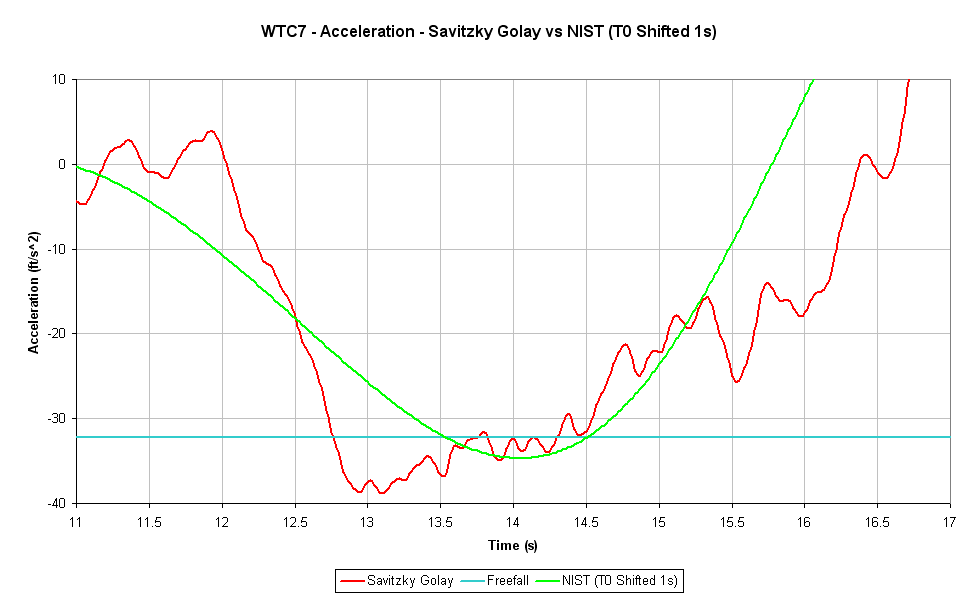
Are these your charts? They have your name on them.
http://femr2.ucoz.com/_ph/7/590673176.png


My acceleration profile, and the NIST acceleration profile.
A lot of effort was applied to ensure the very highest possible data quality, utilising original DV video recordings, per-field tracing, static point extraction, ...

The techniques were developed over quite a period of time, and I'm personally not aware of any way to increase raw data accuracy. It's well sub-pixel already, and the limitation is the quality of the original recordings imo.
<snip>
Here's a few different smoothing methods from the same raw data...
All show an initial period of less than FFA.

The staging was not a very good idea imo. And AT is not a good description either...

NIST say their estimation of approximate and average acceleration is equivalent to the acceleration of gravity during that period.
The consensus is a period AT FFA + femr2 shows a period AT and Past FFA.
Your graphs show 3 stages : <FFA, =>FFA. <FFA.
Or I can change it into 3 Periods instead of 3Stages: Period 1<FFA, Period 2 => FFA, Period 3 <FFA.
The salient point was that - Explosives were not used to cause the North wall to collapse. It had already fallen ~ 7 feet at less than FFA and was accelerating towards FFA.
 
Last edited:
Serious is a rather subjective evaluation.
True. Your opinion is that a circa 7 degree error in trajectory parameter doesn't matter. I find that rather bizarre.

NIST go to the bother of constructing the aircraft with this kind of precision...
25793812.png

...and you don't think they should be fussed about where they point it ?

Lateral approach angle was one of the primary influential parameters and primary sources of uncertainty.

(The full list was ...Impact speed, Vertical approach angle of the aircraft, Lateral approach angle of the aircraft, Total aircraft weight, Aircraft materials failure strain, Tower materials failure strain and Building contents weight. A very short list. Approach angle pretty darn important)

However, when it came to the global impact analyses NIST chose NOT to vary the lateral approach angle, and fixed it based upon a single observable...damage to the NE corner of the bulding.

Ew.
 
True. Your opinion is that a circa 7 degree error in trajectory parameter doesn't matter. I find that rather bizarre.

NIST go to the bother of constructing the aircraft with this kind of precision...
[qimg]http://femr2.ucoz.com/_ph/9/25793812.png[/qimg]
...and you don't think they should be fussed about where they point it ?
In all honesty, no :)

I have my own views on the subject, which get pretty off-topic not only for this thread, but for the whole forum.
 
NIST say their estimation of approximate and average acceleration is equivalent to the acceleration of gravity during that period.

There you go, nit-picking words again. What NIST really meant was "AT". Right Chris7?

Calling someone a liar because you define a word differently is a pathetic excuse to discredit and a diversion from the facts you cannot refute.

:rolleyes:
 
Last edited:
If you accept that NIST lied and their final report is a fraud then you are justified in not believing their FFA analysis.

But you can't have it both ways....
Said the man who's been trying to do exactly that for months on end.
 
[def] consensus: general or widespread agreement
By NIST, Chandler, Gage, C7.
Where does Chandler specify Stage 1, 2, 3 ?

Where does Gage specify Stage 1, 2, 3 ?

C7 hasn't produced any data. Scratch.

I don't specify Stage 1, 2, 3.

Are these your charts?
Yes.

They have your name on them.
No they don't.

All show an initial period of less than FFA.
Of course. Are you expecting a step function like C7 ?

The consensus is a period AT FFA
Nope.

femr2 shows a period AT and Past FFA
Nope. Nowt AT "FFA". Some around, and some over, sure.
 
As an FYI I'm going through all 5397 posts here for links and YouTube videos etc, so that all the best arguments of everyone here will be part of the chrismohr911.com re-re-rebuttal side of things. When I finish this I'll do the same with the James Millette Dust Study, and even go back to Gage's Next Debate, the pre-Gage debate thread from a couple years ago.

I've gone through 25 pages of posts so far. Insane, aren't I?

In the meantime, three other people are helping me with these responses. Thanks for all your help.
 
Yes, you are insane :D


I just did a little research on the well-known Ft- Worth Landmark Tower demolition in 2006 - perhaps this has a place somewhere in your rebuttals?

Found this video:

http://www.youtube.com/watch?v=JhaTHN3McXY

It was shot from a location 0.4 miles by foot away from the tower, that would be roughly 2000 feet as the bird flies:

See Google Maps

You can check that if you zoom into Google StreetView at location "A", pan around, and compare with the video.


Please note the following features:
  • There are at least two helicopters overhead, creating a blanket of noise that certainly depresses the sound recording level
  • At 1:10 minutes, the first flashes are seen...
  • ...and immediately noticed, as the man says "there it goes" at 1:11
  • At 1:12 the first in a serious of very noticable BANGs is heard. Sound travels at ca. 1,100 ft/second, so just under 2 seconds delay is expected
  • Also at 1:12, the building has clearly began to move down (sometimes I think I see a bit of downward displacement while the 1:11 mark is still on, but difficult to be certain without a good video tool)...
  • ...AND immediately it also starts to lean to the left
  • At the 1:17 mark it drops out of view behind the overpass
  • By that time, the roofline has moved laterally by about half the width of the face of the tower, which I estimate to have been perhaps 90 feet.

This falling to the side was by design:
The implosion was designed so that the building would fall into the two- level basement and into trenches dug on the north and west sides of the structure.
Source: http://www.dhgt.com/PDF/A talented team of demolition experts.pdf


I think the two main lessons to be learned from these observations are:
a) The MANY explosions are CLEARLY heard 2000 feet, even against really loud background noises.
b) "Symmetry" is not a defining characteristic of controlled demolitions. CDs can be designed to go straight down, but they also have to be designed to topple if that is what's desired.


I think this can serve as a reference point to asses WTC7 videos, which were shot from a similar distance.


(P.S.: According to this data sheet, the roof / architectural height was 115.83 m, that's 380 feet. I suppose that includes mechanical penthouses. I think I can count 23 visible floors, out of 30 above ground floors. Estimating that the penthouse was equivalent to 1.67 floors, I have 12 feet per floor, so the roofline fell very roughly 300 feet in 6 seconds. That would be an average acceleration of 16.7 ft/s2 = 5.1 m/s2 = 52% of g. Caution: Hefty error margin, +/- 15 or 20%! This is rough and dirty!

The above source says "The total time required for the building collapse was only 13 seconds from the first blast until the structure hit the ground" and "detonation period was set for a total of six seconds"), so total collapse time was 7 seconds for 116 m, which would correspond to 48% of g, but as "7 seconds" is a rounded figure and could be anywhere between 6.5 and 7.5 seconds, the range goes from 42 to 56% of g; uncertainty in all involved values is even greater than that.)
 
No. Time to remind (?) you what you are actually looking at.
I had not read chapter 12, my bad. NIST did explain the curved line. I stand corrected.

Their Stage 1 is incorrect. They determined that inward bowing was downward motion even though they knew that might be what they were looking at.
NIST Appendix L pg 32
A kink developed in the north facade approximately where column 76 projects to the north face. The kink may have formed in the plane of the north facade or it may represent a displacement in the structure along this line towards the south.

Their curved line is above the data points between 1.75 s and 2.5 s. Correcting these errors puts the displacement curve almost exactly on the FFA line for over 2 s.

The kink is erroneous although it appears that everything but the west end starts down before the west end.
http://www.internationalskeptics.com/forums/showpost.php?p=8333225&postcount=5185

Can you put your >g on the NIST FFA graph like they did with their displacement curve? That's what I was talking about when I said they could not be compared. But NIST did it so maybe you can.

You have WTC 7 falling at >g for about 1.6 s and as much as 38 ft/s2.
http://img19.imageshack.us/img19/2173/femr1.jpg

I would like to see what that looks like on the NIST graph. Chris Mohr thinks the interval between 2.25 and 2.5 s is >g. That's a lot less than the 1.6 seconds you calculate.

I noticed in your next post that all the different methods are aligned on the graphs [except for the Stage 1 part]. Thanks for all the data. It will take some time to figure out how you got 2 + 2 to = 5.
 
Status
Not open for further replies.

Back
Top Bottom