"In motion" = word games.
Nope. Static = static. In motion = in motion.
Yes, but you were incorrect.
The NW corner was not descending at all and then it went into FFA.
Depends what angle you look from (and how much actual motion you deem "unimportant"). Flexure of the North facade was quite complex, and to make correct statements you must look at multiple angles.
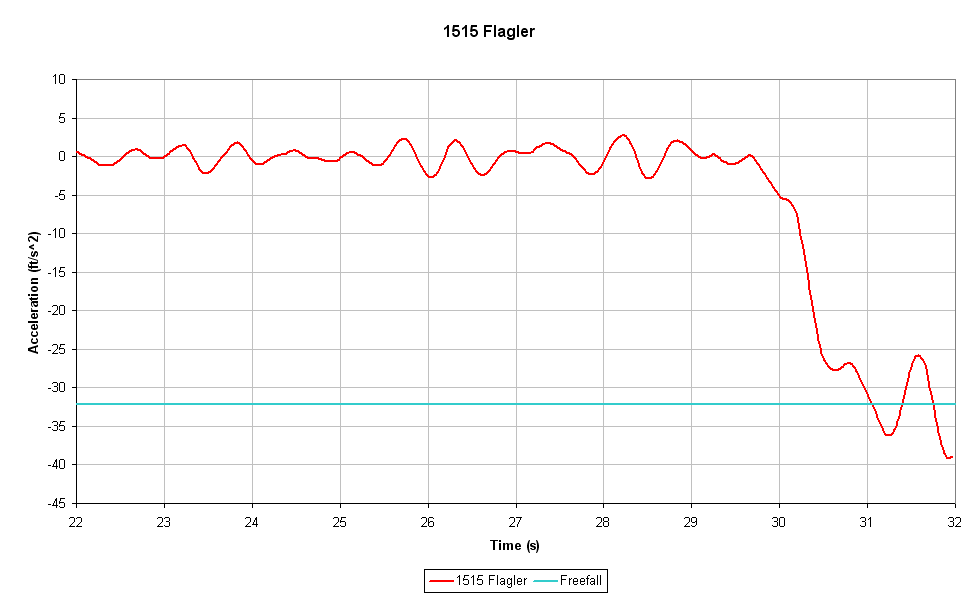
And most importantly...it did not go from static straight to "FFA" in the slightest. It took time to accelerate. About a second.
The screen shots in post 5185 are enough to determine that there was no significant downward movement of the NW corner and a slight downward movement of the rest of the roofline before the onset of FFA.
Yet if you look at the same building from another viewpoint, the perceived motion differs.
You need to look closely from multiple angles.
You are nobody and your graphs are a bunch of pseudo science.
I'm crushed

You used a program that was not designed to measure velocity.
Correct. I used a program designed to track extremely fine
motion (although it
does indeed show velocity in pixel units, which could be calibrated via setup of a coordinate system...in 3D
That inclusion is, however, intended to help de-glitch traces rather than anything else, and it won't "smooth" ). Translation to real-world units, and derivation of velocity and acceleration was performed separately, as I've already said earlier.
NIST and Chandler knew what programs to use.
What programs did they use ?
You do not know better than NIST and Chandler.
Better ? I spent time extracting higher fidelity data s'all.
The results differ, as the data is are more accurate, enabling me to make more specific statements about the motion. That's all.