Richard Gage Blueprint for Truth Rebuttals on YouTube by Chris Mohr

Status
Not open for further replies.
Remember the context. WTC collapses. I was responding to a specific scenario by explaining that scenario. I said "you are talking about a situation which has FFA plus a superimposed over G bit." So I was referring to the bit "what you are talking about" with "you" being C7. When discussing a specific WTC situation it is unlikely that I will change context - especially when I am trying to stop the truther doing just that. And I won't be putting all the disclaimers into every explanation "we are talking about the scene you set BUT if it was a different scene I would say something different." :D
I see. Problem is, if you don't, your words are open to misunderstanding and to claims that you have admitted something you haven't. I was not entirely sure if that was clear in that case, thus my need to clarify.


One of us is missing something. Where does the pull down force come from in a collapsing building if it isn't from gravity facilitated by removing something?
No comment needed.
From gravity, facilitated by columns buckling, not necessarily removed. Maybe the problem is that, to me, "removed" has a connotation that the column is providing exactly zero support (as opposed to some resistance while buckling or even negligible support).

In case it's not clear, my point was that it's possible that the sum of downward force over the façade exerted by the collapsing core and transmitted through girders and beams, and the resistance opposed by the façade's lower columns, could be (in an ideal situation) zero, in which case the façade would fall at FFA with no removal of any support.
 
It's probable that NIST used NO software for their vertical trace data aquisition. It's probable that they used a manual, by hand, method.
Aww, you've spoiled it :D I remember you've said so in past, that's why I asked C7 about the software used by NIST. And yes, given the small amount of data points involved, and the fact that during the explanation of the moiré technique they mention more or less that there were too many points to extract if done by hand and they felt the need to automate it, I'd say it's a safe assumption.


Out of order, while in the subject of tracing by NIST and Chandler:
Oops. Just checked, and, he didn't.

He used the even more inferior "Physics Toolkit", which doesn't even HAVE a tracking engine.

Unless Chandler has repeated his WTC7 data acquisition with another method, then his WTC7 data was generated manually, by hand. Ew.
That's what I thought, but I hadn't taken Chandler's position data into account yet, just focusing on the low quality of NIST's which alone refutes C7's arguments.

Anyway, that's a good point. So Christopher7 has made up that Chandler and NIST used "the right software" to actually acquire the data, when in reality they both did the acquisition by hand. Here we have a sarcastic expression for such a case, that he's "covered in glory". I can't figure out an English equivalent right away.

I guess Christopher7's argumentation technique is trial and error: he makes something up and waits to see if it flies. Yes? Good. No? He just makes up a new claim. That keeps the thread going nowhere, as intended, and he gets the attention he wants as a good troll.


I've probably seen each of the... (I've lost count... maybe 6 or 7 times) you've posted it :)

I'd recommend you to use a link to one of them in future. That repetition is considered spam and I've seen it sanctioned.


Correctly includes deinterlacing and RGB colour splitting and replicating traces on each colour field (6 traces per frame), ...

[qimg]http://femr2.ucoz.com/_ph/7/45980309.gif[/qimg]
What are we seeing? That habit of posting images without labels and without an explanation is a bit annoying. I can only guess that it's a trace of don't-know-what showing each RGB channel separately, given the context.
 
I see. Problem is, if you don't, your words are open to misunderstanding and to claims that you have admitted something you haven't. I was not entirely sure if that was clear in that case, thus my need to clarify....
Understood but I'm not sure that I agree. However It is a reminder that readers do not always interpret what I write as I meant it. And the risks of "writing down" to the level of those who either don't understand or are determined to not understand. Recall my original target reader was C7 - and I had decided to write within the scenario which he accepted.
...From gravity, facilitated by columns buckling, not necessarily removed. Maybe the problem is that, to me, "removed" has a connotation that the column is providing exactly zero support (as opposed to some resistance while buckling or even negligible support).

In case it's not clear, my point was that it's possible that the sum of downward force over the façade exerted by the collapsing core and transmitted through girders and beams, and the resistance opposed by the façade's lower columns, could be (in an ideal situation) zero, in which case the façade would fall at FFA with no removal of any support.
You are relying on the net effect of two (or more) forces adding up. Remember that my question to you was "Where does the pull down force come from..." If the columns are still resisting you how does some other part of the building derive the extra downward force to transfer to the still resisting columns? Haven't you simply shifted the source of pull down from the façade columns to some other location? And how does it source and deliver that extra pull down?
 
Last edited:
Visit with Richard Gage

Hi gang,

Richard Gage was in Denver last night. Karen and I had tickets to see Mahler's 3rd Symphony, so I came in at 10pm to his "Experts Speak Out" tour/presentation. When he saw me he invited me up and asked me what I thought of his movie. I said it was the best thing he'd ever produced, but it had the same technical arguments that appear in Blueprint for Truth. He then asked me to tell people about my YouTube videos, where people could see my rebuttals of either Blueprint or Experts since the content was the same.

Around midnight I drove him over to a party in his honor so we had some one-on-one time. Looks like we may be seeing a Wagner opera together next fall. We talked about the Millette dust study (more on that later). In public I was able to correct his misimpression that Millette had found that the chips were not paint (Millette said they are paint but he hadn't yet ID'd them).

We both thought people would have questions for me, but there weren't any. When the presentation finally ended, though, there was a line of people waiting to either challenge me or thank me for being respectful etc.

OK call me weird I really like the guy. I was impressed though that he encouraged people to look at my YouTube videos! Also as I was about to leave he said, "At the end of our lives I hope we can both figure out together which one of is is blind, because one of us is on all this!"
 
My first impression is that he is supremely confident that he has the loyalty of his converts and is not overly concerned about winning new ones outside his current market demographic.
 
OK call me weird I really like the guy. I was impressed though that he encouraged people to look at my YouTube videos!

I agree he is a very friendly and likable guy in person (I have met him).

I'm not sure I would be all that impressed with this. Can you think of a better way to convince people you're sincere than asking them to view the opposition?

Gage is selling a belief, your facts are really not that important (or are his).

just my $.02
 
RIchard Gage may seem like a nice guy, but knowingly misrepresenting the collapse mechanics to a vulnerable public is morally repulsive.

He is not the only one that does it and such behavior is not limited to one side of the "debate".


The atmosphere among "debaters' may seem polite, but the effect these representations have on the listening audience may not be so nice and festive. They should be considered as more important than the feelings of those presenting the information.

Both "sides" have a moral responsibility to get their facts right.
 
Last edited:
Also as I was about to leave he said, "At the end of our lives I hope we can both figure out together which one of is is blind, because one of us is on all this!"

And what if you are both wrong? One "side' does not exist in opposition to the other.

Both "sides" can be checked against the most accurate information available. If this is done, I think it is within ones power to verify that both positions present incorrect information as if it is true.

Accuracy should be the standard from which all positions are judged, not through artificially narrowed pairings.
 
Last edited:
given the small amount of data points involved, and the fact that during the explanation of the moiré technique they mention more or less that there were too many points to extract if done by hand and they felt the need to automate it, I'd say it's a safe assumption.

For clarity, they performed a kind-of automation technique to determine their T0, by looking at the brightness of a chosen pixel, but once that location and frame was selected, yes, manual, and with a variable number of frames advanced between by-hand manual samples, and a jump in horizontal location upon the roofline.

I can only guess that it's a trace of don't-know-what WTC7 NE Corner showing each RGB channel separately, given the context.
Correct.
 
A snake oil salesman impresses a preacher as being a nice guy. Is there a punchline contest to follow?
 
I can only guess that it's a trace of don't-know-what WTC7 NE Corner showing each RGB channel separately, given the context.
Correct.
Still unacceptably incomplete.

"This image shows a trace of position over time decomposed by RGB of WTC7 NE Corner from the ____________ video, where the black line is the _______ component, the cyan line is the ______ component, and the red line is the ______ component, with the position scale in ________ and the time scale in __________, from ___________ to _(release?)_.

Or to put it in a different format, each graph should include a specification of:
  1. What the graph shows.
  2. Where it comes from (ETA: and whether it was preprocessed in any way).
  3. What does each line represent.
  4. What the axes are.
  5. What units they have.
  6. What range does each axis have, if not self-obvious (the Y range in that graph is self-obvious, but the choice of zero for time isn't - if it's arbitrary, say so; being arbitrary is not self-obvious).
1 and 2 are usually in the title of a graph, e.g. "WTC7 NW corner position over time, NIST Cam 3 video". 3 is usually in a small legend box within the graph. 4 and 5 are usually labels for the axes, e.g. "Time (s)" and "Position (px)". 6 is usually explained in the accompanying text if not self-obvious, or it could be included in the title if the graph is meant to fully speak by itself (e.g. "WTC7 NW corner position over time, Cam 3 video, from start of significant movement to release".

Most of your graphs lack several of these, and aren't accompanied by corresponding explanations when you present them. More often than not, these can't be easily deduced from the context either, especially since you mix quite heterogeneous materials during discussions. The resulting ambiguity makes it near impossible to really get your point.
 
Last edited:
I gave up after giving femr2 this type of advice regarding graphs after doing so multiple times. The lack of clarity is a feature, not a bug.
 
Still unacceptably incomplete.
It's not important (for that graph, posted for the reason it was).

Simply a piccy to illustrate the phrase "RGB colour splitting and replicating traces on each colour field".

It really doesn't matter WHAT it is a trace of, as for highest accuracy an RGB colour split should (almost) always be performed.

You correctly determined the only important point I was trying to get across.

Note that they are not identical.

The resulting ambiguity makes it near impossible to really get your point.
You got the point fine.
 
The NW corner stays at about the same place in the meantime, while the NE corner has already fallen a few pixels. A trace of that side might be interesting, if it were doable. It might be doable for the first few frames.

346289729.gif


The source video was pre-stabilised with use of two static regions within SynthEyes, then pegged to be static around the NW corner.

There's negligible camera motion or rotation.

An (automated) trace is fairly impractical with that viewpoint.

Watch it a few times zoomed to get a clearer impression of the motion ocurring.
 
I gave up after giving femr2 this type of advice regarding graphs after doing so multiple times. The lack of clarity is a feature, not a bug.
:D

Well, anyway that (and this) should be enough of a message to him that his explanations can be totally pointless if the data he supports them with is unreadable.

graph.png


You correctly determined guessed the only important point I was trying to get across.
I could as well not have asked, think my guess might be erroneous, and forget about it. Then the graph would have been totally useless.
 
In my video #18 I say freefall doesn't mean zero resistance, it means zero NET resistance. My honest guess is that there may have been a very small amount of resistance left over from the columns after they lost their load-bearing capacity (maybe 2%).
That is where you are wrong.

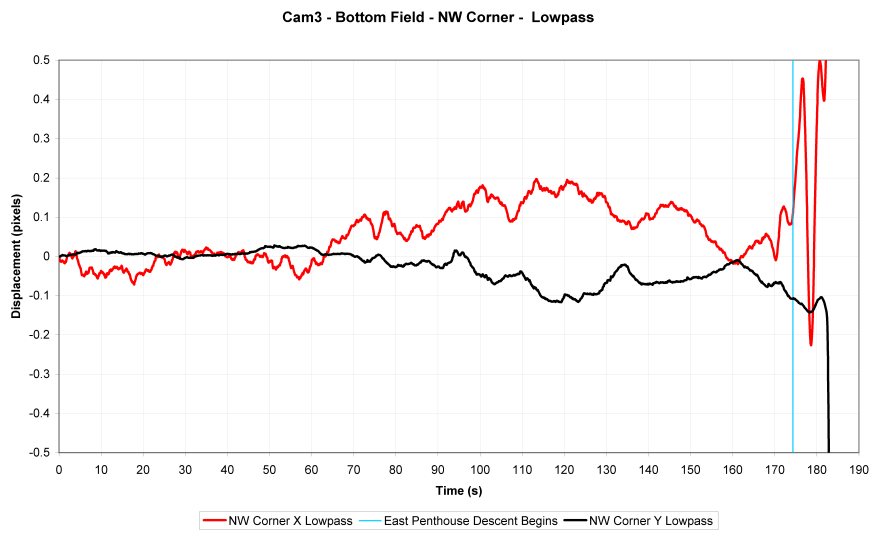
The west part of the roofline moved down a few feet while the NW corner did not move at all. Then the entire upper part of the building goes into free fall as observed.

The two examples on the right show a column that has just begun to bend and one that has folded almost completely. The one that has just begun to bend still has most of its ability to resist. The one on the far right has folded almost completely but is still providing about 2% of its original resistance.

bucklonggraph.jpg


The impartial engineers told you that a column only loses a small part of its resistance at first. A a column, and more so a series of columns with moment frames, that have only lost a few feet to bending still have most of their resisting ability. The 2% doesn't occur until until the columns have folded completely. That would not occur until the roofline had descended 20 feet or more.
 
The west part of the roofline moved down a few feet while the NW corner did not move at all.
You seem to have a very selective memory...


NW corner was in motion long before the "west part of the roofline moved down a few feet".

How about a shorter time interval...


Shorter still...


Or how about the same motion from the NIST report...
930069773.png


And a closer view...


Then the entire upper part of the building goes into free fall as observed.
No, it doesn't. You've seen both the NIST acceleration profile, and mine, and NEITHER behave as you describe. (Neither does Chandler's data indicate anything more than AVERAGE roughly, about "FFA" over a period of time...for a single point on the North facade.).
 
Last edited:
Understood but I'm not sure that I agree.
I have no problem with your disagreement here, I was unsure myself of what you meant :)

You are relying on the net effect of two (or more) forces adding up. Remember that my question to you was "Where does the pull down force come from..." If the columns are still resisting you how does some other part of the building derive the extra downward force to transfer to the still resisting columns? Haven't you simply shifted the source of pull down from the façade columns to some other location? And how does it source and deliver that extra pull down?
Ok, it took a bit to make these diagrams but here they are finally, sorry for the delay. This is my view of what happened inside the building. The diagrams are 2D, so the E-W progressive collapse is not accounted for in them.

Bear with me if I tell you that this is WTC 7 :) The thicker vertical lines in the middle represent the core and the outer thinner ones represent the perimeter.

wtc7fall1.png


Now, the core collapses and starts to fall. The beams and girders transmit force from the falling core to the perimeter. The perimeter was until that point just holding its own weight and that of the connected floors as normal.

wtc7fall2.png


The core is now effectively pulling the perimeter downwards. Elastic tension accumulates. The perimeter can't bear its own weight plus that of the core and fails. There may be a certain dynamic overloading effect at this point, but it's probably mostly static overloading.

wtc7fall3.png


Under that elasticity hypothesis, the core could have bounced if the perimeter and girders resisted, and go upwards. It's not a physical impossibility. Of course, in practice the unions would probably break before that happened, and many other things could be happening inside preventing that.

And here's where I said that there is a possibility (infinitely unlikely) that the force the core is exerting on the perimeter equals the resistance of the columns, and therefore the resultant force is its own weight, making it fall at exactly g, even if the buckling columns of the perimeter are opposing resistance (cancelled by the sum of the downward forces of the girders and beams).

ETA: This hypothesis also explains the above claim of resistance by C7, by the way. That's what he is not getting at all when C.Mohr says that the NET resistance (i.e. the sum of resistance plus downward force) is zero. (It's probably not zero, it goes to negative at one point and then to positive again.) And the elasticity accounts for the slower progression from under-g to over-g during a second, as opposed to a sudden almost inelastic yank like in the crane example.
 
Last edited:
You seem to have a very selective memory...

http://femr2.ucoz.com/_ph/7/2/666377698.jpg

NW corner was in motion long before the "west part of the roofline moved down a few feet".
"In motion" = word games. You know what I meant. The NW corner was not descending at all and then it went into FFA.

The screen shots in post 5185 are enough to determine that there was no significant downward movement of the NW corner and a slight downward movement of the rest of the roofline before the onset of FFA.

You are nobody and your graphs are a bunch of pseudo science. You used a program that was not designed to measure velocity. NIST and Chandler knew what programs to use. You do not know better than NIST and Chandler.

C7 said:
Then the entire upper part of the building goes into free fall as observed.
No, it doesn't. You've seen both the NIST acceleration profile, and mine, and NEITHER behave as you describe.
Hogwash. Both NIST and Chandler said WTC 7 fell at FFA based on their analysis.

(Neither does Chandler's data indicate anything more than AVERAGE roughly, about "FFA" over a period of time...for a single point on the North facade.).
Roughly? Why do you persist in lying about that? NIST measured to within one tenth of one percent. That is considered "at FFA" by any reasonable person.
 
Status
Not open for further replies.

Back
Top Bottom