Richard Gage Blueprint for Truth Rebuttals on YouTube by Chris Mohr

Status
Not open for further replies.
That's the most likely reason for over-g.
No!

I have stated that it is "possible" for the interior columns to "momentarily" pull the outside walls down at greater than g, but only if all the supporting structure below both were removed allowing them both to fall at FFA.

The physical reality that you are ignoring is; buckling framework provides resistance and FFA means no resistance.

Even if your greater than FFA were true, it would require all the supporting structure to be removed to attain FFA.

The impartial engineers told Chris that the columns would lose a small part of their resistance when they first began to buckle. That means that the columns would prevent FFA.

That the east part of the roofline moves down a few feet and this could be columns buckling but they would still be providing a lot of resistance when the roofline went into FFA. They had to have been removed to allow FFA.

The exterior columns in the NIST model were still buckling and providing resistance when they had buckled ~20 feet and were still preventing FFA. The NIST model is not falling at FFA.
 
Last edited:
No!

I have stated that it is "possible" for the interior columns to "momentarily" pull the outside walls down at greater than g, but only if all the supporting structure below both were removed allowing them both to fall at FFA.

The physical reality that you are ignoring is; buckling framework provides resistance and FFA means no resistance.

Even if your greater than FFA were true, it would require all the supporting structure to be removed to attain FFA.

The impartial engineers told Chris that the columns would lose a small part of their resistance when they first began to buckle. That means that the columns would prevent FFA.

That the east part of the roofline moves down a few feet and this could be columns buckling but they would still be providing a lot of resistance when the roofline went into FFA. They had to have been removed to allow FFA.

The exterior columns in the NIST model were still buckling and providing resistance when they had buckled ~20 feet and were still preventing FFA. The NIST model is not falling at FFA.
Christopher7 you have all the bits in this post BUT you are switching horses in mid stream which confuses your logic.

Let me take it bit by bit:
Actually he is right but let's give that one a rain check for now.

...I have stated that it is "possible" for the interior columns to "momentarily" pull the outside walls down at greater than g, but only if all the supporting structure below both were removed allowing them both to fall at FFA....
TRUE. AND you are talking about a situation which has FFA plus a superimposed over G bit. Technically the lot which is falling at FFA is an isolated sub-sytem acting as a free body. The "over G" situation can arise within such a sub system free body. And there will be a complementary bit of "under G" so that the net is FFA for the full sub-system. The "over G" and "under G" bits cancel out. The mass of the subsystem falls with its centre of mass exhibiting FFA.
...The physical reality that you are ignoring is; buckling framework provides resistance and FFA means no resistance....
TRUE. But you are moving away from the scenario of paragraph two where you accepted FFA and moving to a "No FFA" setting - hence my "change horses" comment. This is the first change. At this stage you draw no conclusions but the confusion is starting.
...Even if your greater than FFA were true, it would require all the supporting structure to be removed to attain FFA....
Already agreed as TRUE and back focussed on the "first horse" of an FFA scenario.
...The impartial engineers told Chris that the columns would lose a small part of their resistance when they first began to buckle. That means that the columns would prevent FFA...
You have switched from the FFA scenario to a No FFA scenario. So we are no longer discussing the same scenario.

The clue to your thinking could be in the next bit which shows that you have them as timed sequences - a period of "buckling" with the resistance BEFORE FFA occurs THEN a period of FFA which means all buckling resistance is gone. So two distinct stages.
...That the east part of the roofline moves down a few feet and this could be columns buckling but they would still be providing a lot of resistance when the roofline went into FFA....
The "when" makes the statement wrong. Change it to "before" because "when the roofline went into FFA" all resistance was gone. So EITHER "columns buckling [would be providing no resistance] when the roofline went into FFA.." OR "columns buckling but they would still be providing a lot of resistance [before] the roofline went into FFA.."
... They had to have been removed to allow FFA.
TRUE


...The exterior columns in the NIST model were still buckling and providing resistance when they had buckled ~20 feet and were still preventing FFA....
We were discussing the real world NOT the NIST model. So another change to the third scenario and we are no longer discussing the situation we were with in previous paragraphs.
...The NIST model is not falling at FFA.
I'll take your word for it. The problem comes when we mix up bits of logic or evidence which come from different scenarios. You cannot mix and match bits of "what really happened" explanations with different bits from a "Why NIST was right/wrong" discussion. Each scenario to be legitimate has to be a complete explanation which legitimately stands in its own right.

There are provisos for managing around that issue but lets take another rain check - it causes more confusion than it is worth IMNSHO.
 
Last edited:
In addition, C7 makes a critical mistake that some lever action yanking the structure down could only pull an assembly that is at g to over g, as in:

- acceleration without yank: awithout = 1 g
- acceleration imposed by yank: ayank = 0.05 g (just to put a number to it)
- resulting acceleration: aobserved = awithout + ayank = 1.05 g

Of course, the same could logically be true for an assembly that experiences some residue resistance from below, let's say:
- acceleration without yank: awithout = 0.9 g
- acceleration imposed by yank: ayank = 0.15 g (just to put a number to it)
- resulting acceleration: aobserved = awithout + ayank = 1.05 g
 
In addition, C7 makes a critical mistake that some lever action yanking the structure down could only pull an assembly that is at g to over g, as in:

- acceleration without yank: awithout = 1 g
- acceleration imposed by yank: ayank = 0.05 g (just to put a number to it)
- resulting acceleration: aobserved = awithout + ayank = 1.05 g

Of course, the same could logically be true for an assembly that experiences some residue resistance from below, let's say:
- acceleration without yank: awithout = 0.9 g
- acceleration imposed by yank: ayank = 0.15 g (just to put a number to it)
- resulting acceleration: aobserved = awithout + ayank = 1.05 g
Agreed but this "free body" stuff is confusing enough without getting too pedantic on details of remote possibilities. A worryingly large proportion of qualified engineers get it wrong......:(

(AND Yes, it is me the arch pedant for logic, saying that :o )

My aim in that post was to sort out the overlapping mix of conflicting scenarios. Even calling them "horses for courses...." :o
 
In addition, C7 makes a critical mistake that some lever action yanking the structure down could only pull an assembly that is at g to over g, as in:
That lever action is a bunch of crap. The entire upper portion was in free fall so there are no internal stresses.

You too are ignoring the physical reality that all the supporting structure has to be REMOVED for free fall to occur. [even with your absurd lever action]

You can't get free fall if buckling columns are providing resistance and they were for at least 20 feet of the descent in the NIST model.
 
Last edited:
The NW corner stays at about the same place in the meantime, while the NE corner has already fallen a few pixels. A trace of that side might be interesting, if it were doable. It might be doable for the first few frames.
Was done quite some time ago (with camera #3), so noisier than more recent traces, but ...


I'd suggest it shows the initial twisting flexure more prominently than actual vertical release point.

And horizontal motion...


Other locations were also traced...


Similar traces exist for the Dan Rather footage, but I'll have to find them in the piling system somewhere.
 
From the opposite side, I'm a computer scientist and I understood the concepts involved in the analysis just fine. I think Chris just likes to call anything that goes over his head "technobabble".

I'd like to think he's aware that in the real world, the writers can't just make the Enterprise work, and technobabble actually has to make sense if it's being looked at by people who know what you're talking about, otherwise serious problems could occur. From TVTropes;

The ICAO Accident Prevention Manual mentions an incident where a private pilot once wrote the authorities asking if he could save money by mixing kerosene with his aircraft fuel. They sent back a letter stating: Utilization of motor fuel involves major uncertainties/probabilities respecting shaft output and metal longevity where application pertains to aeronautical internal combustion power plants. Pilot's reply: "Thanks for the information. Will start using kerosene next week." Answering by cable this time, the authorities responded: Regrettably decision involves uncertainties. Kerosene utilization consequences questionable, with respect to metalloferrous components and power production. Cable reply from the pilot: "Thanks again. It will sure cut my fuel bill." Response by telex within the hour: DON'T USE KEROSENE. IT COULD KILL THE ENGINE, AND YOU TOO!

And you're a CARPENTER claiming to know better than the hundreds of PhD's at NIST, plus Dr. Bazant........

Now, where'd that damn irony meter go......

Yet when you ask him, directly, if he thinks he knows better, he doesn't answer, despite that being the subtext of his posts. Heck, it's the text.
 
Last edited:
...all the supporting structure has to be REMOVED for free fall to occur...

Yes/no-questions are kinda frowned upon here, but here is one anyway:

C7, is an object that accelerates downwards at a>g in free fall? Yes or no?

(I am asking you to consider this using the strictest and most neutral definition of the term "free fall"; if you do so, the answer can be answered with either yes or no, there is no third option)
 
No, he just talked a bunch of techno-babble. The program he used was not suited for velocity.
What program did I use ?

You do not understand that the data points are not precise.
Correct.

There is some error when taking data from a video
Correct.

so an average of the data points is used.
Almost correct. Say rather that noise in the data must be taken account of, either by averaging, smoothing, ...

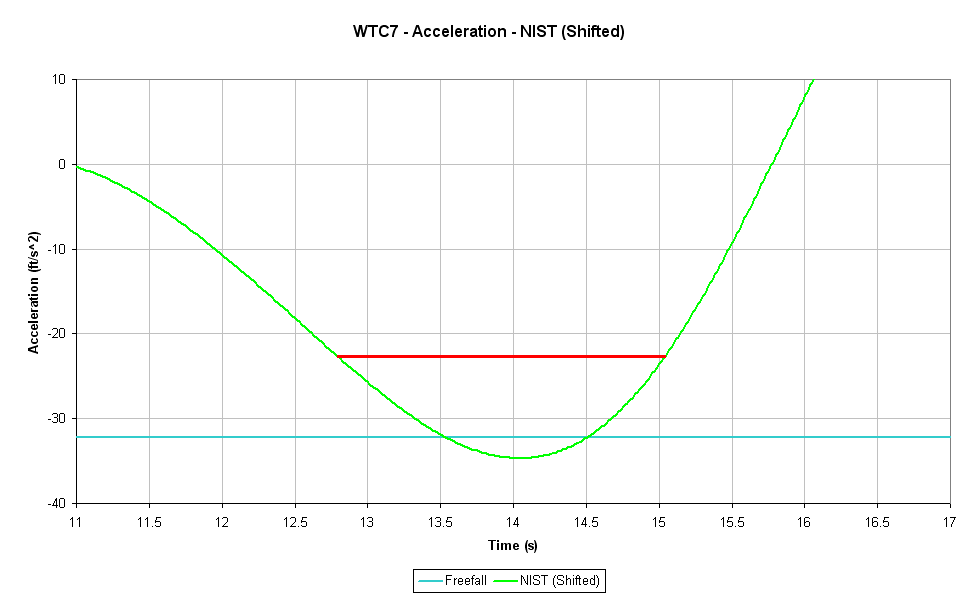
Chris Mohr demonstrates his total lack of understanding of the laws of physics and what the NIST and Chandler graphs depict when he talks about faster than FFA.
NIST equation for acceleration DOES exceed g...


We have scientific conformation from both sides that WTC 7 fell at FFA for ~2.25 seconds.
Not "AT". And a fair bit less than ~2.25s.

Again, the red line on the NIST acceleration profile above shows you a 2.25s interval.

How much of that red line rests upon the blue "freefall" line ?

Remember, that IS the NIST acceleration data derived from their equation for velocity...


795385257.png
 
Last edited:
Evidence?

More accurately, most engineers don't disagree with NIST. There are millions of engineers in the world. Millions. All AE911T can rustle up is about a tenth of a percent of the US population of engineers, not even the world's, and that's before including the architects. Since NIST's report is actually used in courses for both fields, without the students largely calling BS, that means they become more and more irrelevant every year. In fact, the percentage they represent is below the percentage of the general population with mental illness.

Yeah that's an excellent example. The wooden tower probably weighed 2 or 3 pounds.

Clayton Moore? Ignoring the actual point of something? What a shock!

Good work. You proved a structure of an ounce or so of spaghetti could support a pound of spaghetti indefinitely.

Patented Moore one liner that he thinks is witty but only addresses a straw man.
 
FEMR is an anonymous poster and his analysis is crap. He used a program not designed to do what he used it for. To take the word of an anonymous poster over professionals from opposing sides who used the correct software is folly. This is just an attempt to muddy the waters by people desperate to deny the confirmed scientific proof of FFA.
What makes you think that NIST used the correct software?

What software did NIST use?

When you have the response you will realize that you're making stuff up... again.


Even if your greater than FFA were true, it would require all the supporting structure to be removed to attain FFA.
Nope, you're ignoring the crucial point. Greater than FFA proves that gravity is not the only force pulling downward. That force MUST be greater than any resistance opposing the movement for that acceleration to be reached. Due to the presence of an acceleration greater than FFA, your claim that the supporting structure had to be removed is reduced to an unsupported (pun intended) bare assertion. That's why you need to deny it over-g for your delusion to come true.
 
Last edited:
TRUE. AND you are talking about a situation which has FFA plus a superimposed over G bit. Technically the lot which is falling at FFA is an isolated sub-sytem acting as a free body. The "over G" situation can arise within such a sub system free body. And there will be a complementary bit of "under G" so that the net is FFA for the full sub-system. The "over G" and "under G" bits cancel out. The mass of the subsystem falls with its centre of mass exhibiting FFA.
I don't fully agree to that, in that FFA is not necessary for an over-g situation. Remember the crane: due to the small elasticity of the cable, the acceleration probably suffered a very sharp increase, and that's independent of the acceleration of the falling piece: it just required a certain initial velocity providing the energy necessary for the arm to buckle.

Or, in other words, the system didn't need to be falling at FFA, it just was necessary for some parts to be in movement when the façade buckled.

(I think that's what Oystein notes later).


They had to have been removed to allow FFA.
TRUE
I don't agree to that either. If the force pulling down equals the force that the buckling columns oppose, FFA can be attained without removing anything.

But then, there's no proof of instant acceleration equal to g for any significant amount of time anyway.
 
Similar traces exist for the Dan Rather footage, but I'll have to find them in the piling system somewhere.
I'm interested in that view, which is the pic shown by C7 where the NE corner appears lower. The graphs you've shown don't exhibit such anomaly, and so far I can only explain that in two ways: (1) the pic is somehow deceiving or (2) that detail isn't visible in that perspective.

On an unrelated note, I've just realized that single static point extraction can't cope with camera rotation, and that two static points are needed for that. I'm not sure if the software allows that.


I've used other smoothing methods, but assume this is what you're after.
Actually it's C7 who asked for data and formulas. The data is there in the graphs, and if he didn't ask for these formulas, then he should have been more specific.

C7, now you have the data and formulas that you demanded, therefore your stated requisites have been met.
 
Christopher7, a downward acceleration of g (9.81 m/s2) does not necessarily mean the exterior is "freely falling". It means that the additions of all the forces on it, in the upwards and downwards directions, balances out to moving toward the earth at g (9.81 m/s2). There can be resistance below in the upwards direction, balanced in opposition by gravity and the force applied by the already collapsing interior applying pressure from above. Its as simple as that.

When you keep saying "freefall" and mean freely falling, you are making an assumption that a structure moving toward the earth at g (9.81 m/s2) does not allow you to make when there are other forces present in addition to gravity.
 
I don't fully agree to that, in that FFA is not necessary for an over-g situation....
Remember the context. WTC collapses. I was responding to a specific scenario by explaining that scenario. I said "you are talking about a situation which has FFA plus a superimposed over G bit." So I was referring to the bit "what you are talking about" with "you" being C7. When discussing a specific WTC situation it is unlikely that I will change context - especially when I am trying to stop the truther doing just that. And I won't be putting all the disclaimers into every explanation "we are talking about the scene you set BUT if it was a different scene I would say something different." :D
...Or, in other words, the system didn't need to be falling at FFA, it just was necessary for some parts to be in movement when the façade buckled...
So you are back on WTC but in a different scenario to what I was responding to....
...I don't agree to that either. If the force pulling down equals the force that the buckling columns oppose, FFA can be attained without removing anything....
One of us is missing something. Where does the pull down force come from in a collapsing building if it isn't from gravity facilitated by removing something?
...But then, there's no proof of instant acceleration equal to g for any significant amount of time anyway.
No comment needed.
 
Christopher7, a downward acceleration of g (9.81 m/s2) does not necessarily mean the exterior is "freely falling". It means that the additions of all the forces on it, in the upwards and downwards directions, balances out to moving toward the earth at g (9.81 m/s2). There can be resistance below in the upwards direction, balanced in opposition by gravity and the force applied by the already collapsing interior applying pressure from above. Its as simple as that.

When you keep saying "freefall" and mean freely falling, you are making an assumption that a structure moving toward the earth at g (9.81 m/s2) does not allow you to make when there are other forces present in addition to gravity.
Good point. In his "Truth Rebuttals on YouTube" ChrisMohr refers to "net zero force" or words to that effect. And that reference puts us back on topic....;)
 
What makes you think that NIST used the correct software?
It's probable that NIST used NO software for their vertical trace data aquisition. It's probable that they used a manual, by hand, method.

Worse than that, their trace start point and end point are from different locations along the roofline.

I assume you've seen my list of issues with the NIST vertical trace before.

Chandler used the free software Tracker.

It seems C7 can't see beyond the fact that Tracker has inbuilt functionality to derive velocity from the program itself.

However, and it's a really big however, the feature tracking engine within the SynthEyes software (which I use for raw data aquisition only) is FAR superior to that in Tracker.

Just one reason why it costs (only!!!) ~$600 and has been used in Hollywood movies such as The Amazing Spiderman, The Girl with the Dragon Tattoo, Mission Impossible: Ghost Protocol, Harry Potter and the Deathly Hallows: Part 2, Green Lantern, Cowboys and Aliens, Source Code, Thor, I Am Number Four, X-Men: First Class, Tron: Legacy, Vampires Suck, The Sorcerer's Apprentice, Iron Man 2, Alice in Wonderland, Straw Dogs, Avatar, A Nightmare on Elm Street, The Imaginarium of Doctor Parnassus, 2012, District 9, Transformers: Revenge of the Fallen, The Final Destination 3D, Terminator Salvation, Fast & Furious, Underworld 3, The Day the Earth Stood Still, Eagle Eye, National Treasure: Book of Secrets, The Golden Compass, Transformers, Pirates of the Caribbean: At World's End, Spiderman 3, Evan Almighty, Pan's Labyrinth, Charlotte's Web, Casino Royale, Pirates of the Caribbean: Dead Man's Chest, King Kong, Final Destination 3, Jarhead, Transporter 2, Brothers Grimm, Mr. and Mrs. Smith, The Island, Charlie and the Chocolate Factory, The Amityville Horror, National Treasure, Boogeyman, Blade: Trinity, The Day After Tomorrow (Uncharted Territory), Van Helsing, Texas Chainsaw Massacre, Lara Croft Tomb Raider: The Cradle of Life, Bad Boys 2, and many more ...

The tracking engine is superb. (I've compared many)

For all operations on the data after initial data aquisition I use MATHS.

Some performed within MSExcel, others (such as the Savitzky Golay smoothing) I use OriginPro 8.1, a >$1500 professional math and data analysis suite.

If C7 wants to defend Chandler's use of the Tracker software, I suggest he contacts David himself and acquires his WTC7 data. I have his WTC1 data and wasn't at all impressed. You can see his levels of accuracy (or not) from his videos, threw away the majority of data by not deinterlacing and skipping frames, ...

My data is extracted from the very best quality video available (3*1GB DV from NIST in the case of Cam#3, commercial DVD for Dan Rather) which is treated correctly before attempting data extraction.

Correctly includes deinterlacing and RGB colour splitting and replicating traces on each colour field (6 traces per frame), ...

45980309.gif
 
Last edited:
Good point. In his "Truth Rebuttals on YouTube" ChrisMohr refers to "net zero force" or words to that effect. And that reference puts us back on topic....;)
In my video #18 I say freefall doesn't mean zero resistance, it means zero NET resistance. My honest guess is that there may have been a very small amount of resistance left over from the columns after they lost their load-bearing capacity (maybe 2%). Then, for three very short instants totalling about a second, the torquing and leveraging of the beams and columns in the collapsing building created more downward force ON THAT ONE PERIMETER POINT THAT WAS MEASURED and the part of the building below it than any residual resistance. Oystein just explained how that would be possible (post 5203) and i say as much in my video. The randomness of the period of near-freefall rate above and below freefall is either due to the margin of error of the measurements (as C7 says) or accurate (as femr says).

Chris7 that seems like a valid point of debate. femr's explanations of his software and measuring techniques seems good to me. Quit calling it crap, and quit calling me utterly lacking in any understanding of physics.
 
Chandler used the free software Tracker.

Oops. Just checked, and, he didn't.

He used the even more inferior "Physics Toolkit", which doesn't even HAVE a tracking engine.

Unless Chandler has repeated his WTC7 data acquisition with another method, then his WTC7 data was generated manually, by hand. Ew.
 
Status
Not open for further replies.

Back
Top Bottom