• Quick note - the problem with Youtube videos not embedding on the forum appears to have been fixed, thanks to ZiprHead. If you do still see problems let me know.

WTC7 and the girder walk-off between column 79 and 44

Status
Not open for further replies.
That wasn't so hard. :)

That is an obscure question, especially if I got the right answer for the wrong reasons. Are you covering for ozeco41? Can you tell me how I got the right answer with the wrong assumptions?

I'm wondering why you're asking me these questions. I simply assumed you had an issue with NIST's FEA and you had already contacted them.

Am I wrong, do you not have a problem with their FEA and have contacted them for correction?

:confused:
 
That wasn't so hard. :)


I'm wondering why you're asking me these questions. I simply assumed you had an issue with NIST's FEA and you had already contacted them.

Am I wrong, do you not have a problem with their FEA and have contacted them for correction?

:confused:

Nope. Your assumption is not correct. My FEA agrees with the NIST but ozeco41 says I got the right answer for the wrong reasons. I want him to clarify and provide me with his assumptions.
 
Nope. Your assumption is not correct. My FEA agrees with the NIST but ozeco41 says I got the right answer for the wrong reasons. I want him to clarify and provide me with his assumptions.

For those of us that don't want to search the thread for your quotes of ozeco41, you might link them.
 
Nope. Your assumption is not correct. My FEA agrees with the NIST but ozeco41 says I got the right answer for the wrong reasons. I want him to clarify and provide me with his assumptions.
Sorry, I was confused.

BTW: I don't believe I feel the need to "cover for" ozeco41 (or anyone else), he's a big boy.

;)
 
The shock wave from a directional device is orders of magnitude greater in the direction designed for.

No, not really. As I showed above, the blast energy emanating from any point on the surface of a shaped charge is no stronger than the energy from any other point. The blast energy from any point on the back and sides of a shaped charge is just as strong as any point inside the conical portion. All the shaping does is cause blast energy to converge on a central point.

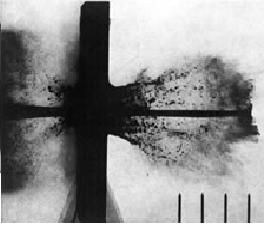
The photograph provided by miragememories confirms exactly what I have described.

ShapedCharge1.jpg


The image of an armor plate defeated by a shaped charge "HEAT" warhead (High Explosive Anti-Tank) shows rapidly expanding gases, fragments and spalling from both sides of the armor plate. Standing on either side of the plate would be just as destructive to a material as weak as glass.

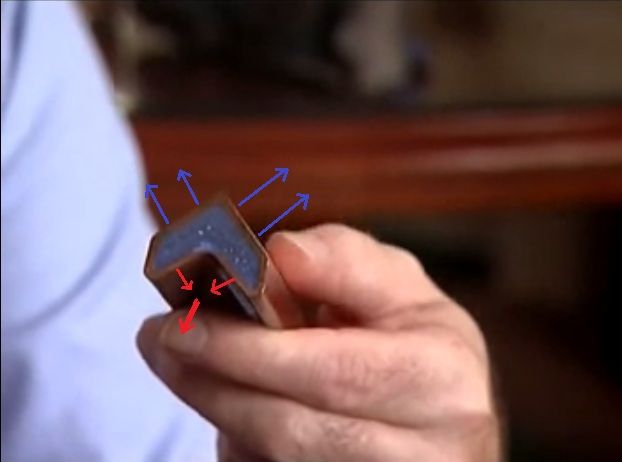
Look again at the image of the shaped charge held by Mark Loizeaux:
MarkLoizeauxholdingshapedcharge-B.jpg

The copper sheath does not attenuate the blast energy. It makes it stronger (see my reference to the US military Mk-84 bomb above). The copper on the indented side would be compressed, superheated and turned into a hypersonic jet of liquid metal. the copper sheathing on the back side of the charge would be torn apart by the blast and turned into shards of shrapnel.

Here's an experiment; turn to the nearest window, walk to the point in the room farthest from it and fire a pistol at it. Now multiply that millions of times over and spread it out across the otherwise undamaged side of WTC7. That is what we would have observed had WTC7 been a controlled demolition.

Windows were broken on a face that was parallel to two faces of column 79 and I have shown that.

Actually, ~I~ posted the photo showing the handful of windows breaking.

You are trying to refute that with the simplistic and enormous leap that windows on all sides would have to be broken.

You aren't even reading what I have posted. Let alone going outside this message board trying to learn something before embarrassing yourself with me here.

I never said that just one or a few charges would break every window in the building, I said that all of the charges would do that.

I stated that thousands of charges would have been necessary to bring down WTC7. Dr Niels Harrit, your co-author on the paper that you were unable to get properly reviewed and published agrees with me. he stated that "I personally am certain that conventional explosives were used too, in abundance... Tons! Hundreds of tons! Many, many, many tons!"

Controlled Demolition Inc. describes their efforts to bring down the J.L. Hudson building in Detroit:

CDI’s 12 person loading crew took twenty four days to place 4,118 separate charges in 1,100 locations on columns on nine levels of the complex. Over 36,000 ft of detonating cord and 4,512 non-electric delay elements were installed in CDI’s implosion initiation system, some to create the 36 primary implosion sequence and another 216 micro-delays to keep down the detonation overpressure from the 2,728 lb of explosives which would be detonated during the demolition.

WTC7 was twice the height of the Hudson building. it was a building of more modern construction than Hudson and the above ground portions were wider and deeper too. it's likely that in any plausible scenario, anywhere between 8,000 to 12,000 shaped charges would have been needed.

CDI goes on to describe additional precautions taken during their preparations:


Even with all the precautions to control overpressure, the age, existing cracks, and poor condition of glazing windows in vacant structures on the north, east and west sides of the J.L. Hudson complex, window breakage was a concern. CDI had seven glass company crews on standby to handle any problems. Although Homrich/NASDI has placed over 2,000 yards of soil over utilities in the four adjacent streets, emergency utility crews were also standby "just in case."

The backblast from the non-shaped portions of the charges is so great that CDI was concerned about blast waves and shrapnel breaking windows in buildings across the street. In this case we have been discussing windows in WTC7 itself. This is devastating to your claims.

That would require quantification, which you have not done. It is incredible that you would have the nerve to declare victory without doing so, as you essentially have no argument without quantification.

Now you are blatantly lying. You have managed to cast doubt on both your skill in your chosen profession and your moral character (though arguably not as much as your anti-semitic attacks on Mark Roberts).

On the other hand, my argument has merit on the directionality issue alone.

I backed my claims up with real world examples. You have done nothing but proclaimed yours to be the Word of God and insisted that you don't need anything else.

On the bright side, I now know how Ryan "I creamed him without breaking a sweat" Mackey must have felt. :D

:dc_biggrin: :dc_tongue: :dc_shocked: :Dancing_cool: :Dancing_biggrin: :Dancing_mad:
 
Last edited:
The backblast from the non-shaped portions of the charges is so great that CDI was concerned about blast waves and shrapnel breaking windows in buildings across the street. In this case we have been discussing windows in WTC7 itself. This is devastating to your claims.

Great post, though I've just clipped out this part of it, as it bears repeating.

The "shape" of a shaped charge just ensures that the copper strip does its job. That the rest of it blasts itself to hell and back is not in doubt, except in Szamboti-land.
 
No, not really. As I showed above, the blast energy emanating from any point on the surface of a shaped charge is no stronger than the energy from any other point. The blast energy from any point on the back and sides of a shaped charge is just as strong as any point inside the conical portion. All the shaping does is cause blast energy to converge on a central point....
My commendation yet again Sword_Of_Truth for an excellent explanation.

...and my qualifications include Civil/Structural engineering AND Military Engineering with demolitions training.
 
Nope. Your assumption is not correct. My FEA agrees with the NIST but ozeco41 says I got the right answer for the wrong reasons. I want him to clarify and provide me with his assumptions.

For those of us that don't want to search the thread for your quotes of ozeco41, you might link them.
Enik is misrepresenting my statements - again. I suspect that it is genuine misunderstanding rather than deliberate dishonesty. However even misunderstanding is hard to accept because my posts were explicit and clear - or so I thought. :o

These are relevant bits:
Post 2167 makes it clear that I admire a lot of Enik's work just as I admire the technical research work done by femr2 and Major_Tom. ... BUT to be very clear the fact that I admire some aspects of anyone's work does not imply that I am a slavish supporter of every word they utter. :)
Enik's FEA work is impressive. I would expect it to be correct within the context of boundary assumptions. It is the boundary assumptions I am not sure about at this stage. There can be no doubt that Tony Sz's boundary assumptions were not supported. Enik has gone a bit broader in the physical boundary but still using the same temperature assumptions. (And there are other factors.)
Far too much for me to comment on at this time and my current location...
So note my caution was about the boundary assumptions. And very clearly stated. It has been shown many times in this thread that Toby Sz's boundary assumptions may be wrong (and probably are wrong). Tony's claim fails because HE has not dealt with the "may" of "may be wrong" - the "probably" bit is not critical.

Enik in his first FEA took the same boundary therefore the same constraint which he failed to acknowledge despite the topic being identified many times in this thread.

For his second FEA it appeared at first glance that Enik has extended the boundary for the FEA. A good step. I could not determine if:
A) he had gone far enough; OR
B) Adequately dealt with the temperature effects.

Since he was agreeing with NIST and disagreeing with Tony I thought it likely that debunker members could jump on Enik's work as proof that NIST was right. Therefore I advised caution.

Now Enik's recent post makes a statement and a request. The statement:
...but ozeco41 says I got the right answer for the wrong reasons. I want him to clarify....
That is a misinterpretation of something where I had been quite precise. I did not say Enic "got...." I said (words to the effect of) "may have got....and I don't know yet." See the earlier part of this post Enic and others who are interested.

And the request:
... and provide me with his assumptions.
...I have been holding fast against Tony Sz's attempt to get me to accept "reversed burden of proof" and have previously stated why I will not do it for Tony. Enik is caught by the same reasoning which is two parts - maybe three:
1) I won't accept reverse burden of proof; AND
2) I doubt - see my lengthy post #2390 - that it is possible to be conclusive BUT Enik is as good as anyone we have posting at applying FEA. So good luck to him.

Post 2148 contains my comment which Enik has now misrepresented. At the time I posted it I was on holiday in Fiji and had poor computer/Internet facilities. So the reason for my limited comment should be obvious. This is what I said - responding to Oystein BTW:
Enik initially made the same technical error as Tony Szamboti made here - on which error I and tfk challenged Tony. Enik initially accepted Tony's false context. He has now slightly broadened his parameters and come up with an answer which agrees with NIST.

I am not convinced at this stage- I suspect he may have got the NIST agreeing answer for wrong reasons. I will study his findings in more detail - not for some time I am in Fiii on a holiday....
Whilst I was not very explicit the key words were in the caution I suggested by saying "I suspect" - not "know" merely "suspect" and "may have got" - not "has got..." I expected anyone posting on engineering matters to be familiar with the common problem of getting the "right answer for the wrong reasons" and my caution until I knew better was professionally prudent. At least one other member agreed on that - Mark Lindeman IIRC.
However this was Enik's immediate response:
I will look forward to your FEA when you return.
Which was exactly the same style as the evasive truther trickery and (pretended I think) obtuseness which Tony Sz had been responding with. So I lost interest in further discussion with Enik at this stage.

And that should be enough to show the context for Enik's misunderstandings of what I said.

At this point I may as well foreshadow the next barrier facing Tony if he ever does get past the boundary assumptions problem. It is this:

My interest remains in the "CD or Not CD at WTC7?" question. And whether NIST was right or wrong is irrelevant to that question. If anyone cannot see why we can have another derail into details whilst I explain. It may be off-topic but not as far off topic as the sinking of the Titanic. :D
 
Last edited:
The copper on the indented side would be compressed, superheated and turned into a hypersonic jet of liquid metal.
Do you happen to have an idea of what temperature is it heated to? I've been looking for that in past but found nothing.

Great explanation, by the way.
 
Do you happen to have an idea of what temperature is it heated to? I've been looking for that in past but found nothing.

Great explanation, by the way.
I tried Google with search terms 'copper temperature "shaped charge" ' and got a lot of hits.

This one seems to be one of the landmark papers which others are quoting/referring to:
http://ieeexplore.ieee.org/xpl/logi...4915369/5102701/05102725.pdf?arnumber=5102725
Abstract

A two‐band ir radiometer was used to measure the residual temperature of thin copper plates shocked with various explosives. Evidence indicates that a large shock‐induced emittance has been largely compensated, and the results agree with other experiments but not with hydrodynamic theory. Preliminary results for the temperature of a copper shaped charge jet in flight yield a temperature of 432 °C.

I haven't done any further research and zero "Quality Assurance" ;)
 
450oC to 1080oC according to Global Security.org.

This differs somewhat from Ozecos source, though.
Thank you very much for the reference. Not so much actually, I think you have misunderstood the reference. The source says it reaches a mean temperature of about 450°C, which is consistent with 432°C for a single shot, and mentions the copper melting point of 1083°C to indicate that therefore the jet is a solid, but might have a molten core, etc.
 
No, not really. As I showed above, the blast energy emanating from any point on the surface of a shaped charge is no stronger than the energy from any other point. The blast energy from any point on the back and sides of a shaped charge is just as strong as any point inside the conical portion. All the shaping does is cause blast energy to converge on a central point.
From the Global Security website you linked to

In 1965 a Russian scientist proposed that a shaped charge originally developed for piercing thick steel armor be adapted to the task of accelerating shock waves. The resulting device, looking little like a wind tunnel, is called a Voitenko compressor. The Voitenko compressor initially separates a test gas from a shaped charge with a malleable steel plate. When the shaped charge detonates, most of its energy is focused on the steel plate, driving it forward and pushing the test gas ahead of it. Ames translated this idea into a self-destroying shock tube. A 66-pound shaped charge accelerated the gas in a 3-cm glass-walled tube 2 meters in length. The velocity of the resulting shock wave was a phenomenal 220 000 feet per second. The apparatus exposed to the detonation was, of course, completely destroyed, but not before useful data were extracted.

You should also read the first paragraph in this article http://nowa.pirotechnika.one.pl/www2/kumulacja.pdf which talks about energy directionality. The container provides tamping and redirects energy. It isn't just about convergence.
 
Last edited:
When the shaped charge detonates, most of its energy is focused on the steel plate, driving it forward and pushing the test gas ahead of it.
How many "orders of magnitude" is one "most"?


You should also read the first paragraph in this article http://nowa.pirotechnika.one.pl/www2/kumulacja.pdf which talks about energy directionality. The container provides tamping and redirects energy. It isn't just about convergence.
That's fully consistent with the explanation given by Sword before. Are you sure you want to dig deeper?
 
The temperature of the copper extrusion is highly variable. Nearly all of the heating is due to strain energy in the extrusion itself. Furthermore, the jet is at such high kinetic energy that its temperature is hard to sense -- and indeed difficult to define. Depending on the mission, one might actually attempt to tune the temperature of the copper jet, subtly altering the geometry until you got precisely the right working temperature, and thus the correct mix of strength, ductility, contact friction, abrasiveness, and secondary (heat) effect on the target.

Anyway, Sword Of Truth is of course quite correct, and Tony is of course quite full of nonsense. While it is indeed true that a shaped charge focuses its energy, and the shock wave will be strongest along that focus, it is complete madness to think there's effectively no damage away from the axis of the focus.

This is easy to demonstrate. Once again, I find myself indebted to Mythbusters:


This is a HEAT-style RPG warhead exploded inside a light structure. As you can clearly see, the explosion is focused (you can see the jet exit at left), but it's nowhere near 100%. The remainder is more than sufficient to completely obliterate light construction at close range.

This has been known forever. Modern tankers typically have a choice of HEAT-style or kinetic energy penetrator (e.g., APFSDS) rounds. When encountering lightly armored or unarmored targets, they use HEAT. Sure, the jet effect is probably going to be wasted completely, but there is still a substantial blast effect, enough to kill and injure at a surprising distance. Furthermore, this is for a military shaped charge which focuses onto a single line, as opposed to a demolition-style shaped charge which is a so-called "linear shaped charge" and focuses into a plane. The conventional demolition charge is a great deal less focused than the example above.

It should also be pointed out that the pressure to destroy structural steel is vastly higher than that to break a window -- typically on the order of 36,000 PSI, whereas a window may not survive even 2 PSI. If we insist on the ability to destroy columns without damaging windows nearby, we are talking about a stupendously effective focus, one that does not exist in reality. If it did, I can easily imagine a wide range of useful applications for such a technology.

Pressure isn't the whole story anyway. This is just another example of untrained individuals reaching past their expertise, and being forced to think in terms of linear approximations, first-order guesses, and so on. In an actual shaped charge attack, it is the actual momentum of the driver mass (the copper liner) coupled with the extremely high strain rates that result that cause fracture, spalling, and rupture of the target. Pressure also doesn't like to stay put -- even if we could contain the primary blast 100%, the reflected shockwaves from the steel surface would likely have enough power to break windows. So would pieces of the copper jet, which then bounce around inside the target just like bullets. The noise alone might be enough to break windows, as might the vibration.

In short, to claim the magic of shaped charges means demolition that preserves nearby windows is not merely ignorant, it is in fact indicative of a rather limited or biased imagination that borders on incompetence.

Nice to see you again, Tony. I really wish you'd find a healthier hobby. You've got some smarts, you just need to use 'em better.
 
Last edited:
How many "orders of magnitude" is one "most"?...
Probably less than one decimal order - I would be surprised is it was two or more. That comment straight off the "top of my head" after a brief thought about the three dimensional mechanics involved. The physics involved is still Newtonian BUT given the extremely high velocities involved the mass and inertia of the components taking part would be of far greater significance than most of "us" (and certainly "I") have any "gut feeling" for. So pull out the slide rules*. ;)


* "Slide rules" - yes I am from that era...:rolleyes:

PS I see Ryan beat me to the post with a good explanation. Just two points on Ryan's comments:
1) the 32,000 to 2 is about four decimal orders of magnitude - way beyond the <1 probable and <2 almost certain of my guestimation for the focussing of "most" energy.

2) Ryan focuses on the artillery/ordnance uses in the military. Army engineers also use linear shaped charges for demolitions so both "single line focussed" AND "linear shaped charges" are in the military inventory.
 
Last edited:
Status
Not open for further replies.

Back
Top Bottom