• Quick note - the problem with Youtube videos not embedding on the forum appears to have been fixed, thanks to ZiprHead. If you do still see problems let me know.

WTC7 and the girder walk-off between column 79 and 44

Status
Not open for further replies.
I've yet to work with a structural engineer that was at all surprised that the buildings came down. The only thing any of them have found surprising was how long the buildings stood.

Oh really? Well not to get too off topic, a clear example of structural engineers being surprised the towers came down, are the ones who were involved in the design of the buildings themselves. They clearly believed they built a building to withstand just what happened. Please do not give me the usual stuff, that it did withstand the plane impact. They clearly did not intend for the building to withstand the impact and only stand for a short time. They wanted it to remain standing. Could they have made a mistake, and not accounted for everything, sure, but they still would have been surprised the towers came down.
 
Last edited:
It has been "shown otherwise" several times in this thread already.


I've read at least three quotes by Spanish architects and engineers who predicted the collapse of the towers before it happened.

One of them added no extra details. From the other two, one said that they made drawings of how the towers would fail and collapse, and then it happened exactly like that, and they joked with needing to hide the drawings before the FBI found out.

The last one told us that they were in the architecture faculty watching the TV, and they were making bets about how long it would take for them to fall. Apparently the guy who tells the story estimated about one hour. I know, it's insensitive. But not surprising at all to many people with technical background.

The quotations in Spanish:

"Cuando vi que las torres seguían ardiendo, pensé que era irremediable que se cayeran", recuerda el arquitecto Ricardo Aroca. El acero puede llegar hasta los 500 grados antes de perder el coeficiente de seguridad, pero aguanta bajo un incendio durante dos horas si está bien protegido por hormigón. Pero el hormigón es frágil. "Aquí lo que pasa es que la protección debió de quedar muy dañada con el impacto", cree Aroca.
Diario de Navarra, September 13 2001. http://www.diariodenavarra.es/decim...internacional/las-torres-gemelas-cayeron-peso

PD2: Por cierto, soy arquitecto. Nunca he creído en la teoría del derribo de la WTC7, ni en teorías extrañas sobre el derrumbe de las torres gemelas. También vi en directo todo el atentado, justo cuando me encontraba reunido con varios compañeros (otros tres arquitectos y un ingeniero). Recuerdo que un buen rato antes de caer la primera torre, los cinco que allí estábamos reunidos (ya no encima de los planos, sino frente al televisor) coincidíamos en lo mismo: “Se van a caer las dos torres como si fueran de cartón, como un castillo de naipes”. El ingeniero no conocía la estructura de las torres, pero los arquitectos que allí estábamos sí. Los cuatro habíamos viajado en distintos momentos a NY, y los cuatro habíamos visitado las torres gemelas. Los cuatro conocíamos el novedoso sistema estructural que soportaba ambos rascacielos. Lo habíamos visto docenas de veces en revistas técnicas y de diseño, y también lo habíamos visto insitu, en NY... Aún guardo los dibujos que hicimos para explicarnos entre nosotros cómo iban a caer las torres... Y menos de media hora después, cayó la primera torre tal cual lo habíamos imaginado. Tal cual. Luego la segunda. Tal cual. Recuerdo a un compañero haciendo una broma sobre esos dibujos que acabábamos de hacer: “Habrá que quemarlos (los dibujos), porque como algún día los encuentre el FBI, vamos a tener problemas”.
http://natsufan.livejournal.com/35491.html#t875683

Yo vi la movida en directo en la Escuela de Arquitectura de A Coruña. Pues bien, estábamos haciendo apuestas acerca de cuánto duraría cada torre cuando aún no había caído ninguna. Yo no les daba más de una hora, así, a ojímetro. No me equivoqué mucho.​
http://m.forocoches.com/foro/showthread.php?p=41256085#post_message_41256085

Well I don't know Spanish, but I'll take your word for it. In the above post I gave clear examples of structural engineers that by definition were surprised the towers came down. No, no where in this thread was it "shown otherwise"
 
Yes, and I pointed out that when the engineer predicted it, it was not something that had never happened before, because it had just happened twice before.


That would indeed be a tremendous leap of faith -- unless the engineer were capable of comprehending the role of the fires in the collapses of the towers. I wonder if an engineer employed by the FDNY to evaluate the structural safety of fire scenes could possibly be capable of appreciating the effects and importance of fire. It's hard to believe, I know. But one extremely subtle clue that his keen analytical mind just might have picked up on was that the towers did not collapse immediately upon being hit by planes, but did so later after having been on fire.

And I recall just about no one being shocked when WTC7 collapsed. (Startled, sure, because no one knew what moment the collapse would happen.) The first responders on the scene even seemed to expect it, what with having withdrawn from the area despite having very good personal reasons for wanting to stay. Come to think of it, I wonder why none of them told that engineer, "No way that building's coming down. It wasn't hit by a plane, dumbass! I'm ordering my company to stay in the danger zone and continue to try to save the lives of brothers we think are trapped in there." Could it be that they weren't idiots?

Respectfully,
Myriad


Your reasoning is circular, they expected it because they were told it was going to collapse. Whoever he was it was someone they clearly trusted. Try as you might, no one is going to believe "everyone" knew it was coming down. Again if it was so apparent, the investigation should have been a piece of cake for NIST.
 
Oh really? Well not to get too off topic, a clear example of structural engineers being surprised the towers came down, are the ones who were involved in the design of the buildings themselves. They clearly believed they built a building to withstand just what happened. Please do not give me the usual stuff, that it did withstand the plane impact. They clearly did not intend for the building to withstand the impact and only stand for a short time. They wanted it to remain standing. Could they have made a mistake, and not accounted for everything, sure, but they still would have been surprised the towers came down.

Well I don't know Spanish, but I'll take your word for it. In the above post I gave clear examples of structural engineers that by definition were surprised the towers came down. No, no where in this thread was it "shown otherwise"
You did? Where? Quotes and sources, please.
 
Oh really? Well not to get too off topic, a clear example of structural engineers being surprised the towers came down, are the ones who were involved in the design of the buildings themselves. They clearly believed they built a building to withstand just what happened. Please do not give me the usual stuff, that it did withstand the plane impact. They clearly did not intend for the building the withstand impact and only stand for a short time. They wanted it to remain standing. Could they have made a mistake, and not accounted for everything, sure, but they still would have been surprised the towers came down.

Please show that to be the case......bet you can't.

Please show that they designed the building to withstand the impact of a fully fueled 767 (a plane that did not even exist when the towers were designed!) and the resulting fires. As I recall they calculated that they would survive the impact of the similarly sized 707 but at a lower speed and took no account of fuel loading and fire. This was to answer a planning question not part of the design requirements. Was this a mistake, in 20 20 hindsight yes.....but then it was a common mistake that was in every building designed in the last 50 years. I think the would have been shocked when they collapsed but likely not very surprised.

I believe only one building in the world is designed with that in mind.....and thats the new WTC1

As one data point I was shocked that the WTC towers fell but it only took a few minutes studying the design to see why they did. And after the WTC towers fell I was not that surprised that WTC7 fell as well.....
 
Oh really? Well not to get too off topic, a clear example of structural engineers being surprised the towers came down, are the ones who were involved in the design of the buildings themselves. They clearly believed they built a building to withstand just what happened. Please do not give me the usual stuff, that it did withstand the plane impact. They clearly did not intend for the building to withstand the impact and only stand for a short time . They wanted it to remain standing. Could they have made a mistake, and not accounted for everything, sure, but they still would have been surprised the towers came down.

Sorry, tmd.

You don't know what you are talking about.

This question has been addressed in detail. I have highlighted the statements of yours that are simply, factually incorrect.

Do yourself & your credibility a favor. Get some facts, learn something before spouting nonsense.
 
Your reasoning is circular, they expected it because they were told it was going to collapse. Whoever he was it was someone they clearly trusted. Try as you might, no one is going to believe "everyone" knew it was coming down. Again if it was so apparent, the investigation should have been a piece of cake for NIST.

Knowing something is going to fail is very different from knowing EXACTLY why it failed the way it did. Firemen seeing WTC7 bulge out and make strange noises would act on the safe side and assume failure is likely........and they were right. However its a safe bet that they had no clue what exactly it was in the building that was the part that would finally fail and bring it down.
NIST was tasked to find that part and they did so to the satisfaction of most experts in the field. Two completely different tasks and one much easier than the other.
 
Again if it was so apparent [that the building would collapse], the investigation should have been a piece of cake for NIST.


That is completely wrong. So much so that it might very well be the initiating factor of the entire panoply of fractal wrongness that truthers display concerning Building 7.

A trend can be apparent, and the eventual consequences obvious and inevitable, and still require a lot of investigation to determine exactly what happens in the end. This wasn't a ship heading for an iceberg, that could either miss it and survive unscathed, or hit it and sink. It was a building already on fire, already damaged and distorted, with no prospect of firefighting and no possibility of ever being occupied again. The only question was how long it would last, and what would give way first.

NIST addressed the latter question, after the fact: what gave way first?

By doing so they appear to have have given you the impression that the failure they identified was the only failure possible. That is, you appear to believe that had the girder between columns 79 and 44 not walked off, the building would still be standing. And equivalently, for the engineer to predict the collapse, he had to know specifically what was going to happen to that one particular girder.

Those would be absurd beliefs, supported by no evidence whatsoever.

That was the point (which you managed to evade, of course, despite the map I provided) of the burglary analogy. Knowing the place is going to be robbed because its door is wide open all night is not the same as knowing who's going to rob it. And if the police do investigate to determine exactly who robbed it, that doesn't mean the place wouldn't have been robbed if those specific people had been out of town that night.

Respectfully,
Myriad
 
Oh really? Well not to get too off topic, a clear example of structural engineers being surprised the towers came down, are the ones who were involved in the design of the buildings themselves. They clearly believed they built a building to withstand just what happened.

Not true.

"To the best of our knowledge, little was known about the effects of a fire from such an aircraft, and no designs were prepared for that circumstance. Indeed, at that time, no fireproofing systems were available to control the effects of such fires."

- Leslie Robertson
 
That is completely wrong. So much so that it might very well be the initiating factor of the entire panoply of fractal wrongness that truthers display concerning Building 7.

A trend can be apparent, and the eventual consequences obvious and inevitable, and still require a lot of investigation to determine exactly what happens in the end. This wasn't a ship heading for an iceberg, that could either miss it and survive unscathed, or hit it and sink. It was a building already on fire, already damaged and distorted, with no prospect of firefighting and no possibility of ever being occupied again. The only question was how long it would last, and what would give way first.

NIST addressed the latter question, after the fact: what gave way first?

By doing so they appear to have have given you the impression that the failure they identified was the only failure possible. That is, you appear to believe that had the girder between columns 79 and 44 not walked off, the building would still be standing. And equivalently, for the engineer to predict the collapse, he had to know specifically what was going to happen to that one particular girder.

Those would be absurd beliefs, supported by no evidence whatsoever.

That was the point (which you managed to evade, of course, despite the map I provided) of the burglary analogy. Knowing the place is going to be robbed because its door is wide open all night is not the same as knowing who's going to rob it. And if the police do investigate to determine exactly who robbed it, that doesn't mean the place wouldn't have been robbed if those specific people had been out of town that night.

Respectfully,
Myriad

I'm not going around in circles with you. This engineer clearly made his determination on something. It couldn't have been historic prescience, as it never happened before and there was no reason to think it would happen this time. What led him to make that determination? You'd think at the very least the public could know who he is, so he can be recognized for saving lives?
 
Your reasoning is circular, they expected it because they were told it was going to collapse. Whoever he was it was someone they clearly trusted. Try as you might, no one is going to believe "everyone" knew it was coming down. Again if it was so apparent, the investigation should have been a piece of cake for NIST.

I've already explained that there's a difference between suspecting the joint was damaged enough to come down, and knowing precisely what happened. You and Tony keep strawmanning this. In Myriad's analogy, he knew that the store almost certainly would be robbed, though he didn't know exactly when, or by who, or what they would take.

Which is why you and Tony can't rebut Myriad's analogy with anything more than hand-waving.

And, of course, you are accusing the FDNY of being complicit in the murder of 3,000 civilians and 300 firefighters, and are saying a CD occurred in a building that was on fire. Either of those ever happened before?
 
I'm not going around in circles with you. This engineer clearly made his determination on something. It couldn't have been historic prescience, as it never happened before and there was no reason to think it would happen this time. What led him to make that determination? You'd think at the very least the public could know who he is, so he can Tacobe recognized for saving lives?

Tacoma Narrows Bridge. (Galloping Gretie) They knew the bridge would collapse. No bridge had ever collapsed in that manner. They just did not know what was going to fail first.
 
Last edited:
I'm not going around in circles with you.
You haven't even gotten off the blocks. You are literally avoiding talking about his main point(knowing generally that an event would happen is different from knowing exactly how it happened), because you know you're losing. Which means that you're either deliberately misunderstanding him or operating under heavy bias.

This engineer clearly made his determination on something. It couldn't have been historic prescience, as it never happened before
It happened twice, both on that same day, as far as anyone knew. Even if the engineer hadn't been in on the hypothetical conspiracy, he had just seen WTC 1 collapse under similar conditions. 7 was evacuated, and there was no need to look for people in light of other, higher priorities. Testimonials have been provided from other professionals, including people on this forum, who saw it coming with a similar degree of accuracy and even less information than the engineer had. While you are too lazy to plug these accounts into Google translate, but will willingly sneer at them.

and there was no reason to think it would happen this time. What led him to make that determination?...
The very reasons that you claim don't exist; the building displaying signs of severe damage, such as the distortion on the outside and the groaning of structural members on the inside. For that distortion to even be noticeable or measurable would mean that there is some serious misalignment going on with the building. Think a visibly dislocated shoulder.

Incidentally, the firefighter's had already "pulled it" by the time they, not the lone engineer, made the determination, including evidence from firefighters who had been inside the building. Not to mention the debris from 1 and 2 with potential survivors. They had better things to do than fight a losing battle with fire.

http://www.911myths.com/html/wtc7_pulled.html

• The building had sustained damage from debris falling into the building, and they were not sure about the structural stability of the building.
• The building had large fires burning on at least six floors. Any one of these six fires would have been considered a large incident during normal FDNY operations.
• There was no water immediately available for fighting the fires.
• They didn’t have equipment, hose, standpipe kits, tools, and enough handie talkies for conducting operations inside the building.
 
Last edited:
I'm only posting this once. Everyone else can look at it. The designers clearly thought it could withstand an impact.

http://www.youtube.com/watch?v=DEOcoqujzqc

http://www.youtube.com/watch?v=aHGllrXsgEI

I see. In your second video, did you note where Mr. Robertson said "the airplane that we were envisioning, one of the heaviest of its time, flying slow and low, lost in the fog?"

Here is JREF's own Tony Szamboti, posting as "realcddeal" being thoroughly refuted on this point:


beachnut said:
No, I am saying that a real 600 MPH is what the towers were designed to take. That would be a 600 MPH ground speed. You guys are confusing the issue and trying to say it wasn't 600 MPH they were designed to take. They were.
No, a 707 does not do 607 mph at 1300 feet, and the design was a slow speed impact.

Here is what the chief structural engineer said – he wrote this first hand. This is not a news story or hearsay, it is fact.
Leslie E. Robertson, , said: on being hit by a commercial jet - "... The structures of the buildings were heroic in some ways but less so in others. The buildings survived the impact of the Boeing 767 aircraft, an impact very much greater than had been contemplated in our design (a slow-flying Boeing 707 lost in the fog and seeking a landing field). Therefore, the robustness of the towers was exemplary. At the same time, the fires raging in the inner reaches of the buildings undermined their strength. In time, the unimaginable happened . . . wounded by the impact of the aircraft and bleeding from the fires, both of the towers of the World Trade Center collapsed."
http://www.nae.edu/nae/bridgecom.nsf/weblinks/CGOZ-58NLCB?OpenDocument
This is fact not hearsay. This would have made a real peer review of your paper which now you protest. I am an engineer for 33 years and a pilot for 34 years, I can peer review your paper but you are being stubborn.

Slow speed was the design, and the top speed at 1300 feet clean would be 361 KIAS (knots), and that is 100 knots over the speed limit of 250 KIAS. The speed limit for all pilots below 10,000 feet is 250 knots. http://www.internationalskeptics.com/forums/showpost.php?p=2857058&postcount=511 apathoid posted the calculator for this, thanks.

5 years later, still no progress in comprehending this issue.

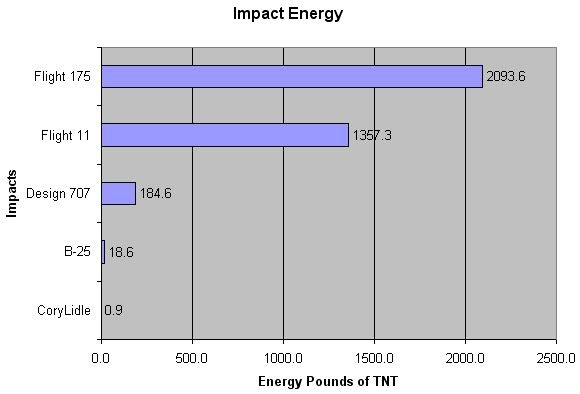
ETA - from one of beachnut's posts, here is the difference in force applied to the 2 towers.

Design - 187 pounds of TNT (Boeing 707 at 180 mph)
Flt 11 - 1300 pounds of TNT
Flt175 - 2093 pounds of TNT

impactenergywtc.jpg

...and we are way off topic vis a vis "building 7" now.
 
Last edited:
Oh now I see it. This engineer, must have based his conclusion on the vast case history of fires bringing down steel frame skyscrapers. Makes perfect sense now. Thanks for the clarification.

Where in my post did I say that? Are you reading different words than what appear on the screen?
 
I was saying everyone was shocked to see the towers come down.

Bzzzzzzzzzzzzzzzzzzzzzzzt! WRONG!

A friend of mine and I both thought they would collapse......adding us to a long list of people who thought the same.

Do you have any other false assertions we can help you with (I know you do ;))?
 
Well I don't know Spanish, but I'll take your word for it. In the above post I gave clear examples of structural engineers that by definition were surprised the towers came down. No, no where in this thread was it "shown otherwise"
Not the wisest examples to use. The engineers who designed the towers had an emotional involvement that could affect their capacity of assessing the situation. I'm more interested in what independent parties said. I've provided three examples of architects expecting it. In one of the examples, four of them note explicitly that they knew the structure of the towers, and all four believed they would fall.

Google Translate did a fairly good job on the quotes, by the way, in case you're interested in the contents:

http://translate.google.com/transla.../forums/showpost.php?p=8325132&postcount=2249

("ojímetro" is slang meaning eyeballing, literally "eye-meter")
 
tmd2_1 and TZ are engaging in a combination of Call To Perfection Fallacy, Equivocation Fallacy and Arguments from Incredulity.

When confronted with the fact that FDNY expected 7 to collapse, partly due to an unidentified engineer's assessment, they invoke the Call To Perfection fallacy, demanding that it would be impossible to make this prediction without understanding EXACTLY how it was going to collapse.

When confronted with an EXACT explanation of the collapse they immediately deflect it by claiming variously (insert your argument from incredulity here) that the freefall somehow invalidates the explanation - actually that is just a simple lie, but it's disguised as an incredulous statement. You see, the equivocation is that somehow Freefall = CD, but that is actually not a scientific fact; Truthers have simply come to believe this by conflating freefall with CD.

The gist of all this is that they handwave everything away, whether it's an off-the-cuff estimate on the day or a multiyear investigation. None of it, they claim, is valid - except of course their claims.

In my experience this form of argumentation is not different from that of no-planers or steel-to-foam/dust theorists. It relies heavily on refusing to accept any evidence or analysis which contradicts the conspiracists claim.
 
Not the wisest examples to use. The engineers who designed the towers had an emotional involvement that could affect their capacity of assessing the situation.
That's the impression I got watching deMartini say "several" plane impacts could be withstood as they would just be pinpricks of the mesh design of the WTC (in the first video tmd linked).


("ojímetro" is slang meaning eyeballing, literally "eye-meter")
Sweet. I hadn't heard this before - like it.
 
Status
Not open for further replies.

Back
Top Bottom