• Security incident: ISF was recently accessed by intruders. Please change your password, and change it anywhere else you used it. Read more

Richard Gage Blueprint for Truth Rebuttals on YouTube by Chris Mohr

Status
Not open for further replies.
The "computer software" is likely to be a simple linear fit in excel. Excel certainly chooses the same fit using digitised data from the NIST velocity graph.

Yeah, that was funny. I like to think that NIST used something a bit more supple than Excel -- but for that particular task, they didn't even need software, really. Fitting an OLS line to ten points is easy enough to do with a cheap calculator.
 
Really Mark? I mean we all know they have unlimited funds and therefore have a magical form of thermite (+2 stealth). But should we really assume that they have software and materials better than a high school science teacher? That's quite a stretch, don't you think?
 
Giving yourself backpedal room, I see.

Yes I can. No version of the conspiracy is possible with only a few people, or even a few dozen.

I do no know which is sadder.......Kevin Ryan's less than simplistic concepts of how things work in a modern high rise in NYC, or the fact that C& actually believes it.

And troofers wonder why Ryan got sacked by UL? :eek:
 
I do no know which is sadder.......Kevin Ryan's less than simplistic concepts of how things work in a modern high rise in NYC, or the fact that C& actually believes it.

And troofers wonder why Ryan got sacked by UL? :eek:

The world is apparantly full of the competence challenged, and the worst subset of these place an unwarranted excessive faith in their own competence and that of those whose ideas they agree with. The death spiral of the Truth movement gives me faith that the majority has rejected the Truther house of cards in favor of an acceptance of the common narrative.
 
Really Mark? I mean we all know they have unlimited funds and therefore have a magical form of thermite (+2 stealth). But should we really assume that they have software and materials better than a high school science teacher? That's quite a stretch, don't you think?

LOL.

But, seriously, the point is that it doesn't take any kind of expertise or resources to use OLS regression. When experts use it, that's more or less the point: it's a deliberate choice to Keep It Simple, Stupid. When non-experts use it, it's often because they don't know any other way. It's really very odd for someone to comment on how NIST and Chandler used computer software!! to fit a line through those points.
 
Moiré technique for dummies

Here's an explanation on how NIST got horizontal sub-pixel resolution out of the WTC7 video. That should help understand how they derived their sub-pixel data and why it can't be applied in the other direction.

I know this forum likes animated GIFs so I'll use that...

:boxedin:

(Sorry about the gifs, I couldn't find a better way to explain it)

Let's say we have a dark band almost vertical, but with a certain angle, that may move left and right.

moire-bar.gif


But that movement may be subtle when looked from the distance. This is how it might look at a distance, as captured from a camera, cropped to our region of interest:

moire-small.gif


Barely noticeable movement, isn't it? Well, that's exactly the problem. We can't really appreciate the movement clearly, and the displacement from that perspective is less than one pixel in both directions.

Now let's zoom into what the camera caught:

moire-pix.gif


Yes, it really is the same, just zoomed 24x. Notice that seemingly up-down movement? That is precisely the moiré effect exploited by NIST.

In order to quantify that up-down movement, observe that the 3rd column is basically black, and the 2nd and 4th columns have gradients. The one in the 2nd column goes from dark to light, and vice versa for the 4th column.

Note also that each of the pixels on the 2nd column is either darker than the corresponding one from the 4th column in the same row, or lighter.

And note also that there's a row where they cross: in one row the one in the left is darker than the one in the right, and in the next row it's the opposite.

That's the characteristic that NIST exploited to measure the vertical movement of the moiré pattern.

In the following image that crossing row is marked with a triangle, and the center of the original bar is marked with a cross:

moire-annotated.gif


It can clearly be seen how the vertical position of the arrow is related to an horizontal position of the center. Therefore, determining that vertical position will give us information about the horizontal movement. Note also how the horizontal movement all happens within one pixel. That means that the vertical location of the crossing point is giving us sub-pixel information about the horizontal one.

Now, that amplification is bigger the straighter up the line is, as long as it is not perfectly vertical. The technique depends on finding a spot where such a pattern can be found, and that is at only a slight angle with respect to the horizontal or vertical pixels.

The technique has a bunch of assumptions: that the camera CCD is more or less linear if the colors of both sides are not equal, that the façade doesn't flex, and that the variation of angle is insignificant.

How was that applied to WTC7?

Figures C-4 and C-5 of the NIST report are pretty much self-explanatory but just in case let me add an explanation:

moire-nist-ncstar1-9-c4.jpg


That's a frame from the video with a grid and pixel column numbers added. In my example the pixel columns were numbered from 0 to 4.

moire-nist-ncstar1-9-c5.jpg


That's a zoom-in from figure C-4 showing their choice of pixel columns, which were 517-519, with vertical arrows pointing to pixel column 518 and horizontal arrows pointing to the vertical position where the intensity of the pixel at column 517 crossed with the intensity of the pixel at column 519.

Note also how the angle with the vertical was much smaller than the one I've used for explanatory purposes. That means much bigger amplification of the horizontal movement.

It should be clear from the above explanation that NIST found no such horizontal reference line with the same characteristics and the right inclination to amplify the movement in a way that let them apply the same trick.

Yet femr2's tracking program was able to reproduce these results and applies equally to the horizontal and vertical direction.



Therefore, the common claim made by those opposing any further questioning of 9/11 -- that any conspiracy involving insiders would have had to be too vast and could not be kept secret -- is not supported by the facts.

In this second essay, we'll review the security organizations and contractors that had access to the Twin Towers. Due to the complete rebuilding of the security systems at the WTC complex after the 1993 bombing, it is clear that a plan could have been developed at that time to allow access to those who might desire to bring the towers down. The few primary security companies involved could have enabled such access by installing loopholes or providing access keys to anyone, including demolition contractors. Other WTC contractors, particularly those hired to complete certain electrical or construction related upgrades, could have been involved in the installation of demolition devices or related infrastructure. The primary security companies might have also controlled access to certain areas in order to prevent others from discovering what was going on. Additionally, other authoritative groups (e.g. Silverstein Properties and local government offices) could have facilitated the plan.


No vast conspiracy here just security companies, demolition contractors, electrical contractors, and all of their help who could have, might have done something.
 
Yep. Except this conspiracy would require both a large number of people from inside and outside the CIA. You can't rig three buildings with explosives/thermite/both by
sitting in a Langley Hooters after work with your coworkers. It will require non-Agency cooperation. Civilian experts. Paying off the FBI, NIST, and so on, and so forth. They would have to come up with this unprecedented thermite-based demo method, hire experts, and build something close to a scale model to test it. They have to hire contractors to replicate a good portion of a 47-story building, much less the Twin Towers. Several times, just to make sure they got it perfect. We are already talking tens if not hundreds of millions of dollars, not including developing the charges in the first place.

Which is more amazing: That the Vast Conspiracy managed to organize itself without anyone dissenting or spilling the beans, or that the Vast Conspiracy pulled off the biggest demolition job in history, undetected, with untested methods?

Thermite had never been used since, as a stunt, it was used to bring down two columns of the skyride of the 1937 Chicago Exposition. (It must have been a dazzling light show.)

Did they practice doing a "switcheroo" between the airliners and their remote-controlled lookalikes? Did they ever test the lookalikes to see if they would even work? And where did they do the testing? How many people were involved in designing, building, and testing of these craft? Where was it done? Seems like Wikileaks would have a field day with that one!
 
Which is more amazing: That the Vast Conspiracy managed to organize itself without anyone dissenting or spilling the beans, or that the Vast Conspiracy pulled off the biggest demolition job in history, undetected, with untested methods?

Thermite had never been used since, as a stunt, it was used to bring down two columns of the skyride of the 1937 Chicago Exposition. (It must have been a dazzling light show.)

Did they practice doing a "switcheroo" between the airliners and their remote-controlled lookalikes? Did they ever test the lookalikes to see if they would even work? And where did they do the testing? How many people were involved in designing, building, and testing of these craft? Where was it done? Seems like Wikileaks would have a field day with that one!

45 seconds to demolish 3 huge skyscrapers is more than amazing, it's arazing.
 
45 seconds to demolish 3 huge skyscrapers is more than amazing, it's arazing.

That was actually a clever pun. Well done.

Of course, the greater point you're trying to make is still wrong; the buildings were "demolished" over a course of about nine hours, all told, by plane impacts, building collapse debris, and fire.
 
Last edited:
Hello? :boggled:
Smoke is covering 25 floors at the NE corner in the camera 4 still. [before the west penthouse collapsed] and cameras 8 and 9 show the smoke was coming from near the west end.

I provided evidence to show that the bottom floors of WTC 7 were obscured by smoke that would have covered flashes from thermite devices.

The bit about "the coverup depended on whether there was a camera recording at the precise moment the building fell." came out of your head.
This is unbelievable. Smoke lightly "covers" 25 floors of the NE corner, but for starters, in your post 4834 your pictures of that smoke show that the center of the perimeter is completely visible down to around the 11th floor! Second of all, that smoke is not thick enough to completely cover blinding light. Third, your claim is like saying sunlight can't penetrate through clouds. Fourth, thermite burns for 45 seconds so even if that one corner could be obscured for the first moments of the collapse, the debris pile would still burn blindingly bright for another half minute or so. Fifth, the Camera 3 video NIST used for their measurements clearly shows the entire East Penthouse collapsing with windows breaking out as it comes down. I see NO evidence of thermitic material higher up in the building blazing through the broken windows as the East Penthouse collapses. The smoke in the NE corner may well be related to the massive internal collapse that had just taken place on that side, or maybe it was coincidence, I don't know. Sixth, Dave Thomas's comment that this is "performance art" sums up my initial response to this claim. Seventh, I feel like an idiot wasting my time with any response to this at all!
 
Here's an explanation on how NIST got horizontal sub-pixel resolution out of the WTC7 video.
A good explanation, that should help many here. Thanks.

I wrote a similar tutorial some time ago, but can I find it ?! :)

Duty bound to add a few missed points, and a few additional issues with the method...

(Sorry about the gifs, I couldn't find a better way to explain it)
A picture can be worth many a word, especially with this kind of topic.

Note also that each of the pixels on the 2nd column is either darker than the corresponding one from the 4th column in the same row, or lighter.
The optimal situation is where the brightness of both are equal.

NIST converted the video to greyscale (black and white) and so were working with intensity only. As that uses an 8bit colour index, the theroretical maximum number of sub-pixel divisions is 256 (0 to 255) or ~0.004 pixels.

It can clearly be seen how the vertical position of the arrow is related to an horizontal position of the center.
The horizontal position is calibrated by measuring how many vertical pixels are present before the same intensity recurs in the next adjacent pixel...

875158827.png


In your example there are 11 vertical pixels between (near) equivalent intensity, therefore 1 horizontal pixel equates to 11 vertical pixels.

The effective sub-pixel resolution is therefore 1/11 pixels (~0.09 pixels).

Now, that amplification is bigger the straighter up the line is, as long as it is not perfectly vertical.
Indeed...more vertical pixels until the same intensity recurs.

The NIST example had 100 vertical pixels to one horizontal pixel, giving a 0.01 pixel horizontal resolution.

The technique has a bunch of assumptions: that the camera CCD is more or less linear if the colors of both sides are not equal, that the façade doesn't flex, and that the variation of angle is insignificant.
Indeed. Some further factors...

As the technique uses only pixel intensity, and not region based pattern matching (such as I use) then it is very sensitive to:

a) Lighting changes.
b) Smoke, as this affects localised pixel intensity.
c) Viewpoint perspective, as the *response* is not linear if the building is not perfectly vertical wrt to viewpoint.
d) Camera motion.

femr2's tracking program was able to reproduce these results and applies equally to the horizontal and vertical direction.
Indeed, and in addition many of the highlighted issues mentioned by both yourself and I do not affect results.

Specifically static point extraction (removal of camera motion), insensitivity to smoke, CCD and lighting changes, linear response (although perspective still skews results).

The end result being my methods achieve similar fidelity (better than 1/100 pixel absolute) with the data being unaffected by numerous noise sources such as smoke, and barely affected by camera motion.

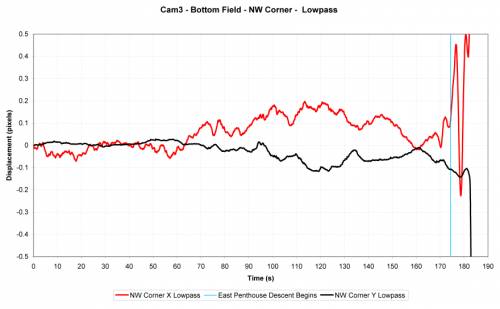
For the longer timespan traces such as that in C-9...
930069773.png

...the NIST data is affected by slight camera motion, with the equivalent being...
666377698.jpg


Although they have different timespans, careful inspection reveals that much of the NIST data is not "real" motion, but small variation in camera position.
 
Femr2: "A good explanation, that should help many here. Thanks.

I wrote a similar tutorial some time ago, but can I find it ?! "


I hope so, and if you could please provide a similar small tutorial on subpixel tracing for those who take an interest in your measuring techniques, that would be wonderful.

You already did this, so if you could please provide links to the explanations, that would be peaches.
 
NIST converted the video to greyscale (black and white) and so were working with intensity only. As that uses an 8bit colour index, the theroretical maximum number of sub-pixel divisions is 256 (0 to 255) or ~0.004 pixels.
Hmm, that's a subtle point. I believe that that doesn't impose a limit to the method, at least if it's somewhat expanded to do some averaging. The practical limit is the height in pixels of the façade.

I can see the possibility of achieving, for example, resolutions of 1/300 px even with 256 tones per pixel. The crossing point doesn't depend on the number of tones, though it can span over several rows, so you can take the height as the average between the highest and the lowest points where the pixel intensities are equal at both sides.


Specifically static point extraction (removal of camera motion), insensitivity to smoke, CCD and lighting changes, linear response (although perspective still skews results).
Lens distortion too. But I don't expect that to alter the data significantly.


The end result being my methods achieve similar fidelity (better than 1/100 pixel absolute) with the data being unaffected by numerous noise sources such as smoke, and barely affected by camera motion.
The difficulty in error estimation is another of its pitfalls, as you know. You can just say it "probably" achieves that fidelity.


Although they have different timespans, careful inspection reveals that much of the NIST data is not "real" motion, but small variation in camera position.
Interesting.
 
Status
Not open for further replies.

ISF - Join now!

Every member here is approved by hand. No bots, no spam, just people who care about evidence and honest debate.

Membership is free!

Create your free account

Back
Top Bottom