• Security incident: ISF was recently accessed by intruders. Please change your password, and change it anywhere else you used it. Read more

Forum Birdwatching 2012

Never had heard of a Pileated Woodpecker, but after looking at the pictures I suspect you are right. They seem to range in my area and are much more common.

Thanx for the info!!

Ivory billed woodpeckers aren't just uncommon, they're likely extinct. There have been a few well publicized instances in the last 6 years or so of potential observations, but it's far from certain that they were actually ivory billed. Prior to that it had been something like 70 years since they had been reliably observed in the US.

Honestly though, if you saw a crow sized woodpecker in the US, it was a pileated.
 
Pity we didn't have a thread last year after all... I was traveling quite a bit, and for once managed to get my camera out every once in a while. Here's some nice pictures from Sweden:

Thanks. Those are spectacular photos.

I have no idea what the last one is, but will be watching to find out.
 
#$(*&@ shorebirds, how the (*@$&^! am I supposed to figure out which &^@#%$*&^ species is-

ahem.

Bolsa Chica Ecological Reserve, Huntington Beach, CA
26 April 2012, late afternoon/early evening.


Allen's Hummingbird - Selasphorus sasin
American Avocet - Recurvirostra americana
American Coot - Fullica americana
Anna's Hummingbird - Calypte anna
Blue-Winged Teal - Anas discors - My first! (I think)
Brown Pelican - Pelecanus occidentalis
California Towhee - Pipilo Crissalis
Common Merganser - Mergus merganser - My first! (I think)
European Starling - Sturnus vulgaris
Forster's Tern - Sterna Forsteri
Great Blue Heron - Ardea herodias
House Finch - Carpodacus mexicanus
House Wren - Troglodytes aedon - My first AFAIK, but it's a pretty drab little bird so maybe I've simply overlooked them in the past. Great song, though.
Large-billed savannah sparrow - Passerculus sandwichensis rostratus
Long-Billed Dowitcher - Limnodromus scolapaceus
Marbled Godwit - Limosa fedoa
Mourning Dove - Zenaida Macroura
Northern Shoveler - Anas clypeata
Pied-billed grebe - Podilymbus podiceps
Red Knot - Calidris canutus (I think I've misidentified these in the past)
Ruddy Duck - Oxyura jamaicensis
Semipalmated Sandpiper - Calidris pusilla
Short-Billed Dowitcher - Limnodrums griseus
Snowy Egret - Egretta thula
Whimbrel - Numenius phaeopus
Willet - Catoptrophorus semipalmatus

I didn't even try to identify the gulls. There were a lot of gulls.

Some pictures:

Allen's Hummingbird (on Flickr)


Forster's Tern, Heroic Portrait (on Flickr)


Got it! (on Flickr)


Not the most graceful birds . . . (on Flickr)

ETA: I've got to start being realistic about the time involved in these little expeditions. I was there for about 2 hours, and my total travel time was maybe 1/2 hour because I had to be down in that area anyway.

But going through the 176 pictures . . . was another 5 hours.

 
Last edited:
Great photos though.

Thanks. I just need to work on my discipline in going through the photo sets as they come in. At last count, I had a backlog of 74 sets in various stages of review. Most of them are not birds, and most of the sets are smaller than this one, and I've done at least some work on every set. But it's still kinda depressing to open that folder. And I'll be taking 2 more sets tomorrow: a radio-control aircraft meet, where I'll be flying and photographing, and then a trip to the small lake across the street from the flying field for wildlife shots.

<sigh> I like taking pictures, I like having good pictures, and working my way through the sets isn't unpleasant, but . . . sheesh.

Oh, Allen and Forster want their birds back.

Hey, Allen's hummingbird is right where he left it. I'm not driving all the way back down to HB just because he forgot to get his bird back. As for Forster, well, he can have his bird back when I get my sawzall back. "I just need to borrow it for a couple hours, man." Shyeah, right, that was in February!
 
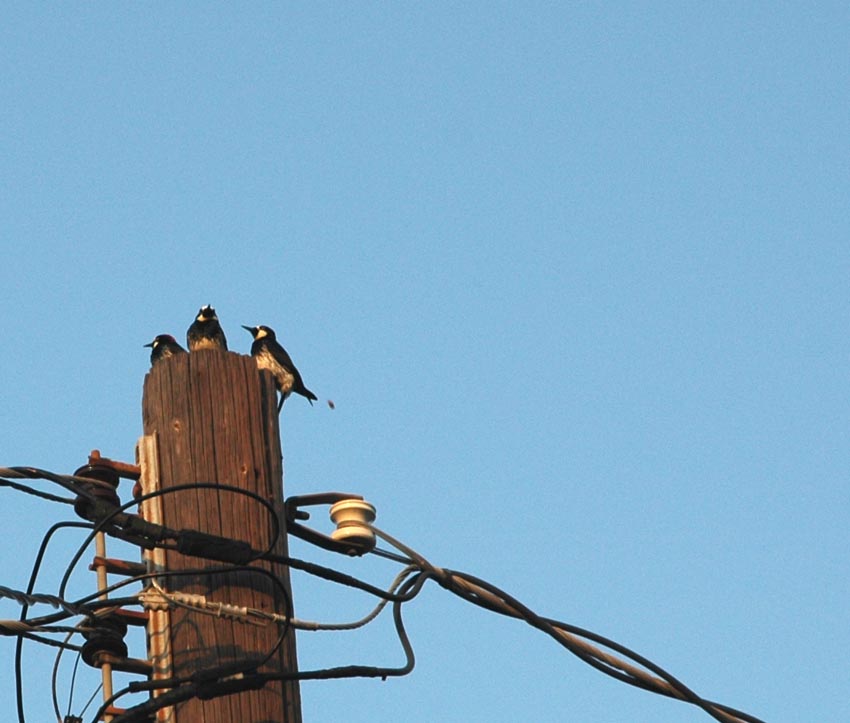
I've been hearing a woodpecker drumming on the pole at the corner of my lot every day for several weeks now. It starts before I wake up (it's usually why I wake up) and continues for a while. Today the bird was out in the afternoon. It turns out it's not one, but three!

Nuttle's woodpeckers from the look of them. Must be a family.

woodpeckers.jpg


The small blur by the right one's tail is something it had been working on. After picking it up, putting it down and pecking at it, he finally picked it up and tossed it aside.
 
Had a nice day out yesterday, with species as:
Greenshanks Tringa nebularia
Long-tailed Duck Clangula hyemalis
Lesser Whitethroat Sylvia curruca
Parasitic Skua Stercorarius parasiticus
Gadwall Anas strepera
Common Sandpiper Actitis hypoleuca

While heading back to the boat, we heard an unusual song, and were speculating on whether or not this was a Nightingale Luscinia megarhynchos when the phone rang, and another birdwatcher who was on the next island told us he had heard one about an hour before we heard ours, so we went to that island and could not only hear the Nightingale he had found, but also most likely dismiss ours as something else (still unidentified). We heard ours only for about 30 seconds.

Still, I haven't heard a Nightingale in Sweden for almost ten years, and there's still less than a hundred records here, so that was a nice start of spring.
 
Nuttle's woodpeckers from the look of them. Must be a family.

Acorn Woodpeckers, actually. They're common in the western US and famously live as "families" of cooperatively breeding individuals. In other words, some adult birds willingly forgo breeding in a given year and invest their parental effort in the offspring of another pair of birds. Usually the "helpers" are offspring of that pair from previous years, and by investing a few years in helping, they gain experience as parents themselves, stand to inherit the territory after their parents are dead, and all the while increase their inclusive fitness by helping with the development of their siblings.

Somewhere in your neighborhood is a big tree with the trunk pock-marked with hundreds of holes in which these woodpeckers have cached acorns.

(Nuttall's is a little black and white woodpecker in CA with a "zebra-striped" back.)
 
Wow! Amazing pictures! I didn't have my equipment with me yesterday aside from my binoculars, but for the first time in too long the wife and I went for a simple birdwatching stroll, at Daniel Webster Wildlife Sanctuary in Marshfield, MA - very windy so not much going on.

Young Bluejay sitting on the rafters of the entrance building welcoming visitors.
Red Winged Blackbirds
Tree Swallow
Barn Swallow (My wife's favorite, so there's that)
Canada Geese (All of them, I think)
Osprey
Northern Harrier
Yellow Warbler
Chipping Sparrow
White Throated Sparrow
Crows
Killdeer
Hairy Woodpecker
Eastern Bluebird

All in all a very slow day. Was going to go to a migrant trap called "Ferry Hill Thicket" but it was too late in the day. For any Southeastern Massachusetts birdwatchers, it's an extremely small area.

ferryhill.jpg


From Ferry Hill Road on the left to Peabody on the right, it's max 200 yards. But at the best I've seen it, I've seen 12-15 different species of warbler. Canada, Magnoilia, Blackburnian, Black Throated Blues, Black Throated Greens, etc. Amazing place if you get there on a nice spring morning.
 
Last edited:
Summer has arrived!

Yes.

This is my annual "Swifts have arrived in the UK" post.

Spotted the first one of the year in west London yesterday.
Weather has been so awful that I am yet to see them over our home in east London.
 
I end with a quiz. What is this:

[qimg]http://i721.photobucket.com/albums/ww219/Kotatsu_no_Leo/D1263642.jpg[/qimg]

It's from one of the countries above.

I'd go for a puffback shrike - not sure which one.
 
We did!
(we just didn't tell you about it)
:whistling

As a revenge, I will twitch something you really want to see in a few weeks when I go off on a birdwatching expedition to the Baltic Sea.

Thanks. Those are spectacular photos.

I have no idea what the last one is, but will be watching to find out.

Thank you! The identity of the bird will be revealed below.

#$(*&@ shorebirds, how the (*@$&^! am I supposed to figure out which &^@#%$*&^ species is-

This is a nice book, even though many birds look very stout and short-billed. In general, it's quite useful, though.

Had the first mocking bird babies of the year in the yard, early it seems. Begging in trees.

There's been several reports of very early duck chicks here in Sweden, with a Mallard being see walking around with her chick on the frozen surface of the city moat sometime in February.

This is my annual "Swifts have arrived in the UK" post.

That's it, I will stop wearing this knitted hat when I go outdoors now.

I'd go for a puffback shrike - not sure which one.

Correct! It is a Black-backed Puffback Dryoscopus cubla! Caught, banded, de-loused, and photographed at Udzungwa National Park, Tanzania. Well done!
 
I tried taking a walk with my daughter today and bird watching, but was thwarted. Even though it's the beginning of the warbler migration through my area, I didn't get to see much. A 4 year old is not an asset when one wants to be quiet and walk slowly, but that was nothing compared to the news helicopters.

My favorite walk/watching path goes right underneath the bridge that some idiots were arrested for trying to blow up. Apparently a lightly traveled bridge that was not damaged in any way and is no longer surrounded by police is worth filming to them, so there were news helicopters circling for at least an hour. It made it very difficult to hear anything and also scared the snot out of the nesting pair of bald eagles. The FOX helicopter in particular was bad about this, it hovered right over their nest for several minutes and scared one of the adults off of the nest entirely, and the other was freaking out. The irony of the self-proclaimed uber-patriotic FOX types harassing the national bird did not escape me.

In any case, I was able to see a few warblers, and my daughter and I got a really good look at a blue-gray gnatcatcher lining its nest.

Aside from the usual suspects we saw:
Bald eagle - Haliaeetus leucocephalus
Blue-gray gnatcatcher - Polioptila caerulea
Palm warbler - Dendroica palmarum
Prothonotary warbler - Protonotaria citrea
 
Well, the wife went to Foxwoods very early this morning, so I took the opportunity to go to that Ferry Hill Thicket I mentioned up above. Good thing, too. It was warbler city there, best I've ever seen!

Black-Troated Blue Warbler
Black-Throated Green Warbler
Magnolia Warbler
Common Yellowthroat
Canada Warbler
Kentucky Warbler
Northern Parula
Yellow Rumped Warbler
Yellow Warbler
Black and White Warbler
American Redstart!! (First time I've seen that one)
Another lifer for me, this one was kinda lame but I've just never seen one for some reason:
Indigo Bunting

Two lifers in one morning. Not too shabby!

This is the best image of any of them I could manage. It's the Northern Parula. How people manage to get such great photos of warblers like the above links is beyond me. They're too fast, too high up in the trees, to nestled inside a bush to get a look long enough to take a photo.

parula.jpg


Anyway, the others:
Grey Catbird
Northern Waterthrush
Northern Cardinal
Comorant (Flyby)
Snowy Egret (Flyby)
Cooper's Hawk
Grey Squirrel (inside the aforementioned hawk's talons)

And I think that's about it. What a great day! -- Well, morning. Now that I'm home and it's the first day since about 2 weeks of crappy weather, well - the lawn's about 6" high. Time to go to work.
 
Went with a few friends to Öland, an island in the Baltic Sea, to do some birdwatching during the weekend. Haven't collected my notes and stuff yet, but some observations:

- "Pale-bellied" Brent Goose Branta bernicla hrota, one among about 2000 of nominate subspecies;
- Citrine Wagtail Motacilla citreola, an adult, beautiful male;
- Broad-billed sandpiper Limicola falcinellus;
- Pomarine Skua Stercorarius pomarinus;
- Black kite Milvus migrans and Red Kite Milvus milvus;
- Red-breasted Flycatcher Ficedula parva, Pied Flycatcher Ficedula hypoleuca and Collared Flycatcher Ficedula albicollis;

We also had at least 12 species of mammal, including Beaver Castor fiber, Pine Marten Martes martes, Grey Seal Halichoerus grypus and Water Vole Arvicola terrestris. Added to this, lots of orchids, butterflies, beetles, and other stuff.
 
Went down to Abalone Cove, which is on the southern coast of the Palos Verdes Peninsula, which is part of the LA Metro area.

Not a lot of birds out, and while I got some pictures, none of the bird pictures were noteworthy (or postworthy).

The birds were:
American Crow, Corvus brachyrhynchos
Lesser Goldfinch, Carduelis psaltria
Heermann's Gull (probably), Larus heermanni
Snowy Egret, Egretta thula
California Towhee (probably), Pipilo crissalis
Western Gull, Larus occidentalis
Marbled Godwit, Limosa fedoa
Whimbrel, Numenius phaeopus
Brown Pelican, Pelicanus occidentalis
 

ISF - Join now!

Every member here is approved by hand. No bots, no spam, just people who care about evidence and honest debate.

Membership is free!

Create your free account

Back
Top Bottom