• Quick note - the problem with Youtube videos not embedding on the forum appears to have been fixed, thanks to ZiprHead. If you do still see problems let me know.

WTC7 and the girder walk-off between column 79 and 44

Status
Not open for further replies.
is it? what makes it so?

I'm waiting for the explanation of its derivation, then perhaps a technical rebuttal before I make my own, non-engineer's judgement
It was derived using the formulas given.

* * * * *

tfk, A professional engineer would know the formulas needed or know where to look for them.

Do your own analysis if you really are an engineer.

How much would a 53' 4'' beam sag at 600oC, and 700oC ?

At what point would loss to sag exceed elongation?

PUOSU
 
Hey Chris,

All right, Chris.
This is now YOUR assertion.

Copy & paste - from your post - the equation that he used to generate his deflection values.

Or be proven incompetent to understand even this 5th grade requirement.


How long does it take an "engineering messenger" to copy & paste one measly equation???
 
Dr. Bazant, the man who uses freefall through the first story to gain nearly three times the velocity input to the kinetic energy, 58 x 10e6 kg instead of the actual 33 x 10e6 kg mass of the North Tower upper section, and about 60% of the actual column resistance to come up with a kinetic energy to resistance ratio that is overstated by about 8.5 times?

Is that the Dr. Bazant you are taking about? If so,

:dl:

Which has NOTHING to do with my comment. Oh, and did you write a discussion on Dr. Bazant's paper showing the errors?

My guess is no......
 
Not when the steel is already hotter than the gases. All the windows on the north side of floor 12 were broken right up to where the fire was [between columns 52 and 53]. Cool air was mixing with the hot gasses that were blown thru the building and out the south side. This was an hour and a half before the collapse.

[qimg]http://img691.imageshack.us/img691/4135/firesimcompare97.jpg[/qimg]

This is quite possibly the most retarded thing I have ever seen. And it's not the first time you've posted this load of ass discharge.

You really think that A: the steel that was heated somehow became HOTTER than the actual fire/air in the building? How the **** does that work?

Show me the math. I would LOVE to see the mental gymnastics that you go through to explain this. It will make for a great laugh for my students too.

Secondly, you actually think that because windows are broken, that it is going to cool off the air temperature in the building? Holy **** man. You REALLY 'aught to stick to framing in windows and trimming out baseboards.....
 
Chris,

It was derived using the formulas given.

:dl: :dl: :dl:

Yeah, sure Chris.

Now we BOTH know that you don't have a clue where that value comes from.

But we've BOTH known that for quite some time now, haven't we? (Or is this really news to you??)

The more, uh, significant (perhaps "insignificant", in this case) fact is that now EVERYONE knows that you haven't the slightest clue where Tony's values for deflection come from.
___

BTW, no, Chris, it did NOT come from the formulae given. It can NOT possibly be derived from the formulae given.

That was exactly my point.
That you've failed to comprehend.
That you've failed to comprehend because you're incompetent at math, amongst myriad other subjects.

A point that, amusingly, you've possibly not understood until right now.

1 equation, Chris, 2 unknowns.

Do you even know what that phrase means?

tfk, A professional engineer would know the formulas needed or know where to look for them.

I don't have to look for the formula, Chris.
I know the formula.

Or I should say that I know the formula that I VERY STRONGLY suspect that Tony used. That is exactly why I asked him to provide that information. So that I could confirm my suspicion.

Tony very strongly suspects that I know which formula he used, too. And that is the most likely reason that he is not replying to my request.

(You see, this is "engineer's stuff", and we've already well established that this is over your head.)

If I am right, the formula is called the "deflection of simply supported beams with distributed loads equation".

I know this formula because I personally generated a similar one for the division of Teledyne that I worked for. But our design was sufficiently different from anything in the books ("Roarke's Equations for Stress & Strain"), that I couldn't simply look it up. I had to do the calculus to derive it.

Teledyne used that formula to successfully design & build connectors for the electronics industry for about 5 years, until the company eventually bought an FEA program.

(Did you catch that word "successfully"?)

One of the reasons that it took so long to justify the expenditure for the FEA program was … you guessed it … "Do we really need it? Tom's equations work really well."

Knowing that equation, I also know its limitations. I strongly suspect that Tony used that very same equation and simply substituted the values of E at temperature.

This will give wrong answers for anything except small deflections.

Do your own analysis if you really are an engineer.

Been there.
Done that.
Got the company stock to prove it.

;-)

PS. You seem to forget that we've already well established that you aren't competent to participate in these discussions.
 
Last edited:
Tony,

Dr. Bazant, the man who uses freefall through the first story to gain nearly three times the velocity input to the kinetic energy, 58 x 10e6 kg instead of the actual 33 x 10e6 kg mass of the North Tower upper section, and about 60% of the actual column resistance to come up with a kinetic energy to resistance ratio that is overstated by about 8.5 times?

Is that the Dr. Bazant you are taking about? If so,

:dl:

Dr. Zdenek Bazant

Bazant's CV: http://www.civil.northwestern.edu/do...ant/resume.pdf
Bazant's list of publications: http://www.civil.northwestern.edu/do...t/publicat.pdf

Highlights:

Education
C.E., Czech Technical University, Prague, Civil Engineering (Structural Engineering) 1960
Ph.D. (in mechanics)., Czechoslovak Academy of Sciences, Prague 1963
Postgraduate diploma in Physics, Charles University, Prague 1966
Docent habil., Czech Technical University, Prague 1967
S.E. 1970, Illinois Registered Structural Engineer


Research
Prof. Bazant's interest spans mechanics of materials and structures, structural safety, response uncertainty, and engineering applications. The current investigations include some fundamental problems in the field of quasibrittle fracture and damage mechanics, fracture scaling and its asymptotics, size effects, probabilistic mechanics and extreme value statistics, ... constitutive models, progressive collapse of buildings, missile impact, seismic response, ... chemical reaction kinetics, ... , thermodynamics, poromechanics, ... His research team has been developing material models for fiber composites, concrete, rocks and soils, sea ice, snow, tough ceramics, sandwich shells, rigid foams, cellular materials, bone, and shape memory alloys. Applications have covered structural and aero-space engineering, building codes, ship design, automotive crashworthiness, arctic engineering, earthquake engineering and nuclear safety. Although the emphasis is theoretical, his team also conducts specialized fracture testing of composites, concretes and rocks. Computational modeling is a heavy component in each problem, but Bazant's attitude is to seek first analytical solutions and asymptotics-based approximations. The current and recent research sponsors include NSF, ONR, DoT, WES, ARO, DoE, AFOSR, Sandia N.L., Chrysler, Boeing, Cirrus Aircraft, and Argonne N.L.

Teaching Activities
Inelastic Analysis of Structures
Stability of Structures

Cohesive Fracture and Scaling


Honors and Awards
Elected to:
National Academy of Sciences;
National Academy of Engineering;
American Academy of Arts and Sciences;
Austrian Academy of Sciences;
Accademia Nazionale dei Lincei (Rome);
Spanish Royal Academy of Engrg.;
Engrg. Academy of Czech Rep.;
Academia di Scienze e Lettere (Milan);
European Academy of Sciences and Arts.

Six Honary Doctorates (Boulder, Prague, Karlsruhe, Milan, Lyon, Vienna).

Awards & Prizes
Prager Medal from Society of Engineering Sciences;
von Karman Medal;
Newmark Medal;
Lifetime Achievement Award;
Croes Medal;
Huber Prize and TY Lin Award from ASCE;
Honarary Member ASCE;
Nadai Medal and Warner Medal from ASME;
L'Hermite Medal from RILEM;
Exner Medal, Austria;
Humboldt Prize, Germany;
Torroja Medal, Spain;
Solin Medal, Prague;
Z. Bazant (Sr.) Medal, Prague;
Stodola Medal, Slovakia;
Roy Award, Am.Ceramic Soc.;
ICOSSAR Award;
Czech Soc. for Mech. Medal;
Outstanding Contribution Award, IACMAS;
Guggenheim, NATO, JSPS, Humboldt, Ford and Kajima Fellowships;
National Winner, 1958 Math.Olympics, Czechoslovakia;

Among top 100 Highly Cited Scientist in Engineering ( >9300 citations )

Former President of SES, IA-FRAMCOS (founder) and IA-CONCREEP (founder);
Former Editor, Journal of Engineering Mechanics, ASCE.


Selected Publications

Textbooks (Number: 6) including:
Bazant, Z.P., and Cedolin, L. (1991). Stability of Structures: Elastic, Inelastic, Fracture and Damage Theories, Oxford University Press, New York (textbook and reference volume); republished (with updates) by Dover Publications (No. 42568-1), New York 2003 (1011 pp. + xxiv pp.).

Jirasek, M., and Bazant, Z.P. (2002). Inelastic Analysis of Structures. J. Wiley & Sons, London and New York (textbook and reference volume, 735 + xviii pp.).

Bazant, Z.P. (2002). Scaling of Structural Strength. Hermes Penton Science (Kogan Page Science), London; 2nd updated ed., Elsevier, London 2005


Books Edited with Chapter Contributions (Number: 20) including:
Bazant, Z.P., Bittnar, Z., Jirasek, M., and Mazars, J., Editors (1994). Fracture and Damage in Quasibrittle Structures: Experiment, Theory and Computer Modeling

Bazant, Z.P., and Ra japakse, Y.D.S., Editors (1999). Fracture Scaling (Proc., ONR Workshop on Fracture Scaling, University of Maryland, College Park, June 10–12, 1999

Xi, Y., Bazant, Z.P., Pijaudier-Cabot, G., and Bittnar, Z., Guest Editors (2005). Model-Based Simulation of Durability of Materials and Structures, special issue of J. of Materials Engineering ASCE 17 (3), 239– 369 (with Editorial, pp. 239–240).

Bazant, Z.P., and Cedolin, L. (1991). "Stability of Structures: Elastic, Inelastic, Fracture and Damage Theories", Oxford University Press, New York (textbook and reference volume, 984 + xxiv pp.).

Bazant, Z.P. (2002). "Scaling of Structural Strength." Hermes Penton Science, London (French transl. with updates, Hermes, Paris, 2004).

Bazant, Z.P. (2004). "Scaling theory for quasibrittle structural failure." Proc., National Academy of Sciences 101 (37), 13397-13399 (inaugural article).

State-of-Art Articles and Research Review Articles (Number: 51)

Published Biographies and Volumes Dedicated to Bazant (Number: 12)

Research Articles in Conference Proceedings (Number: 208)

Public Policy Contributions (Number: 5)

Research Articles in Refereed Journals and Book Chapters (Number: 484), including:

Bazant, Z.P. (2001). “Why did the World Trade Center collapse?” SIAM News (Society for Industrial and Applied Mathematics) Vol. 34, No. 8

Bazant, Z.P., and Zhou, Y. (2001). “Why did the World Trade Center collapse?—Simple analysis.” Building Research Journal 49 (3), 135–146


Bazant, Z.P., and Zhou, Y. (2002). “Why did the World Trade Center collapse?—Simple analysis.” J. of Engrg. Mechanics ASCE 128 (No. 1), 2–6;

Bazant, Z.P., and Verdure, M. (2007). “Mechanics of progressive collapse: Learning from World Trade Center and building demolitions.” J. of Engrg. Mechanics ASCE 133 (3), 308–319.

Guo, Z., and Bazant, Z.P. (2006). “Size effect on buckling strength of eccentrically compressed column with fixed or propagating transverse crack.” Int. J. of Fracture 142, 151–162.

Bazant, Z.P., Le, J.-L., Greening, F.R., and Benson, D.B. (2008). “What did and did not cause collapse of World Trade Center twin towers in New York?”. J. of Engrg. Mechanics ASCE 134 (10) 892–906. (5), p. 54.

____

Tony Szamboti's resume:

BSME.

Highlights: AE911T engineering guru??
____

Talk about being down 35 - 0 in the bottom of the 9th, 2 out, nobody on, 0 & 2 pitch to Mr. Magoo at the plate…

What am I saying. That's all wrong.

The lights went out, the crowd went home about 2007.

Somebody please tell Tony that he was called out on the next pitch.
___

That's some raging case of Unprofessionalism you've got there, Tony.

You'd best never aspire to become a PE with that lack of professional ethics.
___

PS. Why don't you stop, no REALLY stop, and read thru that CV. That's the ABBREVIATED version!!

No, REALLY read thru it, not just the bold parts. Not skip over it because you don't want to know.

Then come back with your laughing dogs...

PPS. ... putz.

 
Last edited:
You really think that A: the steel that was heated somehow became HOTTER than the actual fire/air in the building?
Retarded is the interpretation of what I posted.

Show me the math.
Please :rolleyes: The breeze from the NW was blowing thru the building, mixing with and cooling the hot gasses from the fire. If you want to know exactly how much, do the math yourself.

Secondly, you actually think that because windows are broken, that it is going to cool off the air temperature in the building?
Yes, retarded is thinking a breeze blowing thru the building would not cool the air temperature down.
 
Retarded is the interpretation of what I posted.

Please :rolleyes: The breeze from the NW was blowing thru the building, mixing with and cooling the hot gasses from the fire. If you want to know exactly how much, do the math yourself.

Yes, retarded is thinking a breeze blowing thru the building would not cool the air temperature down.

It WOULD be retarded, if it wasn't for the fact that there are fires burning in the building that are HEATING THE INCOMING AIR.

Seriously, do you even stop to think, or would that cause you to trip over your mental shoelaces?
 
Now we BOTH know that you don't have a clue where that value comes from. But we've BOTH known that for quite some time now, haven't we?
Yes, so why are you wasting so much time and column space going on and on about it instead of addressing the point?

Do an analysis of the sag v expansion. Use whatever formulas you like. Beams really do sag. How much? PUOSU

Been there.
Done that.
Got the company stock to prove it.
Of course you do dear. And because you own stock in Teledyne, no one can predict the sag of a beam because you say so. :rolleyes:
 
Yes, so why are you wasting so much time and column space going on and on about it instead of addressing the point?

Do an analysis of the sag v expansion. Use whatever formulas you like. Beams really do sag. How much? PUOSU

Of course you do dear. And because you own stock in Teledyne, no one can predict the sag of a beam because you say so. :rolleyes:

Be hush, child.

Grownups talking now.

Tony, your assumptions, methods & equations, please.
 
The breeze from the NW was blowing thru the building, mixing with and cooling the hot gasses from the fire.

...


Yes, retarded is thinking a breeze blowing thru the building would not cool the air temperature down.

:jaw-dropp

I... I... I...

Boy Scout Firebuilding
The classic way to start a fire is to use several sheets of crumpled newspaper, pile on some twigs or kindling split to approximately 1/4" diameter, then use increasingly larger pieces of split wood stacked loosely in a crisscross or teepee-shaped fashion. A match lights the paper, which gets the smallest pieces going, which in turn get the larger pieces going. Soon you have a nice bed of hot coals, which allows you to add full, un-split pieces from the woodpile.

If you have a woodstove, build the pile close to where the air comes into the stove. More air will get into the stack and cause it to catch faster. Bellows can help direct air to your firestarting efforts in either a stove or fireplace.

http://www.northlineexpress.com/item/5PB-BELLOW/Power-Bellows

The Power Bellows makes starting a fire simple. Just point the gentle air stream to build your blaze quickly. It saves the bother of using wads of paper and other primitive methods to get your fire going. The Power Bellows is also safer to use. When you need to revive a dying fire, keep your hands and face away from hot surfaces and use the Power Bellows. The long metal-tipped tube directs the current of air to where you want it.


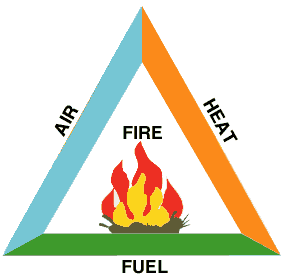
371590_fire_triangle.gif
 
Retarded is the interpretation of what I posted.

Please :rolleyes: The breeze from the NW was blowing thru the building, mixing with and cooling the hot gasses from the fire. If you want to know exactly how much, do the math yourself.

Yes, retarded is thinking a breeze blowing thru the building would not cool the air temperature down.

A breeze would increase the heat released; this is why you want to keep air away from fire. Fire bad, more air on fire, very bad. Air is fuel for the fire.
http://en.wikipedia.org/wiki/Fire_triangle
Are you using science or the religion of 911 truth to come up with this attack on NIST?

Why does Truth Phalanx uses a quote supporting religion? Is your version of 911 truth a religion, and truth is the light?
[QUOTE]“Truth is so obscure in these times, and falsehood so established, that, unless we love the truth, we cannot know it.” - Blaise Pascal.
[/QUOTE] Why does 911 truth use quotes like this? Is this a 1984 approach to science?

Maybe a vector in the right direction is needed.
... I am debating the gentleman who created the video, "Shear Ignorance" and this is going to be one of his (and others) points as to why NIST's explanation is incorrect and why the girder couldn't have walked off.

NIST states 600C, an 11" wide plate, and a lateral push of 5.5" to fit their explanation.

Any thoughts about this?
How would a breeze change NIST's explanation?

http://img571.imageshack.us/img571/6915/meridian6.png
Does this support NIST, or your undefined claims? What are your claims? What caused the collapse if not fire?
 
Retarded is the interpretation of what I posted.

Please :rolleyes: The breeze from the NW was blowing thru the building, mixing with and cooling the hot gasses from the fire. If you want to know exactly how much, do the math yourself.

Yes, retarded is thinking a breeze blowing thru the building would not cool the air temperature down.

Yup - what you posted is indeed retarded. Ever stood by a bonfire with a breeze feeding it and noticed how it burned hotter. Do you ever have a barbeque? Ever heard of the expression "fan the flames"?
 
It WOULD be retarded, if it wasn't for the fact that there are fires burning in the building that are HEATING THE INCOMING AIR.
Retarded is making that argument as if heating up lower Manhattan was a concern. The other side of that thermodynamic axiom - the incoming air is cooling the hot gasses from the fire, is what is of concern here.

Furthermore, the cool breeze would be flowing thru the area of the beams in question without mixing very much with the hot gasses from the fire.

ETA: The fire had burned out in the area in question about 3:45 p.m.

keygirderandbeamswairfl.png
 
Last edited:
Retarded is making that argument as if heating up lower Manhattan was a concern. The other side of that thermodynamic axiom - the incoming air is cooling the hot gasses from the fire, is what is of concern here.

Furthermore, the cool breeze would be flowing thru the area of the beams in question without mixing very much with the hot gasses from the fire.

[qimg]http://img706.imageshack.us/img706/2197/keygirderandbeamswairfl.png[/qimg]

Engage brain for a minute. So the breeze is increasing the supply of oxygen to the flames.

What happens in the real world when you increase the oxygen supply to a fire?

I'm basing this on my observations from when I was about 10 years old.
 
Retarded is the interpretation of what I posted.

So, please explain to me what I got wrong. Explain please.


Please :rolleyes: The breeze from the NW was blowing thru the building, mixing with and cooling the hot gasses from the fire. If you want to know exactly how much, do the math yourself.

Yes, retarded is thinking a breeze blowing thru the building would not cool the air temperature down.

Nope, it's your claim, back it up with the math.

I'll give you a few pointers.

1- You need to figure out the sq. ft of the broken windows, and calculate how much air will move through that per minute in cu. ft. To do this, you need to know how much of a breeze there was that day.

2-You'll then need to figure out the approximate fuel load and any variables in the area. For instance, walls and partitions.

3-You'll then need to calculate the amount of heat energy per kg. expressed in joules per hour.

Once you've figured out that, you need to account for any negative pressure you may have. Burning fires consume A LOT of oxygen, which will then have an effect on the amount of free oxygen left to do any kind of heat reduction.

Good luck. It should take you about half a year. Maybe we can compare notes? :dl:


Yeah right, who am I kidding. WE all know that you'll never do such a thing.

Oh, and don't forget that once the oxygen is consumed, the amount of heat energy increases. That is a key calculation.

Good luck
 
Retarded is making that argument as if heating up lower Manhattan was a concern. The other side of that thermodynamic axiom - the incoming air is cooling the hot gasses from the fire, is what is of concern here.

Furthermore, the cool breeze would be flowing thru the area of the beams in question without mixing very much with the hot gasses from the fire.
ETA: The fire had burned out in the area in question about 3:45 p.m.

[qimg]http://img706.imageshack.us/img706/2197/keygirderandbeamswairfl.png[/qimg]

Holy ****, just when I thought you couldn't POSSIBLY be more ignorant about fire science, you break through to a whole 'nother layer of ignorance.

Wow. Just.....wow......
 
It was derived using the formulas given.


tfk, A professional engineer would know the formulas needed or know where to look for them.

Do your own analysis if you really are an engineer.

Not only that, but an engineer doesn't need to appeal to authority, even going so far as to bold the title "Dr." Yikes. :D

As Tony has pointed out a few times, the opinions of anonymous internet posters claiming to be "engineers" are worth zero. It's a non-debate.
 
Last edited:
Status
Not open for further replies.

Back
Top Bottom