• Quick note - the problem with Youtube videos not embedding on the forum appears to have been fixed, thanks to ZiprHead. If you do still see problems let me know.

WTC7 and the girder walk-off between column 79 and 44

Status
Not open for further replies.
Well, enough of this nonsense.

Here's the answer to why you need only about 4.5" (actually, less than that will do) of westward push in beam B1 (below) in order for the girder to walk off both the seat & the support plate.

Tony, C7 & gerrycan have been made the patently false assumption that all of the relative motion between the girder & the seat is achieved by moving the girder to the west.

This is only 1/2 of the relative motion between the two parts.

Here is a drawing of the Northeast quadrant of WTC7 to get oriented.
Note: All single story images are the 13th floor for the Case B temperatures.

picture.php


A compass rose is at the center top for directions.
As noted, beams are labeled B#, Columns are labeled C# & Girders are labeled G#. (Where # is a number.)

Note well that all of the EW beams attach to (& push) girders, and none to C79.
Note well that girder G2 attaches to (& push) C79.

Now look at this diagram of the heating sequence on floor 13:

picture.php


It shows that the fires approached Col 79 from the south and on the east side of the Girders between Column 80 & Column 44.

Here is a drawing of the damage to the connectors & beams between 3.7 & 4.0 hours.

picture.php


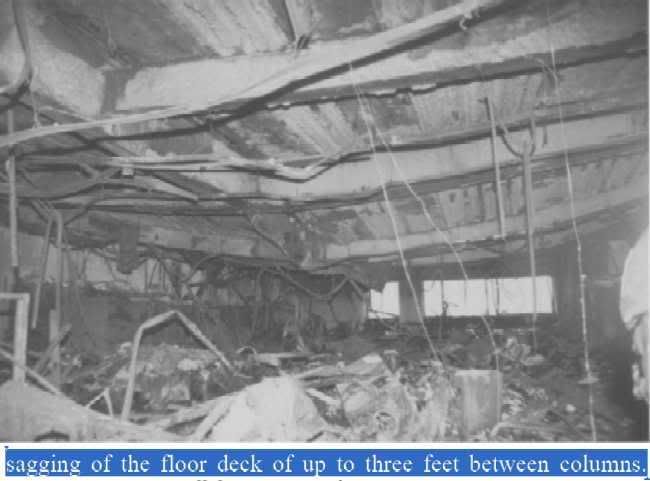
The heat clearly fractured the shear studs between the concrete & beams on the east side of the girder line between C80 & C44. The fires & heat also fractured most of the connections between the beams & girders on the east side of the girders, and buckled some of the beams.

All of the connections between the girders & Col 79 have been sheared, with the exception of the connection to Girder G2 in this diagram.

This means that Column 79 is completely free to deflect towards the east on this floor.

When beam B1 heats up, it pushes on Girder G1, moving its end generally towards the west (actually WNW). The end of girder G1 is going to move in an arc, with the center of the arc being the closest intact connection to one of the B2, B3, etc Beams, north of C79.

After all of the bolts on the east side of G1 & the beam between C79 & C80 have been sheared, then the fire moves westward to the interior, right under Girder G2, as shown at 5:30 & 6:00 pm in the concrete slab temp drawings.

When girder G2 heats up, it pushes C79 (right at vertical location of the G1 seat) towards the ESE.

The relative motion between the end of girder G1 & its seat on C79 is the SUM of these two motions.

You guys have only been considering the first component, assuming C79 does not move. This is wrong.

And since it looks like the length of girder G2 is approximately the same as B1, and the temp reached by girder G2 is approximately the same as the temps reached by B1, then the deflection of the relatively free moving column C79 should be approximately the same as the deflection of the end of girder G1. Essentially approximately doubling the Girder G1 to seat movement.

To a first order approximation, 4.5" of B1 motion will result in about 9" of total relative motion between Girder G1 & its seat.

I can easily see an amateur ignoring the expansion of G2. But that could easily be considered a "howler" if an allegedly experienced mechanical engineer were to do so.

Your turn, Tony.
 
Last edited:
DG,

Am I wrong in assuming the bolted connection would be a factor in the displacement of the columns? You don't have to hold back, I can take it.

Of course bolts are a factor. You just have to consider the configuration of the joint, and what the bolts & support plates are doing.

Bolts in most joints (except the Header joints, see below) will fail at relatively low temperatures (around 100 - 200 °C).

NIST goes thru the 6 different types of connectors in NCSTAR1-9 vol 1, pg 23, pdf pg 67.

Header H
Knife K
Fin F
Seated Web Clip SWC
Seated Top Clip STC
Seated Top Plate STP (not diagrammed, a variant of the STC, with a heavy plate as the top


In the cases of all connections (bolted or welded), there will be some clearance between the end of the beam or girder & the side wall of the column.

See Fig 2-15 thru 2-20 of NCSTAR1-9 vol 1, pg 24, pdf pg 68. Always a gap between the end of the beam & the side wall of the column. You always need clearance for big pieces to slide together.

Any thermal expansion will have to close this gap before it starts to deflect a column. So the gap subtracts from the deflection of the column for any given

Of the 6 types:

the header connection is the only one in which the bolt shear is highly unlikely & will not subtract from the deflection. This is because the bolts merely hold on the angle plates, and the beams are fillet welded to the angle plates. The bolts aren't stressed by thermal expansion in this connection design. For this one to fail like the others, the fillet weld has to fail.

fin & knife bolt connection failures can drop the beam or girder IF there are no top webs or bottom webs to catch the beam.

The 3 seated connections (SWC, STC & STP) will not drop the beam or girder immediately on shearing of the bolts. But the girder will be merely perched on top of the seat.

This is NEVER a good thing in a large structure, especially when components are moving around significant distances because of fires, fractured concrete, fractured bolted connections, etc.

It's as though the original building were a Mercedes sedan. All bolts tightened, everything tight as a drum.

The building with the shear studs pulled out of the concrete floors & the connection bolts sheared, etc is like the same Mercedes but if you removed most of the bolts in the front suspension. All the components are rattling around, and it is very easy to imagine (and to realize) a situation where the whole front end collapses.

The composite action of the shear studs & concrete tied everything together really, really well. The loss of these ties from the fire & thermal expansion of the beams turned the whole east side of the building into one giant "rattle-trap" down on the lower floors.

It is not the least bit surprising that some confluence of motion dropped some primary girders off of their seats. It may well have been something as simple as a slight gust of wind, that the intact building would have taken effortlessly, but will all those loose & fractured connections, the building shifted & collapsed.


tom
 
Well, enough of this nonsense.

Here's the answer to why you need only about 4.5" (actually, less than that will do) of westward push in beam B1 (below) in order for the girder to walk off both the seat & the support plate.

Tony, C7 & gerrycan have been made the patently false assumption that all of the relative motion between the girder & the seat is achieved by moving the girder to the west.

This is only 1/2 of the relative motion between the two parts.

Here is a drawing of the Northeast quadrant of WTC7 to get oriented.
Note: All single story images are the 13th floor for the Case B temperatures.

[qimg]http://www.internationalskeptics.com/forums/picture.php?albumid=638&pictureid=5841[/qimg]

A compass rose is at the center top for directions.
As noted, beams are labeled B#, Columns are labeled C# & Girders are labeled G#. (Where # is a number.)

Note well that all of the EW beams attach to (& push) girders, and none to C79.
Note well that girder G2 attaches to (& push) C79.

Now look at this diagram of the heating sequence on floor 13:

[qimg]http://www.internationalskeptics.com/forums/picture.php?albumid=638&pictureid=5836[/qimg]

It shows that the fires approached Col 79 from the south and on the east side of the Girders between Column 80 & Column 44.

Here is a drawing of the damage to the connectors & beams between 3.7 & 4.0 hours.

[qimg]http://www.internationalskeptics.com/forums/picture.php?albumid=638&pictureid=5838[/qimg]

The heat clearly fractured the shear studs between the concrete & beams on the east side of the girder line between C80 & C44. The fires & heat also fractured most of the connections between the beams & girders on the east side of the girders, and buckled some of the beams.

All of the connections between the girders & Col 79 have been sheared, with the exception of the connection to Girder G2 in this diagram.

This means that Column 79 is completely free to deflect towards the east on this floor.

When beam B1 heats up, it pushes on Girder G1, moving its end generally towards the west (actually WNW). The end of girder G1 is going to move in an arc, with the center of the arc being the closest intact connection to one of the B2, B3, etc Beams, north of C79.

After all of the bolts on the east side of G1 & the beam between C79 & C80 have been sheared, then the fire moves westward to the interior, right under Girder G2, as shown at 5:30 & 6:00 pm in the concrete slab temp drawings.

When girder G2 heats up, it pushes C79 (right at vertical location of the G1 seat) towards the ESE.

The relative motion between the end of girder G1 & its seat on C79 is the SUM of these two motions.

You guys have only been considering the first component, assuming C79 does not move. This is wrong.

And since it looks like the length of girder G2 is approximately the same as B1, and the temp reached by girder G2 is approximately the same as the temps reached by B1, then the deflection of the relatively free moving column C79 should be approximately the same as the deflection of the end of girder G1. Essentially approximately doubling the Girder G1 to seat movement.

To a first order approximation, 4.5" of B1 motion will result in about 9" of total relative motion between Girder G1 & its seat.

I can easily see an amateur ignoring the expansion of G2. But that could easily be considered a "howler" if an allegedly experienced mechanical engineer were to do so.

Your turn, Tony.

Tom, you know as well as the rest of us do now that girder G1 had web to flange stiffeners on it at it's column 79 side (as seen in drawing 9114) which would require much more than 6.oo" to push it off its seat.

In addition, girder G2 was restrained by 12 beams with shear studs on them framing into it from the north and south, so it isn't just free to move and apply all of its expansion to column 79. If you remove all of these beams from girder G2 it will buckle before it can push column 79 to the east.

Please tell us how much you calculate for the movement of girder G2 when it is restrained by the 12 beams with shear studs, and how much more horizontal travel would be required by considering the stiffeners on girder G1. You also need to apply the temperatures to the beams in the northeast and to girder G2 that were occurring simultaneously. I can guarantee you won't be getting 4.5" of travel for each member.

There are two other issues you need to resolve here and they are that at 500 degrees C girder G1 would be up against the side plates of column 79 and providing additional restraint against expansion from the west and the connection between girder G2 and column 79 needed to be broken at some point to allow column 79 to buckle.

There is a reason those web to flange stiffeners on girder G1 weren't included in the NIST models and I would imagine the heating occurring at different times and the other conflicts I mention here are why they didn't come up with the scenario you are trying to claim here.
 
Last edited:
In the last couple of hours I looked at whether the girder could fall due to axial shortening. It doesn't look like it.

There is about 1.2" of clearance on both sides before the girder contacts anything.

I looked at it for girder temperatures of 500, 600, and 700 degrees C.

Even at 700 degrees C the net expansion of the 45 foot long girder is 3.985", and that would cause a permanent buckle of about 1.600" or about .800" per side.

The shortening due to sagging of the girder at 700 degrees C was 0.752 inches total and that would be split about each side for .376" per side.
This gives a total contraction after cooling of about .800 + .376 = 1.18" per side.

The web of the girder was 2.4" past the face of the 2 inch thick under seat plate at column 79 and about 3.4" over the vertical stiffener on the column 44 side. So it doesn't look like the girder contraction theory has any merit.

As for your question of whether I would be comfortable with a natural mechanism which can be shown to be sound, I would say yes. Unfortunately, as you can see here, we don't have that. You will have to excuse me if I don't go for Beachnut's and Noahfence's "it was fire" rants with no basis.

Please show why that would definitely be the case.......seems to me that if fastenings failed at one end before the other (and they would)then there is no reason to assume that most if not all the shortening would occur at the free end.
 
Oe more thing I need to say here before I go is that TFK's claim that the concrete would fail before the shear studs would isn't sound.

The concrete in the slabs of WTC 7 had a compressive strength of 3,500 psi and the shear studs were 3/4" diameter x 5.00" long. That means they each had a bearing area of 0.75" x 5.00" = 3.75 sq. inches on the concrete and there were 30 of them on the girder according to John Salvarinas' paper so they had a total bearing area of 112.5 sq. inches.

The total buckling load of all five beams was 26,738 lbs. at room temperature and it would have been less at higher temperature. Applying this maximum buckling load on the bearing area of the shear studs on the girder and the concrete gives a stress of about 238 psi. Hardly enough to fail the concrete.

It is the lack of basis for claims like TFK's that causes me to refrain from posting and arguing ad nauseum on forums like this. However, it was important here to jump in and help explain the actual basis which shows the NIST girder walk-off mechanism for the collapse initiation of WTC 7 is impossible and non-explanatory.

Compressive loads are measured with flat surface to a flat surface. A round bolt would be a very different loading and the force required to fracture the concrete would likely be much lower. Plus as the beams sag the concrete would have likely cracked under its own now unsupported weight alone adding further weaknesses to it resisting the beam contracting. Further if the concrete got hot enough it will fail.
http://www.promat-tunnel.com/en/concrete-spalling-effect-standard-fire-tests.aspx

In conclusion you have failed to show that your claim has any merit.
 
Last edited:
That means they each had a bearing area of 0.75" x 5.00" = 3.75 sq. inches on the concrete and there were 30 of them on the girder according to John Salvarinas' paper so they had a total bearing area of 112.5 sq. inches.

Why does Salvarinas' paper show studs on the girder between column 79 and 44, yet on the Cantor drawing S-8 AND the Frankel Steel drawing E12/13, none are shown for the girder?

Why does Salvarinas' paper show studs on the W30x116 north on column, yet on the Cantor drawing S-8 and the Frankel Steel drawing E-12/13, none are shown for that girder?

Why does Salvarinas' paper call out 32 studs for the 24x55 floors beams on the east side of WTC7 yet Cantor drawing S-8 and Frankel Steel drawing E12/13 call out 28 studs per floor beam, not 32?

Why does Slavarinas' paper call out 32 studs typical for ALL the floor beams along the south wall yet the Cantor drawing S-8 and the Frankel Steel drawing E-12/13 show between 20 and 26 studs on certain floor beams?

You are taking the drawings of a man who wrote a paper before WTC7 was even completed over two different drawings that show he is wrong?

May I ask why?
 
Tony,

Tom, you know as well as the rest of us do now that ...

Are you REALLY certain that you want to play the "look at all of the engineers supporting me versus nobody supporting you" card?

Last time I checked, the engineers behind you were, let's see, Bjorkman and, uh, … well, that's about it.

Tom, you know as well as the rest of us do now that girder G1 had web to flange stiffeners on it at it's column 79 side (as seen in drawing 9114) which would require much more than 6.oo" to push it off its seat.

[deleted]

will address later.

In addition, girder G2 was restrained by 12 beams with shear studs on them framing into it from the north and south, so it isn't just free to move and apply all of its expansion to column 79.

Why the hell do you make the same mistake over & over & over & over again, Tony?

The building would not & did not collapse in its "as built" condition.

Why do you constantly cite its "as built" condition when referring to the "instant before collapse" state of the building.

How many beams & how many shear studs are restraining girder G2 just before collapse, Tony?

If you remove all of these beams from girder G2 it will buckle before it can push column 79 to the east.

You'll forgive me for not accepting your baseless assertion.

There is nothing on the 13th floor that restrains the column from moving eastward, so your assertion that the girder will buckle first is fanciful at best.

Please tell us how much you calculate for the movement of girder G2 when it is restrained by the 12 beams with shear studs, and how much more horizontal travel would be required by considering the stiffeners on girder G1. You also need to apply the temperatures to the beams in the northeast and to girder G2 that were occurring simultaneously. I can guarantee you won't be getting 4.5" of travel for each member.

I don't have to calculate squat, Tony.

On the one hand, I have the calculations of a large group of expert engineers using large precise, carefully constructed models of the whole 10th thru 14th floor of the building & solved using supercomputer performance clusters.

On the other hand, I have you making baseless assertions with zero COMPETENT models, which look at only one or two components at a time.

Your assertions & your guarantees aren't worth a thing.

There are two other issues you need to resolve here and they are that at 500 degrees C girder G1 would be up against the side plates of column 79 and providing additional restraint against expansion from the west and the connection between girder G2 and column 79 needed to be broken at some point to allow column 79 to buckle.

Great Tony.

If everything matches perfectly the unloaded, theoretical dimensions on the drawings (which it won't), you've got a sliver of steel, 0.16" wide (minus any corner breaks that a steel worker would have ground into the corners of the beam after cutting it to length) x 18" high resisting thermal expansion & keeping your building from falling down.

What could possibly go wrong with that?

What happens if the beam pushing the girder heats up before the girder comes to your 500°C?

What happens when the girder sags?

What happens if the girder cools down by 75°C?

Does this REALLY look like an insurmountable problem to you, Tony? Would you design a 47 story tall building depending on that 0.16" sliver of steel down on the 13th floor to keep it standing?

As for your bolts having to fracture, column 79 is the highest loaded column in the building. It is being bent out of alignment. It is also being heated by the fires.

The erection bolts are intended ONLY to hold the beams & girders in place while the concrete is poured & hardens. They were never intended, and are woefully undersized, to resist any significant structural loads.

There is a reason those web to flange stiffeners on girder G1 weren't included in the NIST models …

And what reason is that, Tony?

Are all those NIST engineers liars & traitors, Tony?

Is that your assertion?

Be sure to include that in your letter when you "respectfully" ask them to "correct their mistakes".

… and I would imagine the heating occurring at different times and the other conflicts I mention here are why they didn't come up with the scenario you are trying to claim here.

Your imaginings are irrelevant.
 
Last edited:
Compressive loads are measured with flat surface to a flat surface. A round bolt would be a very different loading and the force required to fracture the concrete would likely be much lower. Plus as the beams sag the concrete would have likely cracked under its own now unsupported weight alone adding further weaknesses to it resisting the beam contracting. Further if the concrete got hot enough it will fail.
http://www.promat-tunnel.com/en/concrete-spalling-effect-standard-fire-tests.aspx

In conclusion you have failed to show that your claim has any merit.

No, I was right. The bearing area of a bolt is the projected area. See what the Seel Construction manual says about it here http://www.bgstructuralengineering.com/BGSCM13/BGSCM003/BGSCM00306.htm

The 238 psi compressive bearing stress experienced by the concrete from the beam expansion loads before they buckle is extremely low and there is simply no chance of concrete failure. TFK was talking out of his hat when he said the concrete would fail before the shear studs on the girder between columns 44 and 79.
 
Last edited:
The 238 psi compressive bearing stress experienced by the concrete from the beam expansion loads before they buckle is extremely low and there is simply no chance of concrete failure. TFK was talking out of his hat when he said the concrete would fail before the shear studs on the girder between columns 44 and 79.

Were you aware of the fact that heat will cause concrete to fail?
 
Tony,


Are you REALLY certain that you want to play the "look at all of the engineers supporting me versus nobody supporting you" card?

Last time I checked, the engineers behind you were, let's see, Bjorkman and, uh, … well, that's about it.


[deleted]

will address later.


Why the hell do you make the same mistake over & over & over & over again, Tony?

The building would not & did not collapse in its "as built" condition.

Why do you constantly cite its "as built" condition when referring to the "instant before collapse" state of the building.

How many beams & how many shear studs are restraining girder G2 just before collapse, Tony?


You'll forgive me for not accepting your baseless assertion.

There is nothing on the 13th floor that restrains the column from moving eastward, so your assertion that the girder will buckle first is fanciful at best.


I don't have to calculate squat, Tony.

On the one hand, I have the calculations of a large group of expert engineers using large precise, carefully constructed models of the whole 10th thru 14th floor of the building & solved using supercomputer performance clusters.

On the other hand, I have you making baseless assertions with zero COMPETENT models, which look at only one or two components at a time.

Your assertions & your guarantees aren't worth a thing.


Great Tony.

If everything matches perfectly the unloaded, theoretical dimensions on the drawings (which it won't), you've got a sliver of steel, 0.16" wide (minus any corner breaks that a steel worker would have ground into the corners of the beam after cutting it to length) x 18" high resisting thermal expansion & keeping your building from falling down.

What could possibly go wrong with that?

What happens if the beam pushing the girder heats up before the girder comes to your 500°C?

What happens when the girder sags?

What happens if the girder cools down by 75°C?

Does this REALLY look like an insurmountable problem to you, Tony? Would you design a 47 story tall building depending on that 0.16" sliver of steel down on the 13th floor to keep it standing?

As for your bolts having to fracture, column 79 is the highest loaded column in the building. It is being bent out of alignment. It is also being heated by the fires.

The erection bolts are intended ONLY to hold the beams & girders in place while the concrete is poured & hardens. They were never intended, and are woefully undersized, to resist any significant structural loads.


And what reason is that, Tony?

Are all those NIST engineers liars & traitors, Tony?

Is that your assertion?

Be sure to include that in your letter when you "respectfully" ask them to "correct their mistakes".


Your imaginings are irrelevant.

Tom, you are talking a lot of smack here but not much substance.

The girder between columns 76 and 79 would buckle by the time it pushed column 79 just 1.6 inches to the east if it were unrestrained by the 12 beams framing into it with shear studs. I did the calculation and that is at room temperature. If it is hot it buckles earlier. There is no way you can get 4.5 inches of eastward movement the way you envision.

In addition, your attempt at an alternative scenario here is just that. It is not what NIST alleges. So I don't know why you keep claiming they are right and then feel the need to show an alternative, albeit one that doesn't work either.

The reality is that, both the original NIST scenario and your alternative, for the girder failure at column 79, are impossible. However, the NIST is responsible to the public to generate an accurate and sound report, so they will have to correct their error. You can just chalk it up to not looking hard enough before saying it. Sort of like what you did with your claim that the concrete would fail before the shear studs on girder G1 before the beams to the east of girder G1 buckled. Sheeplesnhills tried to challenge that here and was wrong in how he determines bearing area.
 
Last edited:
Do you? The vast majority of your posts seem to lack them.

Are you forgetting about one important factor?

The assembly as a whole is weakened........
 
Were you aware of the fact that heat will cause concrete to fail?

Hey, that sounds like a lot of smack, what heat!?

Where is the substance, someone might think you are a shill. Wait, if someone knows you are a shill, you can't be a shill. Now that is irony.

http://i286.photobucket.com/albums/ll116/tjkb/woodsteelfire.jpg

What is funny, how much sag was there. Ordinary office fire, like WTC 7, can cause damage which renders buildings useless, totaled. Why can't the collapse when the fire is not fought? right

http://i286.photobucket.com/albums/ll116/tjkb/onemeridiansag.jpg
onemeridiansag.jpg

This building was totaled by fire! Fireman saved it from collapse, fires were fought, and firemen stepped up and saved the building. Tony and 911 truth have failed to present a paper in a real journal to support their fantasy of CD, and don't realize NIST is not needed to understand fire destroyed WTC 7. CD a fantasy, and the walk off is not needed to shoot down 911 truth claims.

It would be cool if 911 truth tried to produce a paper, they claim to have 1600 PLUS experts; why can't they do anything of substance?

I have seen zero effort of 911 truth to do the required work to refute NIST, and I don't need NIST; 911 truth attacks others, and they fail to prove their CD delusion, they would rather attack NIST, and fail.
 
Several more posts have gone by now, Tony. You've yet to provide any evidence for your claims.

Why?

Its obvious, like C7, he has no case or the wherewithal to make one, so it's NIST random sniping. A way to delay the inevitable, certainly no way to win a case. Plus, you can look real smart to others 'cause you can add numbers up and make engineery sounding assertions. It's like Creationism and "teach the controversy".
 
Its obvious, like C7, he has no case or the wherewithal to make one, so it's NIST random sniping. A way to delay the inevitable, certainly no way to win a case. Plus, you can look real smart to others 'cause you can add numbers up and make engineery sounding assertions. It's like Creationism and "teach the controversy".

Well, I'm as technical as a toddler....and he's not fooling me with all this engineery sounding drivel...
 
Shear studs

No, I was right. The bearing area of a bolt is the projected area. See what the Seel Construction manual says about it here http://www.bgstructuralengineering.com/BGSCM13/BGSCM003/BGSCM00306.htm

The 238 psi compressive bearing stress experienced by the concrete from the beam expansion loads before they buckle is extremely low and there is simply no chance of concrete failure. TFK was talking out of his hat when he said the concrete would fail before the shear studs on the girder between columns 44 and 79.

Tony's as predictable as ever.

Wrong reference.
Failure to read the NIST document.
Incomplete, irrelevant calculation.
(238 psi is meaningless. The question "what was the stress level?" is irrelevant to the question "which fails first?"
Simple assertion.
And wrong.

Tony's assertion that "there is simply no chance of concrete failure" is simply wrong.

From NCSTAR 1-9 vol 2, pg. 469.

NIST said:
Shear Stud Connector Failure

Shear stud failure in a composite floor system occurs when the concrete slab is either crushed or cracks around the shear stud, or the shear stud separates from the floor beam.

[Note: gerrycan (or Tony, if he is the source of gerrycan's information) asserted that the failure would be shearing of the shear stud.]

The two mechanisms that NIST mentions are concrete failure (as I stated) and stud-to-beam-flange weld failure (which I did not mention).

Neither one of these failure modes is shearing of the stud.

NIST provides a detailed description for the failure of these studs, and focuses completely on the concrete failure. It's results are:

The loads for a weak fracture of the concrete is about 17 kip.
For a strong way failure of the concrete, it's about 21.5 kip.

On aggregate, NIST used the average strength of 19.4 kip.

[See fig 11-8, NCSTAR 1-9 vol 2, pg 468, pdf pg. 130]
___

Now let's figure out what it would take to shear the bolt.

Typically, the shear studs were 0.75 in. in diameter by 5 in. long, spaced roughly 1 ft to 2 ft on center.

NIST NCSTAR 1-9 vol , pg 15, pdf 59

It doesn't say what alloy the studs are made from, but it is safe to assume that it would be made from a low carbon, mild steel alloy. This gives excellent weldability and toughness, which is why it is used for structural steel. It is also one of the weakest steels available, so any other alloy will have a higher shear load.

Using standard rule of thumb for steel: the ultimate shear strength (USS) is approximately 0.75 * ultimate tensile strength (UTS).

According to my trusty old Marks ME handbook (1978), UTS for mild steel ranges from 58 to 80 KSI. I'll use the average 69 KSI, which should be conservative for 3/4" studs.

This gives a USS of 52 ksi, and a shear load of about P = 52 ksi (π d2/4) = 23 kips.

This is higher than the value for both the weak & strong concrete failure modes.

I note that NIST later says the following:

NIST said:
The nominal capacity of a 3⁄4 in. stud is roughly 20 kip at room temperature

NCSTAR 1-9 vol.1, pg 347, pdf pg. 391.

Note that this is the correct temp to use, because analysis shows that these shear studs fail at around 100 - 150°C.

This again puts the stud shear load (20 KSI) slightly higher than the average concrete failure load (19.4 KSI).

Again, Tony's assertion that "there is no chance of concrete failure" is shown to be simply wrong.


tk

PS. How adamantly, determinedly dumb are you, Tony?

There are NO shear studs on the girder between Col 79 & Col 44.

NIST was explicit about this.

But you think that they're lying, don't you?
 
Last edited:
Status
Not open for further replies.

Back
Top Bottom