Richard Gage Blueprint for Truth Rebuttals on YouTube by Chris Mohr

Status
Not open for further replies.
So why is it issuing almost horizontally in line with individual storeys of broken windows?

That's why I love JREF.

I figured there must have been some sort of term for smoke exiting windows, but I didn't know what it was. Issuing. Thanks!
 
I'm betting MM never responds in any sort of substance to all the videos and photos we've just provided.
 
That's why I love JREF.

I figured there must have been some sort of term for smoke exiting windows, but I didn't know what it was. Issuing. Thanks!

I thought so too. However, my only experience with that word in that specific context is the biblical "issue".
 
"The damage to parts of the WTC7 south face was severe only in that had the building not collapsed, the cost of repairs would have been severe.

Structurally, it has not been established that the WTC7 south face damage was severe enough to have factored into the global collapse initiation.

The videos DO NOT show smoke pouring out of almost every floor, and the NIST, in spite of years of trying, never found sufficient evidence (anecdotal or otherwise) to support your chosen belief that; "videos show smoke pouring out of almost every floor except a few at the top."

What the videos show is a wall of smoke moving up the south face of WTC7. A great deal of that smoke was contributed by WTC 6 which was showing far more intense fire activity."
"Said MM, which he followed with pictures which, conveniently, don't show the joint engulfed in flames."
reformattng is mine

Where are the photos of WTC7 which show it was a "joint engulfed in flames"?

MM
 
Last edited:
"MM,

This reply is shameful. Even for you...

...It is not clear that smoke was pouring out of "almost every" floor.
It's not clear that smoke was pouring out of most floors.

The above is not clear because of the massive amount of smoke pouring out of the building obscured the windows behind the smoke.

It is plainly clear that there were massive fires in that building...

...NONE of the smoke that was moving up the side of WTC7 was from WTC6. The extremely hot smoke from WTC6 moved straight up vertically in the air above WTC6 on a day that had very little wind.

It is provable, for anyone with half a brain & a willingness to look at the videos, that the smoke adjacent to WTC7 came from WTC7.

This is a simple lie that is supported ONLY by a refusal to look at the videos. Or to look at the photographs carefully."

"... The damage was not that severe - floors 5 thru 17 and floor 44 to the roof. Floors 18 thru 43 were not damaged.

fig1233debrisdamagecomp.jpg


The fires on floors 19, 21, 29 and 30 had burned our by 1 p.m. The only other fire reported on the south side was floor 12 around noon to 1 p.m. There was no damage to any columns due to fire.

It did not tip over badly. The debris was contained mostly within the footprint."

wtc7wtc6smokin1rua0.png


wtc167ge0.png


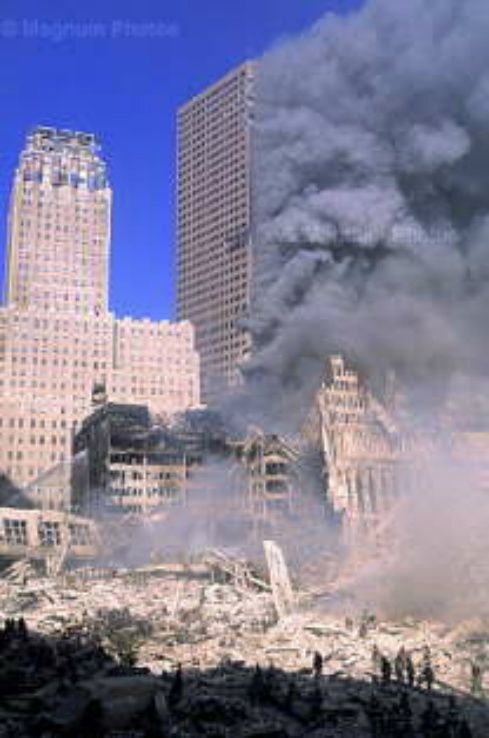
That looks like one great big 'sucking'smoke chimney created by the southside debris damage.

MM
 
And we've posted videos and photos and screenshots showing smoke coming out of 7. But keep reposting the same photos we've already refuted.

The idea that a building could be in a widespread multi-floor fire for 7 hours largely unfought and not sustain heavy damage is ludicrous.
 
I don't know if this has ever been addressed before. If it has, I apologize for the redundancy.

Christopher7 has been claiming that "the entire upper block of WTC7 (finally he excludes the east penthouse) fell as a single unit."

He bases his claim on a statement in the NIST report that says:

NIST said:
When all the exterior columns had buckled, as shown in Figure 12–62, the entire building above the buckled-column region moved downward as a single unit, resulting in the global collapse of WTC 7.

NIST NCSTAR 1-9, pg. 588 (vol 2, pdf pg 250), emphasis added

Chris7 bases his contentions on this quotation being literally correct.

However, right above this section, the same report says the following:

NIST said:
Once column support was lost in the lower floors, the remaining exterior structure above began to fall vertically as a single unit.

NIST NCSTAR 1-9, pg. 586 (vol 2, pdf pg 248), emphasis added


These two quotes seem to be, and (from a structural point of view) are, mutually exclusive.

How can we reconcile these two sentences?

It turns out to be quite easy to figure out which is right, and which is wrong.

The "remaining exterior structure" quote is correct.

The "entire building" quote is wrong.

I'll give Chris7 an opportunity to make his case for his interpretation.

If anyone can provide a link to another thread where this is discussed & resolved, and they've provided the definitive information that settles the issue, then I'll let the matter drop.

If the issue has not been definitively resolved, then I'll start a new thread & present my case.


tom

PS. Chris Mohr, you might be interested in this.
 
That looks like one great big 'sucking'smoke chimney created by the southside debris damage.
MM

The reason that you keep repeating this lie is that you refuse to look at the video, in which the smoke's motion is obvious.

And the videos clearly show the smoke emanating FROM WTC7 & blowing SOUTHWARD (towards & above WTC6).

Not emanating FROM WTC6 & blowing NORTHWARD (into your delusional chimney).

This has been addressed time, after time, after time, after time.

And here you are, repeating lies.

As I said: "shameful".
 
Last edited:
I like how 7 apparently provided a chimney for 6, despite the latter being 8 stories, the former being 47 stories, and having a multi-lane street between them.
 
Thanks CJ,

You're not too late! I used Chris7's little spat with me as an opportunity to to look more carefully at your two videos. In the first, not only is smoke obviously pouring straight out from windows on most floors, but there is a lot of different-colored smoke in the bottom right quadrant of the video. I wonder if that distinctly different smoke came from Building 6 or elsewhere. Instead of blowing out of the building, this smoke near the bottom right is just hanging in the air. How anyone could say the smoke pouring OUT of Building 7 from most floors is just smoke hanging around and floating towards it due to low pressure is beyond me.

Much more interesting to me: the Building 7 collapse from this diagonal angle. I've seen this before, but I didn't look at it 1/4 second at a time. Eyeballing it carefully, it looks like it is falling straight down for around the first two seconds of the outer perimeter wall collapse (seconds 0:03-0:04). You can tell because a vertical line of windows matches up perfectly against the silhouette of the building in front of it and to its right. At 0:05, if you pause right there, you can see that the windows are no longer in alignment with the vertical reference point of the silhouetted building. The southward tilt of the collapse has already begun. So around the time that NIST measured the beginning of the 2.25 seconds of "at freefall" drop for the north perimeter roofline, the building itself was tilting noticeably southwards!

Which brings up a question: did NIST measure the rate of collapse of the north perimeter roofline from the better-known straight on view of the north face? Or did they use THIS video, kind of from the side? Because if they used the famous north-face-straight-on view, would the "at freefall" measurement have been an illusion as the building was also falling backwards? I don't know; this is an open question.

Another question: is Chris7 right when he says that moment frames helped hold at least the three visible walls of the building together during its collapse (I'm guessing yes)? What about his claim that these moment frames hold everything together rigidly in 100% alignment with no part moving even a centimeter up down left or right or in or out as long as the moment frames are there (I'm guessing no way Jose)?
TFK I think your two NIST quotes are new, at least to me, and very interesting. These minor verbal errors happen all the time in technical writing.

I'm still hoping you or someone can clarify my questions in my post here. These are some interesting ones for me, at least. But I'll admit that the question about whether moment frames are 100% rigid and inflexible is kind of, uh, rhetorical.
 
I like how 7 apparently provided a chimney for 6, despite the latter being 8 stories, the former being 47 stories, and having a multi-lane street between them.

Chimneys like this can exist, but they need to have a stonkin' great fire in them. Such mechanisms were once used to ventilate mineshafts ;)
 
Wow. I almost made that same claim, but realized that I wasn't sure and didn't know what to Google. So the very thing MM claims was in effect to produce the appearance of smoke from a large fire would've required a large fire. Well done, MM. Bravo.
 
TFK I think your two NIST quotes are new, at least to me, and very interesting. These minor verbal errors happen all the time in technical writing.

I'm still hoping you or someone can clarify my questions in my post here. These are some interesting ones for me, at least. But I'll admit that the question about whether moment frames are 100% rigid and inflexible is kind of, uh, rhetorical.

I'll defer to Architect on the question of moment frames when used in buildings. Buildings have a lot of consideration beyond just plain strength in their design.

[BTW, terminology. In this context, a "moment" is a "twisting or torquing force".]

But in other types of structures, moment frames are pretty weak.

A moment frame is a rectangle.

The advantage of a rectangle in a building is that you can put windows into it & see out, and it costs a lot less than a truss frame (see below).

The failure mode is when the rectangular frame turns into a parallelogram, by the top member sliding to one side & the two vertical members rotating to an angle. (This is the way that a bookcase would collapse if you removed the back thin sheet of wood, particle board or pressed cardboard, whose job is to prevent this rotation.)

The resisting moments necessary to prevent the rectangle from collapsing to the side must be provided by short extensions (i.e., reinforcements) at the connections. But they have such short "moment arms", that the assembly generally turns out to be comparatively weak. If you used pin joints to hold together a moment frame, the structure would be unstable & collapse. ETA: Just like one of those expanding wooden gates that we used to put at the tops of stairs to keep young kids from falling down them. (Rectangles, with pin joints. bad example. -tk. Better example: free collapsing & expanding parallelograms that navigators used to use to transfer heading from compass rose to flight path. )

The point is that the strength of a moment frame structure depends on the strength of the moment resisting connections at each intersection of beam & column.

In contrast, a much stronger frame member is a truss, which is a triangle. Or rather, a collection of triangles. In a triangular frame, all 3 end points are completely constrained, and are immobile unless one of the members fails. This is exactly why you see all cranes built with triangular truss members in the extendable arms that have to carry the weights.

Equally important, in a truss, you don't depend on moments being generated at the vertices of the triangle to provide the strength of the frame. One could use (free rotating, zero resisting moment) pins at each vertex, and in principle, the frame would be just as strong as a welded assembly. (In reality, it'd have a lot more "slop" in the structure due to clearances, but the strength should be approximately the same as if one welded the members.)

One problem with truss supports is that you can't see out the windows without having a diagonal member break up your view. And you need to use a lot more material as well, which increases the cost.

If you look at fig 2-25 of NCSTAR1-9 (pg 31, pdf pg 75), you'll see that they added diagonal members to the rectangular moment frames in order to form the two "belt trusses" all the way around the building at the bottom floors & midway up the building in order to stiffen & strengthen the structure. Take a rectangular moment frame, and turn it into two trusses by adding a single diagonal member, and the frame will be much, much stronger.

Just a caveat here, you should solicit Architect's take on this too.

With regards to your other questions:

ChrisMohr said:
did NIST measure the rate of collapse of the north perimeter roofline from the better-known straight on view of the north face? Or did they use THIS video, kind of from the side?

NIST used the same one that Chandler did: the straight on view (aka "Dan Rather" viewpoint.)

They did NOT analyze the descent of "the roofline". They analyzed the descent of one point on the roofline: the north west corner.

ChrisMohr said:
Because if they used the famous north-face-straight-on view, would the "at freefall" measurement have been an illusion as the building was also falling backwards?

Nope. Not due to falling backwards.

But it is important that you understand something: Neither the northwest roof line point, nor the external frame of the building, fell at a constant acceleration.

By choosing to do a "linear interpolation" of the velocity data, both Chandler & NIST FORCED the results to produce a (false) "constant acceleration". Their choice of a linear interpolation automatically hides any details of varying acceleration.

However, if you look at the raw data, you can immediately see where certain adjacent data points have a slope (if you connect the two adjacent dots) that is greater than the average (implying a higher acceleration than "g"), and other adjacent data points that have a slope less than the average "g".

The finer detail analysis that I & others have done show a much closer approximation to instantaneous acceleration by analyzing every frame rather than every 7th or 8th frame (NIST did 4 data points/sec, 1 out of every 7.5 frames, or 1 out of every 15th field).

When you analyze all the frames, it becomes obvious that the descent of that point was NOT any constant acceleration, much less "g". It varied below & above "g". In addition, the acceleration gradually increased, rather than jumping immediately to its absolute value, as something that was really in free fall would do.

ChrisMohr said:
is Chris7 right when he says that moment frames helped hold at least the three visible walls of the building together during its collapse (I'm guessing yes)?

Bad guess.

No, he is not right. He just wishes it to be so. He's not provided any data to show this.

NIST explicitly states that THEIR MODEL (not reality, their model) shows something entirely different: that the west face exterior columns buckled first (near column 14, the southern most column on the west side of the building).

"... exterior columns adjacent to the seven columns severed in the southwest region due to the collapse of WTC 1 were the first to buckle because additional load was distributed to them following the debris impact damage."
NCSTAR1-9, Vol 2 pg 586 (pdf pg. 248)

Then they say: "The south and west exterior columns buckled first, followed by the north and east face columns."

This is mutually exclusive of Chris7's claim. In as much as NIST are a bunch of structural engineers, and Chris7 is not, I'll go with NIST.

I don't know of anyone who has done an analysis on all 3 sides of the building, comparing the timing of multiple points on the roofline to the descent of the northwest corner.

The person that may have done so is femr2. He doesn't seem to post here anymore, and based on history, I'd be leery of taking any analysis of his at face value.

I believe that he is honest, but I am also certain that he frequently ignores significant effects, and greatly overestimates the precision of his measurements.

ChrisMohr said:
What about his claim that these moment frames hold everything together rigidly in 100% alignment with no part moving even a centimeter up down left or right or in or out as long as the moment frames are there (I'm guessing no way Jose)?

Much better guess.

Again, this is merely his wishful thinking. The building was disassembling. There was no possibility that the strength of the moment frames could resist that disassembly, as proven by the fractured components lying on the ground after the fact.

All of this will become moot, and yet will hold together logically, when I explain why the one NIST quote, "the entire building above the buckled-column region moved downward as a single unit" has to be wrong.

And their quote "the remaining exterior structure above began to fall vertically as a single unit" has to be right.


Tom

 
Last edited:
Thanks Tom this is almost Architect-level answering!

Does anyone have a more precise analysis of exactly when Building 7 began to tilt noticeably southward? My best guess was two seconds of straight-down, and based on eyeballing the windows lined up against the building silhouetted in front of it, the tilt began in the third second.

Also, does anyone know how much strength is lost when a column buckles? I'm guessing a very high percentage, like 98% or so. That's why the idea that other forces like torquing and leveraging can bring the speed of collapse of one small part of the building to freefall acceleration.

Also Tom, like you I have asserted in my video 18 that the lines connecting the data points show slightly faster-than-freefall for a total of around one second. Chris7 says that is within the margin of error of the measurements, which seems possible to me. That's why I'm always careful to say "possibly faster than freefall, but within the margin of error."

And OMG NIST analyzed that one point on the northwest corner, not even the whole roofline as I mistakenly and generously said, certainly not the entire north face, and sure as hell not all four sides of the building as chris7 has asserted (due to the 100% rigid moment frames). Amazing how the correction of my minor mistake takes me even further from chris7's assertion, isn't it?
 
Also, does anyone know how much strength is lost when a column buckles? I'm guessing a very high percentage, like 98% or so. That's why the idea that other forces like torquing and leveraging can bring the speed of collapse of one small part of the building to freefall acceleration.

Through air, sure. Through the rest of the building? No, never. Ever.

Ever.

What don't you guys get about this? After ten years.

What part of normal structural resistance, even of buildings on fire (as opposed to buildings on smoke) don't you understand? Five-year-olds understand this. Why don't grown-up internet "debunkers" understand this? What's the learning difficulty here?
 
Through air, sure. Through the rest of the building? No, never. Ever.

Ever.

What don't you guys get about this? After ten years.

What part of normal structural resistance, even of buildings on fire (as opposed to buildings on smoke) don't you understand? Five-year-olds understand this. Why don't grown-up internet "debunkers" understand this? What's the learning difficulty here?
I'm just bad at learning things that aren't true.
 
Status
Not open for further replies.

Back
Top Bottom