• Quick note - the problem with Youtube videos not embedding on the forum appears to have been fixed, thanks to ZiprHead. If you do still see problems let me know.

WTC7 and the girder walk-off between column 79 and 44

Status
Not open for further replies.
I put the [to the east] in italics to indicate that I had added it. Is using the asterisk better?


Buckling beams rocked the girder off of its seat
to the east.

NCSTAR 1-9 Vol.1 pg 353 [pdf pg 197]
rocking of the girder off its seat* at Column 79 as shown in Figure 8–27 (b)
*to the east
[FONT=&quot]http://img208.imageshack.us/img208/8979/figure827.jpg[/FONT]


It doesn't make a difference how you write it, it's not in the NIST report anywhere, so why are you adding it?

Furthermore, none of the figures show it walked/rock east, they all show it went west, even though they don't state it. So what's the problem? Where did you get this delusion that it walked east?

Sure looks like it was pushed west to me..
Beam.png
 
Last edited:
It doesn't make a difference how you write it, it's not in the NIST report anywhere, so why are you adding it?
A noted "to the west" and "to the east" to make it clear that NIST has the girder failing in opposite directions.

Furthermore, none of the figures show it walked/rock east, they all show it went west, even though they don't state it. So what's the problem? Where did you get this delusion that it walked east?
Where did you get this delusion that I said it walked east?
In the "rocked to the east" failure it first walked west, but not off its seat. Then it rocked off its seat to the east.

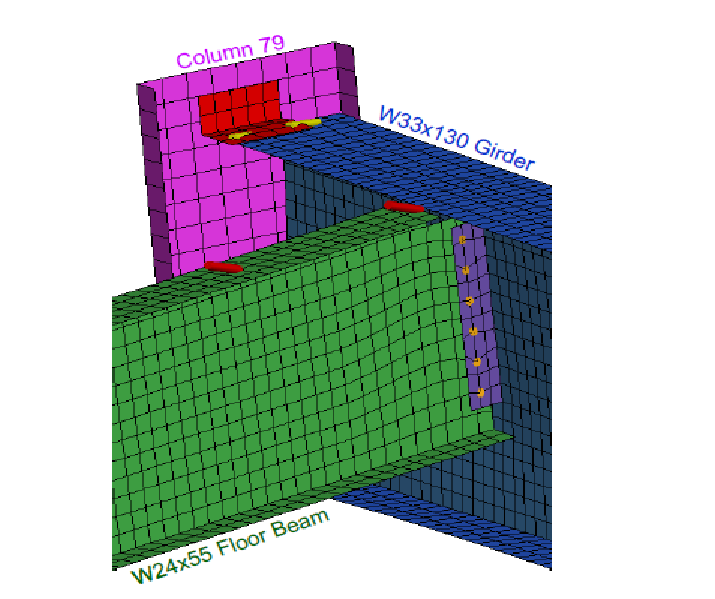
You didn't bother to click on the link in my post. You posted the graphic for the lateral displacement that does not walk off but not the one on the same page that shows it rocking off to the east. How could you not see it? Here is the graphic for the "rocked to the east" failure:

figure827.jpg
 
A noted "to the west" and "to the east" to make it clear that NIST has the girder failing in opposite directions.
No, you claim that they have the girder falling in opposite directions, from the preliminary report.

Where did you get this delusion that I said it walked east?
In the "rocked to the east" failure it first walked west, but not off its seat. Then it rocked off its seat to the east.
Bwuh?

You didn't bother to click on the link in my post. You posted the graphic for the lateral displacement that does not walk off but not the one on the same page that shows it rocking off to the east. How could you not see it? Here is the graphic for the "rocked to the east" failure:

[qimg]http://img208.imageshack.us/img208/8979/figure827.jpg[/qimg]
In Fight Club, Tyler says he inserts single frames of pornography into family movies to make the audience uneasy. You are doing something similar, except you are claiming that Lilo and Stich was meant to have Ron Jeremy and Danni Ashe as a pair of very, very special guest stars.
 
In Fight Club, Tyler says he inserts single frames of pornography into family movies to make the audience uneasy. You are doing something similar, except you are claiming that Lilo and Stich was meant to have Ron Jeremy and Danni Ashe as a pair of very, very special guest stars.

Yes, exactly. This is what the retards of 9/11 Truth think they're doing. Or are they really doing it? Anyway, yes...yes...this is a great comparison.
 
A noted "to the west" and "to the east" to make it clear that NIST has the girder failing in opposite directions.

In the "rocked to the east" failure it first walked west, but not off its seat. Then it rocked off its seat to the east.

You posted the graphic for the lateral displacement that does not walk off but not the one on the same page that shows it rocking off to the east.

Ok, so it the expanding floor beams push the girder towards the west, as shown here:
walkoff.jpg

and here
Beam.png


Then, after it had been pushed laterally, it buckled and was rocked to the east, as shown here:
figure827.jpg


So what's the problem then?

In the "rocked to the east" failure it first walked west, but not off its seat. Then it rocked off its seat to the east.

You even say this, so why are you trying to say NIST says it fell both ways when you yourself have stated it was only pushed to the west, and not fallen..

Unless, you are referring to this part in the first picture;
Forces from thermal expansion failed the connection at Column 79, then pushed the girder off the seat.

However, as has already been shown, this is from the preliminary report, not the final NIST report. Therefore, most people would understand that a final report supersedes preliminary reports.

Your discrepancy seems to simply be over the choice of words used between the two, seeing as the preliminary did not use the words 'rocked' or have a 3d diagram to show it.

Why are you using out of date information to prove a point when it doesn't really even do that?

What is your point of this? That because you accuse NIST of having to reevaluated which way a girder fell that therefore super-duper-nano-hushaboom-thermite-bomb-controled demolition was the cause in stead?
 
Last edited:
Ok, so it the expanding floor beams push the girder towards the west, as shown here:
http://img7.imageshack.us/img7/1313/walkoff.jpg
and here
http://i962.photobucket.com/albums/ae107/sniperNZSAS/Beam.png

Then, after it had been pushed laterally, it buckled and was rocked to the east, as shown here:
http://img208.imageshack.us/img208/8979/figure827.jpg

So what's the problem then?

You even say this, so why are you trying to say NIST says it fell both ways when you yourself have stated it was only pushed to the west, and not fallen.
Emphasis added.
Incorrect. I quoted the NIST final report which states the girder would have fallen to the floor below.

Unless, you are referring to this part in the first picture;

However, as has already been shown, this is from the preliminary report, not the final NIST report.
You missed this part:

NCSTAR 1-9 Vol.2 pg 527 [pdf pg189]
"A girder was considered to have lost vertical support when its web was no longer supported by the bearing seat. The bearing seat at Column 79 was 11 in. wide. Thus, when the girder end at Column 79 had been pushed laterally at least 5.5 in., it was no longer supported by the bearing seat."

pg 488 [pdf pg 150]
Walk-off failure of beams and girders was defined to occur when (1) the end of the beam or girder moved along the axis of the beam until it was no longer supported by the bearing seat, or (2) the beam or girder was pushed laterally until its web was no longer supported by the bearing seat. … Under such conditions, the beam would fall to the floor below under its self weight. When this occurred in the ANSYS analysis, the beam was removed. When a girder failed in this manner, the floor beams that it supported were removed at the same time.
 
I stand corrected.

What significance does this have?

Heh.

For what it's worth, just looking at the references to the final 1-9, the passage in Vol. 1 describes the LS-DYNA finite element analysis, and the passage in Vol. 2 describes the Case B ANSYS analysis.

To me it seems badly mistaken (and might even be construed as disingenuous) to present any difference between these analyses in the terms that "NIST has" two contradictory conclusions. I'm open to actual argument that some important issue is at stake here.
 
I stand corrected.

What significance does this have?
NIST has the girder failing twice - in opposite directions. This report is not credible.

Furthermore, they lied about the width of the seat.

NCSTAR 1-9 Vol.2 pg 527 [pdf pg189]
"A girder was considered to have lost vertical support when its web was no longer supported by the bearing seat. The bearing seat at Column 79 was 11 in. wide. Thus, when the girder end at Column 79 had been pushed laterally at least 5.5 in., it was no longer supported by the bearing seat."

A W33x130 beam has an 11.5 inch flange
http://sketchup.google.com/3dwarehouse/details?mid=ede17dee1c6001777a2f9c9c4280baa6

and the seat is wider than the flange so it's at least 12 inches wide, not 11 inches.
http://img407.imageshack.us/img407/2503/fig821.jpg

That means that the beams would have to expand at least 6 inches.


Using the formula an page 343-344 0f NCSTAR 1-9 Vol.1
Substituting the length of the beams - 52 feet x 12 = 624 inches

If a 52 foot (624 in.) long beam is heated so as to uniformly increase its temperature by 600 ºC, and the coefficient of thermal expansion is taken to be 1.4x10⁻⁵ / ºC, the elongation would be,
St= (1.4x10⁻⁵ / ºC) × (600 ºC) × (624 in.)

0.000014 x 600 = 0.0084 x 624 = 5.24 inches

0.000014 x 630 = 0.0088 x 624 = 5.50

0.000014 x 688 = 0.0096 x 624 = 6.01

Ambient temperature is 22oC or 72oF

So the beams would have to be heated to 700oC to expand 6 inches.
 
Heh.

For what it's worth, just looking at the references to the final 1-9, the passage in Vol. 1 describes the LS-DYNA finite element analysis, and the passage in Vol. 2 describes the Case B ANSYS analysis.

To me it seems badly mistaken (and might even be construed as disingenuous) to present any difference between these analyses in the terms that "NIST has" two contradictory conclusions. I'm open to actual argument that some important issue is at stake here.
Page numbers please?

Do you think that having the girder fail by being pushed off its seat to the west and also fail by being pulled off its seat to the east is not a problem?
 
Last edited:
Page numbers please?

Do you think that having the girder fail by being pushed off its seat to the west and also fail by being pulled off its seat to the east is not a problem?

You did not understand Mark's point. Read it again.
I think he refers to YOUR references, so consult YOUR page numbers, and then go look what the respective contexts are: Two different simulations.

Now I don't know the answer to the following question but: Are both simulations (LS-DYNA and ANSYS Case B) used to suppport the eventual comclusion? I understand that where there is a Case B, there may also be cases A and C. Is Case B the relevant one?
 
Emphasis added.
Incorrect. I quoted the NIST final report which states the girder would have fallen to the floor below.

You missed this part:

NCSTAR 1-9 Vol.2 pg 527 [pdf pg189]
"A girder was considered to have lost vertical support when its web was no longer supported by the bearing seat. The bearing seat at Column 79 was 11 in. wide. Thus, when the girder end at Column 79 had been pushed laterally at least 5.5 in., it was no longer supported by the bearing seat."

pg 488 [pdf pg 150]
Walk-off failure of beams and girders was defined to occur when (1) the end of the beam or girder moved along the axis of the beam until it was no longer supported by the bearing seat, or (2) the beam or girder was pushed laterally until its web was no longer supported by the bearing seat. … Under such conditions, the beam would fall to the floor below under its self weight. When this occurred in the ANSYS analysis, the beam was removed. When a girder failed in this manner, the floor beams that it supported were removed at the same time.

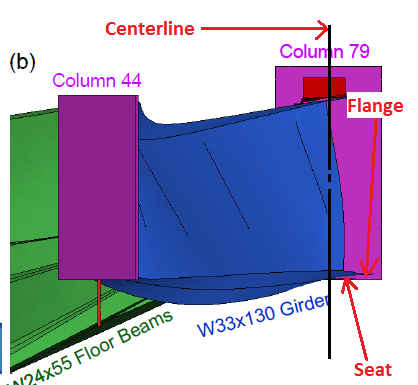
How do you get that the picture below shows the beam rocking off to the east? The bottom flange (called out with the red arrow) of the girder is shown to be out past the edge of the seat (the line pointed at and called out with the red arrow). That shows the girder being pushed west. Also, the web of the girder is shown to be WEST (pushed to the right) of the centerline of column 79.
seat1.png
 
How do you get that the picture below shows the beam rocking off to the east? The bottom flange (called out with the red arrow) of the girder is shown to be out past the edge of the seat (the line pointed at and called out with the red arrow). That shows the girder being pushed west. Also, the web of the girder is shown to be WEST (pushed to the right) of the centerline of column 79.
http://i238.photobucket.com/albums/ff290/gamolon/seat1.png
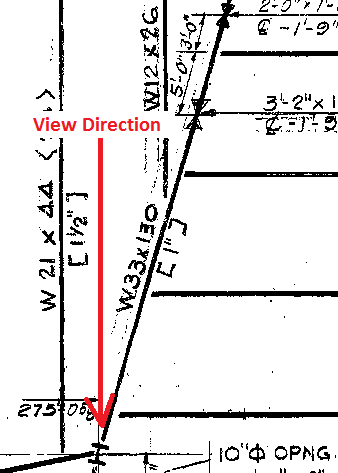
The beams are on the east side so it's rocking to the east. The view is from the west side.
 
The beams are on the east side so it's rocking to the east. The view is from the west side.

No.

In that picture, west is to the right and east is to the left.

The web of the girder is pushed to the right of the centerline of the face of column 79 (west) and the bottom flange end of the girder is pushed west of the seat.

How can the girder be moving east when the bottom flange end is pushed PASSED the edge of the seat to the right (west) and the web is to the right (west) of the face centerline of the column?
S-8girder1.png
 
You did not understand Mark's point. Read it again.
I think he refers to YOUR references, so consult YOUR page numbers, and then go look what the respective contexts are: Two different simulations.

Now I don't know the answer to the following question but: Are both simulations (LS-DYNA and ANSYS Case B) used to suppport the eventual comclusion? I understand that where there is a Case B, there may also be cases A and C. Is Case B the relevant one?
Thank you Oystein. Your comment rang true enough that it caused me to go back and check it out. I don't know how I missed the significance of this but yours and Marks comments got me to see it a different way than I had been interpreting it:
1-9 Vol.1 pg 353
This analysis demonstrated possible failure mechanisms that were used to develop the leading collapse hypothesis further. The failure modes in this model were incorporated into the 16 story ANSYS and 47 story LS-DYNA analyses

That explains the two theories. Thank you Mark for your comment. I have no problem making a 180 degree turn when presented with a convincing point that proves my current thinking wrong and this is such a case.

However, I see a problem with GIGO in the subsequent analyses. There are numerous fraudulent aspects in the "rock to the east" analysis.

1) they applied 4 hours of heat at 1100
oF but the fires only burned for 20 to 30 minutes in any location
2) they heated the entire area all at once but that is not what happened in the actual fire.
3) They applied that 4 hours of heat in 1.5 seconds giving a false result. That did not allow the beams to sag which they would have done because the bottom flange would be hotter that the top flange. It also did not allow for heat dispersal thru the slab and to other structural members.
4) They heated the beam but not the slab to get the shear studs to fail. That gave a false, excessive temperature differential.
5) they lied about the width of the seat.

These were not carried forward but they are worth mentioning because they are fraudulent
6) once the bolts on the seat and top clip had broken there would be no axial restraint on the beams on that end so they would not buckle.
7) they left out the three short cross beams between the exterior wall and the northmost floor beam as well a one more between that beam and the next. It would not have buckled sideways but downward.
 
Last edited:
No.

In that picture, west is to the right and east is to the left.

The web of the girder is pushed to the right of the centerline of the face of column 79 (west) and the bottom flange end of the girder is pushed west of the seat.
Correct

How can the girder be moving east when the bottom flange end is pushed PASSED the edge of the seat
Incorrect. The bottom flange is still on the seat and the top is bending to the east in the middle. The graphic is not clear but the text says that the collapsing floor beams on the east side rocked the girder [needs a pivot point] off its seat.

http://i238.photobucket.com/albums/ff290/gamolon/S-8girder1.png
 
It's really not a great diagram, but it looks to me like the girder is twisted, with the bottom being pushed west and the top east.
 
Thank you Oystein. Your comment rang true enough that it caused me to go back and check it out. I don't know how I missed the significance of this but yours and Marks comments got me to see it a different way than I had been interpreting it:
...
That explains the two theories. Thank you Mark for your comment. I have no problem making a 180 degree turn when presented with a convincing point that proves my current thinking wrong and this is such a case.
You're welcome, and thanks for digging deeper. I have never worked my way through NIST's Building 7 report, as this is not one of my main interests, but I do follow debates somewhat, and I am glad some people are reading carefully.

However, I see a problem with GIGO in the subsequent analyses. There are numerous fraudulent aspects in the "rock to the east" analysis.
Hmm after this latest experience with your missing something, perhaps you ought to be more cautious with words such as "fraudulent"? GIGO is a base problem for all simulations, and can't fully be excluded when sims get as complex as this one. But does that constitute fraud? It's fraud if false statements are made on purpose. I don't think you can prove fraud by just reading the allegedly fraudulent document - any information within that reveals wrong information would almost by definition be evidence against fraud.

1) they applied 4 hours of heat at 1100[/FONT]oF but the fires only burned for 20 to 30 minutes in any location
2) they heated the entire area all at once but that is not what happened in the actual fire.
3) They applied that 4 hours of heat in 1.5 seconds giving a false result. That did not allow the beams to sag which they would have done because the bottom flange would be hotter that the top flange. It also did not allow for heat dispersal thru the slab and to other structural members.
4) They heated the beam but not the slab to get the shear studs to fail. That gave a false, excessive temperature differential.
5) they lied about the width of the seat.

These were not carried forward but they are worth mentioning because they are fraudulent
6) once the bolts on the seat and top clip had broken there would be no axial restraint on the beams on that end so they would not buckle.
7) they left out the three short cross beams between the exterior wall and the northmost floor beam as well a one more between that beam and the next. It would not have buckled sideways but downward.

They lied about the width of the seat? How do you know? You think someone sat there, looked up 12 inches, and then said to himself "nyahhh, I am gonna show them suckers" and deleted the 2 and wrote 1 instead to make it 11 inches? Why do you think so? Does it make a difference? Would a seat width of 12 inches made a fundamental difference? If not, why would anybody lie here, instead of err - or perhaps the 12 inches are erroneous, I am not sure that this has been determined in this thread yet.

The details of how they simulated what - I wouldn't call detailed and open information about what they really did "fraud". If I tell you that I took 4 apples from your kitchen, left no money, but cleaned the sink instead, would I be fraudulent because you expected me to take 2 oranges in exchange for drying the dishes? I think "fraud" is really the wrong word here. You could say that you think what they did is wrong or stupid or incompetent or has this and this problem, but since they inform you exactly on the shortcuts they used, there is no fraud. It would be fraud if they said they simulated 20 minutes of 1100° when in fact they applied 4 hours.


I think you would be a lot smarter if you didn't use such derogatory terms to describe your disagreement with methods. You see, perhaps the problem is not their methods, perhaps the problem is your insufficient understanding for the rationale behind those methods. Perhaps you have never used ANSYS or LS-DYNA before to do such simulation? Perhaps 1.5 seconds are plenty in such sims to account for bending of beams? I don't know. Elsewhere, when they build up the entire structure, they apply gravitational loads over a period of several seconds, to allow for normal stress to build up gradually. This is of course far from reality: They did not build WTC7 to completion in zero gravity and then cranked up gravity linearly over a few seconds. Instead, it took months for the gravity loads to build up. Was that fraud, too?

 
Last edited:
You're welcome, and thanks for digging deeper. I have never worked my way through NIST's Building 7 report, as this is not one of my main interests, but I do follow debates somewhat, and I am glad some people are reading carefully.


Hmm after this latest experience with your missing something, perhaps you ought to be more cautious with words such as "fraudulent"? GIGO is a base problem for all simulations, and can't fully be excluded when sims get as complex as this one. But does that constitute fraud? It's fraud if false statements are made on purpose. I don't think you can prove fraud by just reading the allegedly fraudulent document - any information within that reveals wrong information would almost by definition be evidence against fraud.


They lied about the width of the seat? How do you know? You think someone sat there, looked up 12 inches, and then said to himself "nyahhh, I am gonna show them suckers" and deleted the 2 and wrote 1 instead to make it 11 inches? Why do you think so? Does it make a difference? Would a seat width of 12 inches made a fundamental difference? If not, why would anybody lie here, instead of err - or perhaps the 12 inches are erroneous, I am not sure that this has been determined in this thread yet.

The details of how they simulated what - I wouldn't call detailed and open information about what they really did "fraud". If I tell you that I took 4 apples from your kitchen, left no money, but cleaned the sink instead, would I be fraudulent because you expected me to take 2 oranges in exchange for drying the dishes? I think "fraud" is really the wrong word here. You could say that you think what they did is wrong or stupid or incompetent or has this and this problem, but since they inform you exactly on the shortcuts they used, there is no fraud. It would be fraud if they said they simulated 20 minutes of 1100° when in fact they applied 4 hours.


I think you would be a lot smarter if you didn't use such derogatory terms to describe your disagreement with methods. You see, perhaps the problem is not their methods, perhaps the problem is your insufficient understanding for the rationale behind those methods. Perhaps you have never used ANSYS or LS-DYNA before to do such simulation? Perhaps 1.5 seconds are plenty in such sims to account for bending of beams? I don't know. Elsewhere, when they build up the entire structure, they apply gravitational loads over a period of several seconds, to allow for normal stress to build up gradually. This is of course far from reality: They did not build WTC7 to completion in zero gravity and then cranked up gravity linearly over a few seconds. Instead, it took months for the gravity loads to build up. Was that fraud, too?

The bottom line is, according to the truthers, that NIST made a mistake which discredits their end conclusion. NIST clearly states that the seat was 11 in. wide and that the girder would need to be pushed 5.5 in. due to thermal expansion in order for it to come of it's seat and fail.

What I see is the in addition to thermal expansion, was the sagging of the floor beams AND the girder that also contributed to girder coming off it's seat. Also, the heat would have weakened the seat plate.

I don't see where any of this is explained by NIST, so the truthers are sticking to those two mistakes as gospel and using them to invalidate the end result, being that the girder walked of it's seat.

In their eyes, using the information in NIST's report, the beam should still be on the seat.

My question is, how do you argue with that? Is there more in the report that is being missed?
 
Last edited:
The bottom line is, according to the truthers, that NIST made a mistake which discredits their end conclusion. NIST clearly states that the seat was 11 in. wide and that the girder would need to be pushed 5.5 in. due to thermal expansion in order for it to come of it's seat and fail.

What I see is the in addition to thermal expansion, was the sagging of the floor beams AND the girder that also contributed to girder coming off it's seat. Also, the heat would have weakened the seat plate.

I don't see where any of this is explained by NIST, so the truthers are sticking to those two mistakes as gospel and using them to invalidate the end result, being that the girder walked of it's seat.

In their eyes, using the information in NIST's report, the beam should still be on the seat.

My question is, how do you argue with that? Is there more in the report that is being missed?

My question is: How sensitive is the model to such changes in values - does it really make a difference if the girder needed to walk 5.5 or 6 inches? There is considerably uncertainty about input values, and about intermediary values (like for how long which temperatures were reached). NIST tried to "tweak" the input values such that the result resembles observations rather well without leaving a comfort zone of reasonable assumptions. That is how you work such models. Many truthers object already to this approach.

Will you find more mistakes if you keep looking? Yes, without a doubt. Some of the mistakes will, if corrected, make the collapse more likely, some less likely. Question is how sensitive the model is to such mistakes.


What NIST modeled a building that is very similar to what WTC7 really was, and also fires that were very similar to the observed fires. If the physics and engineering incorporated into the software works correct, they showed that a building very similar to WTC7 can collapse if subjected to fires very similar to the fires of 9/11, in a fashion that looks very similar to the real collapse.

So does it matter much if they are not exact in every detail? Is it reasonable to expect that they are perfectly correct in every detail?
 
Status
Not open for further replies.

Back
Top Bottom