• Security incident: ISF was recently accessed by intruders. Please change your password, and change it anywhere else you used it. Read more

Belief in the Afterlife

Actually the topic was that I'm not so interested in the evidence per se, at this juncture, for the existence of the Afterlife as the psychological and sociological forces behind the theory. Why do people believe it it? Who do people not believe in it?;)

People don't believe in it because there is no credible evidence for it. Provide that evidence and one is helpless but to believe it.

Anecdotes don't get it.
 
People don't believe in it because there is no credible evidence for it. Provide that evidence and one is helpless but to believe it.

Anecdotes don't get it.

Technically, anecdotes are evidence, they're just not reliable evidence. That's the error most people make when they hear a story (read about it, see it portrayed on TV or in the movies, etc.) about a NDE. They accept the veracity of the story, and don't seek to couple it with more reliable forms of evidence to provide any kind of valid proof.
 
Technically, anecdotes are evidence, they're just not reliable evidence. That's the error most people make when they hear a story (read about it, see it portrayed on TV or in the movies, etc.) about a NDE. They accept the veracity of the story, and don't seek to couple it with more reliable forms of evidence to provide any kind of valid proof.

Which is why I said anecdotes don't get it. They can't stand on their own as evidence for themselves. Well, for an NDE anyway. You tell me you walked your doggy last night and I say well okay; tell me you pulsed out and saw god, I'm looking for more info.
 
What's more he added something more that I profoundly agree with: He said that if there is any kind of Life-After-Death then the religions are not in any way related to it.

I do not believe you for a second. Link to quote please.

ETA: In other words, I think you're full of bovine excrement... again.
 
Last edited:
Which is why I said anecdotes don't get it. They can't stand on their own as evidence for themselves. Well, for an NDE anyway. You tell me you walked your doggy last night and I say well okay; tell me you pulsed out and saw god, I'm looking for more info.

Sorry, I didn't read that in your post. I'm not trying to be argumentative.
 
... my main point is that such a statement cuts both ways: If NDE's are glimpses of the real Afterlife then wishing them not to be real, and desperately hoping that they're just illusions of the hypoxic, dying brain, for reasons of MBA-hood or other motives, doesn't maker that true either.
So how would you interpret the NDE-like experiences reported under experimental or accidental hypoxia?

For example, some military pilots undergoing G-stress testing and training in centrifuges have reported the tunnels of white light, ghostly figures, etc., when they come round having lost consciousness. Are these hallucinations caused by hypoxia, or does hypoxia allow glimpses of the afterlife?

Which seems the most plausible explanation?
 
I do not believe you for a second. Link to quote please.

ETA: In other words, I think you're full of bovine excrement... again.

It's around 24 mins in to this interview

To summarise, it's in the context of talking about Pascal's wager, and saying that if, hypothetically, there is life after death (which he's strongly convinced there isn't), then no human knows what the requirements for qualification are (if there are any).
 
What I have an issue with is that disbelief in the Afterlife is somehow the purely pragmatic and rational option, and that belief in the Afterlife is generated though wishful-thinking.

That's a bit like saying that rejecting the existence of pink invisible unicorns is due to the fear of the unknown.

Psychological motivations underlying adopting the null hypothesis, even if thos motivations actually exist, are neither necessary nor sufficient for adoption of the null hypothesis.
 
That's a bit like saying that rejecting the existence of pink invisible unicorns is due to the fear of the unknown.

Psychological motivations underlying adopting the null hypothesis, even if thos motivations actually exist, are neither necessary nor sufficient for adoption of the null hypothesis.


Neither belief nor disbelief are required in order to consider how an afterlife may be possible. However pink invisible unicorns aren't even possible because it's a logical contradiction.
 
Neither belief nor disbelief are required in order to consider how an afterlife may be possible.
True, if we're just brainstorming hypothesis and make no pretense to sufficient evidence.

However pink invisible unicorns aren't even possible because it's a logical contradiction.

Good point, except that the logical contradiction you noted is completely superfluous to my point. Remove "pink" or "invisible" (thereby removing the logical contradiction) and my point stands just as well.
 
True, if we're just brainstorming hypothesis and make no pretense to sufficient evidence.

Good point, except that the logical contradiction you noted is completely superfluous to my point. Remove "pink" or "invisible" (thereby removing the logical contradiction) and my point stands just as well.


Still not sure how how pragmatic and rational equates to a bit like fear of the unknown, or how pink or invisible unicorns have anything to do with the possibility of an afterlife. But BTW, not long ago I heard a story on the radio about a unicorn sighting in Italy, but it wasn't pink, which must be why the skeptics have moved the goalposts from normal colored unicorns to pink ones ... they must have caught wind of the story someplace and decided to add "pink" in there just to be on the safe side ;)
 
But BTW, not long ago I heard a story on the radio about a unicorn sighting in Italy, but it wasn't pink, which must be why the skeptics have moved the goalposts from normal colored unicorns to pink ones ... they must have caught wind of the story someplace and decided to add "pink" in there just to be on the safe side ;)

No, the Pink Unicorns have been around a long time and I have studied their history... I can even prove that pink unicorns exist.

Let's look at the evidence: Many stories about unicorns have been written through the ages so they must be based on fact. A list of the unicorn stories to support my claim that they have been seen and recognised for a long time is:
The First Animal Named
Daniel and the Unicorn
King Arthur and the Unicorn
The Unicorn Who Walks Alone
The Fair Maid and the Snow White Unicorn
Shimmer
The Court of the Summer King

Unicorns get more than one mention in the Bible... An accurate historical record of our planet's history:
Numbers 24:8 “God brought him forth out of Egypt; he hath as it were the strength of a unicorn: he shall eat up the nations his enemies, and shall break their bones, and pierce them through with his arrows.”
Deuteronomy 33:17 “His glory is like the firstling of his bullock, and his horns are like the horns of unicorns: with them he shall push the people together to the ends of the earth: and they are the ten thousands of Ephraim, and they are the thousands of Manasseh.”
Job 39:9-10 “Will the unicorn be willing to serve thee, or abide by thy crib? Canst thou bind the unicorn with his band in the furrow? or will he harrow the valleys after thee?”
Psalm 22:21 “Save me from the lion's mouth: for thou hast heard me from the horns of the unicorns.”
Psalm 29:6 “He maketh them also to skip like a calf; Lebanon and Sirion like a young unicorn.”
Psalm 92:10 “But my horn shalt thou exalt like the horn of a unicorn: I shall be anointed with fresh oil.”
Isaiah 34:7 “And the unicorns shall come down with them, and the bullocks with the bulls; and their land shall be soaked with blood, and their dust made fat with fatness.”

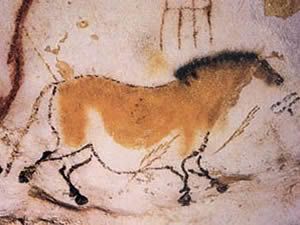
And even before the Bible was written, during the Upper Paleolithic period, people were painting Unicorn's on cave walls:
Lascaux-cave-painting.jpg

http://www.theartwolf.com/news/lascaux-caves-danger.htm

So let's move on the physical biological evidence for Unicorns.
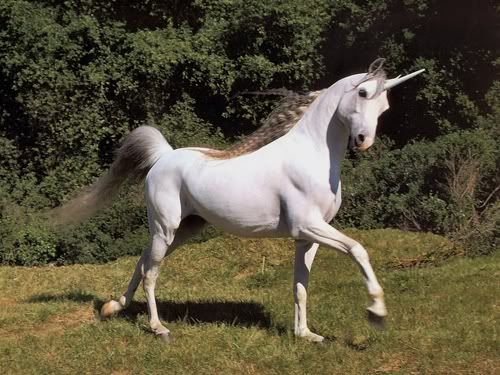
Well we know that a Unicorn looks like this:
unicorn.jpg


Because here is a photo of one.

But despite some people photographing them over the years, we have never actually been able to prove their existence, because no scientist has ever managed to capture one. So let's look at the data available.

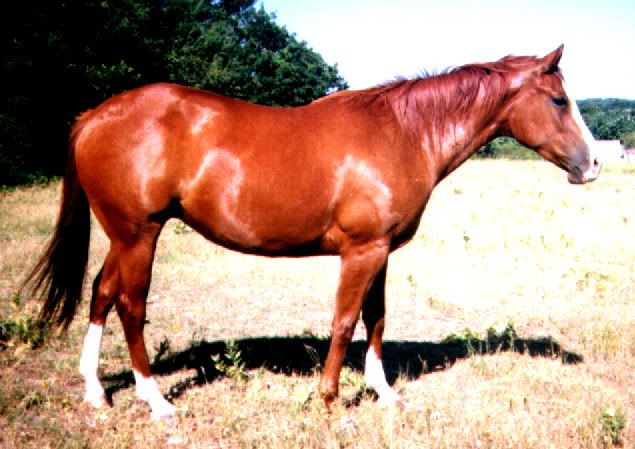
The above photo is obviously based upon one of these animals:
horse.jpg


A horse...which we have much conclusive proof of the existence of and biological data: http://en.wikipedia.org/wiki/Horse
but it's the wrong colour. We are looking for proof of a pink unicorn...

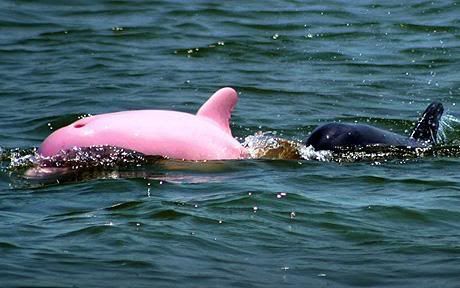
Well as the horse is a mammal, if it was possible to have a pink mammal, it would prove that it is possible to have a pink horse.
pink_dolphin.jpg

A pink mammal then!
http://www.recipezaar.com/bb/viewtopic.zsp?t=294948
Which we know is a mammal because scientists have examined them in great detail: http://en.wikipedia.org/wiki/Dolphin

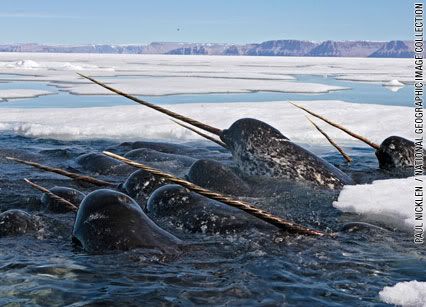
So now all the various bits are coming together, we know we can have a pink horse. All that is missing is a single horn...

narwhals_closeup.jpg

The Narwhal is only one contender... because of it's closer relationship to the pink dolphin, but there are a few others.

Here's one that bears more than a passing resemblance to the horse:
unicorn_narrowweb__300x4520.jpg

A single horned deer.
Full story here

So now you can see how all this evidence builds up into a picture of Pink Unicorns being real...

I would further contend that there are two distinct species of pink unicorns too. A visible and an invisible kind... the invisible one's are proving much harder to pin down the evidence for though, so there is much doubt as to their true existence.

 
Still not sure how how pragmatic and rational equates to a bit like fear of the unknown, or how pink or invisible unicorns have anything to do with the possibility of an afterlife.

Here's how it works:

What I have an issue with is that disbelief in the Afterlife is somehow the purely pragmatic and rational option, and that belief in the Afterlife is generated though wishful-thinking.

Porterboy is hypothesizing about how disbelief in the afterlife might have some non-rational psychological motives, just like atheists sometimes psychologize about how believers in the afterlife do so as wishful thinking.

So my reply,

That's a bit like saying that rejecting the existence of pink invisible unicorns is due to the fear of the unknown.

Psychological motivations underlying adopting the null hypothesis, even if thos motivations actually exist, are neither necessary nor sufficient for adoption of the null hypothesis.

makes the point that because no belief in the afterlife is the null hypothesis, any psychological motivation for no belief in the afterlife is superfluous, just like if fear were the reason for disbelieving in unicorns. In both cases, a psychological reason is given for a position, but those psychological reasons are neither necessary nor sufficient for holding those beliefs. The null hypothesis is held for other (rational) reasons.
 
Good post. But the concept of an afterlife is relevant because a generated construct could possibly facilitate it by way of memory storage of our data. Conceivably our data ( that which makes us us ) could be inserted into any other realm after our death in this one. If there existed a record of our entire existence, then we could be resurrected with complete memories and fully intact bodies. In every meaningful way this would amount to life after death.
I was reading a sci-book about that recently; sorry:o can't remember the title. One of the characters was terminally ill and wanted to put his mind onto computer. In that situation you could also produce a copy of yourself, like copying a file, which would mean there'd be two of you, till you died. :eek:
 
I was reading a sci-book about that recently; sorry:o can't remember the title. One of the characters was terminally ill and wanted to put his mind onto computer. In that situation you could also produce a copy of yourself, like copying a file, which would mean there'd be two of you, till you died. :eek:

I think that the key word here is fiction.
 
, but that's not me controlling it, and while a crude form of the "computational model" the parallel is correct. It's not afterlife, it's a mimic.
Like Rimmer's hologram in Red Dwarf. He says: "This is not me." (pointing to himself, which is a philosophical paradox!:confused:) "This is a computer simulation of me."
 
It does not mean that someone who doesn't believe must think this.

My tack is "I have to face it." Whether I face it well or not is another matter.
I know, I mustn't generalize.:o Skeptics are as much individuals as Woo's are. What I'm doing is reporting my assessment of what I gather from speaking to non-Afterlife-believers and reading Materialist research and commentary.
 
Here's how it works:


Porterboy is hypothesizing about how disbelief in the afterlife might have some non-rational psychological motives, just like atheists sometimes psychologize about how believers in the afterlife do so as wishful thinking.

So my reply,


makes the point that because no belief in the afterlife is the null hypothesis, any psychological motivation for no belief in the afterlife is superfluous, just like if fear were the reason for disbelieving in unicorns. In both cases, a psychological reason is given for a position, but those psychological reasons are neither necessary nor sufficient for holding those beliefs. The null hypothesis is held for other (rational) reasons.


Geeze you've gone all serious on me. I thought we could play with the issue of pink unicorns some more. Anyway, the concept of belief is an emotional and/or faith driven state. If it weren't in the title of this thread, we could leave the issue of belief out of it altogether and simply call this thread "The Afterlife" and debate about whether or not A: It exists. or B: It doesn't exist. But having a null hypothesis on a belief isn't really the same thing, and it's not something that can be measured empirically. We simply have to take someone's word that are telling the truth about what they believe ... and regardless of whatever they believe, it still may not be the way things actually are. So perhaps the bottom line issue is why believe anything until you can be reasonably certain it's actually the way things are. Is there any way to reasonably certain that an afterlife is possible? Yes. Can we be reasonably sure about anything else? Maybe. But how? That would depend on an understanding of the nature of reality itself ... we're not there yet.
 
So perhaps the bottom line issue is why believe anything until you can be reasonably certain it's actually the way things are.

Be careful, you are getting dangerously close to understanding the concept of the null hypothesis.
 

ISF - Join now!

Every member here is approved by hand. No bots, no spam, just people who care about evidence and honest debate.

Membership is free!

Create your free account

Back
Top Bottom