
-
Security incident: ISF was recently accessed by intruders. Please change your password, and change it anywhere else you used it. Read more
You are using an out of date browser. It may not display this or other websites correctly.
You should upgrade or use an alternative browser.
You should upgrade or use an alternative browser.
Black Smoke=Incomplete Combustion?
triforcharity
Banned

- Joined
- Jun 23, 2009
- Messages
- 13,961
Sorry, that was my department. We got it confused. We have narrowed it down to two employees, and they are both going to have a shootout at the OK Corral, to see who gets to stay here at NWO headquarters.
I'll keep you posted.
I'll keep you posted.
twinstead
Penultimate Amazing

- Joined
- Apr 8, 2005
- Messages
- 12,374
Sorry, that was my department. We got it confused. We have narrowed it down to two employees, and they are both going to have a shootout at the OK Corral, to see who gets to stay here at NWO headquarters.
I'll keep you posted.
Well, at least you're taking care of the problem. In their defense though, the "raging inferno" and "oxygen-starved fires" settings are way too close together. I must give some blame to the smoke generator manufacturer.
Sabretooth
No Ordinary Rabbit

The fact that you've now moved on to two new strawmen arguments, after providing "explanations" about incomplete combustion that were already provided in my posts suggests to me that you've now conceded the point. Good.
What's the next topic? Why smoke can't weaken steel?
Yes, yes, your "incomplete combustion" comment is technically accurate...
But...as TFC has already pointed out, it is nearly impossible to achieve "complete combustion", so the argument really is pointless...
...now, how about making your point?
cludgie
Critical Thinker

- Joined
- Feb 15, 2007
- Messages
- 312
Tell them to run 'buncefield oil depot' through Google Images. A storage depot fire in the UK a few years ago where the initial explosions could be heard about 60 miles away and the smoke was visible that far away too. The fires took 2 days to put out.
Justin39640
Illuminator

- Joined
- May 22, 2009
- Messages
- 4,202
Yes, yes, your "incomplete combustion" comment is technically accurate...
But...as TFC has already pointed out, it is nearly impossible to achieve "complete combustion", so the argument really is pointless...
...now, how about making your point?
Just think of what your car does to try to get as complete a burn as possible from the smallest amount of fuel, and still isn't 100%.
Last edited:
Sword_Of_Truth
Penultimate Amazing
- Joined
- May 8, 2006
- Messages
- 11,494
Just a reminder, for those who can't handle the truth, even a frigging campfire can turn steel into partially cooked spaghetti:
(note the presence of smoke indicating incomplete combustion)
(note the presence of smoke indicating incomplete combustion)

Ah, so that explains why you've never been able to answer whether you think it is possible to tell the time of day from the sun's position.Darn, can't read any of zero, zero, zero, zero 63's posts.
MattTheTubaGuy
Critical Thinker

- Joined
- Mar 15, 2010
- Messages
- 261
See the NIST dry Christmas tree fire video for an example of ordinary room contents generating thick dark smoke and getting mighty hot. Flashover (when basically everything in the room, including fire gases like carbon monoxide (ignition temp ~ 1100F), all burn at once) occurs around 40 seconds elapsed time. It's scary as heck and very impressive.
OMG that's scary!
I really hope I never have to contend with a fire! (I really don't think all my LEGO will help in a fire, or should I say, it WILL help the fire!)
I haven't really seen many fires, but I have seen the effects of them.
A school hall of one of the local schools was burnt down by some stupid teenagers. the result: bent and buckled steel structure from the roof over the charred remains of the hall.
NoahFence
Banned

Ah, so that explains why you've never been able to answer whether you think it is possible to tell the time of day from the sun's position.
Viewing the Science Channel (Or was it History) and their show "Rising" - the new Terminal at Ground Zero is designed to use the sun's rays at exactly the time of the 1st impact to shine a beam of light into the Terminal.
sheeplesnshills
Illuminator
- Joined
- Mar 5, 2010
- Messages
- 3,706
Here we have 40ft(?) flames coming from the South tower and black smoke
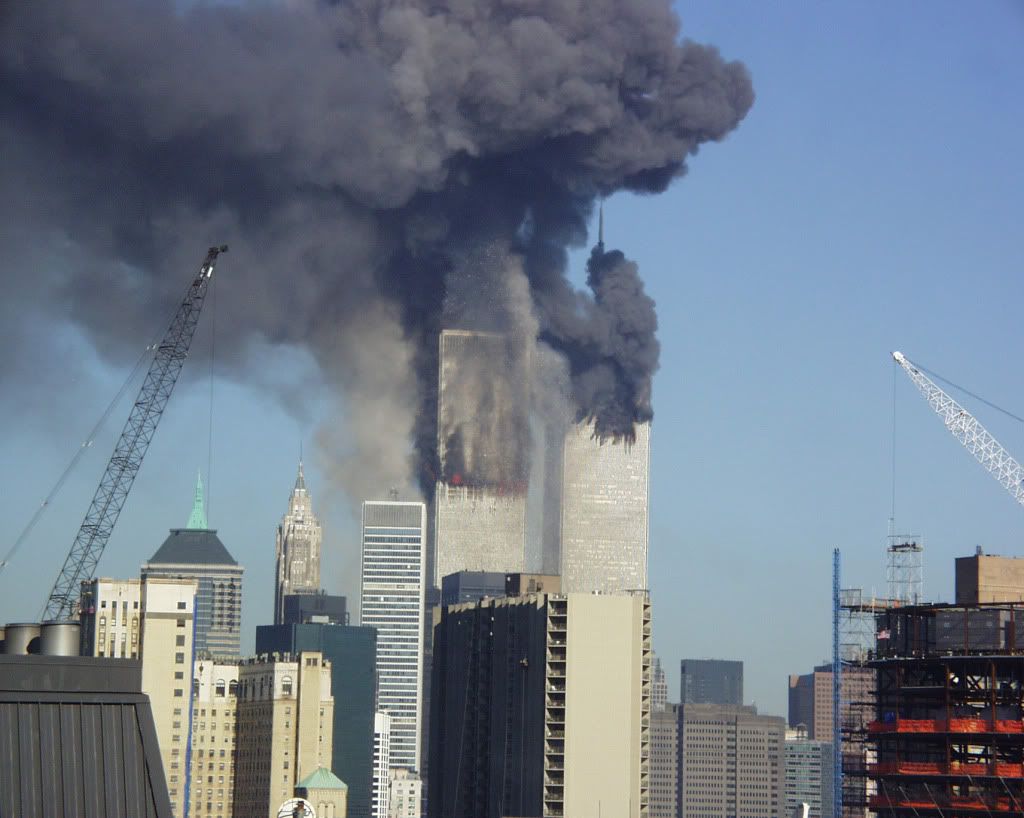
and here we have similar flame in the north tower after the south tower fell.....and more black smoke.
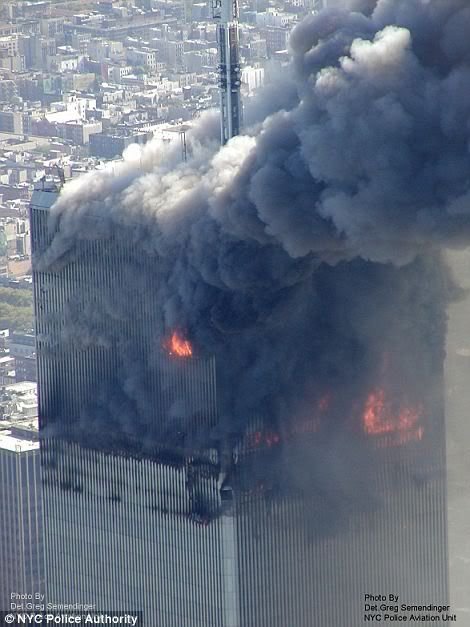
I don't care if either were"incomplete combustion".....they sure look hot to me.
and here we have similar flame in the north tower after the south tower fell.....and more black smoke.
I don't care if either were"incomplete combustion".....they sure look hot to me.
Trojan
Muse
Just had a truther raise this argument
I gave him this citation in reply
http://www.fireengineering.com/arti...ssue-9/features/the-art-of-reading-smoke.html
Black Fire
“Black fire” is a good phrase to describe smoke that is high-volume, turbulent velocity, ultradense, and black. Black fire is a sure sign of impending autoignition and flashover. In actuality, the phrase “black fire” is accurate-the smoke itself is doing all the destruction that flames would cause-charring, heat damage to steel, content destruction, and victim death. Black fire can reach temperatures of more than 1,000°F! Treat black fire just as actual flames-vent and cool.
Wind, thermal balance, fire streams, ventilation openings, and sprinkler systems change the appearance of smoke. Analyze all smoke observations in proportion to the building. For example, smoke that is low-volume, slow-velocity, very thin, and light-colored may indicate a small fire, but only if the building or box is small. This same observation from several openings of a big-box store or large warehouse can indicate a large, dangerous fire.
"Basic facts here, thick black smoke is caused by incomplete combustion therefore, low temperature, that is lower temperatures that could be achieved by more complete combustion"
I gave him this citation in reply
http://www.fireengineering.com/arti...ssue-9/features/the-art-of-reading-smoke.html
Black Fire
“Black fire” is a good phrase to describe smoke that is high-volume, turbulent velocity, ultradense, and black. Black fire is a sure sign of impending autoignition and flashover. In actuality, the phrase “black fire” is accurate-the smoke itself is doing all the destruction that flames would cause-charring, heat damage to steel, content destruction, and victim death. Black fire can reach temperatures of more than 1,000°F! Treat black fire just as actual flames-vent and cool.
Wind, thermal balance, fire streams, ventilation openings, and sprinkler systems change the appearance of smoke. Analyze all smoke observations in proportion to the building. For example, smoke that is low-volume, slow-velocity, very thin, and light-colored may indicate a small fire, but only if the building or box is small. This same observation from several openings of a big-box store or large warehouse can indicate a large, dangerous fire.
Justin39640
Illuminator
- Joined
- May 22, 2009
- Messages
- 4,202
Just had a truther raise this argument
I gave him this citation in reply
http://www.fireengineering.com/arti...ssue-9/features/the-art-of-reading-smoke.html
Black Fire
“Black fire” is a good phrase to describe smoke that is high-volume, turbulent velocity, ultradense, and black. Black fire is a sure sign of impending autoignition and flashover. In actuality, the phrase “black fire” is accurate-the smoke itself is doing all the destruction that flames would cause-charring, heat damage to steel, content destruction, and victim death. Black fire can reach temperatures of more than 1,000°F! Treat black fire just as actual flames-vent and cool.
Wind, thermal balance, fire streams, ventilation openings, and sprinkler systems change the appearance of smoke. Analyze all smoke observations in proportion to the building. For example, smoke that is low-volume, slow-velocity, very thin, and light-colored may indicate a small fire, but only if the building or box is small. This same observation from several openings of a big-box store or large warehouse can indicate a large, dangerous fire.
Black smoke is usually a hydrocarbon fire. Ask him if he had ever seen a gasoline tanker truck fire.
www.youtube.com/watch?v=3V9TrY5cf_Q
www.youtube.com/watch?v=IBF65lCV4uc
All smoke indicates incomplete combustion. The color indicates what might be burning. If it was complete, there would be no smoke. Hence complete lol.
cjnewson88
Graduate Poster

- Joined
- Oct 19, 2011
- Messages
- 1,765
Sad but true that I had a truther try a tell me a couple of weeks ago that black smoke means the fire was nearly out.
Have these people ever started a bonfire with diesel before? Or burned a couch or bed mattress in the middle of the street in their student days? I'm guessing most are either townies that probably never stepped foot in rural areas before, and/or are drop-outs that never went to university.
Retarded argument, one of the worst. I put it in the same category as 'pull it'; just a waste of an argument.
Speaking of which, anyone noticed these sorts of desperate claims/theories that have been buried for the past few years are beginning to resurface? It's like every few years the retards are allowed off their meds for a month and they reappear on the internet.
Have these people ever started a bonfire with diesel before? Or burned a couch or bed mattress in the middle of the street in their student days? I'm guessing most are either townies that probably never stepped foot in rural areas before, and/or are drop-outs that never went to university.
Retarded argument, one of the worst. I put it in the same category as 'pull it'; just a waste of an argument.
Speaking of which, anyone noticed these sorts of desperate claims/theories that have been buried for the past few years are beginning to resurface? It's like every few years the retards are allowed off their meds for a month and they reappear on the internet.
ref
Master Poster

- Joined
- Dec 15, 2006
- Messages
- 2,685
Ooh, I love it when these ancient claims pop up! I get an excuse to revisit my history research!
Black smoke = Died down fire
What a silly claim. That must be an old one, since it's so silly. And guess what (drumroll) it is one of the first claims 9/11 truthers ever made, congratulations!
Jim McMichael (still no more info about this guy) did it with his October 21, 2001 article "Muslims Suspend Laws of Physics!" Yeah, you read it right, Jim originally wrote that piece in 2001.
Here is what he wrote: "Then by 9:03 (which time was marked by the second plane's collision with the south tower), the flame was mostly gone and only black smoke continued to pour from the building. To my simple mind, that would indicate that the first fire had died down, but something was still burning inefficiently, leaving soot (carbon) in the smoke. A fire with sooty smoke is either low temperature or starved for oxygen -- or both. http://www.fosters.com/news2001c/september/11/04758CA1-AC58-4591-9F50-5976D2 BE2E04.jpg"
That's it! That's all he wrote about the topic. He speculated with his, quote "simple mind"!
That's all it took to give birth to this, and the claim is still circulating over 10(!) years later. That's how thinly based these claims are, but damn they are sticky.
Black smoke = Died down fire
What a silly claim. That must be an old one, since it's so silly. And guess what (drumroll) it is one of the first claims 9/11 truthers ever made, congratulations!
Jim McMichael (still no more info about this guy) did it with his October 21, 2001 article "Muslims Suspend Laws of Physics!" Yeah, you read it right, Jim originally wrote that piece in 2001.
Here is what he wrote: "Then by 9:03 (which time was marked by the second plane's collision with the south tower), the flame was mostly gone and only black smoke continued to pour from the building. To my simple mind, that would indicate that the first fire had died down, but something was still burning inefficiently, leaving soot (carbon) in the smoke. A fire with sooty smoke is either low temperature or starved for oxygen -- or both. http://www.fosters.com/news2001c/september/11/04758CA1-AC58-4591-9F50-5976D2 BE2E04.jpg"
That's it! That's all he wrote about the topic. He speculated with his, quote "simple mind"!
That's all it took to give birth to this, and the claim is still circulating over 10(!) years later. That's how thinly based these claims are, but damn they are sticky.
Last edited:
leftysergeant
Penultimate Amazing

- Joined
- Jul 13, 2007
- Messages
- 18,863
Next time some moron says that black smoke means that the fire is going out, send the drooling fool here.
ergo
Illuminator

- Joined
- Aug 15, 2010
- Messages
- 4,339
Here is what he wrote: "Then by 9:03 (which time was marked by the second plane's collision with the south tower), the flame was mostly gone and only black smoke continued to pour from the building. To my simple mind, that would indicate that the first fire had died down, but something was still burning inefficiently, leaving soot (carbon) in the smoke. A fire with sooty smoke is either low temperature or starved for oxygen -- or both. http://www.fosters.com/news2001c/september/11/04758CA1-AC58-4591-9F50-5976D2 BE2E04.jpg"
That's it! That's all he wrote about the topic. He speculated with his, quote "simple mind"!
.
Yes, large volumes of thick smoke without attendant flames do indicate a struggling fire. Why? Because smoke is incomplete combustion.

NoahFence
Banned
Yes, large volumes of thick smoke without attendant flames do indicate a struggling fire. Why? Because smoke is incomplete combustion.
Were the flames coming from the twin towers attendant enough for you?
Is there one idiotic truther meme that you'll admit is made up bunk?
sheeplesnshills
Illuminator
- Joined
- Mar 5, 2010
- Messages
- 3,706
Yes, large volumes of thick smoke without attendant flames do indicate a struggling fire. Why? Because smoke is incomplete combustion.
which takes us back to this picture again.........does this fire look like its "struggling"?
This is after the collapse of WTC2 and so long after most iof not all the jet fuel has gone......
ergo
Illuminator
- Joined
- Aug 15, 2010
- Messages
- 4,339
which takes us back to this picture again.........does this fire look like its "struggling"?
No, I would agree that the fires that are visible in that shot look very robust.
But with the exception of the one on the corner (in sheeples' image) which is exuding a thick black smoke cloud, you can see the rest of the visible fire has much less smoke issuing from it. It's the floors where we don't see flames that are issuing the most smoke.
When skeptics talk about the towers being mostly smoking rather than flaming they are referring to how the towers appeared generally over the course of time that they burned:


The burning was never seen to engulf an entire floor at once. And comparing this to other building fires, these were not infernos.
Last edited: