• Quick note - the problem with Youtube videos not embedding on the forum appears to have been fixed, thanks to ZiprHead. If you do still see problems let me know.

Explain consciousness to the layman.

Status
Not open for further replies.
I believe you are using one, right now, to post to this very forum! :jaw-dropp

Yes, that thing on your lap or desktop is a Turing machine with many, many optimizations. Strip out all the optimizations, like word width and pipelining etc., and you can distill any computing machine into a one-bit Turing machine. Processor/memory -- they are functionally identical. That machine on you lap or desk just does it faster.
 
It should be noted that a machine that can control robot spiders (or indeed CG spiders that operate in real time) is not the same thing as a Turing machine. It's a control mechanism.

The brain IS a control mechanism. It's purpose, from the c. elagans to Einstein and everything in between, is to take input from the world, process it with past input, then tell the body what to do to survive(1).

Whether it's a computer program controlling a robot spider or an onscreen spider, or replaces the wet brain in a real spider, the argument is they are doing the same thing and it's unclear if a turing machine could never do this in c. elegans, spiders, or humans.

(1) More specifically, the brain is a collection of modules, each of which has the purpose of increasing the likelihood that the genes responsible for creating that module are replicated. Our first task then is to identify how the consciousness module helps pass on the genes that create it (I'm not eliminating the possibility it's a diffuse emergent module that's a characteristic of the brain as a whole).

For example, the module responsible for a strong red quale helps one grab a red fruit in green foliage before one with weaker red quale might. In an environment with a shortage of food, genes for a weak or missing red quale will not be passed on, and those for a strong one will.

Understanding of every feature of the brain and of consciousness can be helped by this model. Also, each feature seems to me computable.

This sense that consciousness and qualia are outside of what is computable doesn't logically follow from the idea that all the modules that make up C+Q are computable.

Why we feel that the subjective experience of redness requires some kind of immaterial magic is the remaining mystery.
 
Last edited:
If and when we figure out how the sense of qualia emerges in our consciousness, we will probably know the steps that would lead to it.

I do believe we'd have to determine if qualia exist, first. Your post answers none of my questions.

Proto-qualia would have some, but not all, of the stages of what we would figure out qualia to be. The answers will become more specific, once the details become more specific.

I'd like you to become more specific. You usually are.
 
Why we feel that the subjective experience of redness requires some kind of immaterial magic is the remaining mystery.


When we encounter a puddle and sidestep it we are not aware of actually THINKING about all the processes that went into taking the action of sidestepping. We did not say
  • I am analyzing the image on my retina
  • I am comparing that to my long term memory
  • I am analyzing what it is
  • Aha it is a puddle
  • That means it is wet
  • That means my shoes are going to get wet
  • Getting wet shoes is not good
  • I better direct my muscles to move to the Left or right…which is better?
  • Let me look left and right and see which is a better course of action
  • Let me analyze the image on my retina
  • Etc. etc. etc.

Each of the above actions requires a similar process of a detailed sub-list of thinking. But we do not THINK all this….it is done by various parts of the brain automatically. We are not AWARE of thinking about each process.

Just moving an arm to grab an object on a table from among other objects and obstacles on the table requires a TREMENDOUS amount of processing and sub-processing and sub-sub-processing and the vast majority of it is done without a conscious deliberate willful process of doing them.

If you have ever tried to program a robot arm to autonomously perform the above task you would know what amazing accomplishment it is to do the action. If you ever watch a baby trying to learn how to do the same task you would gain an insight into how different a robot program is from the human learning process. The human brain never solves any Jacobians to move an arm around obstacles and grab an object. We never do any matrix inversion or solve forward kinematics and reverse kinematics matrixes in our brains.

Have you ever heard of Ivan Pavlov and his experiments about Conditioning?


In Pavlov's famous experiment he got dogs to drool saliva every time they heard a bell.

In other words there was a mental reaction in the brain of the dogs whenever they heard the bell. This mental reaction caused the dog to believe that there is food and thus start drooling as if there is real food.

All that was the result of CONDITIONING.

The experiment was done on Dogs but the very same principles are applied on humans to cure things such as phobias and addictions and other psychological problems. Even skills such as piloting a plane or fighting can be honed by conditioning methods.

Conditioning is nothing more than repetitively subjecting the person to something for the brain to eventually start thinking about it on a LOWER LEVEL of processing that higher levels become unnecessary in the actions carried out.

There are SCADS of things the brain carries out without the need for the higher levels of thinking.
  • A baby does not THINK about how to suckle whenever a teat is introduced in its mouth.
  • We do not DELIBERATELY raise the level of Adrenalin to help the muscles work faster and stronger whenever we are afraid.
  • We are not specifically aware of the actions of our digestive system. We do not THINK the stomach into secreting the enzymes and into pulsating the muscles to push the food to the intestines etc.
  • Once we learn how, we never think again about preventing our bladder action during sleep....despite the sleep condition of unawareness.
  • We cannot even control our heart.
  • An arachnophobe is not WILLINGLY activating the fright and fight mechanisms every time s/he sees a spider. All the hormones and chemical cocktails released that cause numerous other effects are all done even despite and against the aware wishes of the person.
  • Many many more such things.

So there is no mystery there. There are things that are done by sections of the brain with other parts of the brain being uninvolved in the process. Thus if the parts of the brain associated with being aware do not play part in the action then they are called subconscious actions and reactions and effects and thoughts.
 
Last edited:
Computation is physical. So your distinction arises from confusion, again.


Talk about hand-waving the problem !

The computational theories claim that consciousness is entirely independent of any possible physical substrate. Consciousness would be created by computation done with colliding asteroids or packs of cards in exactly the same way. There is nothing happening in the brain which creates consciousness which is inherent to it.

This is obviously entirely different to any other biological process, and is clearly not physical in the same sense as, say, respiration.

The alternative to this is to assume that consciousness is tied to some specific action of the brain, in the same way that respiration is tied to the passage of oxygen atoms through the lungs.
 
The pebbles wouldn't, but the system would. The pebbles alone are like the RAM without the CPU.
Would it be fair to say that the pebbles & sand system borrows, and exhibits to a lesser extent, the consciousness of whatever sentient entity is moving them?
 
I do believe we'd have to determine if qualia exist, first. Your post answers none of my questions.
We know people have a "sense that qualia exists", whether it is real or not. That "sense" could be abbreviated as "qualia", and the word is still useful. This is, in fact, how a several contemporary writers are using it.

If it is not something that actually exists, we must figure out how and why humans feel like it does, and why anything should feel like anything, at all!
I don't think the dimissal of "qualia" as a phenomenon answers that question very well.

Explanations, such as Dennett's, that don't use the word "qualia" are more satisfactory, but ironically, what Dennett is describing IS how "qualia" might work. He just doesn't like using that word for it.

We do this with other words:

We know ghosts do not litterally exist. But, simply saying that won't explain why so many people see them all the time. Perhaps it might sound silly to define the word "ghost" as "the sense that there is a ghost in the room", whether it is real or not. But, you would be doing so when you say "The ghosts are all in your head".
(Or, more specificallly: "Several aspects of our mind cause ghosts to appear: agentism, essentialism, etc. have all been well studied", after which one can go into more details.)

Other writers use the word "homunculus" and "cartesian theatre" when talking about consciousnes, but some of them use those words to label empirical things that give us a "sense" of that "homunculus" or "theatre".


I'd like you to become more specific. You usually are.
You run into the same problem when people ask "where does one species end and another begin" when examining a dense fossil record of ancestors between two very different looking entities.
Only worse, because we don't have as much information to examine, when it comes to qualia, yet.

But, what's so hard about being open to "proto-qualia"? We accept "proto"-everything-else, in biology. What is it about qualia that makes us assert that it must come in an all-or-nothing form?

 
Last edited:
Would it be fair to say that the pebbles & sand system borrows, and exhibits to a lesser extent, the consciousness of whatever sentient entity is moving them?


Pebbles are not BIOLOGICAL things and thus they require a motivator. Biological things move and grow and are ACTIVE PROCESSES in and of themselves (due to active chemical and electrical engines).

A human brain is a HUMONGOUS biological PROCESS that acts and reacts on its intertwined parts with side-effects and due to muscles there are also side-effects on the environment outside the brain bundle which in turn cause environmental changes that cause effects and side-effects on the brain bundle.

These POSITIVE and NEGATIVE FEEDBACK effects can cause cascading and diverging as well as stable and unstable loops and sub-loops and the whole thing becomes a mess of DYNAMIC CONSTRAINTS.

So the human brain does NOT require a MOTIVATOR let alone one with a consciousness for us to inherit from.
 
There are SCADS of things the brain carries out without the need for the higher levels of thinking.
  • We cannot even control our heart.
Nitpick: I'm not sure which heart function you're talking about, but the beating of the heart is not controlled by the brain. The brain does serve a role in regulating heartbeat, but that is something we can actually control to some extent.
 
The computational theories claim that consciousness is entirely independent of any possible physical substrate.

I don't think that's quite right. It requires a physical substrate, and probably a certain amount of complexity, structure, loop, etc. But it's true that it's hard to see why biological substrates would work while non-biological ones wouldn't.
 
We know people have a "sense that qualia exists", whether it is real or not. That "sense" could be abbreviated as "qualia", and the word is still useful. This is, in fact, how a several contemporary writers are using it.

If we merely use it to mean "behaviour associated with certain stimuli", then sure. Unfortunately it's hard to use it that way since many, many people are using it in a near-dualistic sense.

If it is not something that actually exists, we must figure out how and why humans feel like it does, and why anything should feel like anything, at all!

Indeed. However I'd like your take on two of my previous points:

1) Some people can learn to control their response to pain and thus have a much higher pain tolerance. How does that work within the "qualia" theory vs the behavioural theory ?

2) Since computers seeing "red" do not experience "redness", how do you define when "redness" is experienced ?

You run into the same problem when people ask "where does one species end and another begin"

That's a tad different, though. Species are a theoretical construct.

But, what's so hard about being open to "proto-qualia"?

2 things:

1) Do qualia exist at all ?
2) What's a proto-qualia, exactly ?
 
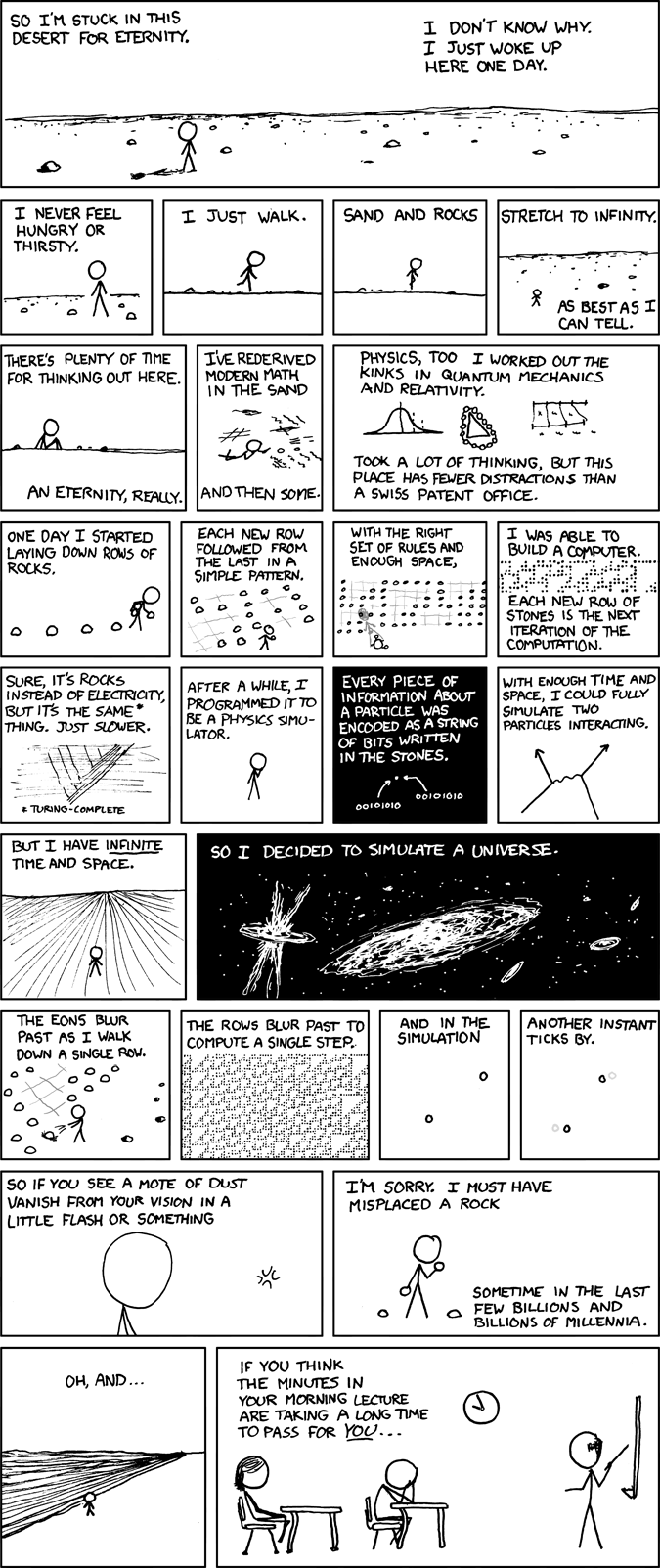
Would it be fair to say that the pebbles & sand system borrows, and exhibits to a lesser extent, the consciousness of whatever sentient entity is moving them?
No, that's not correct, and this is a very important point:

a_bunch_of_rocks.png


(XKCD by Randal Schwartz. Sharing and hotlinking expressly permitted under Creative Commons Attribution-NonCommercial 2.5 License.)
 
The brain IS a control mechanism. It's purpose, from the c. elagans to Einstein and everything in between, is to take input from the world, process it with past input, then tell the body what to do to survive(1).

Whether it's a computer program controlling a robot spider or an onscreen spider, or replaces the wet brain in a real spider, the argument is they are doing the same thing and it's unclear if a turing machine could never do this in c. elegans, spiders, or humans.

It's clear that the specification for a Turing machine does not involve any kind of control or monitoring system. If the brain is primarily a control mechanism, then reasoning about Turing machines does not apply.
 
Would it be fair to say that the pebbles & sand system borrows, and exhibits to a lesser extent, the consciousness of whatever sentient entity is moving them?

No, because a giant pebble sorting machine, working according to a predefined list, could produce the patterns.
 
Nitpick: I'm not sure which heart function you're talking about, but the beating of the heart is not controlled by the brain. The brain does serve a role in regulating heartbeat, but that is something we can actually control to some extent.


Yes.
 
Leumas, I loved your response, but let me focus on this as a direct question:

Why do we by default assume that the subjective experience of redness requires some kind of immaterial substrate?
 
If the description of Turing machines doesn't have real-life implications, then why are we talking about them at all?

The description of Turing machines does have real life implications.

However, the fact that Turing machines are imaginary does not imply that Turing equivalent processes have no relation to physical reality.

Which is the entire point -- your rejection of the notion of mental processes being based on computation relies entirely upon this fallacy you have constructed that the "physical" is somehow fundamentally different from the "computational."

That fallacy stems from nothing but blind ignorance of facts, as multiple people have pointed out to you. There is no such thing as "non-physical" computation. All computation must occur using a physical process. Period. No exceptions.

This is easy to see. First, you can't actually compute on a Turing machine because they do not exist in reality. Second, even if they did -- and they don't, remember -- they would be just as physical as your brain.

Saying "consciousness is physical, not computational" is not valid. That's like saying a gumdrop is sugar, not candy.
 
Status
Not open for further replies.

Back
Top Bottom