3) The Witnesses, a) fire, M.Bashir, the hole in the wall
(a bit different than the organization I set out with, section three is the last, in three parts)
Witnesses to the same real-world incident will recall all kinds of details differently. The mind is a malleable thing, and memory slippery, often deceptive. Plus people can occasionally tell lies, even under oath not to.
That's why we usually prefer physical evidence over eyewitness testimony. But here, we've got to do it the other way around if the rebel fighters are to get off the hook as they have so far.
When witnesses can agree on the basics of an important detail, it means either a real memory, or a well-coordinated cover story. The men who fled the shed all swear to the same
basic story, the guilt of the brigade soldiers, their cruelty in general prior to the massacre day, the use of automatic fire and hand grenades, and they agree roughly on the number of prisoners on the fateful day (120-200 given range, most at about 150).
But from there it breaks down.
For example, so far all agree the fire was set sometime after they’d gone, or they would have mentioned it. Even Abdulrahim Ibrahim Bashir, who hid in a nearby house and watched the place for three days (guards about, digging, etc.) somehow he didn’t see when the fire was set. Before the rebels took it is all he was sure of. "The [warehouse] was already burning when the rebels came," he said, "but I didn’t see how it happened. I just saw it when the rebels came; it was already burnt, and black smoke was coming out. I left around sunset yesterday [August 26]."
But then there’s Mohammed Bashir, no relation I know of to the guy he contradicts. For reference, he’s as dark-skinned as the escapees get, among the majority we get to see. He might well have a bit of black African blood in him, but nott he gallons shed by the other escapees who look almost like “Gaddafi’s African mercenaries.” He spoke to
the Daily Mirror, with a handy picture there (the older guy on the left).
His account is strange in a few ways. He describes the shed wrong - a "container," stifling hot, men died from the heat, thin metal walls, banging on them. These walls are lined with cinderblocks, make no banging noise, wouldn't allow bullets, and shielded the inside from the sun's heat. And there's decent ventilation all over the leaky place.
Further, Bashir says he was still hiding in the shed, just minutes after the shooting on the evening of the 23rd, when the fire was started.
…something happened, either his gun was jammed or he ran out of ammunition. He walked away to get another gun and I ran to the other side of the container and hid behind an empty gas canister."
“That’s when they poured petrol in and set it alight. They were trying to hide evidence but people were still alive. I could hear them scream."
And smoke was still wafting off the shallow pile of
about 50 bodies only, five days after the fire was first set. The Mirror was all alone reporting as fact that people were burned alive there (writer Martin Fricker also managed to count
one of the nine surrounding bodies, a record low).
Those screaming people being burned alive apparently weren't able to get out the door. So why didn’t they run through the “hole in the wall?” Mohammed did.
“...still alive. I could hear them scream. My friends and I ran through a hole in the wall and tried to escape across the compound.”
Getting out, easy. Crossing the yard, murderous.
"I know at least three men did not make it and were shot in the back by the Gaddafi soldiers."
Abdulatti Haleem said, as the UK Daily Telegraph related it, "after the firing stopped he and about 30 others ran out through
a hole they had made in the hangar wall." Bashir al-Siddeq's version sounds a bit less kinetic. He told the Canadian CBC News "when [the massacring soldiers] went to re-load their guns, he crawled over bodies to a hole in the wall, and in the chaos, escaped." Eighteen others escaped, per what CBC's Susan Ormiston reported, apparently also out of this hole. Both mention people then geing shot as they ran towards a way to escape the compound altogether.
There
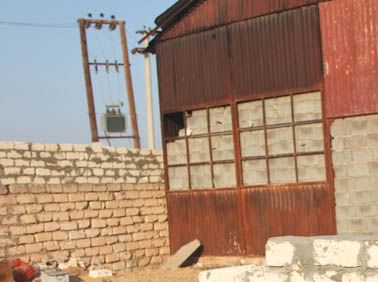
is a hole in the wall, exactly one rough portal just capable of allowing human passage from that cinderblock box. It's on the building's northwest corner, in the upper portion of the west wall, passing through a window in the outer tin. It seems to have a lower lip approximately six feet off the ground. To get through that, one would have to be normal sized or smaller, pull oneself through somewhat carefully, one at a time, after having climbed up on something.
But two different witnesses describe "running" through this hole. One of these specifies he kept running across the yard after that. Again, Mohammed Bashir said “my friends and I ran through a hole in the wall and tried to escape across the compound."
At least one exterior photograph taken by the Human Rights Watch team (cropped here) shows this breach in the corner. As you can see, it leads straight onto the top edge of the northern outer wall of this mini compound. Could you get from the hole to the wall’s crest? I could. Escape from there was all but done.
As the satellite imagery shows (northwest/north shed corner, by a white car), immediately on the other side of that north wall is the open street and across that, all kinds of shelter and perhaps aid, and chances to keep running and hiding farther and farther from the bullets. Climb out onto the wall, swing legs over, plop down and run. Easy.
So why did old Mr. Bashir and his friends decide to plop back down on the yard side of the wall and then run across the controlled compound to some other wall they’d have to climb from scratch? Only to have their eyes shot out while climbing it?
On the other hand, if he's a fake survivor,why did another survivor, Ibrahim Zadan, come by and hug him in remembrance? Zadan's also been seen hugging an unnamed apparent survivor, as well as Bashir al-Siddeq, who's been seen hugging yet another unnamed weeping survivor, and so on... quite a reunion on the 27th and 28th of August. Who organized it?