• Quick note - the problem with Youtube videos not embedding on the forum appears to have been fixed, thanks to ZiprHead. If you do still see problems let me know.

Merged Apollo "hoax" discussion / Lick observatory laser saga

Status
Not open for further replies.
They are pointing that thang, that "spaceship" in the wrong direction nomuse, and sure, my initial presentation is a rough guess as to what one is dealing with here. Rough guesses notwithstanding, the NASA boys are off target nomuse, and in a bad bad bad bad bad bad bad bad way.


0.164o is "way off target" in a "bad bad bad bad bad bad bad bad way"??? Your ignorance of orbital mechanics amuses us.

Considering the rendezvous radar had a beam width of 3.3o and a range of 750 km and so could paint a swath of space 86 km in diameter then 5.2 km is a ridiculously small error.


I shall now endeavor to find out what the real consequences would have been were any of this bogus scenario real.


I already told you what the consequences would be: a one second firing of the APS. Although, they'd probably use the RCS for its finer velocity control.
 
Excellent points Loss Leader......Excellent points.....


So, you queste me, tell me I've made excellent points, and then proceed to ignore them. Not only do you invoke your own "common sense" to say tat a rendezvous would be difficult, but you somehow invoke my common sense to do so.

All the while, you do not answer the only question that matters: How much drift out of the orbital plane were the LM and CM designed to tolerate before lacking the fuel/time it would take to correct?

Unlesss you have external facts supporting your answer, you have once against submitted nothing but an Argument from Incredulity that must be ignored.


We may conclude, given this internal incoherence, that this story is not true, the LM take off story and if the LM take off story is true, all of Apollo must be bogus big big big time. A huge problem for absolute sure.


Your definition of "huge problem" is not returning the same results over here.
 
Two different thinks altogether......

So, you queste me, tell me I've made excellent points, and then proceed to ignore them. Not only do you invoke your own "common sense" to say tat a rendezvous would be difficult, but you somehow invoke my common sense to do so.

All the while, you do not answer the only question that matters: How much drift out of the orbital plane were the LM and CM designed to tolerate before lacking the fuel/time it would take to correct?

Unlesss you have external facts supporting your answer, you have once against submitted nothing but an Argument from Incredulity that must be ignored.


Your definition of "huge problem" is not returning the same results over here.

Two different thinks altogether......

My point is that 2 ships cannot link if they are 600-900 feet apart. 600 feet is 600 feet. The astronauts said no out of plane adjustments were made period. There was no equivocation on their part. And so, per the Apollo 11 narrative, the ships are roughly 600 feet from one another, and as such, DID NOT LINK, and as they did not link, this whole embarrassing thang is an utterly fake whole embarrassing thang. That is established. No longer a point in dispute. Check NASA's own documents.

Your question is a good one. It is a question/challenge related to the point discussed above in that were this real, one could ask oneself, "if two 1969 vintage ships were out of plane in this regard, 600 to 900 feet, could they link up? Would it be possible?" I'll explore that.

However, with respect to the events of 07/21/1969, the Apollo 11 astronauts claim that they made NO, NONE, ZERO! out of plane adjustments. As such, we know they are lying, and we recognize Apollo to be a fraudulent nauseatingly bogus charade. We know this because the Eagle's top was out of plane some. If they were out of plane 50 feet, it is infinitely too far. If off by 10 feet, it is a miss of infinite inaccuracy. If the docking attempt is a 10 foot miss, that is as bad as a 10,000 foot miss. A miss is a miss and I have caught them in a big fat lie confirming a miss.

Think of it like taking a class pass/fail Loss Leader. Pass/fail is like successful rendezvous/miss. There is no middle ground. These boys are lying Loss Leader. It is not only obvious, it is stated by the "astronauts" themselves as fact. NO OUT OF PLANE CORRECTION WAS MADE, A FACT!

We can all look into whether or not a 600 foot correction is feasible, a reasonable and related question, but WHETHER ONE COULD OR COULD NOT CORRECT FOR 600 FEET, OR AS LITTLE AS 60, IS IRRELEVANT HERE. THE ASTRONAUTS LIED AND SAID NO ADJUSTMENT WAS NECESSARY, NONE WAS CARRIED OUT.

Apollo Loss Leader is very very very fake, must be, they "missed"........
 
^
Just pure incredulity backed up by no facts, either present of historical. No answer to any of my questions.
 
If off by 10 feet, it is a miss of infinite inaccuracy.


Oh my God! You didn't know spacecraft could change their attitude and make small velocity changes!!! Unbelievable! Absolutely unbelievable! If I hadn't read it myself I wouldn't have believed it.

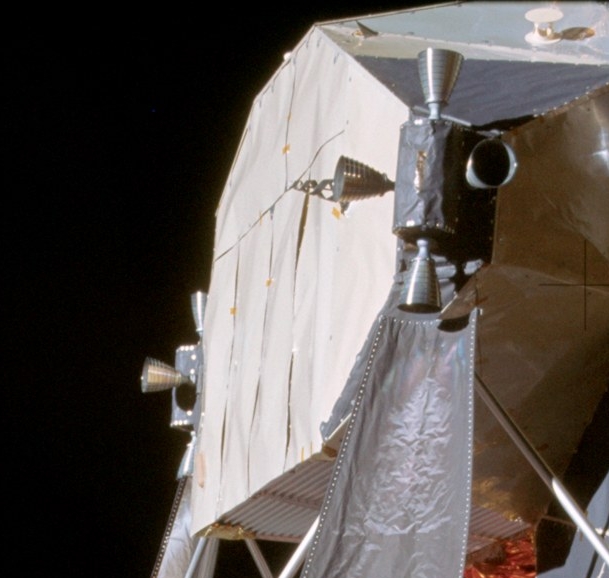
They used small engines, like these cone shaped things on the LM and Service Module:

LM_RCS.jpg


2414894626_6dbc7a2a05_z.jpg


They are called Reaction Control Systems, or RCS. By firing the engines in different combinations the spacecraft could translate (i.e. "move") up, down, left, right, forward, and backwards, or change its attitude in roll, pitch, and yaw.

How did you not know this???

If the docking attempt is a 10 foot miss, that is as bad as a 10,000 foot miss. A miss is a miss and I have caught them in a big fat lie confirming a miss.


the? the docking attempt??? Singular!!!

You actually think there was only one possible attempt to dock!!! Oh my God!

I did not think anybody could be so ignorant about Apollo to not know how spacecraft control their attitude and direction, but there you go.

That's a Stundie.
 
Check out Washington's Office of Aviation Research's General Aviation Lightning Strike Report and Protection Level Study...

And if you knew anything about the airline or aircraft industry, you'd know that General Aviation has nothing to do with commercial air carriers. It certainly has nothing to do with manned space flight.

The report features the statement; "a lightning strike can impose severe damage to critical and essential systems of any aircraft".

Where to begin?

CA and GA aircraft are certified airworthy by two completely different sets of regulations. CA airworthiness requires a demonstration of lightning survival. GA airworthiness does not. The difference between CA and GA airworthiness was prominently discussed in the introduction to the report, from which you drew your quote.

The report is entirely silent on the subject of whether any of the 95 lightning strikes it studied resulted in a diversion or declaration of emergency. Since your claim is that Apollo 12 should have "diverted" (i.e., landed immediately), the findings of this report do nothing to change the general policy that the flight continues to its destination after a lightning strike.

Any statement of the form, "______ can cause severe damage to an aircraft," is generally true and may hold for a variety of causes. It is a non sequitur to claim on that basis that any item you would put in the blank space necessarily does cause severe damage, or necessarily requires some mitigation in design and operation. One is a statement of causality ("can cause"); the other is a statement of frequency ("does cause"). None is a statement of policy ("pilot should then do..."). You are trying to argue judgment and policy, so this report has no findings that pertain to your argument.

In fact your data reports that only about one-third of all lightning strikes to unprotected aircraft (i.e, those that do not include any specific lightning-mitigation) caused any damage at all. This supports the assertion of NASA engineers that the Apollo CM has an inherent degree of lightning protection.

The type of damage studied in your report was primarily electrical interference and electrical failure, and included such inconsequential effects as the dimming of cabin lights (p. B-1). The data do not report how many instances of electrical effects self-corrected, or were corrected or correctable in flight by crew action. In-flight corrections to electrical malfunctions include switching to spares and resetting circuit breakers. Further, electrical malfunction is eminently discoverable by automatic means in a spacecraft. All these factors were present for Apollo 12.

A significant finding of the report was the increase in lightning strike reports, and the discovery that many strikes previously had simply not been reported (p. 14) unless damage had occurred. This supports my point that lightning strikes are seen as largely inconsequential in aviation -- lightning is an accepted and planned-for characteristic of the intended operating environment.

The purpose of the report was to assess the factors affecting lightning reporting in general aviation (as opposed to commercial), and to recommend policies for data collection in the future from GA aircraft. Flight crew procedures during and immediately following a lightning strike, and traffic controller involvement, are not affected by or even mentioned in this report. Since your argument deals with the behavior of the flight crew and ground controllers, this report is largely irrelevant to your argument.

I'd take that to mean a space ship too, wouldn't you...

No, I wouldn't. Kindly stop begging the question. An Apollo spacecraft is not a commercial airliner no matter how much you would like it to be. Commercial aviation has nothing to do with experimental space flight no matter how badly you wish otherwise.

The larger issue is that this is not an airplane. It is a spaceship, albeit a pretended one...

It is considered a real spacecraft by everyone in the relevant industry. It is considered a real spacecraft also by the people who wrote the report you just cited.

The larger issue is that you continue to apply apples-and-oranges comparisons and question-begging to an incident that has already been studied specifically at length by subject-matter experts. Your opinions continue to diverge from the facts. Your judgment in this case has been shown inadequate, and has been roundly rejected. At your request, I polled subject-matter experts; the results unanimously rejected your belief.

Why do you continue to offer the same refuted line of reasoning over and over again?

And as lightning CAN cause severe damage

...but did not in this case.

...and as this damage could not be adequately assessed via telemetry and astronaut visuals

Expressly false.

Apollo can only be very very very very very fake...

OMG!! Lightning!

You still have not addressed the specific engineering analysis of Apollo 12. Why not? You still insist on your misinformed judgment over that of experts, and general handwaving concerns (most of the them irrelevant) rather than the specific circumstances of the occurrence.
 
and as this damage could not be adequately assessed via telemetry and astronaut visuals,


Wait a minute.

I missed this quote previously. So I ask now, on what do you base this statement and what specific proof do you have?

You have a "very very very very very" bad habit of making technical assertions based on nothing more that your wish for it to be true.

I'd ask you to verify this statement or retract it.
 
How is that not backed up by facts?

^
Just pure incredulity backed up by no facts, either present of historical. No answer to any of my questions.

How is that not backed up by facts Loss Leader?

Show me where in the Apollo 11 Mission Report, Technical Crew Debriefing, Post flight Press Conference transcripts that it indicates an out of plane adjustment was made........Cite a relevant section Loss Leader of one of those documents where the astronauts discuss having made an out of plane adjustment and of course I shall retract this claim, no problem.

I do not believe you can. I do not believe you will be successful in such a regard....

My facts are spot on........
 
My claim is that an Apollo craft is so very unique......

And if you knew anything about the airline or aircraft industry, you'd know that General Aviation has nothing to do with commercial air carriers. It certainly has nothing to do with manned space flight.


Where to begin?

CA and GA aircraft are certified airworthy by two completely different sets of regulations. CA airworthiness requires a demonstration of lightning survival. GA airworthiness does not. The difference between CA and GA airworthiness was prominently discussed in the introduction to the report, from which you drew your quote.

The report is entirely silent on the subject of whether any of the 95 lightning strikes it studied resulted in a diversion or declaration of emergency. Since your claim is that Apollo 12 should have "diverted" (i.e., landed immediately), the findings of this report do nothing to change the general policy that the flight continues to its destination after a lightning strike.

Any statement of the form, "______ can cause severe damage to an aircraft," is generally true and may hold for a variety of causes. It is a non sequitur to claim on that basis that any item you would put in the blank space necessarily does cause severe damage, or necessarily requires some mitigation in design and operation. One is a statement of causality ("can cause"); the other is a statement of frequency ("does cause"). None is a statement of policy ("pilot should then do..."). You are trying to argue judgment and policy, so this report has no findings that pertain to your argument.

In fact your data reports that only about one-third of all lightning strikes to unprotected aircraft (i.e, those that do not include any specific lightning-mitigation) caused any damage at all. This supports the assertion of NASA engineers that the Apollo CM has an inherent degree of lightning protection.

The type of damage studied in your report was primarily electrical interference and electrical failure, and included such inconsequential effects as the dimming of cabin lights (p. B-1). The data do not report how many instances of electrical effects self-corrected, or were corrected or correctable in flight by crew action. In-flight corrections to electrical malfunctions include switching to spares and resetting circuit breakers. Further, electrical malfunction is eminently discoverable by automatic means in a spacecraft. All these factors were present for Apollo 12.

A significant finding of the report was the increase in lightning strike reports, and the discovery that many strikes previously had simply not been reported (p. 14) unless damage had occurred. This supports my point that lightning strikes are seen as largely inconsequential in aviation -- lightning is an accepted and planned-for characteristic of the intended operating environment.

The purpose of the report was to assess the factors affecting lightning reporting in general aviation (as opposed to commercial), and to recommend policies for data collection in the future from GA aircraft. Flight crew procedures during and immediately following a lightning strike, and traffic controller involvement, are not affected by or even mentioned in this report. Since your argument deals with the behavior of the flight crew and ground controllers, this report is largely irrelevant to your argument.


No, I wouldn't. Kindly stop begging the question. An Apollo spacecraft is not a commercial airliner no matter how much you would like it to be. Commercial aviation has nothing to do with experimental space flight no matter how badly you wish otherwise.


It is considered a real spacecraft by everyone in the relevant industry. It is considered a real spacecraft also by the people who wrote the report you just cited.

The larger issue is that you continue to apply apples-and-oranges comparisons and question-begging to an incident that has already been studied specifically at length by subject-matter experts. Your opinions continue to diverge from the facts. Your judgment in this case has been shown inadequate, and has been roundly rejected. At your request, I polled subject-matter experts; the results unanimously rejected your belief.

Why do you continue to offer the same refuted line of reasoning over and over again?


...but did not in this case.


Expressly false.


OMG!! Lightning!

You still have not addressed the specific engineering analysis of Apollo 12. Why not? You still insist on your misinformed judgment over that of experts, and general handwaving concerns (most of the them irrelevant) rather than the specific circumstances of the occurrence.

My claim is that in the context of a lightning strike, the Apollo 12 craft would be viewed, were any of this "real", as so very unique a flying machine that no one would know in any meaningful sense the full extent of damage to the craft without examining it materially. As such, it never would be allowed to travel to the moon after such a strike were men actually aboard.

Your lengthy analysis Jay, as such, is simply and sadly wrong. Simply because this is an obvious fact, and sadly because we all got ripped off so bad, especially ripped off emotionally. You and me both, ripped off emotionally big time.....
 
I did not think anybody could be so ignorant about Apollo to not know how spacecraft control their attitude and direction, but there you go.

"This" is the reason why no one here agrees with you, Patrick...because of your extreme ignorance regarding anything space related...

Given this ignorance, why should anyone here take what you say, seriously??
 
Edited by Gaspode: 
Edited for moderated thread.


My point is that 2 ships cannot link if they are 600-900 feet apart.

Yes. That's why one ship will simply fly 600 feet over to the other one. Duh.

The astronauts said no out of plane adjustments were made period.
Yes. That's because a terminal error of 600 feet would be considered a direct hit.

No longer a point in dispute.
For you to declare victory after repeating your colossal blunder from months ago merits one of these: :jaw-dropp

Check NASA's own documents.
I assure you I've read NASA's documents on lunar orbit rendezvous and the LM control systems many, many times. Clearly you have not, because they describe a model of orbital operations that bears no resemblance whatsoever to anything you've stated or alluded to here.

"if two 1969 vintage ships were out of plane in this regard, 600 to 900 feet, could they link up? Would it be possible?" I'll explore that.
Please do "explore" that. You pretty much just lost any credibility that you might have had that you know anything about how space works.

If they were out of plane 50 feet, it is infinitely too far. If off by 10 feet, it is a miss of infinite inaccuracy.
Wow. Just ... wow.

If the docking attempt is a 10 foot miss, that is as bad as a 10,000 foot miss.
Actually we prefer a 10,000 foot "miss." You want the last nautical mile or two after TPI to be terminal maneuvering and braking, not an orbital coast that may result in inadvertent contact. Anything within about 2 nautical miles at is considered a direct hit.

And as others have noted, you seem to persist in the error of thinking that rendezvous and docking was a one-shot deal determined entirely by initial conditions. That's as absolutely wrong as it can possibly be, and if you had really read NASA's documents you would know this.

NASA expected significant dispersions from the lunar orbit insertion maneuver. That's why the rendezvous process was formulated stepwise, and why that's still the way we conduct orbital rendezvous today.

Further, the rendezvous process provides for several terminal rendezvous and docking attempts. It's not, nor ever was, a one-shot deal. Your concept of orbital rendezvous as a do-or-die one-time engine burn, lobbing the LM on a trajectory that has to intersect the CSM exactly the first time, is about as comically far off the mark as it can be.

And you know this. You've had the process explained to you in depth, and admitted at the time that it answered your dilemma. Why you choose to revisit it now is disappointing, but frankly expected.

We know this because the Eagle's top was out of plane some.
The "top?" What part of an orbit is that? Are you actually assuming that an orbit's apoapsis and its anti-nodes are the same thing? Please take class or something!

Think of it like taking a class pass/fail Loss Leader. Pass/fail is like successful rendezvous/miss. There is no middle ground.
No, orbital rendezvous is exactly not like a pass-fail test. It is exactly the opposite. It is a multi-step processes that allows accumulated errors and dispersions to be detected and corrected in an adaptively converging solution, with little or no time pressure involved.

While you claim to know "some engineering," you continually demonstrate a complete lack of understanding of some of its core principles, the one in this case being the idea of a tolerance. On an unadjusted grading scale, both a score of 92% and one of 100% qualify as an A letter-grade. 92 percent is "good enough." The guy who gets 92% gets the same outcome as the guy who gets 100%, but the former has more time to drink beer and chase girls.

Terminal phase insertion has a nominal distance of 2 miles, plus an RCS tolerance of many more miles. That is, a "hit" is to reach altitude within two miles of your docking target. Several miles out at the antinode is annoying but manageable. Alignment begins to occur at 600 feet, which is considered equivalent to a final approach.

If your TPI burn parks you at 2 miles out, you got an A. If it parks you 11 miles out, guess what -- you still got an A. That's the idea of a tolerance, and until you wrap your mind around it you won't be convincing any engineers that you know anything about their profession.

We can all look into whether or not a 600 foot correction is feasible...
You do that. While you're at it, you can also investigate whether a brush is useful for applying paint, and whether there's some way to prevent air from rushing out of a balloon neck once it has been inflated.

but WHETHER ONE COULD OR COULD NOT CORRECT FOR 600 FEET, OR AS LITTLE AS 60, IS IRRELEVANT HERE.
No it isn't irrelevant. It's the question Loss Leader asked you to study and answer. Almost every spacecraft has a delta-v capacity. If you're arguing that the Apollo spacecraft can't have docked for such a great error, you are responsible for quantifying the error and showing the corresponding limit that is exceeded.

Real world machines have a tolerance to accommodate varying performance. The Apollo spacecraft was no exception.

The explicit out-of-plane correction maneuver was planned in case the plane error grew to be several degrees or more. For fractions of a degree, it's handled during ascent guidance simply by yawing into the correct plane. But when the error becomes too great, a separate maneuver is done at apoapsis. It's done there because a plane-correction maneuver is a pure delta-v maneuver, and the spacecraft's velocity is slowest at that point. Ironically it's more fuel-efficient to wait and correct the plane errors later, another counterintuitive aspect of space flight.

THE ASTRONAUTS LIED AND SAID NO ADJUSTMENT WAS NECESSARY, NONE WAS CARRIED OUT.
That's right. None was necessary and none was carried out. You're the only one who seems to think one was necessary, but only because you don't know the first thing about orbital mechanics or spacecraft dynamics, and so you're making up a bunch of properties and requirements that, in your naive understanding, might seem to be true, but which simply are not.

You're acting literally like a "surgeon" who has never studied anatomy and never seen the inside of an organism.

 
Last edited by a moderator:
<snip for brevity, sorry>

I agree wholeheartedly with the above.

Patrick, can you elaborate on the role and responsibility of the PIC on a commercial flight?

Can you elaborate on the lightening precautions installed on civil aviation aircraft, from privately owned aircraft down to microlights?
 
My claim is that in the context of a lightning strike, the Apollo 12 craft would be viewed, were any of this "real", as so very unique a flying machine...

You just got finished trying to tell us that what holds for a GA aircraft ought also to hold for a spacecraft. Now you're telling us that we have to treat it as a special case. Kindly make up your mind.

...no one would know in any meaningful sense the full extent of damage to the craft without examining it materially.

Asked and answered. In-flight validation of the spacecraft was a design requirement and an ordinary part of every Apollo mission. With regard to your point above, the Apollo CSM was special in this respect. It was instrumented for in-flight diagnosis.

Your lengthy analysis Jay, as such, is simply and sadly wrong.

Prove it.

(And "OMG!! Lightning!" is not proof.)

Simply because this is an obvious fact...

So all the engineers who studied this incident are wrong just because you say they are.

...and sadly because we all got ripped off so bad, especially ripped off emotionally.

No, space engineering isn't an emotional thing for me. It's just what I do for a living. If you want to admit to making emotionally-motivated claims, go right ahead. It would explain a lot about this debate.
 
Show me where in the Apollo 11 Mission Report, Technical Crew Debriefing, Post flight Press Conference transcripts that it indicates an out of plane adjustment was made....

Straw man. Your error is in assuming wrongly that a small dispersion requires the explicit out-of-plane maneuver to correct for it.

Your facts are not the least bit correct. You display almost complete ignorance of orbital mechanics in general and orbital rendezvous in particular. Because of the very wrong and very naive assumptions you have made, you have attempted -- as usual -- to exaggerate the difficulty of space flight in order to try to show that Apollo cannot have succeeded.
 
I wonder if Patrick believes mid-air refueling is possible? I mean how could an aircraft hundreds of miles from the tanker line up so perfectly as to hit the boom dead on? That's just impossible!
 
How is that not backed up by facts Loss Leader?[.quote]


This is just as dishonest a form of argument as I have ever seen. I and many others told you that your calculations about angles and feet are not in dispute, it is your assertion that it caused a "huge problem". What facts do you have to suggest that this difference was or would have been a "huge problem"? How far out of plane were the two spaceships designed to correct? How much of a gap really would have been a "huge problem"?


Show me where in the Apollo 11 Mission Report, Technical Crew Debriefing, Post flight Press Conference transcripts that it indicates an out of plane adjustment was made........Cite a relevant section Loss Leader of one of those documents where the astronauts discuss having made an out of plane adjustment and of course I shall retract this claim, no problem.


Absolutely I will ... just as soon as you show me any evidence that the LM and CM of Apollo 11 were out of plane at all. How much distance in orbit is considered out of plane?


My facts are spot on........


Your logic is as poor as any I have ever seen. I have visited patients in psychiatric hospitals suffering delusions that they were robots, CIA agents, messiahs and more. These people would construct their delusions of stronger stuff than you. The robot guy ate a couple bucks worth of change to prove his point (and, as it didn't exactly hurt him, he felt vindicated).
 
Last edited:
I still haven't see P1000 answer my question.

WHy does every Engineer and Scientist with relevant qualifications and experience think Apollo was real and use it's engineering and data even today?
 
Straw man. Your error is in assuming wrongly that a small dispersion requires the explicit out-of-plane maneuver to correct for it.

Your facts are not the least bit correct. You display almost complete ignorance of orbital mechanics in general and orbital rendezvous in particular. Because of the very wrong and very naive assumptions you have made, you have attempted -- as usual -- to exaggerate the difficulty of space flight in order to try to show that Apollo cannot have succeeded.

What Patrick has is a collection of pieces of data from various sources that he believes he can assemble into some sort of working whole based on 'common sense' and 'if I ran the zoo'. He simply will not acknowledge that others posting here have a greater understanding of the topics under discussion, from space medicine, through the basic maths of Apollo finances, and onto inertial navigation, than he does.
A good example is that as soon as Peterscreek posted his strawpoll of actual air traffic control professionals the lightning topic was abruptly abandoned without any response. Are you ever planning to address that Patrick?
 
The attitude of the spaceship is determined by star sightings RAF....

"This" is the reason why no one here agrees with you, Patrick...because of your extreme ignorance regarding anything space related...

Given this ignorance, why should anyone here take what you say, seriously??

The attitude of the spaceship is determined by star sightings RAF....This is of course a simple fact.

If the star sighting data gives inaccurate/incorrect landing site coordinates, then that same data will result in the provision of an inaccurate/incorrect attitude determination as well. An inaccurate landing site determination as made by way of inaccurate star sightings must be linked to an inaccurate attitude determination as well. It can be no other way.

An inaccurate attitude would mean a launch that would result in an orbit out of plane with that of Michael Collins as related in the Apollo 11 narrative.
 
Status
Not open for further replies.

Back
Top Bottom