Miragememories said:
"I fail to see how mixing nano-thermite with concrete dust will alter its ignition temperature?"
GlennB said:
"It doesn't, it affects its ability to maintain self-sustaining combustion...."
Miragememories said:
"As long as there remains a source of unspent nano-thermite and an exposure to ambient temperatures of 430 C or greater, the thermitic material will continue igniting."
GlennB said:
"At the surface perhaps, but the dust is 95% (actually that's an absurdly generous figure - generous in your favour) concrete which needs to be heated to 430C before the layer below the surface can ignite. See your problem yet?"
At the surface? No. ANYWHERE.
And you can't be pulling numbers from nowhere Glenn. A detailed accounting of the WTC dust at Ground Zero has never been published.
So I'll agree that your 95% figure is absurd instead of just calling it the lie that it is.
If you had been following this thread, you would be aware that I never suggested the thermitic material embedded throughout the WTC dust was being constantly ignited by the heat from concrete debris.
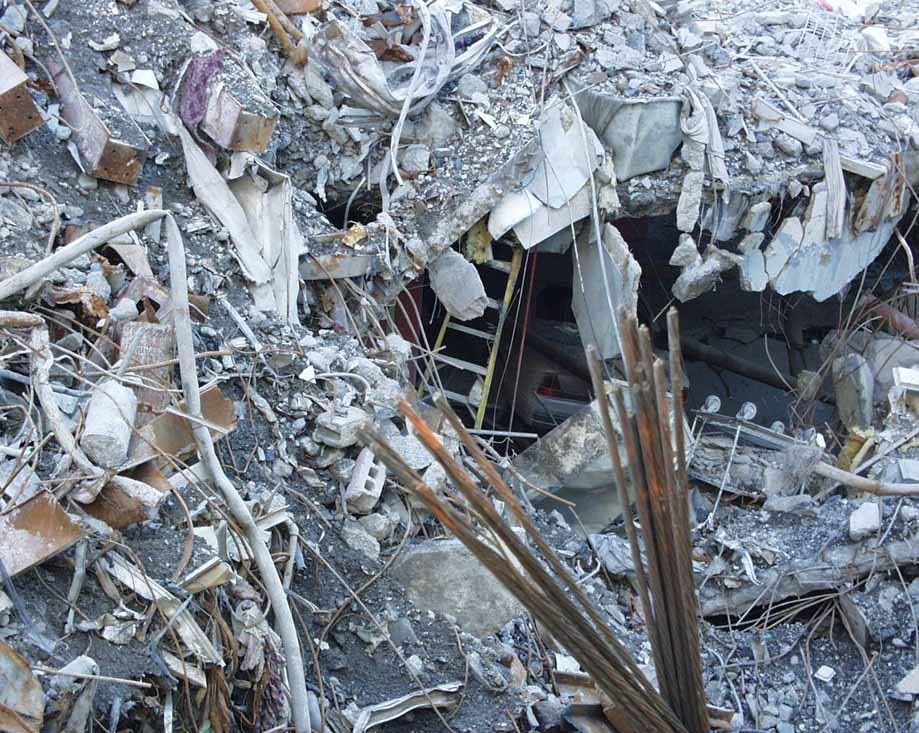
My original reference was to the know hotspots deep in the debris pile. Pockets or cavities in the debris that remained incredibly hot over the ensuing months following 9/11.
Well insulated hotspots that cooled very slowly and subjected to a steady shower of dust disturbed by the vibrations from the surface excavations.
Dust composed of all the materials originally composing the original WTC 1,2 & 7 structures but also containing a high red chip count.
Red chips which would ignite at 430 C
ambient temperatures.
Ignitions that generated heat and if in sufficient quantity over time, would either slow down the cooling in these hotspots or actually make them hotter.
An unproven theory? Yes. But based on the knowledge that the thermitic red chips have been found in every WTC dust sample to date.
GlennB said:
"Even if - and we've seen zero evidence thus far - nano/super thermite actually does have a lower ignition temperature than regular thermite, having it mixed 1:20 with concrete dust will negate any benefit of the lower ignition point. It will probably go out. Even if it doesn't then most of the heat generated by the 5% thermite will go towards heating the concrete dust.
It cannot preferentially heat any steel in its vicinity, over the long periods of time we're discussing. The concrete dust - by your own definition - is much more adjacent and finely-divided than the steel."
Miragememories said:
Well you have seen no evidence because you are sitting in a chair looking at a computer monitor."
GlennB said:
"It might shock you to learn that scientic publications usually find thei rway to the net."
Yes I know that Glenn. My argument is based on a scientific publication.
If you have a peer-reviewed scientific publication that clearly disputes the published findings by Dr. Harrit et al, I would be more than happy to see it?
Miragememories said:
"On the other hand, scientists with the proper tools and access to WTC dust have obtained the necessary evidence."
GlennB said:
"Not Harrit & co. They signally failed to conduct a proper experiment."
That is a very serious claim Glenn.
To back it up, you must
prove that the experiments documented in that published paper were improperly conducted, falsely observed, and had erroneously derived conclusions.
Again Glenn. I look forward to seeing the proof that supposedly supports your strong assertions!
Miragememories said:
"The dust was not pure concrete.
It was a mix containing the pulverized remains of the buildings it once represented.
The fact that nano-thermite should absolutely not have existed in the WTC dust in any amount, but did, clearly indicates that its existence was purposeful and therefore existing in quantities sufficient to achieve said purpose."
GlennB said:
"I asked before and you ignored it - how did this thermite escape its containment/delivery vessels such that it ended up just gnerally suffusing the dust? To survive their original purpose they would have to be very sturdy indeed."
How did it escape?
I never ignored this question at all.
Any method used for containing the original thermitic materials, would only have been required to stay intact during the normal operations within the 3 WTC towers.
On 9/11, when the thermitic material was igniting, at some point before all of the material had successfully ignited, the towers would have begun collapsing. Inevitably, the gravitation forces involved in the massive destruction would have disrupted the ignition path of some of the unspent thermitic material.
Pulverized, along with the building and its contents, the unspent thermitic material was reduced to the red chip form that scientists discovered years later in every WTC dust sample.
Miragememories said:
"Given that its logical purpose was to cause the failure of the WTC 1, 2 and 7 supporting columns, it is reasonable to assume that the successfully observed collapse of those structures caused an indeterminate amount of this thermitic material to suffer a disrupted ignition and thus get pulverized as dust in the ensuing collapse.
The debris pile below said collapse should contain the highest concentrations of this unspent thermitic material."
GlennB said:
"We've allowed 5% thermite in (what you claim) totally pulverised concrete, and this is just the 'spare' thermite. See where this is going? That's thousands of tons of unspent thermite - an absurd notion."
Do I see where this is going? I see you are building a fantasy of your own creation.
I have not specified any specific amount because that would amount to unsupported speculation.
Miragememories said:
"Hotspots deep in the debris pile would provide a steady source of ignition heat for this thermitic dust as it was continually disturbed during the months of debris excavation."
GlennB said:
"And every new injection of thermite-laden dust woud be 95% concrete, by your own reckoning. Concrete that also will be heated by the reaction. Your thermal capacity calculations can never add up."
No. By
your fantasy reckoning.
Why does the dust have to be 95% concrete?
Were the towers 95% concrete? No.
Did excavators find lots of examples of recognizable office contents? No.
Would much of the pulverized office content's dust be composed of plastics and other combustible materials known for their thermal insulating (low heat conductivity) properties? Yes.
Would these this combustible dust ignite in the severely oxygen-starved dust laden WTC Ground Zero debris pile?
No.
When exposed to oxygen-rich outside air, would over-heated combustible dust burst into very hot flame? Yes.
Was this observed? Yes.
Would such sudden additional heat in already existing hotspots, allow for the creation of red hot or molten metal? Seems quite reasonable.
The layers of concrete and combustible dust in the cavity walls would likely sufficiently insulate the thermitic red chips above to prevent them from reaching ignition temperature until they fell into the cavity or reached very close proximity to it.
Miragememories said:
"If the temperatures in these hotspots achieved steel melting levels, than the steel would melt.
Now if you think there is another reason why we had months of metal melting heat in that smothering pile of dust Glenn, I'd be interested in hearing it?"
GlennB said:
"Metal? Yes, conventional fire could have melted metal in places. There was no agent down there - thermitic or otherwise - that could have melted steel"
Opinion-based statement. Everyone has one. You are entitled to yours.
Personally, I give more weight to the opinions of those who were there, and/or those who have provided published reports to substantiate their professional opinions.
GlennB said:
"Throughout you are trying to have your cake and eat it. You want the temperature of the thermite reaction but sufficiently diffuse to operate slowly, unaware of the fact that then you run into irresolvable issues of thermal capacity and conductivity."
Wrong.
Nowhere do I suggest the reaction speed of thermitic material should be different from what is scientifically known.
I have suggested that a naturally occurring consequence of surface excavation at the WTC Ground Zero debris pile, would be a steady, dust disturbing vibration.
A natural expectation from this, would be that pre-existing hotspot cavities deep in the debris pile would receive a steady influx of falling pulverized concrete, pulverized glass and other building materials, pulverized office furnishings and other building combustibles, and pulverized thermitic material in the form of red chip laden dust.
Since part of the dust makeup is the known to be thermitic red chips, and since we know they ignite at 430 C, it would be expected that they would indeed ignite when faced with 430 C or greater temperatures.
Again Glenn.
if you think there is another reason why we had months of metal melting heat in that
smothering pile of dust, I'd be very interested in hearing it?"
MM