Moderated Global Warming Discussion

Status
Not open for further replies.
It's not a tornado area, it's a cyclone area. And the cyclones are getting worse.

Cyclones, tornadoes, hurricanes, tropical storms, earth quakes, forest fires, the principles the same; build a house in prone areas and not take due diligence you should pay through the nose for insurance.

It's getting worse because people continue to build sub par homes in these areas expecting insurance to cover them.
 
Cyclones, tornadoes, hurricanes, tropical storms, earth quakes, forest fires, the principles the same; build a house in prone areas and not take due diligence you should pay through the nose for insurance.

It's getting worse because people continue to build sub par homes in these areas expecting insurance to cover them.

continue? sub-par? expectations?
supporting evidences?
 
Cyclones, tornadoes, hurricanes, tropical storms, earth quakes, forest fires, the principles the same; build a house in prone areas and not take due diligence you should pay through the nose for insurance.

It's getting worse because people continue to build sub par homes in these areas expecting insurance to cover them.

The area has up till now been quite insurable and profitable.
 
continue?

Indeed, many homes are rebuilt and even developed without the current technology that could prevent the disaster from being employed. There are tornado proof homes, they've been around for years. The same goes for fire proof homes.


Not using the available technology in prone areas would be "sub-par".

expectations?

Building a home in a tornado prone area that doesn't employ the technology available and then relying on insurance to pay for it if and inevitably when it gets destroyed is this "expectation".

supporting evidences?

Fireproof homes: Frank Lloyd Wright started designing fireproof homes in 1900, over 100 years ago.
http://en.wikipedia.org/wiki/A_Fireproof_House_for_$5000
http://www.theage.com.au/national/designers-donate-fireproof-homes-20090607-bzts.html
http://www.thisoldhouse.com/toh/article/0,,20153991,00.html
Tornado Proof Homes: slightly more difficult to build and more costly, they exist, they're just "ugly". Short of that there are "wind resistant" homes that stand up to tornadoes much better.
http://www.msnbc.msn.com/id/4315757...build-tornado-proof-homes-price/#.TkGQVWHGUuc
http://www.wisehomedesign.com/tornado-proof-home.html
Hurricane proof homes: Basically a variation on tornado proof and wind resistant homes they have the added element of dealing with storm surge by raising the foundation.
http://en.wikipedia.org/wiki/Hurricane-proof_building
http://www.topsider.com/hurricane-proof-homes.asp
http://www.sciencedaily.com/videos/2007/0406-hurricane_resistant_house.htm
 
You cannot make a tornado-proof home or a hurricane-proof home.

All you can do is limit damage from less-intense storms and winds on the fringe of such an event.

The reason it is not ever possible is that though just wind can be dealt with up to a point with the right fasteners and construction, what you cannot deal with;

1. Storm-propelled objects.
2. Rain driven by wind so hard it almost acts like a solid.
3. Storm surge.
4. Direct lightning.
5. Storm-caused power-cross.

And probably a few things I didn't consider.

These are storms so intense that really nothing above-ground stands a chance from a direct hit.

When that sort of thing was rare, you could plan for it and set appropriate actuarial tables. Not so any more.
 
You cannot make a tornado-proof home or a hurricane-proof home.

That's not what the building experts say. Hurricane proof homes are rather easy to build, tornado proof homes are just expensive. There's actually one built here by some guy who is an obvious nut, but it's tornado proof none the less. It's probably fireproof as well, it's concrete block on an 18 inch I-beam frame. :jaw-dropp

All you can do is limit damage from less-intense storms and winds on the fringe of such an event.

Yes, and when you reduce the damage to almost zero it becomes "proofed".

The reason it is not ever possible is that though just wind can be dealt with up to a point with the right fasteners and construction, what you cannot deal with;

1. Storm-propelled objects.

Concrete. (ICF)

2. Rain driven by wind so hard it almost acts like a solid.

Concrete. (ICF)

3. Storm surge.

Platforms.

4. Direct lightning.

Grounding

5. Storm-caused power-cross.

You mean shorting? That's done by circuit protection.


These are storms so intense that really nothing above-ground stands a chance from a direct hit.

That's what insurance is for.

When that sort of thing was rare, you could plan for it and set appropriate actuarial tables. Not so any more.
Nonsense. There's no new categories of hurricanes or tornadoes. It's a very simple matter of updating probabilities.

The big bad global warming wolf can't get all the little piggies.
 
The area has up till now been quite insurable and profitable.

And this is the fact that some refuse to accept, conditions and situations are changing and getting worse, it isn't the same as building in a flood plain where local traditions indicate severe floods will occur every decade or so. It is a matter of building in an area where wildfires/floods/severe storms were once-a-century or more rare events, and now they are starting to occur with much more frequency and even extending beyond areas where they have ever been known to happen before.
 
Wrong.

Limiting to zero is not an option.

You cannot build ANY building other than a blockhouse that will survive a direct F5 storm.

Not even remotely possible.

If grounding could deal with lightning, the Building Entry Protector engineers I have worked with would be THRILLED. As it is, with the best suppressors, semiconductor plus gas tube, you can only handle nearby strikes, induced charge, not direct ones.
 
...When that sort of thing was rare, you could plan for it and set appropriate actuarial tables. Not so any more.

Not that the rest of your post was unimportant, but this last cuts to the chase. And is especially relevent when we talk not just about traditional ranges, but newly expanding ranges for many of these phenomena.
 
Is natural gas a climate change solution for Canada?
http://www.pembina.org/pub/2240
Is natural gas a climate change solution for Canada?
Published July 14, 2011
By Matthew Bramley

Our energy systems must change if we are to combat climate change. Many people are asking whether natural gas can play a role as a "bridging" fuel that enables near-term reductions in the greenhouse gas emissions responsible for climate change.

This report explores the role of Canada's federal and provincial governments in shaping future production and use of natural gas in consideration of both the climate and non-climate environmental impacts, and offers recommendations.

Learn more: Briefing note | Media release | Report | Presentation

Seems that others are propounding much the same position I have defended with regards to natural gas, particularly with respect to Canada.
 
That's not what the building experts say. Hurricane proof homes are rather easy to build, tornado proof homes are just expensive. There's actually one built here by some guy who is an obvious nut, but it's tornado proof none the less. It's probably fireproof as well, it's concrete block on an 18 inch I-beam frame. :jaw-dropp

Big difference between Hurricane-proof and hurricane-resistant, same with tornado resistant and fire-resistant. Modern concrete and steel construction high-rises are still susceptible to fires and fire damages, they just don't usually burn to a pile of ashes. I'm sure the concrete and steel structured hospital in Joplin would be considered tornado resistant, and in fact much of the actual structure still stands. This doesn't mean that these structures survive without damage and fully protect all lives and property contained within them.

Damaged Joplin hospital almost the only building left standing in area - http://articles.cnn.com/2011-05-23/...ealth-system-emergency-room-entrance?_s=PM:US
 
That's what insurance is for.


Nonsense. There's no new categories of hurricanes or tornadoes. It's a very simple matter of updating probabilities.

The big bad global warming wolf can't get all the little piggies.

I just pointed out the problems with insurance. They have professionals working out the probabilities already, and the cost is going to rise, even in areas that traditionally don't have high premiums. It's not just the cyclonic storms, ordinary flooding is getting worse as well. Spencer has a picture on his web site of a nice fluffy cloud pouring a few drops of rain onto a sunlit sea. That's his story about the increased water content of the atmosphere. The reality is a lot harsher.
 
You cannot build ANY building other than a blockhouse that will survive a direct F5 storm.

That's nothing new and that's why there's insurance; acts of God.
If grounding could deal with lightning, the Building Entry Protector engineers I have worked with would be THRILLED. As it is, with the best suppressors, semiconductor plus gas tube, you can only handle nearby strikes, induced charge, not direct ones.

lol, global warming didn't create lightning. My home got hit twice, the first time it didn't do anything, the second time it fried my TV and x-box.
 

How many round homes do you see?
Earthquake and Hurricane Proof Buildings

The dome, when finished, is earthquake, tornado and hurricane resistant (FEMA rates them as "near-absolute protection" from F5 tornadoes and Category 5 Hurricanes).

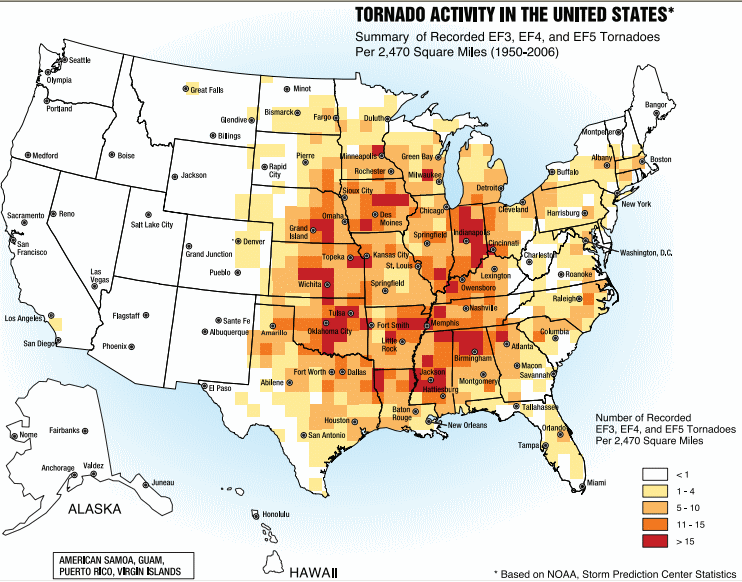
please define "prone" areas.

See: Tornado Alley for example.
Tornado_Alley.gif
 
Atarctic Warming, "Crappy Thermometer Effect"

Atmospheric temperature measurements biases on the Antarctic plateau

"High incoming solar flux and high surface albedo result in radiation biases in Gill (multiplate) styled shields that can occasionally exceed 10°C in summer in case of low wind speed. Although stronger and more frequent when incoming solar radiation is high, biases exceeding 8°C"

Extreme temperature bias in measurements due to improper sensor shielding. I'm sure it only affects Antarctic thermometers. :rolleyes:

Nothing to see here people, move along...
 
How many round homes do you see?
Earthquake and Hurricane Proof Buildings

The dome, when finished, is earthquake, tornado and hurricane resistant (FEMA rates them as "near-absolute protection" from F5 tornadoes and Category 5 Hurricanes).

Perhaps you should complain to the site that the title of the piece and information contained within it are contradictory and this is making you look bad on a skeptical messageboard.

See: Tornado Alley for example.
[qimg]http://upload.wikimedia.org/wikipedia/commons/3/35/Tornado_Alley.gif[/qimg]

So roughly 2/3 of the US should not be building anything but specially designed steel reinforced concrete structures? Is that your serious proposal?

(btw the map you link is inaccurate, and seems to be a statistical probability assessment rather than a historic record of absolute tornado activity over the last half century or so

http://www.infoplease.com/spot/tornado1.html)
 
So roughly 2/3 of the US should not be building anything but specially designed steel reinforced concrete structures? Is that your serious proposal?
Nope, my proposal uses statistics and building engineering. Based on your question I think it may be well beyond your current understanding of both.

(btw the map you link is inaccurate, and seems to be a statistical probability assessment rather than a historic record of absolute tornado activity over the last half century or so

http://www.infoplease.com/spot/tornado1.html)

No, it's correct and sufficient for our purposes. Similar maps using flooding and hurricanes can also be employed. Not only can they be used, they should be used as part of the building code.
 
Atmospheric temperature measurements biases on the Antarctic plateau

"High incoming solar flux and high surface albedo result in radiation biases in Gill (multiplate) styled shields that can occasionally exceed 10°C in summer in case of low wind speed. Although stronger and more frequent when incoming solar radiation is high, biases exceeding 8°C"

Extreme temperature bias in measurements due to improper sensor shielding. I'm sure it only affects Antarctic thermometers. :rolleyes:

Nothing to see here people, move along...

And this changes the delta-T readings from those instruments how? Be very careful before you answer because I know the answer.
 
Status
Not open for further replies.

Back
Top Bottom