God without The Bible – Challenge to Theists

just as an afterthought.....
i think that physicists and astronomers, chemists and biologists, are more likely to actually learn about the nature of 'god' than most theologians.
you sure as heck are not going to find anything real by arguing about books.
the nature of 'god' will never be discovered by in scripture.
it ain't in books.
it's in the very essence of matter and the universe.

That's something I can totally agree with, were it not that I think there is no god at all.

It might also be what sparked many early scientists (any also later on) to start investigating their environment.
 
And here I was, thinking that I was underestimating the current druids.

Turns out I was actually overestimating them.

Funny, that.

Oh,you were. Guys dressed in robes and incongruous black leather shoes poncing around at Stonehenge. The old druids had nothing to do with Stonehenge,it was there a long time before the Celts arrived in Britain.
 
The old druids had nothing to do with Stonehenge,it was there a long time before the Celts arrived in Britain.

I knew that much.

I just didn't know for sure whether the modern druids actually base themselves on historical evidence from the time and/or from actual druids from the time.

Because I'm always interested in reconstructionists.

I once read a great joke somewhere:

What do you call a reconstructionist who has no historical sources to work from?

A LARPer.
 
actually, there is literary evidence that strongly suggests that there were druids in ireland before the celts arrived in 800ish bc.

That's not the same as evidence for how they lived, what they did and who they worshipped, even how they worshipped.

Merely "they were there" is not really enough to build upon in trying to recreate something.
 
That's not the same as evidence for how they lived, what they did and who they worshipped, even how they worshipped.

Merely "they were there" is not really enough to build upon in trying to recreate something.

there is more to be learned of druidic thought and practice from studying ancient irish literature, than is to be learned from roman histories.
for example, 'the colloquy of the two sages' is a discussion between an druid and his student.
 
The differnce is that druids are looking for something which isn't even well defined, and which they don't seek to define.

It only takes a few moments to rectify the inadequacy of definition. Hell, I can make up a definition for them to use if they want to.

How about: An intelligent entity existing independently of physical matter, yet capable of influencing matter and altering events on a cosmic scale.

There, defined with clear parameters. Now they only have to find such an entity. ;)

[...] because getting all serious about it will never get us closer to the knowledge of the nature of 'god'.:)
What is the basis for this assertion?

What is the very essence of matter?
Fermions and bosons. :p
 
It only takes a few moments to rectify the inadequacy of definition. Hell, I can make up a definition for them to use if they want to.

How about: An intelligent entity existing independently of physical matter, yet capable of influencing matter and altering events on a cosmic scale.

There, defined with clear parameters. Now they only have to find such an entity. ;)

what makes you think that 'god' "exist independently of physical matter"?
there are schools of thought that posit that 'god' is the entire, sentient universe.
and what gives you the idea that it is possible to 'find' this entity?
 
what makes you think that 'god' "exist independently of physical matter"?
there are schools of thought that posit that 'god' is the entire, sentient universe.
and what gives you the idea that it is possible to 'find' this entity?


If there truly is a God it must have either physical or energetic properties that we will at some point be able to measure.

Otherwise, it simply does not exist.
 
what makes you think that 'god' "exist independently of physical matter"?


The usual concept of God is of an entity that created the universe and everything within it, matter and energy included. Logically this means that God would have to had existed before the existence of matter and energy, and therefore cannot be a material entity.

there are schools of thought that posit that 'god' is the entire, sentient universe.


Ah, pantheism. This school of thought doesn't make much sense to me. If God is the universe, why attach the separate label "God" to it? Why not call it "the universe"?

It seems intellectually dishonest to refer to the universe by a label that people normally use to refer to the creator of the universe. It's the perfect setup for an equivocation fallacy.

Also, if you define "God" as the "entire, sentient universe", you're begging the question. We already know the universe exists, but you're attributing a quality to it that has yet to be demonstrated.

Why do you assume that the universe is sentient? This seems like a gratuitous anthropomorphism. If "God" is the physical universe rather than some supernatural entity, we already know enough about how it works to be fairly certain that it isn't sentient.

and what gives you the idea that it is possible to 'find' this entity?

I don't believe it's possible to "find" this entity. That's why I added the wink emoticon.
 
The usual concept of God is of an entity that created the universe and everything within it, matter and energy included. Logically this means that God would have to had existed before the existence of matter and energy, and therefore cannot be a material entity.


Ah, pantheism. This school of thought doesn't make much sense to me. If God is the universe, why attach the separate label "God" to it? Why not call it "the universe"?

It seems intellectually dishonest to refer to the universe by a label that people normally use to refer to the creator of the universe. It's the perfect setup for an equivocation fallacy.

Also, if you define "God" as the "entire, sentient universe", you're begging the question. We already know the universe exists, but you're attributing a quality to it that has yet to be demonstrated.

Why do you assume that the universe is sentient? This seems like a gratuitous anthropomorphism. If "God" is the physical universe rather than some supernatural entity, we already know enough about how it works to be fairly certain that it isn't sentient.


I don't believe it's possible to "find" this entity. That's why I added the wink emoticon.

you are labouring under the illusion that i am trying to define 'god'.
where did i say that the universe had to be sentient?
you are looking for dogma and gnosis where there is neither.
i said that i believed 'god' to be unknowable.
did you miss this post?
http://www.internationalskeptics.com/forums/showpost.php?p=7424220&postcount=113
 
Theists say people have existed for around 6000 years. For over 4000 of those years they would have had to have been aware of their God without the “benefit” of what is written in The Bible.

So here's my challenge to Theists . . .

Present your belief that a God exists without referring to The Bible in any way.

This can’t go anywhere and won’t ruffle any feathers. Consider:

The Book of Genesis was written by a person.
The Book of Genesis describes the creation of things before there were people (and of people themselves).
Therefore, the person who wrote the Book of Genesis would not have existed, let alone be aware of God, before the Book of Genesis.
Therefore, the person who wrote the Book of Genesis could not provide proof of the first part of the Book of Genesis.
In conclusion, the first part of the Book of Genesis was written by a person who had no evidence and who either made it up or who was informed by God.

Young Earth Creationists believe the latter rather than the former conclusion. And they can apply it to the whole Bible and their whole religion. That is why they stress the importance of faith.

If the first part of the Book of Genesis is true, it is logically impossible for it to be proven outside of the Bible. Putting the same question in more complex scenario doesn’t change the fundamental question (or the answers) from either side.
 
If the first part of the Book of Genesis is true, it is logically impossible for it to be proven outside of the Bible. Putting the same question in more complex scenario doesn’t change the fundamental question (or the answers) from either side.
So what good is it? If we assume the null hypothesis how do move to believing in the Bible? At best it seems arbitrary.

The question is important in that it highlights that there is no basis for belief.

There is no singular idea or bullet proof means to get theists to see that belief is vacuous. The best we can do is engage in dialog and discussion.
 
you are labouring under the illusion that i am trying to define 'god'.
*I* was the one trying to define God, as a response to Bram Kaandorp's mention of the lack of a clear definition. Whether not you find it useful or appropriate, I don't care.

where did i say that the universe had to be sentient?

You mentioned that "there are schools of thought that posit that 'god' is the entire, sentient universe". You raised the topic, I was simply voicing my thoughts on the subject.

Had I known you were not an adherent of this school of thought, I would have used "they" as a third person collective plural instead of "you" as a second-person collective plural. I apologize if this confused you [second-person singular].

you are looking for dogma and gnosis where there is neither.
i said that i believed 'god' to be unknowable.
did you miss this post?
http://www.internationalskeptics.com/forums/showpost.php?p=7424220&postcount=113

No, but you also said "knowledge is gained in the search for truth" and "happily, the search for 'god' doesn't take up a lot of my time", which strongly implies that you spend at least a small amount of time searching for knowledge of God.
 
So what good is it? If we assume the null hypothesis how do move to believing in the Bible? At best it seems arbitrary.


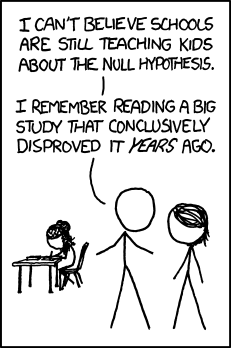
:D

(Sorry. That's the first time I've seen someone use the phrase "Null Hypothesis" since I saw that comic.)
 
So what good is it? If we assume the null hypothesis how do move to believing in the Bible? At best it seems arbitrary.

The question is important in that it highlights that there is no basis for belief.

There is no singular idea or bullet proof means to get theists to see that belief is vacuous. The best we can do is engage in dialog and discussion.

Skip the question in the OP. Get to the nitty-gritty and ask the YECs how they know the first part of Genesis is true if nobody could have been around to witness it. Similar basic question as the OP, but without the possible complications.

There is not, and cannot be, a case where the author of the first part of Genesis witnessed the events, let alone has evidence. Therefore, anybody who believes that first part of Genesis is true must accept that it is true on faith that God communicated that information. And if they believe that God communicated THAT information, then they can believe that God communicated ALL of the information in the whole Bible.

The argument in the Original Post is that before about 2000 years ago the Bible wasn’t written down, but people before then still believed in God without having a Bible to cite as the basis for their belief, so if there is a God those people before the Bible was written must have had evidence to support their belief, and if that evidence can’t be shown then God must not exist.

I respect that argument, but it is indirect and problematic. It is possible for some event to occur, and witness reports of that event to be carried along for some time, and all traces of evidence of the event to disappear, and then the information about the event being written down. The OP seems to imply that if there is no evidence, then the Bible is false. But as I just explained, it is plausible that there can be no evidence, but the event was true. So the argument in the OP does not necessary determine a true or false value.

But if you cut to the chase of the first part of Genesis, it is not possible that witness reports of that event eventually wrote down their information because it is not possible that there were and human witnesses. The author could not have written information based on evidence because the author could not have existed when God made light.

If you reduce the argument to this, there cannot be any evidence and there are no plausible explanations other than accepting the information on faith. Not evidence. Faith. Not plausible in any other way. No manipulations of dates. Alternative interpretations.

The first part of Genesis cannot be accepted as true account of a witness. The witness would not have existed (which is a similar, but round-about and not iron clad, argument the OP is making). And if there was no witness to the first part of Genesis, that person wrote it without evidence. So accepting it as true is a matter of faith. And if you accept that on faith, you can accept the whole Bible on faith, which makes the OP’s request for evidence of other things to support belief in the Bible irrelevant.

 
actually, there is literary evidence that strongly suggests that there were druids in ireland before the celts arrived in 800ish bc.

There is literary evidence that Gandalf and Shadowfax existed in Middle earth.
 

Back
Top Bottom