For the final time, you’re obviously arguing that recovery would’ve happened anyway and would be better if the US cut taxes and spending.
Yes, has that really not been clear to you all this time?
Let’s try proving it without affirming the consequent.
LOL! If you're unwilling to look at past data, proving anything to you is a fruitless exercise. As I have pointed out repeatedly in this and past threads, while pointing to lots of actual data in support, there are four possible cases in recessions/depressions:
- There can be recessions/depressions which end in a relatively short time through cuts (or at least no or very minor increases) in government spending, taxes and regulations.
I've listed lots of examples of these in various past thread.
- There can be cases where recessions/depressions did not end in a relatively short time after cuts (or at least no or very minor increases) in government spending, taxes and regulations.
And as far as I can tell there are hardly any of these.
- There can be cases where recessions/depressions ended in a relatively short time after massive government intervention of the sort pushed by Obama and the democrats (and admittedly, Bush, towards the end of his term).
And as far as I can tell, there are none of these.
- And there can be cases where recessions/depressions ended after a long period of time following massive government intervention.
And there are several of these, including the current on-going example.
I should now add one more case to that …
- There may be cases where recessions/depressions ended quickly after a sizable *stimulus* that was substantially different in character from what Obama and the democrats advocate (
and arguably there is at least one of these).
You don't have to be an economist or an expert or even a *professor* to draw a rational conclusion from that data set (and it's not small dataset). And that conclusion is this: it is foolish to bet that massive stimulus spending of the type advocated by Obama and company will bring a recession/depression to an end more quickly than doing *nothing*. In fact, that data suggests that massive government intervention of the type advocated by Obama and company will likely lengthen and deepen recessions/depressions.
Now you are free to offer examples from the past to argue against what's stated above.

You obviously don’t see that there are numerous mitigating factors for why recovery has been less than stellar compared to previous recessions.
LOL! This argument has been made by several posters previously and in each case I've disproven what was claimed by that poster or shown their logic badly flawed. You are free to offer your own specifics if you want to try your hand.
Or … you can think of it this way. Christina Romer, head of Obama's Council of Economic Advisers, and Jared Bernstein, the Vice President's top economic adviser, published a report in January of 2009, titled "The Job Impact of the American Recovery and Reinvestment Plan" (
http://www.thompson.com/images/thompson/nclb/openresources/obamaeconplanjan9.pdf ). Their report projected (see Figure 1) that without the stimulus, unemployment would hit 8.5 percent in 2009 and then rise to a peak of about 9 percent in 2010. But with the stimulus, they predicted the unemployment rate would peak at just under 8 percent.
Now obviously, for those economists to have made such predictions, they had to have a model. And equally obvious, any model worth it's salt (unless we want to agree that these top economists were incompetent and thus a reflection of Obama's competence?) would have included consideration of your so-called "mitigating factors". So what exactly did they forget, KF? Or what else went wrong that they overlooked? Perhaps the fact that the stimulus money did not do what they claimed it would do? Perhaps the fact that their "multipliers" (see page 12) were completely wrong? Hmmmmmm?
Again though, the evidence just doesn't support you.
The NYTimes? Now there's an unbiased source when it comes to economics.

So tell me, KF, do the *models* that were used to derive the charts in your first link have any relation to the models Romer and Bernstein used? In fact, they do. They are all based on a multiplier approach. So what did they assume for those multipliers? Because if the model is structured similarly and they assume similar multipliers, then one would expect they'll show similar output. In which case they prove nothing at all.
And why isn't an equivalent chart from Romer's model shown? If their results look the same as Romer's, then we'd have good reason to suspect them, since Romer's model clearly didn't work. So can you provide ANY details about those three new models? Or show us how Romer's predictions look plotted on the same axes?
Or do you expect us to just take them on faith like we were expected us to accept Romer's original model on faith? And *trust* the NYTimes to fairly report economic matters? And trust that you are fairly representing what they mean?
Speaking of which, what do you think those model results you link say, KF? I can say this … they don't say a larger stimulus would have fixed anything, like you seem to be claiming. All they say is that the stimulus reduced the number of lost jobs. They don't say that if you increase the stimulus further, you'll get an even bigger reduction. (Although that would be the result because that's the way the models are STRUCTURED given their use of multipliers.) Those results are all for one stimulus level so they don't really say anything meaningful about the effect of a bigger stimulus.
And they don't explain why unemployment exceeded the percentages predicted with/stimulus under Romer's model. Again, can you tell us what any of those three firms predicted the peak unemployment would be with and without stimulus? At least that might at least give us an idea if their models have anything worthwhile to say … or are just as bad as Romer's.
And what else can I say about your proffered *proof*?
IHS, for example, went on record a while back stating that the number of jobs the stimulus saved or created was 1.25 million … at a time when Obama claimed 2 million were saved or created based on Romer's model. And Macroeconomic Advisers estimated only 1.06 million were saved or created, just half as many, during the same time period. So those models seem to be saying something significantly different. They seem to suggest that stimulus is even less impactful than Romer's did. And are liberal models really that uncertain? Why it's almost as bad as Global Warming predictions.

And note this:
http://www.mcclatchydc.com/2011/04/28/v-print/113127/us-economy-slows-sharply-from.html
April 29, 2011
…. snip …
Analysts remained confident that the U.S. economy will continue to grow despite the data showing a sharp slowdown during the first three months of the year, which raised concerns in some quarters that the fragile recovery may be sputtering back into weakness and rising unemployment.
… snip …
A dip in government defense spending, bad winter weather and other factors that slowed first-quarter growth are unlikely to repeat, Wyss said, adding that, "We still think we'll be back in the 3 percent to 3.5 percent range for the rest of the year."
Patrick Newport, an economist for forecaster IHS Global Insight, was similarly optimistic.
So how is IHS' prediction turning out? Hmmmm?
And did you notice the date on your so-called "evidence"? November 2009. Your second link is a NYTimes article titled "New Consensus Sees Stimulus Package as Worthy Step". A *NEW* Consensus … in November 2009. Is it new because White House and liberal sources (like the NY Times) were also claiming there was a consensus back in February 2009?
Of course there wasn't back in February 2009, as noted by Cato:
http://www.cato.org/multimedia/daily-podcast/false-consensus-stimulus "The False Consensus for Stimulus". So how could there be a *new* consensus if there wasn't an *old* one?
And say ... here's an even newer consensus, KF:
http://hotair.com/archives/2011/07/...rities-coast-to-coast-agree-stimulus-flopped/
“Intellectual authorities” coast to coast agree: stimulus flopped
And notice that the conclusion of your 2009 NYTimes article is that the stimulus wasn't big enough. If only it had been larger … MUCH larger … *then* all would be well. Just a good example that liberals NEVER learn. More on that in a moment.
Originally Posted by BeAChooser
In fact, it's hard to even find one example, even before the Great Depression, where the recovery wasn't dramatic and fast if the recession was deep. Even if the leader at the time didn't do what Obama did … i.e., increase government spending and taxes. Go ahead, offer us an example.
Which is ironic as I've pointed out to you numerous times that Reagan increased spending and taxes in the face of a recession.
Your response is a non-sequitor. I challenged you to provide an example of a past recession that was deep where the recovery wasn't dramatic and fast, even if the leader didn't increase government spending and taxes which you are claiming would hasten the recovery. You didn't. Claiming Reagan increased spending and taxes in the face of his recession does not address that challenge. Not at all. Perhaps if Reagan had done nothing, the pace of recovery in his recession would still have been dramatic and fast. Because there are numerous historical examples (that I've already pointed out previously) where deep recessions recovered rapidly even without additional government spending and taxes. The data supports me, not you.
Second, as I've noted to you previously, Reagan's spending and taxes had a different character than that pushed by Obama and current democrats. That different character is why Reagan's economy was not crippled but Obama's has been. And that an argument you basically ignored, as evident by your response to my posts #1776, #1788, and #1792.
In fact, you're complaining about tax increases under Obama that happened after the US got out of recession.
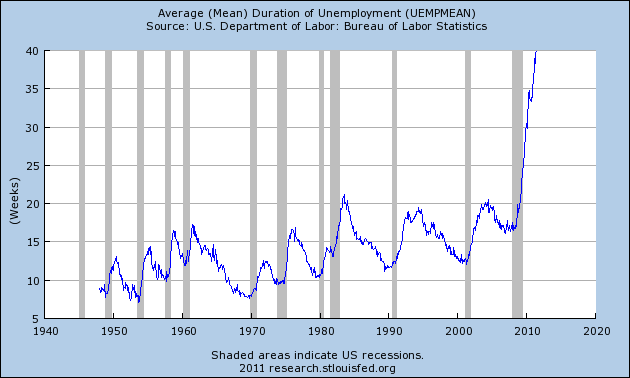
LOL! After all the above facts that have been noted, you still really think the US is out of recession? Well, since you seem to have ignored all the previous facts that suggest otherwise, you might as well ignore what this chart says, too:
And by the way, Obama was talking about drastic tax increases even before his election, a behavior that has probably had almost as much effect on the economy as actually instituting those taxes. His rhetoric alone has killed the economy by creating uncertainty … a let's-wait-and-see-what-happens-before-making-a-decision attitude in both business and personal finance matters.
Reagan increased taxes still a few months until the recession actually ended, yet the economy did not slide back into recession. Go figure.
You'll have to try again if you want me to understand what you were trying to say.
Is it to repeat your previous claim that "Reagan raised taxes in September of 1982 ... snip ... yet the economy did not slink back into recession"? I recall I answered that claim by noting that
while your link at Mises does note that Reagan instituted a tax increase in 1982 (called TEFRA), which it describes as the largest tax increase in history ($214 billion over 5 years), that tax still did not cancel out the effects of the Economic Recovery Tax Act of 1981, which is what got the economy moving in the first place.
There's an interesting chart here:
http://en.wikipedia.org/ wiki/Reaganomics , which sums up the effect of the various tax measures during the Reagan years, and shows that indeed, all told (even accounting for increases in Social Security), the tax burden was reduced by Reagan. And the economy didn't "slink back into recession" as a result of TEFRA because it was already booming (not like now), and $214 billion over the next five years was small potatoes in an economy that would grow over $1.5 TRILLION in that 5 year period.
And I also recall you basically ignoring my response.
Originally Posted by BeAChooser
Indeed. Go ahead, KF, present us with an example from the past where a recovery was as lackadaisical as this one has been. Show us what you think should have happened. Tick tick tick .
What exactly are you asking me to prove?
I didn't ask you to prove anything. I merely asked you to
show us one example from the past where a recovery (from a deep
recession) was as lackadaisical as this one has been. If you can't do it, just admit it. Based on your response, or non-response, I
think most everyone reading this thread can reach their own conclusion about what that *proves* vis a vis my position and yours.
No, KF, I'm considerably older than you. Been out of school for years and years. Which means I have LOTS of *real world* experience ... as opposed to what you've mostly seen, heard and done in the liberally leaning public schools and universities you are still attending.

Originally Posted by BeAChooser
Recall, I made the assertion that in every modern recession, even the deep ones like that in 1981-82, recovery was well under way by now, rather than the economy remaining stagnant and unemployment going back up.
If that is the case
IF that is the case?
then the US is stuck in a liquidity trap and austerity measures are the last thing we should consider.
LOL! Are you sure? Is that what your socialist economic professors are telling you now?
Were we stuck in a liquidity trap when Carter was president and the economy remained stagnant with high unemployment (or at least what passed for high unemployment in those days)? Here's a nice chart that might give you a clue what those Carter years were like (since you are too young to have first hand experience … like I do):
http://2.bp.blogspot.com/-wOqy2cH1QLM/TcOcXydJa3I/AAAAAAAACMk/VM9-O-lUQD0/s1600/saupload_1980s.jpg
Originally Posted by BeAChooser
This is true. And I offered a figure showing what every recession since WWII did as my proof.
And I pointed out that this isn't evidence of anything other than what happened during those recessions. In no way, shape, or form does it constitute evidence that recovery would be better if Obama did nothing.
Suit yourself. I can point you to the data but I can't make you absorb or comprehend it's implications. As our past exchanges have proven. I suppose I could have a thousand examples, and you'd still claim it doesn't constitute evidence of anything. Because, like most leftists, you refuse to learn from history.
Originally Posted by BeAChooser
And then I asked "Why is that? Perhaps because of something that the Presidents who faced this recession did? That's not unlogical, is it?".
Or perhaps the stimulus needed to get the economy rolling wasn't enough?
LOL! I seem to recall conservatives asking you liberals a question back when you began claiming the economy would grow more than the stimulus that was applied. White House economist Larry Summers claimed that every $1 of government spending would yield roughly $1.50 in higher GDP. It was an input to the government's economic models. (And to those 3 models you linked as your *evidence*.) And Conservatives asked the obvious question … if that's true, then why not make the stimulus twice as big as proposed and grow the GDP twice as much? And the response from your side was … {crickets}.
No, Christine Romer and all the rest of the economists that Obama had at his disposal (supposedly the best of the best) assured us that the stimulus that they'd asked for was adequate to keep the unemployment rate below 8%. And now you are telling us that all those economists were wrong?
And at the same time now we are supposed to believe liberal economists (many of the same ones as before, by the way, like Romer) know what they are doing when they tell us it didn't work because the stimulus wasn't big enough? LOL! Why do I remain skeptical that they know what they are doing?
Do you know that
http://nrd.nationalreview.com/article/?q=YzVhZmI5MDAxMDEyZGIzMWVlZTUzZWU1ZDY2ZjExNTQ=
a 1999 study by Christina Romer showed that the average length of recessions from 1887 to 1929 was 10.3 months — without any Keynesian spending schemes — while the average recession from 1948 to 2000 lasted 10.7 months.
But like most liberals, she didn't learn anything … not even from her own study of economic history, and therefore she repeated the same mistake that liberals have been making since Keynesian economics came along. And as a result, she helped turn what probably would have been a rather ordinary but deep recession into what's beginning to look like a depression.
Many economists believe the stimulus passed was inadequate but it was certainly more than enough to get the US out of recession.
And did it? Really? Now try and be honest given all the above data that's been provided.

Seriously, the whining now from certain economists that if only the stimulus had been bigger, all would be well is almost laughable. Take Christine Romer, for example. Again, she was one of the prime architects of the stimulus. She did the modeling for how big a stimulus was needed and what we could expect to see happen as a result of that stimulus. She had defended it as adequate. But when she left her post last year, she sang a new tune. Here, from the Washington Post, no less …
http://www.washingtonpost.com/wp-dyn/content/article/2010/09/01/AR2010090106148_pf.html
Lunch at the National Press Club on Wednesday caused some serious indigestion.
It wasn't the food; it was the entertainment. Christina Romer, chairman of President Obama's Council of Economic Advisers, was giving what was billed as her "valedictory" before she returns to teach at Berkeley, and she used the swan song to establish four points, each more unnerving than the last:
She had no idea how bad the economic collapse would be.
She still doesn't understand exactly why it was so bad.
The response to the collapse was inadequate.
And she doesn't have much of an idea about how to fix things.
Let me repeat what she apparently told the audience … "
he still doesn't understand exactly why it was so bad" and "she doesn't have much of an idea about how to fix things". This, from the economist that Obama presumably thought was the best of the best. This, from an economist now telling us, like you, that the stimulus only needed to be bigger to have worked. And you think now a new set of economists (or at least the same old ones) have it figured out?
Not that you've considered any of that
You are wrong again. I've have indeed considered that argument when it's been mentioned in the past on this forum by folks on your side.
For example, Tranewreck claimed that, and as proof he argued that Germany recovered faster during this recession because they had a bigger stimulus. And my response to his claim (http://www.internationalskeptics.com/forums/showpost.php?p=6370011&postcount=73 ) was, first, to point out that his own source said Obama's stimulus was just as big as Germany's (proportional to the size of the economy) and, second, to point out that Germany's stimulus did not have the same characteristics as Obama's. And they didn't raise taxes. They didn't even talk much about raising taxes. In contrast, we've heard about nothing but raising-tax rhetoric from the Obama administration since the very beginning, making business very leery about expansion and consumers very leery about spending.
Also, whereas Obama has added mountains of new debt, Germany announced an austerity program to go along with their stimulus. They were planning deep cuts to spending. Cuts in welfare. Cuts in federal employment. Not bigger and bigger government, not more and more people on the welfare rolls far into the future, like Obama and democrats talked about and seemingly desired. That gave German employers and consumers more confidence, which was reflected in the speed of recovery.
In post http://www.internationalskeptics.com/forums/showpost.php?p=6445374&postcount=113 , I addressed Tranewreck's claim even further, citing sources to show the difference between the two approaches our countries had to the recession. The bottom line is that there were reasons, other than simply the relative size of the stimulus, for Germany's better recovery. It's economy is more affected by exports than ours, and their recovery was clearly export driven (and that's something mostly outside their control and thus unaffected by stimulus money). Plus, as noted, they tried something entirely different in terms of stimulus. Instead of simply handing out money to unemployed people (like Obama and democrats basically did) and promising the unemployed an even bigger nanny state in the future, they kept their workers employed by subsidizing their existing employment during the downturn (so they were still producing something even during that time). And I'm not talking about Germany primarily helping public sector workers (like Obama's *help* did), but mostly helping private sector workers (the folks who really produce wealth in an economy).
The real problem here, KF, is that you've simply ignored my past responses (and those of other posters) regarding the assertion that the stimulus should have been bigger. You are the one with a closed mind … who simply keeps repeating the same ol' same ol' socialist/democrat mimes and ignoring history, data and common sense. Can you not understand that pulling money from an economy that is in downturn will only prolong the downturn? Can you not understand that the multiplier for Obama-type stimulus is far less that 1.0 and the results of the last stimulus prove it.
because you've clearly already made up your mind that unproven methods of dealing with a recession will work.
Unproven? No, the history I've cited is real world proof. Proof that you continue to simply ignore. You'd rather cling to ivory-tower, ideologically-motivated, "hope and change" speculation spewed by *professors*, socialists, liberal economists and Obama. You'd rather cling to the "models" that your leftist economists presumably used to calculate what would happen with the stimulus … models that are now demonstrably "DISproven".
The substance of your question was that fiscal stimulus has never worked ever
False. I've noted that the type of stimulus Obama and democrats have pushed hasn't historically worked. I've noted that massive intervention by government in economies, ala Obama, has not historically worked out as intended. And I've noted that it clearly isn't working now.
You're implying that fiscal stimulus doesn't work
If that's what you've think, you haven't paid attention, and I'm not going to keep going around and around with you. Either listen or be ignored. Especially if you start up a conversation three weeks after my last long and detailed response to you. Especially if you are going to call me "ignorant of economic history" and imply I'm not as smart as an "imbecile", while demonstrating your own cluelessness and grossly distorting economic history. I'm just not going to go round and round with you about Reagan. We've both said all that can be said. I've better things to do. And because I've already corrected your untruths about Reagan on this thread, I can ignore most of what you post just as easily as I ignore lefty. I've made my case so from now on I'm only going to address any new distortions posted by you to this thread.
For example …
No I mean the one that Clinton had been pushing to reduce since he came into office.
Words are cheap. Clinton said what people wanted to hear. He was a politician. But in the end, Clinton approved the spending that democrat Congresses passed. And thus nothing happened. And that's why GDP remained flat. If he was serious about deficit reduction, he should have vetoed the Deficit Reduction Act of 1993. It was focused on the wrong thing. It increased taxes. And if there is one thing history shows over and over and over, the federal government will spend more than whatever taxes it collects. The notion that Act would reduce the deficit was flawed from the outset. It wasn't until Gingrich and 1995 when Republicans gained control of Congress and cut taxes and spending, that the deficit began to drop. And then Clinton had no choice and was rather preoccupied with keeping himself out of jail. If you think lower spending and less Federal government was EVER Clinton's agenda, you are sadly mistaken. And hence the notion that he favored reducing the deficit is ludicrous. History again proves that was never even in the cards. Not without reducing government spending and doing things that would grow the economy rather than impede it.
And this …
Then you made a ridiculous claim that you can name “hundreds” of socialists/communists in Obama’s inner circle and demanded others put their forum membership on the line to prove you wrong and refused to provide the names until they accepted.
That's not accurate. The topic was whether "most" of the people surrounding Obama (I called it the "inner circle" … his advisers, mentors, co-workers and close friends) have socialist/communist leanings or not. And I'd already named dozens of people who qualified. I'd suggested there were "possibly" hundreds. For which I was ridiculed by posters like you. So I offered them (and later you) a bet. That I could name more people in Obama's inner circle who did have socialist/communist leanings than those who believed otherwise could name people who did/do not. And further, if you managed to get to 199 names, I'd be able to mention a 200th. And I went ahead and named my first name (Van Jones) and said it was your turn. Here's what I then said:
Name a name, KF. And then we'll take turns. If you can get to #199, I'll name my 200th (although my original statement only said there were "perhaps" "hundreds"). In fact, I'll bet my membership to this forum that I can come up with a 200th name if you can get to #199. Now shall we bet you aren't willing to bet your forum membership on that challenge?
And then you ran.
And this …
Originally Posted by BeAChooser
You've defended Van Jones, a communist.
I never actually “defended” him. Rather I said he was no longer a communist.
What you just said amounts to defending him. And you claim he's not a communist as if that's fact. When it is not.
When I first called Jones a Communist, you negated my accusations by accusing me of "consider[ing] anyone left of right as being necessarily a communist," implying that Jones is *just* "left of right" … therefore, no big deal. But that's false. He was and still is on the far left of the political spectrum both in his associations, his rhetoric and his goals.
Later you stated:
No you proved that Van Jones was a communist and that he still leans left today. “Very likely” still a communist remains to be proven.
My response to you was to point out that that since only a few years ago Jones appeared to believe the same things he did when he openly admitted he was a communist (and I remind you that I proved this with numerous sources that you then simply ignored), wouldn't it be "very likely" Jones remains a communist? I still stand by that clear and simple logic.
I quoted Jones admitting just a few years ago that he simply changed his tactics, not his objectives. He said "I'm willing to forgo the cheap satisfaction of the radical pose for the deep satisfaction of radical ends." And I asked you why you couldn't understand that sentence. Have you not figured it out yet, *professor*? And I noted that there is nothing in what Jones has said or what's been reported about him since to suggest he's actually changed his view or his goals. Nothing. Want to try and prove me wrong … or go on ignoring that assertion of fact?
Here you are again pretending that you didn't defend Van Jones and implying that you (and/or others) proved he's now *not a communist*, when in fact you (and the others) did no such thing. You are simply being dishonest, KF. Your current claim is just as dishonest as when you posted to me:
As for Van Jones, we went over that and all you did was quietly drop the subject.
I responded to that assertion here: http://www.internationalskeptics.com/forums/showpost.php?p=5909475&postcount=465 , noting your complete dishonesty regarding the Van Jones discussion and proving (with numerous facts and sources) that Jones was until VERY recently still CLOSELY linked to communists and espousing very communist views. And I asked you, when did he become a *former* communist? A question you then ignored.
But that didn't stop you from trying to defend him further. You did so in a later post, http://www.internationalskeptics.com/forums/showpost.php?p=5910980&postcount=479 , by again dismissing out of hand (or ignoring) all the facts and logic that I noted in my previous posts. You simply would not discuss specific facts.
So I've concluded there is no point arguing with you further on this. No amount of facts and no amount of logic will change your mind or make you see Jones for what he still is. I'm simply posting now to show folks the extent of your dishonesty in describing our past discussions on Van Jones and his nature. The fact of the matter is (easily verifiable) that Jones is still out there stumping for "social justice", "eco justice", for "redistribution of wealth", pushing "class envy" and an agenda thick with "anti-capitalist, communist-type rhetoric" and objectives. He's still advocating equal OUTCOMES and anything less is unjust. Here he is recently saying that: http://www.youtube.com/watch?feature=player_embedded&v=a_-vgtYkJdA . And that at it's core is communism. For Jones, it is not about economic growth. it's about "fairness", even if we all end up less properous. And that, at it's core, is communism. Deny it all you want, KF.
Originally Posted by BeAChooser
You've even remarked that you admire certain communists and have defended the notion of communism.
Yes, certain communists who turned out to be such notorious monsters like Helen Keller and Marin Luther King Jr.
Originally, you stated:
I have an openly communist professor, an uncle who had quite a bit of influence on my life who is a communist [BAC - you later implied he was a "mentor"], and admire several communists.
Naturally, I was curious who these communists you admire were … and you wouldn't name them. Odd that you wouldn't name Keller or King … as if naming them would cause them some harm. Call me a little skeptical that you finally came up with these two names after many, many requests from me.
The big reveal was sometime ago, BAC.
Yeah. All of one month ago … on this thread, no less.
Furthermore, I can’t help it if you’re so paranoid that you made it a year-long crusade to harass me over it.
Harass? Hardly. YOU volunteered that you "admired" communists and had a communist "mentor" while claiming you weren't a communist during a discussion about communists where you were defending communists. So it's rather natural that I'd be curious when you said you admired communists. And my curiousity only grew when you showed yourself to be unwilling to name those admired communists during discussions where you'd been so open about everything else in your life. Remember, it's not the facts that do you in, but the coverup.
Also, what is “defending the notion of communism”? In the sense that I feel they not only have the right to exist and propagate their viewpoint unmolested or in the sense that I agree with them in any significant way?
If only communists felt the same way about non-communists and their right to exist and hold differing viewpoints.
As someone who believes in democracy I recognize the will of the people to self-determine, something you evidently do not.
One of the Founders said that the Constitution is not a suicide pact, or words to that effect. And given the behavior of Communists in subverting governments in case after case over the past 100 years or so, and all the damage that then occurred to those countries, we'd be suicidal to simply ignore the dangers posed by communists now. We have a right to protect ourselves from them … as much a right as we have to limit the activities of Nazis. BOTH have done enough damage and caused enough misery in the world.
In so long as communists/socialists don’t subvert our laws or the legitimacy of the US government they’re something I have to live with.
Don't be modest. You once went so far as to say you don't see communists as a threat. But you should, given their history. But then liberals/leftists never learn from history.
For that matter, once more people read how often I defend Keynesian economic policies they’ll be quick to conclude I’m not a socialist. I know you’re ignorant of such things but socialists generally view Keynesian economics as a form of disguised capitalism.
LOL! In my ignorance, I know that Fabian Socialists would disagree. They, in fact, were inspired by Keynes, who provided a theoretical basis for extensive state involvement in an existing market economy leading to a gradual tranformation to a socialist society. Just like we are seeing today (what a coincidence that Obama's Chief of Staff is a graduate of the London School of Economics founded by the Fabian Society). But then maybe you are "ignorant of such things" because you've been hanging around the more traditional, revolutionary, socialists?
Originally Posted by BeAChooser
Or how about the example of 1921, when President Harding inherited (like Obama claims he inherited) one of the sharpest recessions in US history. … snip …
In fact, the decrease in military spending is what caused the depression and not what fixed it.
How do you know it's not what fixed it? Afterall, you've been arguing that spending is spending. And your charts show that Harding continued to decrease military spending from January 1920 to July 1921, the entire duration of the recession. In fact, the rate of decrease steepened in 1921 and it was still being decreased after the recession was officially over. By your logic that should have caused the downturn to continue even longer or deepen? But it didn't.
And yes, spending in other categories went up (a little) or stayed about the same. But the type of spending matters and the total up amounts were a TINY percentage of the GDP (compared to now). The government basically didn't interfere. Welfare spending only went up about $.05 billion (i.e., it was lost in the noise) between 1920 and 1922, and most of that increase came in the last half of 1921, after the recession was officially over. Pension spending was in flat during 1920 and only started to go up in 1921. Transportation spending did go up … from $1.2 billion to about $1.5 billion during the recession. But note that I haven't objected as much to true and needed infrastructure spending during a recession. It can be a way to get the economy moving again. Because it can produce something that is needed (as opposed to welfare spending which is just a big sink hole). I'm just not sure much of Obama's "green" infrastructure spending qualifies on that basis. Or his repaving of roads that didn't need repaving. And admittedly education spending also went up from 1920 to mid 1921, from $1.3 billion to about $1.6 billion … but again, education spending was different back then. It actually accomplished something and wasn't designed to pad the pockets of unions … as the current stimulus was designed to do.
Here's an entertaining alternative view to regarding the 1920-21 recession/depression from the Ludwig Von Mises Institute:
http://www.youtube.com/watch?v=czcUmnsprQI&feature=player_embedded
One that's a lot more credible than yours. I hope you and the readers of this thread will take the time to watch it. Learn from history, KF, rather than just communist professors.
Originally Posted by BeAChooser
All of this without a government stimulus robbing peter (a privately employed taxpayer) to pay paul (a government worker).
I do find it amusing that the new conservative mantra is to portray government workers as the scum of the earth.
Well, unfortunately, it's gotten to that point. Government workers and their unions have become parasites, sucking away the health of the economy. And most people, not just conservatives would agree with that statement now days. That's why most people say government is too big (http://www.gallup.com/poll/143492/Americans-Image-Federal-Government-Mostly-Negative.aspx ).
Yes, we should all note that what you mean by "different stimulus" is that Reagan put the figurative pedal to the metal with military spending. You claim the difference between his "stimulus" and Obama's "stimulus" is that Obama essentially expanded US welfare programs. You evidently believe the US would have stunning recovery now if Obama had simply spent that trillion on the military.
And how do you know it wouldn't have? Afterall, military spending is what finally ended the Great Depression. Right?
you're arguing that recessions which are nominally "worse" showed greater and faster recovery than in the current recession.
No, I'm not. I'm arguing that recessions which are deeper (worse) show greater and faster recovery than those that aren't as deep … unless government interferes. And historical data clearly proves that assertion. Whether specific recessions were as deep as the current one back in January of 2009 is immaterial to that assertion and conclusion. Why so much difficulty understanding this simple assertion?
Originally Posted by BeAChooser
No one is denying that the peak numbers in the "Great Recession" were/ARE bad. The issue is whether the numbers were worse than the 1981-82 recession peaks back in January 2008, when Bush and Obama began this government spending spree, and began talking about massively raising taxes. And they weren't. As pointed out previously, citing such sources as the NYTimes, the fall in GDP at that time was less than that experienced during the 1981-82 recession. Unemployment was several percent below the 1981-82 peaks. And many other stats show that the recession then was not anywhere near as bad as the 1981-82 recession. Obama LIED when he claimed it was.
So your argument is that Bush screwed up so its Obama’s fault
No, that's not my argument, but it looks like that's the best counterargument you can dredge up. Blame Bush. Figures.
Obama came into office with the worst of the crash already underway.
What nonsense. "worst of the crash already underway"? Surely you can be more precise than that, *professor*. Obama came into office with U-3 unemployment at 7.65%. At the beginning of the recession it was a little over 5%. So it was up 2.65%. And he promised that, with the stimulus, unemployment would not reach 8%. And it went over 10% and is still over 9%. So was 7.65% the worst of the crash? Furthermore, U-6 unemployment, a better indicator of the real unemployment, was fluxuating around 8% when the recession began. When Obama took office it was still below 13%. It went to almost 18% and is still hovering at around over 16%. So was the worst of the crash "already underway" back in January of 2009?
When Obama entered office in January of 2009 GDP growth was at -4.9%, by January of next year it was at +5%.
Yeah, for one quarter. And then want happened? It plummeted. And what is it now? Well under 2 percent and shrinking? The GDP growth rate in the first five quarters that followed the 1980-82 recession was 5.1%, 9.3%, 8.1%, 8.5% and 8%. So really, what did all that Obama stimulus really buy? A lower growth rate than historical data would suggest would have occurred had nothing been done, or at least something quite different than what Obama did? Wake up. The stimulus failed.
I don't disagree that the stimulus failed in its goals.
That's putting it mildly. It's stated goals (by Obama) were to immediately get people back to work through "shovel-ready" jobs (it didn't because the shovel ready jobs never existed in the first place), produce most of the saved and new jobs in the private sector (it didn't … in fact, it produced most of the saved and new jobs in the public sector because it was designed all along to help the union friends of democrats), and keep unemployment from rising above 8% (it didn't … it didn't even come close to achieving that goal).
What I disagree with is your belief that all fiscal stimulus necessarily fails and causes worse recessions.
Which is a strawman since I've never stated that. What I've said is that stimulus of the type and magnitude pushed by Obama and democrats has historically always failed in it's goals and instead causes deeper and/or more prolonged recessions. What Hoover and FDR did and what followed is a case in point. And now Obama has added another data point proving that.
If your sole argument was that the stimulus failed we wouldn't be having this conversation
Perhaps we wouldn't be having this conversation is you'd just get right what I've actually said (over and over).
Originally Posted by BeAChooser
But the depth of the recession is not the issue. It's how fast the recovery should occurs given one as deep as this one. How rapidly GDP grows at the end of recessions. And the data shows clearly that the deeper the recession, the faster the recovery will be … if government doesn't interfere by massive spending and increasing taxes …
The data doesn't support this conclusion. The US had strong economic growth from January 2010 until July 2010.
LOL! The data, especially if you look at all the data and not just the current recession in isolation, does support that conclusion. Which is why you'll find statements by economists all over the internet on how the deeper the recession, the faster the recovery. Your problem is thinking that 5%, 3.7% and 1.7% growth rates in the first three quarters after a deep recession is good. It's not. Historically, growth rates after deep recession have far exceeded those numbers. http://www.creditwritedowns.com/2010/09/gdp-and-recessions-a-valuable-metric-but-overused.html As noted already, comparable numbers for the 1980-81 recesson were 5.1%, 9.3% and 8.1%. In the quarters after the 1953 recession, the growth rate reached 8-11.5%. After the 1973-75 recession, growth rates of 9% were seen. After the 1960 recession, growth rates of 8% occurred. After the 1958 recession, growth rates were 9-10%. And I could go on and on. For all your *education*, you simply don't know what you are talking about, KF. You have no perspective because you refuse to learn from history.
Originally Posted by BeAChooser
as they are doing now and as they did in 1932.
I'm guessing that pointing out growth ended and the economy fell again during the Depression when austerity measures were pushed through congress would be a lost cause.
It would, because that's not what happened, as has been discussed repeatedly on this thread. But then the thread is nearly 50 pages long so we can't expect you to have noticed that. Right?