:But was it welfare spending? No. And therein lies part of the difference from the current administration's policies.[/ quote]
Ahh, I see now. Fiscal stimulus and significantly increasing the national debt is perfectly acceptable so long as it’s being done for good, CONSERVATIVE reasons like a massive build-up of the US military. As opposed to bad, SOCIALIST things like giving people a modest sum of money to buy food, shelter, and medical coverage.
But the federal budget is the only one he had control of during that time. When he entered office, Federal spending was 21.7% of GDP. With a democratic House and a republican Senate, it rose to 23.5% in 1983. But then it declined to 21.2% by the time he left office. Despite all the spending on the military to win the Cold War.
Well, you’ve missed the big question that you most-likely won’t consider anyway. Did Reagan’s spending cuts prompt higher taxation and spending at the state and local level because Reagan cut vital programs?
From the link in the article … the report by Cato that the article is about:
Satisfied?
Fair enough, yes.
:The cutoff date wasn't arbitrary. In 1995, Congress switched hands. So it wasn't Clinton and his policies that drove the economic boom after that, it was Gingrich and the Republican Congress. Clinton just went along for the ride.
I find it amusing that you characterize every president as a weakling being strong-armed into submission by congress. However, it was indeed arbitrary. The claim was that they studied the Bush-Clinton years. Clinton did not leave office in 1995 ergo they did not study the Bush-Clinton years. If they had claimed to be studying the economic impacts of Democratic congresses then it would be a different matter entirely. This is, however, not what they’ve claimed. It’s a very obvious, and shoddy, partisan attack.
:But he did. Now you the one confusing spending with debt and misrepresenting what tax revenues actually did.
Fair enough. However, the claim that tax cuts are what increased revenues is still dubious as best.
You mean the debt that Gingrich and the Republican Congress were paying off?
No I mean the one that Clinton had been pushing to reduce since he came into office. Just because the Republicans were more willing to listen to his
calls for deficit reduction doesn’t mean credit for it should be stripped from him. And I quote…
In a nationally televised address to a joint session of Congress, Clinton unveils his economic plan. The plan focuses on deficit reduction rather than a middle class tax cut, which had been high on his campaign agenda. Clinton also discusses the plan in his first State of the Union address later that day. Even though Democrats control both houses of Congress, the economic plan is in jeopardy because of the president's earlier missteps, which have weakened confidence in the new administration.
And you do know what unfunded liabilities are, don't you? Because Clinton did a lot to make that part of the federal ledger look a LOT worse.
Damn his deficit reduction proposals. :rolleyes
No, you took something I said in another thread completely out of context. I understand if you don't want to acknowledge your use of a very dishonest debating tactic. Really, I understand.
Precisely how was it taken out of context? From what I’ve seen it didn’t take things out of context so much as what you stated made you look very, very, very bad.
But it is in time of war and we were at war. Oh that's right, you liberals never did really believe that the Cold War was a real war.
Well at least you’re a little closer now. You’re calling me a “liberal” instead of a “socialist (communist?)”. You’re still a bit too far left.
No, what you did is show you can misinterpret a chart. As I showed, your source actually proves that federal tax revenues almost doubled under Reagan.
Fair enough, but I’m mostly taking issue with the belief that Reagans tax cuts caused revenues to rise as high as they did and not Reagan’s tax hikes.
Because tax revenues could only double at the same time that tax rates went down significantly, if GDP went up significantly. And it did. GDP went from 2.5 trillion at the end of Carter's Presidency (where it basically sat throughout his Presidency) to about 5.4 trillion by the end of Reagan's administration. And that's why we credit him for stimulating the economy. See?
Nice job quoting me out of context. Here’s what I actually said.
I already pointed out that tax revenues went down under Reagan, so why are we crediting him for stimulating the economy when he did so in a completely irresponsible manner?
Again, BAC, his fiscal policies saddled the US with trillions of dollars of debt. You claim his fiscal policies stimulating an immense growth in the US GDP. Why precisely are we giving him credit for that after his considerably large increase in debt? Is a $2.5 trillion dollar increase in the GDP worth a $2 trillion dollar debt that has to be paid off in full + interest?
No, but then he didn't get a lot of help from the democrat side of the aisle given they were in control of the House for much of his Presidency.
I’m not sure many conservatives, or liberals for that matter, will agree with your characterization of Reagan as a spineless coward who was easily cowed by congress.
It's not irrelevant, not if you are indeed a socialist.
I’m not, so it must indeed be irrelevant.
And I'm sorry, but you sound like one much of the time. You've constantly defended socialist economic policies and socialist inspired universal healthcare.
I know harder-line conservatives than you who are in favor of “socialist inspired universal healthcare”. I’ve pointed out to you, several times, that many nations ostensibly considered economically “freer” than the US have universal healthcare. I’ve also never defended socialist economic policies.
You've defended Keynes, who wrote in his book that "I expect to see the State, which is in a position to calculate the marginal efficiency of capital-goods on long views and on the basis of general social advantage, taking an ever greater responsibility for directly organizing investment", and who argued that "socialization of investment" would "prove the only means of securing an approximation to full employment", and who labeled his approach "liberal socialism."
I’ve never been in an argument with you over Keynes himself. Rather, I’ve defended a few of his economic policies which evidence suggests are sound. Furthermore, this is beyond paranoid thinking on your part. A few commonalities with socialists and a person is a raving Marxist? What nonsense. You’re focusing on what Keynes and socialists have in common and ignoring what they don’t and what they don’t have in common greatly exceeds what they do.
You've repeatedly defended Obama (a closet socialist with scores and scores of socialist and communist friends/associates/supporters) by defending his socialist policies and by dismissing all his contacts and history with socialists and communists.
You’ve been challenged and failed to prove that Obama is a socialist, consistently failed. Rather you devoted an entire thread to reviewing people with any association to Obama, whether they’re socialist/communist themselves, then concluded Obama must be a socialist on those merits alone. Then you made a ridiculous claim that you can name “hundreds” of socialists/communists in Obama’s inner circle and demanded others put their forum membership on the line to prove you wrong and refused to provide the names until they accepted.
You've defended Van Jones, a communist.
I never actually “defended” him. Rather I said he was no longer a communist. Something which fails to be relevant after he was forced into resigning from his position as a powerless czar reporting to an only slightly-less powerless committee.
You've even remarked that you admire certain communists and have defended the notion of communism.
Yes, certain communists who turned out to be such notorious monsters like Helen Keller and Marin Luther King Jr. The big reveal was sometime ago, BAC. Why is it that you still bring up my communist admiration but shy away from mentioning who they were to your following of conservative lurkers?
Furthermore, I can’t help it if you’re so paranoid that you made it a year-long crusade to harass me over it. Also, what is “defending the notion of communism”? In the sense that I feel they not only have the right to exist and propagate their viewpoint unmolested or in the sense that I agree with them in any significant way?
If conservatives lose ground to communism and socialism, that's apparently ok with you since, as you said once, "that's the will of the people."
As someone who believes in democracy I recognize the will of the people to self-determine, something you evidently do not. In so long as communists/socialists don’t subvert our laws or the legitimacy of the US government they’re something I have to live with. Then again, the same can be said of any political persuasion. I don’t necessarily have to agree with them. And I consider the idea of conservatism “losing ground” to communism/socialist to be slightly less likely than OJ Simpson admitting he killed his wife without any financial gain in his favor.
Seriously, KF, why would I not believe you are socialist after all that?
Pretty much because no rational person would conclude that I’m a socialist/communist. Some may suspect it, others would ask, and most everyone would state I’m not after I stated that I’m not. Which I’ve done. Many, many, many times as you’ve constantly been harassing me over it for the past year. For that matter, once more people read how often I defend Keynesian economic policies they’ll be quick to conclude I’m not a socialist. I know you’re ignorant of such things but socialists generally view Keynesian economics as a form of disguised capitalism.
Sigh. I have named examples several times, already, on this very thread. Did you not pay attention, KF? Oh well, I guess I'll have to do it yet again (because liberals never learn?)
Actually I didn’t, this is 48 pages long now and I don’t read threads from start to finish when they get this long. If you do then you’ve proven once and for all which of us has more free time.
The examples you provided are bizarre. Of the three you provided none of them are from a post-WWII business cycle. The first two aren’t unusual in anyway for a 19th century business cycle. Business cycles in the 19th century are noted for being marked with frequent, deep, and lengthy economic downturns, hardly the sort of thing I’d appeal to for a functioning policy of economic stabilization. They’re hardly relevant to the discussion, for that matter, unless you’re claiming that either A) the recession would have continued indefinitely without tax cuts and further austerity measures or B) the Great Recession hasn’t yet ended. Of course you could be arguing for C) with Mhaze, which is that a recession hasn’t actually happened yet.
Consider the downturn (depression) of 1837? It was so serious that 4 million people lost their jobs (that was a lot back then compared to the size of the working population). ...[snip]...
Then we have the depression of 1893. Again, the worst in US history to that point in time. Unemployment went from 4% to over 12%. GDP dropped 10%. But again, we were blessed with a President, Grover Cleveland, who, like Van Buren, was opposed to government intervention. Who, in fact, cut taxes and reduced government spending in response. …[snip]… That downturn was over within 6 years, with unemployment back to 5% and the economy booming. Do you think that's what's predicted now? No, unemployment is predicted to remain high … a new "norm" … with GDP growth relatively stagnant for as far out as we can look (despite massive and costly interventions by the Federal government).
If I were a proponent of laizzes-faire economics looking to take Keynesian economists to task I wouldn’t start by appealing to the response of recessions that were longer and deeper than the current one.
Or how about the example of 1921, when President Harding inherited (like Obama claims he inherited) one of the sharpest recessions in US history. Unemployment rose over 700% in just one year. Production fell 23%. The stock market lost 18%. Yet within within two years (by now), it was over. Unemployment had returned to what was considered full employment and the economy was booming. What happened to make this possible? President Harding cut government spending by 40%, instead of massively increasing it.
Ahh, the ur example often cited by Austrians as refuting Keynesian assumptions on the economy. Here’s what’s wrong with your characterization of events.
For starters,
while spending did indeed fall it only fell in the military.
In fact, the decrease in military spending is what
caused the depression and
not what fixed it. Roughly 2.5 million people surging into the work force from the military as a result of scaling back military spending, to be precise.
He lowered taxes and reduced regulation, all of which helped America's entrepreneurs and capitalists create jobs and push the economy to recover.
Actually he lowered rates and increased the tax base, allowing him to increase revenues anyway.
All of this without a government stimulus robbing peter (a privately employed taxpayer) to pay paul (a government worker).
I do find it amusing that the new conservative mantra is to portray government workers as the scum of the earth.
I'll take your non-response as a concession that you can't really make much a case for giving Clinton the credit for the economic boom during the second half of his Presidency.
So you are four. Frankly, BAC, unless Clinton vetoed those particular bills and congress overrode him then he clearly takes some credit. You were already wrong about Clinton not pushing for deficit and debt reductions, do you really feel like forcing me to make you look foolish again?
But you certainly implied they were in your response.
That would be your imagination at work.
LOL! So having lost the argument on this thread, KF tries to distort it on the other thread, thinking I won't be allowed to respond. Wrong.
First things first; why do you insist on addressing people other than the one you're arguing against? Do you seriously believe that you have a crowd of lurkers who follow you around hanging off your every word? Second, I leave for a little while and you start declaring yourself the "winner"? Precisely how entitled to my free time do you believe yourself to be? Is there a set time in which a person has to respond to a claim on the internet before he's automatically considered wrong? Third, I didn't think you'd be able to respond? What sort of nonsense is that? After my response
you immediately began whining about a fictitious crackdown from the mods on our slight derail. Despite that our posts are still there and you were even allowed to respond with your own continued derail, which was very obviously trying to goad the mods into some sort of action.
The first chart you link does show deficit spending as a percentage of GDP going up following the recession (and then dropping down to basically where it was prior to the recession … because GDP increased dramatically).
To be precise, Reagan entered into office with a deficit of 2.35% of national GDP. It peaked at 5.88% in 1983 and was at 2.79% when Reagan left office in 1989. That's neither here nor there, as my claim was that Reagan presided over a very large increase in deficit spending during the recession in the early 1980's. As much as you try to spin that away it remains a fact. You can clearly see in the chart that I provided that federal spending (in billions)
inches up over $800 billion before the recovery ends.
But that deficit spending had an entirely different character than the current stimulus spending, which is why the economy boomed. As already pointed out above. An argument that KF basically ignored, you'll note.
Yes, we should all note that what you mean by "different stimulus" is that Reagan put the figurative pedal to the metal with military spending. You claim the difference between his "stimulus" and Obama's "stimulus" is that Obama essentially expanded US welfare programs. You evidently believe the US would have stunning recovery now if Obama had simply spent that trillion on the military.
The second chart shows TOTAL government spending (Federal, State and Local) going up from 1980 to 1990. But as already pointed out, Federal spending actually dropped under Reagan.
This is another example of you spinning a claim I’ve made to fit what you need it to. Once again, where spending was when Reagan left office is immaterial to this particular discussion. The only thing that really matters is where it was during 1981-1983 when the recession began, continued, ended, and recovery started.
The second chart, by the way, only shows Federal spending. This is different than the others in that it measures government spending in billions of dollars. While you hand-wave that away as irrelevant, believing that inflation explains the very large increases in spending, it clearly shows that spending under Reagan never went down. What you're referring to seems to be my third chart and while it does show that GDP went down from when Reagan entered into office that's also irrelevant to my claim. The only thing that can be said about your response thus far is that you obviously want to move the goal posts from the relevant area, the 1981-1982 recession, to where these numbers were when Reagan left office.
And perhaps it's time to look at the characteristic of the state and local spending, too. It went up to keep the welfare rolls filled (
http://www.presidentreagan.info/social_spending.cfm ). That was the states' decision.
It’s somewhat prudent to note that state and local spending increases essentially rendered Reagan's spending cuts impotent.
And third, while your link at Mises does note that Reagan instituted a tax increase in 1982 (called TEFRA), which it describes as the largest tax increase in history ($214 billion over 5 years), that tax still did not cancel out the effects of the Economic Recovery Tax Act of 1981, which is what got the economy moving in the first place.
An unproven assumption at best, tax cuts are characterized as being very fast acting as a stimulus. Reagan instituted these tax cuts in 1981 and by 1982 the country was still in recession. This may have prevented the recession from worsening but it hardly got the economy moving again. Compare that to the stimulus package that ended the US previous recession in the span of one month.
There's an interesting chart here:
http://en.wikipedia.org/wiki/Reaganomics , which sums up the effect of the various tax measures during the Reagan years, and shows that indeed, all told (even accounting for increases in Social Security), the tax burden was reduced by Reagan.
Irrelevant, though it does seem to have particularly interesting effects on how people lived. For instance,
this chart shows a long decline in personal savings that started under Reagan. Of course, there's also a chart showing an increase in household debt that
nominally began under Reagan. Somehow Reagan managed to lower the tax burden, slightly, while forcing people to pay down their savings and go into debt in order to get by.
And the economy didn't "slink back into recession" as a result of TEFRA because it was already booming (not like now), and $214 billion over the next five years was small potatoes in an economy that would grow over $1.5 TRILLION in that 5 year period.
The middle of a recession is not "booming". The reality is probably very different and Reagan's tax policy most likely had nothing to do with the recovery or when the recession ended. Most-likely the recession was kept along entirely by contractionary monetary policy and ended once inflation had been strangled out of the economy and lowering interest rates. Reagan had an economic boom coming to him just by the Fed breaking the wage/price spiral.
It follows perfectly; you're arguing that recessions which are nominally "worse" showed greater and faster recovery than in the current recession. I'm pointing out to you that there haven't been any since the Depression.
No one is denying that the peak numbers in the "Great Recession" were/ARE bad. The issue is whether the numbers were worse than the 1981-82 recession peaks back in January 2008, when Bush and Obama began this government spending spree, and began talking about massively raising taxes. And they weren't. As pointed out previously, citing such sources as the NYTimes, the fall in GDP at that time was less than that experienced during the 1981-82 recession. Unemployment was several percent below the 1981-82 peaks. And many other stats show that the recession then was not anywhere near as bad as the 1981-82 recession. Obama LIED when he claimed it was.
So your argument is that Bush screwed up so its Obama’s fault, yeah that makes perfect sense. Obama
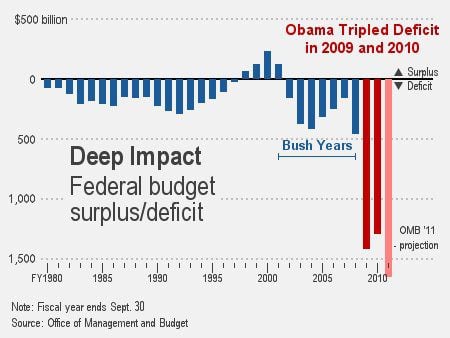
came into office with the worst of the crash already underway. When Obama entered office in January of 2009
GDP growth was at -4.9%, by January of next year it was at +5%. The bill itself was enacted in February of 2009 and by August 19% of the bill had been allocated, the
tax cuts, and that was barely enough to bring
GDP loss to under -1%.
And you bought that lie and apparently still believe it. Furthermore, Obama promised that his stimulus would keep unemployment from rising above 9% and get people back to work quickly. And that didn't/hasn't happened. IT FAILED the purpose that Obama himself set for it. And you can't bring yourself to admit that, can you?
Actually, I’ve never argued otherwise. My argument to this point has been that nothing in examples you’ve cited refutes assumptions made by Keynesians in how to respond to the economic disasters. I fail to see how providing a chart creates that sort of context.
You mean compared to the current recession? False. The 81' recession was just as bad … it was worse … before Obama interfered in this one.
Again, the worst of the crash occurred as Obama entered office and started before he even won the election. This is perhaps one of the most egregious examples of partisan lying on the entire forum.
Worse than what Obama predicted this one would become with that interference. And this one isn't over, despite the "official" declaration. You need only look at the charts I posted above to see that. But you can't bring yourself to honestly do that, can you?
I don't disagree that the stimulus failed in its goals. What I disagree with is your belief that all fiscal stimulus necessarily fails and causes worse recessions. If your sole argument was that the stimulus failed we wouldn't be having this conversation, but you've instead decide to turn the entire discussion into an assault on Keynesian economics in general.
But the depth of the recession is not the issue. It's how fast the recovery should occurs given one as deep as this one. How rapidly GDP grows at the end of recessions. And the data shows clearly that the deeper the recession, the faster the recovery will be … if government doesn't interfere by massive spending and increasing taxes …
The data doesn't support this conclusion. The US had
strong economic growth from January 2010 until July 2010. July 2010, by the way, is when most of the spending from the
stimulus package expired.
as they are doing now and as they did in 1932.
I'm guessing that pointing out growth ended and the economy fell again during the Depression when austerity measures were pushed through congress would be a lost cause.
There’s reason to think that we’ll have a bigger bounce coming out of this recession because we had such a steep decline. The question is: Where is it?"
It can be, essentially, summed up as Obama compromising with Republicans for bipartisan support he didn't get anyway.
Why don't you deal with that fact and question, rather than try to spin a new red herring, KF?
Precisely what do you feel was a red herring?




 I simply said that there is no such word as "unlogical". That was neither friendly nor rude, it was just a correction. I'll be sure to bring a glass of warm milk and a blankie to comfort you every-time someone hurts your feelings by making a rather minor correction to your understanding of the English language.

