• Quick note - the problem with Youtube videos not embedding on the forum appears to have been fixed, thanks to ZiprHead. If you do still see problems let me know.

Merged Continuation - 9/11 CT subforum General Discussion Thread

Status
Not open for further replies.
Calling someone wrong does not make them wrong.


You're right. Being wrong makes them wrong.

How much energy would it take for the upper block of, let's say, WTC 1 to shift horizontally just over half of the building's width? How much energy would it take to overcome the dynamic loading-bearing ability of the intact supports below that block?
 
Last edited:
So the upper block has to shift horizontally in order for it to follow a path other than through the lower block? Preposterous. And how much energy was required for it to plow through 90+ floors of steel and concrete? One of the towers was simply hit on a corner. Again, no toppling toward that side.
 
Last edited:
It should have just remained standing! I know that because it wasn't damaged badly enough to collapse. It's really that simple.
that's not an answer. that's incredulity. We know that building seven started to collapse. You now must show your work and explain why during this collapse you think it should have fallen like a tree.
 
It should have just remained standing! I know that because it wasn't damaged badly enough to collapse. It's really that simple.


You misunderstood me. My question referred to this sentence of yours:

I'm making the claim that if it were to collapse in some way, it wouldn't have collapsed down.


If it wouldn't have "collapsed down" when it collapsed, then what should it have done, and how do you know that?
 
If it wouldn't have "collapsed down" when it collapsed, then what should it have done, and how do you know that?

It should have done what the structure in my video did: topple. I know that because that's what buildings do under those circumstances.
 
that's not an answer. that's incredulity. We know that building seven started to collapse. You now must show your work and explain why during this collapse you think it should have fallen like a tree.

Now you're not making sense. You're asking me to explain how it could topple over after it already started collapsing down. It's a strawman, essentially.
 
So the upper block has to shift horizontally in order for it to follow a path other than through the lower block? Preposterous. And how much energy was required for it to plow through 90+ floors of steel and concrete? One of the towers was simply hit on a corner. Again, no toppling toward that side.
there WAS rotation of the top of that south tower
http://www.internationalskeptics.com/forums/showpost.php?p=5176331&postcount=22
Originally Posted by Scott_Milner
It's no surprise you need to repeat yourself, you don't understand the question. The upper section had angular momentum. At one point it stopped rotating. What force stopped the tilting of the massive block?
I understood the question perfectly. The answer is that your assumptions are wrong. The upper section never stopped rotating.

As I explained in my whitepaper, however, which you obviously did not or cannot read, once the upper portion is loose, there is a restoring torque. This is because the tilt means that, as the upper block descends, it hits more of the lower floors on the down-tilted side. This should be obvious -- the down-tilted corner has fallen farther. If the block continues to rotate, this disparity will increase.

Conservation of momentum dictates that, since it comes in contact with more stationary mass, there is a net force on the downward corner that opposes its direction of rotation. Again, it did not stop rotating, but this is the force that slows the rotation, and it's totally normal.
Originally Posted by Scott_Milner
This section is clearly off axis and has reduced itself from the original size before the lower floors begin to descend. Clearly this is an asymetrical loading and should have fallen off throughout the 1000 feet of "crushing" if you say it had become disconnected.
Impossible. It cannot "fall off" without a lateral force. There can be no lateral force unless the lower portion actually survives the impact. Calculations leave no doubt that it cannot.

That lateral force, again, worked out in my whitepaper, is equal to a minimum of roughly 65 million Newtons, or twice the liftoff thrust of the Space Shuttle. The lower portion cannot provide such an enormous force, and the upper portion would not survive if such a force was applied. I cover this on page 104 of the paper.

This is old, readily debunked crap, and it has nothing to do with the debate. Further discussion is off-topic, particularly as you do not appear able to even absorb what you see in a video correctly.

 
Now you're not making sense. You're asking me to explain how it could topple over after it already started collapsing down. It's a strawman, essentially.
no it is not a strawman. it is what was observed. You need to show your work and explain why what was observed cannot occur during a collapse
 
It should have done what the structure in my video did: topple. I know that because that's what buildings do under those circumstances.
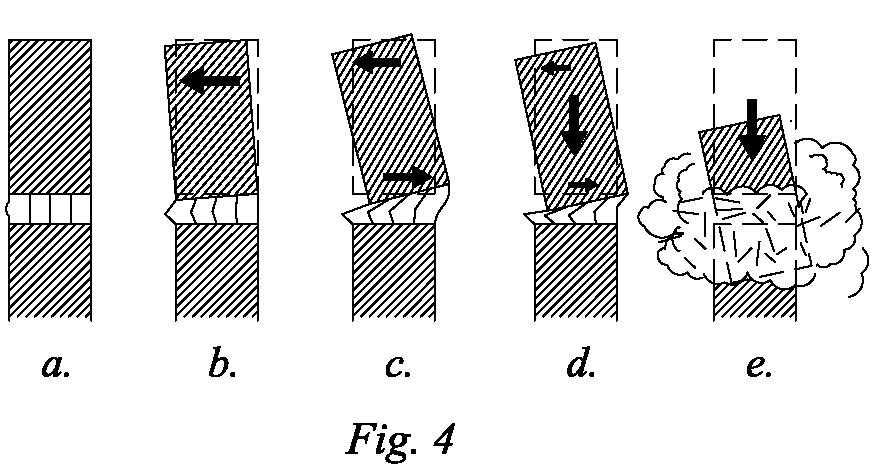
find X

figure4.gif
 
Last edited:
no it is not a strawman. it is what was observed. You need to show your work and explain why what was observed cannot occur during a collapse

Again, strawman.

I'm not claiming that what was observed didn't happen. I'm claiming it didn't happen for the reasons you are claiming.
 
Again, strawman.

I'm not claiming that what was observed didn't happen. I'm claiming it didn't happen for the reasons you are claiming.
than you need to illustrate "your reasons" why it couldn't. Your force diagram. where is it? and its not a strawman.
Edited by kmortis: 
Removed personal comments
 
Last edited by a moderator:
It should have done what the structure in my video did: topple. I know that because that's what buildings do under those circumstances.

Toppling is almost as unlikely as total collapse because of the requirement of SPECIFIC damage as needed when chopping down a tree.


Simultaneous global failure causing structural collapse doesn't occur from damage because damage is partial.

At most a partial collapse could have occurred. Like a landslide or an avalanche.
 
So the upper block has to shift horizontally in order for it to follow a path other than through the lower block? Preposterous. And how much energy was required for it to plow through 90+ floors of steel and concrete? One of the towers was simply hit on a corner. Again, no toppling toward that side.

It is physically impossible for a modern steel framed high rise to topple without a significant lateral force being applied. Since there was no lateral force being applied to the towers on 911, the ONLY way they could fall was more or less straight down.
 
Toppling is almost as unlikely as total collapse because of the requirement of SPECIFIC damage as needed when chopping down a tree.


Simultaneous global failure causing structural collapse doesn't occur from damage because damage is partial.

At most a partial collapse could have occurred. Like a landslide or an avalanche.

Only to those that remain willfully ignorant of structural steel design
 
The path of least resistance is the path which provides the least amount of resistance to motion. What's your point? A ~10 story section of one of the towers choosing to plow through ~100 floors below it is not mass choosing the path of least resistance. That's a mass passing through a larger mass as its being destroyed by controlled demolitions.

Neither of the upper sections decelerates as it encounters undamaged structure, but they should have. Since they did not, the upper sections were not destroying the lower.


As always, the troofer argument misses key details. Newton's first law of physics proves your claim to be invalid.
 
Originally Posted by tempesta29 View Post
The path of least resistance is the path which provides the least amount of resistance to motion. What's your point? A ~10 story section of one of the towers choosing to plow through ~100 floors below it is not mass choosing the path of least resistance. That's a mass passing through a larger mass as its being destroyed by controlled demolitions.

Neither of the upper sections decelerates as it encounters undamaged structure, but they should have. Since they did not, the upper sections were not destroying the lower.


As always, the troofer argument misses key details. Newton's first law of physics proves your claim to be invalid.


First law: Every body remains in a state of constant velocity unless acted upon by an external unbalanced force.[3][4][5] This means that in the absence of a non-zero net force, the center of mass of a body either remains at rest, or moves at a constant velocity.

You want to explain how Newton's first law of physics proves the claim of tempesta29 to be invalid.
 
C7 said:
You don't know what the priorities were so unless you can provide an official source you and TFC are just giving your opinions.
Actually, as a veteran fire fighter, I do. There are certain things that you do just as SOP because it saves you the time at the scene of the fire if you already have a rough outline of your duties.
Clayton pointed out that the offices of the tenants of WTC 7 would be a priority over the tenants in WTC 6.

Your speculation about large amounts of ammo or other things that could blow up is just speculation. Fire is always a consideration and it is just plain silly to claim that they would have dangerous amounts of ammo and/or explosives in a commercial building. Find an official source or stop making that baseless claim.

The priorities are to protect human lives, extinguish the fires and cover exposures to prevent the spread of the fire or thermal injuries to persons in the area. Everyone had been evacuated from WTC7 and the surrounding structures. WTC7 appeared unsafe to enter.
As the NIST reports have shown, traumatized firefighters are NOT qualified to make a determination about the possibility of WTC 7 collapsing. The debris damage did not seriously harm the overall structure of WTC 7. The NIST collapse hypothesis is that an internal failure, that no one could have predicted, started the collapse. Of course, that didn't happen because the fire that supposedly caused it had gone out over an hour earlier.

At 1:30 p.m., the only fires were on floor 7 and floor 12. They could have been easily accessed from the Barkley St. entrances or the east side entrance. Water was available, your denial notwithstanding.

WTC6 was burning very hot, posing a threat to all surrounding structures
Surrounding? Look at the map lefty. The only buildings anywhere near WTC 6 were WTC 5, which had far greater damage and fire than the Verizon building and WTC 7 across the street. WTC 7 was much closer to the Verizon building and the post office so it would be the priority if protecting surrounding buildings were a criteria.

and vehicles and to personnel trying to search for survivors. It was essential, in order to perform the first priority task, i.e., preserving human life
Fighting the 2 fires in WTC 7 would not hamper rescue operations. They had plenty of people to do that.

to extinguish the fire and to cover exposures.
Exposure? Just keep a safe distance from WTC 5 and 6.

there were also numerous vehicles on the street fully-involved, which meant that there was a threat of Class B fires spreading throughouut the area, on top of flying debris from such vehicles as cooked off in the fires.
The vehicles were mostly burned down to nothing but steel so it appears the many were left to burn out. Cars on fire might be a priority but not to the exclusion of a building housing the IRS, FBI, CIA, Secret Service, SEC and the emergency command and control bunker.

As for laying hoses, there are only so many outlets from a water pump, so any added hose connections would not have increased the amount of water that could be delivered. You have ignored too many factors here
You are the one ignoring the primary factor.

The fireboat Harvey, along with a couple other fireboats, supplied all the water with enough pressure to reach the 12th floor and more. So questions about hoses, friction losses and outlets are moot and just an intentional diversion.

Don't forget the point I am making:
NIST claimed that there was NO water to fight the fire in WTC 7.
That is not true.
 
Status
Not open for further replies.

Back
Top Bottom