Moderated WTC 1 features list, initiation model / WTC 2 features list, collapse model

Fair enough.


Hmm.

As an aside, I've located some totally different fuel distribution figures an'all..
[qimg]http://femr2.ucoz.com/_ph/2/2/998583046.jpg[/qimg]

Shall check implications for their alternate Table 5-4.
I'll have to look it up but, Purdue did a lot of work with the "fuel loads" when they did their simulation work. (If anyone has it handy feel free to post the link, I'm not sure when I can get to look it up).
 
It is also clear that NIST (and FEMA) repeatedly state that the jet fuel burned out after a very short period (some NIST references suggesting values as low as *10's of seconds*). I have combined the various spread-out observations from NIST and FEMA to suggest the fuel burned off within 10/15 minutes. A more than generous figure. There are a couple of tentative suggestions from NIST for late unexplained *flare-ups* which are very cautiously attributed to possible unignited pools of fuel, but these themselves are stated to burn out a minute or so after ignition.
Whilst I remember, the following is also in the 1-5 Executive summary...
NCSTAR1-5 E.8.2 said:
Most of the jet fuel in the fire zones was consumed in the first few minutes after impact, although there may have been unburned pockets of jet fuel that led to flare-ups late in the morning

Note again that NIST only tentatively attribute late flare-ups to jet fuel, and even then indicate that the burn time is around a minute.
 
I'll have to look it up but, Purdue did a lot of work with the "fuel loads" when they did their simulation work. (If anyone has it handy feel free to post the link, I'm not sure when I can get to look it up).

I think they only looked at WTC1/Flight 11.

I think with the additional distribution data highlighted, the omission of fuel outside the tower in 5-4 and the supporting text from the executive summary confirming rapid jet fuel burn off, that the topic drift should be about done with.
 
I think they only looked at WTC1/Flight 11.

I think with the additional distribution data highlighted, the omission of fuel outside the tower in 5-4 and the supporting text from the executive summary confirming rapid jet fuel burn off, that the topic drift should be about done with.

...It was on fire, yes, cunningly keen observation
there.

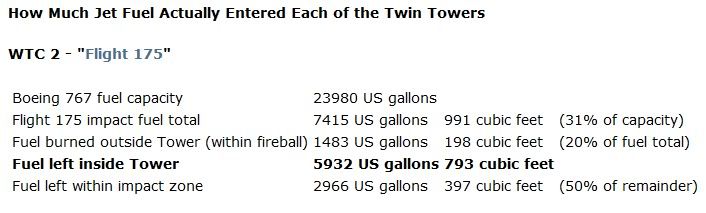
7415 US gallons according to NIST
1483 US gallons of which burned outside the tower immediately after impact
5932 US gallons remaining inside the tower
2966 US gallons within impact zone
... Not overly impressed with your additional features beachnut.
Now that you know 62,000 pounds of jet fuel was on board at impact you could fix your faulty numbers. Do you need me to post the correct numbers for you?

Yes, the features of impacting jets, the extreme kinetic energy due to speeding jets, exceeding standard FAA mandated 250KIAS below 10,000 feet, fires started by jet fuel on multiple floors, massive holes and broken windows feeding the giant fires, fire systems destroyed, fire insulation stripped, are feature you have to ignore to have your inside job claim, CD, and Fictional Official Theory claim remain for your CT.

You should have read all of NIST before posting more cherry-picked and quote-mining nonsense to downplay fire, and jet fuel. You and Major Tom CD claims were proved wrong on 911, what a waste of 10 years comes this 9/11/11 for you and 911 truth. Your posts are as if you are reading NIST the first time, as you had to look up where you cherry-picked one number to make up the rest. The reports have been out for years, why did you fail to get the numbers right the first time?
 
Now that you know 62,000 pounds of jet fuel was on board at impact
ROFL. It has been interesting watching your learning process along the way you know...

Fire were started on multiple floors with 10,000 gallons of jet fuel
66,000 pounds of jet fuel
Exaggerating the values for some reason beachnut ?
...
burned off after 10/15 minutes of course
NIST says 10,000 gallons in their report.
...
All the jet fuel burned off in 10 minutes? Is that short or a long time for jet fuel fires? Do you have a study on jet fuel fires, heat and intensity? What does NIST really say about the fires, how many pages and chapters talk about fires? Is a burned off after 10 minutes, a good summary? After 10 minutes? After?
NIST said about 10,000 gallons on the jets at impact, how did you miss that?
NIST contradict themselves regularly, stating different values in different places, for different purposes.
...
They say 10,000. They also say 9,120. They also provide per-floor totals
it was 10,000 gallons (~)
10,000, 9,120, 7415
...
I agree that NIST have stated varying values
...
Still served only to start some other class-a fires, burned off rapidly.
You must start with nearly 10,000 gallons, if you like take it down to 9300
I know the real value of fuel is 10,000 gallons, which is more than 9,000 gallons, not 7415, which may be from a 9268.75 gallon estimate
They also say 9120 gallons. They also provide per-floor fuel distribution data
The fuel at impact was about 10,000 gallons, 66,000 pounds. When NIST talks about percent of this and that, it is from the 10,000 gallons, unless it is talking about after the fireball. It is not clear
Flt 175 62,000 lb of fuel at impact. This leaves 7515 for distrubution to the floors, and 9,393 gallons at impact.
How many numbers are you going to pull out your ass beachnut ?
...
It rather depends upon whether the impact analysis predicted fuel distributions exclude fuel for the fireball.
Flt 175 62,000 lb of fuel at impact.

This is over 9,000 gallons of fuel at impact, about 10,000 gallons as NIST says
...
Is 7415 gallons the fuel at impact?
If you are saying NIST is using 7415 as impact fuel
I've repeatedly highlighted that NIST have several numbers kicking around in there, including 10,000 gal and 9,120 gal.
...
Yet again, NIST state varying impact volumes including 10,000 and 9,120, with 9,120 being much more likely as a starting point along the processing chain somewhere. Yet you choose to continnually use the inflated 10,000 gallon figure. Awesome.
...
Fires were started on multiple floors by quite a bit less than 10,000 gallons beachnut.
...
Why do you ignore the fuel consumed in the fireball ? Why do you ignore the fuel that flowed away ? Why do you choose to use inflated fuel volume when both NIST and FEMA agree that the jet fuel served only to start class-a fires and was itself consumed after a few minutes.
...
How have you managed to invent that claim ? I've stated the varying volumes of 10,000, 9,120 and the 7415 total. The claim I have made is that Figure 5-4 contains the total amount of fuel distributed to each floor. If it's not, then NIST have another botch in the preceeding text, which wouldn't surprise me.
As an aside, I've located some totally different fuel distribution figures an'all..
[qimg]http://femr2.ucoz.com/_ph/2/2/998583046.jpg[/qimg]

Shall check implications for their alternate Table 5-4.
Well that would tend to suggest that NIST did mess up table 5-4 in NCSTAR 1-5F, and include values excluding that ending up *outside the tower*.
...
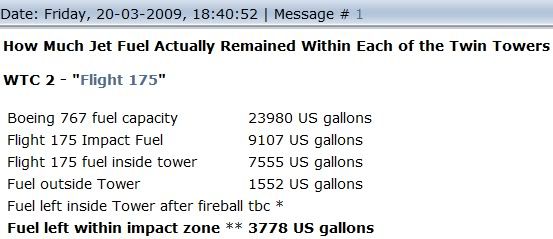
These figures leave an initial 7555 gallons, rather than 7415. (using a fuel density of 6.83 lb fuel/gal. NCSTAR 1-5A p79)

Assuming* that the 20% subtraction for the fireball is already accounted for, and the NIST assertion that 50% flowed away out of the impact zone, that leaves... 3777 gallons in the impact zone. (9107 gallons total...yet another bleedin' different value :rolleyes:)

* the formation of the fireballs demonstrates that a fraction of the remaining fuel was expelled from the building (mostly likely being forced out of openings as an atomized liquid due to the overpressures generated by internal burning).

If the starred behaviour is separate to fuel simply passing through the building, it does suggest that an additional 20% subtraction as suggested by NIST would be appropriate...reducing the impact zone fuel volume to 3022 gallons. Still a bit up from the 5-4 derived value of 2966...
One side of that discussion looks rather consistent, the other...hmm...not a pretty picture. 10,000 gallons ? No. 66,000lb ? No. 9,300 gallons ? No. 9268.75 gallons ? No. 9,393 gallons ? No. etc...

NIST state 10,000 and 9,120 in various places (as I stated repeatedly), with 9,120 being the more likely starting point. I do find it rather funny that, even though I am repeatedly highlighting the varying values NIST use in the report, that you were continnuing to try and bolster your use of 10,000 gallons. At least you now know better eh ;)

So, yes, Table 5-4 omits the fuel outside the tower, yet it is still unclear whether formation of the fireball should result in a 20% reduction of the per-floor values. Regardless, after all your whining we're back at a situation where we have an initial 7555 gallons, rather than 7415. Given that NIST state 50% flowed away from the impact zone, that would leave 3778 gallons in the impact zone.

None of which appear to be 10,000 gallons :) (remember: *Fire were started on multiple floors with 10,000 gallons of jet fuel* was your initial assertion)

Your posts are as if you are reading NIST the first time
ROFL. You san SEE your learning curve above.

I'll freely and gladly admit that in the process of this discussion we have discovered yet another botch in the NIST report...the omission of the fuel outside the tower in Table 5-4, but it has required more than simply reading the report, it has required careful cross-check between two published tables in entirely different sections of the report, along with cross-check of surrounding texts. No great surprise that NIST generate values in one document, then use different values in another location with no explanation as to why. Bit sloppy.

It may mean increasing my original 7415 value to 7555 gallons, leaving a maximum (by NISTs assertions for flow) of 3778 gallons in the impact zone.

"Fire were started on multiple floors with 10,000 gallons of jet fuel" ? No.

Needless to say..."Most of the jet fuel in the fire zones was consumed in the first few minutes after impact".
 
Last edited:
One side of that discussion looks rather consistent, the other...hmm...not a pretty picture. 10,000 gallons ? No. 66,000lb ? No. 9,300 gallons ? No. 9268.75 gallons ? No. 9,393 gallons ? No. etc...

But femr, that is what learning is all about, changing your opinion as better information becomes available.

Beachnut seems a bit polarized, and sometimes a little shy. Maybe this was his way of saying, "Thanks, femr".


I'll freely and gladly admit that in the process of this discussion we have discovered yet another botch in the NIST report...the omission of the fuel outside the tower in Table 5-4, but it has required more than simply reading the report, it has required careful cross-check between two published tables in entirely different sections of the report, along with cross-check of surrounding texts. No great surprise that NIST generate values in one document, then use different values in another location with no explanation as to why. Bit sloppy.

It may mean increasing my original 7415 value to 7555 gallons, leaving a maximum (by NISTs assertions for flow) of 3778 gallons in the impact zone.

I'll make a note of that, thanks.
 
Last edited:
Before the hack, you had 6 pre-collapse features, now you have 4.
Was the list of 6 exhaustive, and is the list of 4 not?
If 6 wasn't exhaustive, why did you pick those 6 instead of any other?

Bumped for Major_Tom
I understand it is easy to overlook small posts with simple questions among the clap-trap of long bitching posts.
 
But femr, that is what learning is all about, changing your opinion as better information becomes available.

Beachnut seems a bit polarized, and sometimes a little shy. Maybe this was his way of saying, "Thanks, femr".


I'll make a note of that, thanks.
femr2 learned about NIST and can't figure out why he has the wrong numbers.


... It was on fire, yes, cunningly keen observation there.

  • 7415 US gallons according to NIST
  • 1483 US gallons of which burned outside the tower immediately after impact
  • 5932 US gallons remaining inside the tower
  • 2966 US gallons within impact zone
Exaggerating the values for some reason beachnut ?
...

I said 10,000 gallons (fuel at impact), wait, I used 62,000 pounds of jet fuel at impact for KE estimates May 13, 2006. 10,000 gallons, 62,000 pounds at impact. Can an engineer say 10,000 gallons? I got better estimates, just ask. I know where they got the real numbers to make the estimate from, you guys are 10 years behind and think you are schooling the world on 911.


. femr2 used 7415 for impact fuel and then made up his numbers based on NIST and botched it. Here are what his numbers should be changed if you inside job guys want the best numbers.
  • 7415 - 9117 US gallons according to NIST
  • 1483 - 1823 US gallons of which burned outside the tower immediately after impact
  • 5932 - 7294 US gallons remaining inside the tower
  • 2966 - 3647 US gallons within impact zone
femr2 is off 20 percent (18.67) using 6.8 lb/gal (I use 6.6, habit from using JP-4, but the fuel ranges from 6.2 to 7 lb/gal, it depends on stuff, more stuff for you want to be engineers and 911 experts to find out)

I said 10,000 gallons for impact, I understand femr2 wants to say 7415, but then why not say 3647 gallons in the impact zone, started the fires!

Both wrong, it was the jet engines that started the fires. Or was it the igniter's when the pilots started the engines. Oops.

Worse part of femr2's post, he quote-mines to make the fires that killed many people seem smaller, less important so he can back in the evildoer inside job. You left out the biggest office fires in history from your all inclusive list of features. Found the bad guys yet? You guys never read NIST and you admit you are "changing your opinion as better information becomes available". You guys are reading NIST for the first time, at least femr2 is, if he would understand what he read, he would not make faulty statements attacking NIST. He made some more mistakes due to lack of comprehension. You guys are a comedy team, "changing your opinion as better information becomes available", this is classic. Try reading NIST, they beat you on the features list, you failed to read NIST - this is proof - "changing your opinion as better information becomes available".


But femr, that is what learning is all about, changing your opinion as better information becomes available. ...
This is funny, you are suppose to be trying to act as if you are schooling us, not exposing that you and femr2 are reading NIST for the first time.

You guys have no clue why NIST has different numbers around the report; like femr2 and the two Flight 175s, no clue. I was using 62,000 pounds of jet fuel at impact over 5 years ago. ... you are just discovering better information. Cool
 
Last edited:
I said 10,000 gallons (fuel at impact)
Dear me beachnut. Don't like admitting your faults do you.

As I made perfectly clear, NIST use varying impact values, including 10,000 gallons and 9120 gallons.

However...
beachnut said:
Fire were started on multiple floors with 10,000 gallons of jet fuel
No, beachnut, fires were not started on multiple floors with 10000 gallons of fuel, which is the point, including your hilarious incredulity about the fuel burning off after a few minutes...which of course both NIST and FEMA agree it did.

Fires were started with much less than that. From the NIST estimates around (a maximum of) 3778 gallons in the impact zone.

I used 62,000 pounds of jet fuel at impact
You also used 66000 pounds, 9268.75 gallons, 9,393 gallons, 9117 gallons... :rolleyes:

femr2 used 7415 for impact fuel
Nonsense. I note your inept attempt to shift context though. Funny man.

and then made up his numbers based on NIST
Incorrect. NIST provided fuel distribution values calculated as-per the details included in the surrounding text.

As I said, it's still not clear whether the 20% fuel consumed within the fireball should be extracted from the fuel left within the building. See NIST quote below.

femr2 is off 20 percent
See above, and...
NIST said:
the formation of the fireballs demonstrates that a fraction of the remaining fuel was expelled from the building (mostly likely being forced out of openings as an atomized liquid due to the overpressures generated by internal burning).
Suggests this is fuel inside the building, not fuel determined to be outside the building immediately after the impact.

using 6.8 lb/gal (I use 6.6, habit from using JP-4, but the fuel ranges from 6.2 to 7 lb/gal, it depends on stuff
Stuff eh ? I stated the conversion supplied by NIST...fuel density of 6.83 lb fuel/gal. NCSTAR 1-5A p79

it was the jet engines that started the fires. Or was it the igniter's when the pilots started the engines.
LMAO. Scraping the barrel now beachnut.

Worse part of femr2's post, he quote-mines to make the fires that killed many people seem smaller
Nonsense. I'm providing more accurate values, and clarifying the numbers for those who are distributing misleading information. That's you in this context, beachnut.

You'll not be saying the 10000gallons of jet fuel started fires on multiple floors again, will you now.

the biggest office fires in history
Incorrect. I've already told you you are wrong on this point, but it hasn't stopped you repeating this falsehood :rolleyes:

I was using 62,000 pounds of jet fuel at impact over 5 years ago
You were using these values just the other day...
66000 pounds, 9268.75 gallons, 9,393 gallons, 9117 gallons... :rolleyes:

You are absolutely full of it beachnut. You have learned your lesson though I'm sure, which is great ;)

you are just discovering better information.
I've discovered another set of fuel distribution values, which alter the values a few gallons here and there, sure.

You say 10000 gallons of jet fuel started fires on multiple floors.

I say that's pathetically inaccurate and respond with...

I say NIST suggest a maximum of 3778 gallons started class-a fires within the impact zone, and that jet fuel burned off after a few minutes.

If you want to argue with that last sentence, go ahead :)
 
You are absolutely full of it beachnut. You have learned your lesson though I'm sure, which is great ...
Funny stuff. Absolutely?
You say 7,415 gallons at impact, your "best number" for over a year. Now you can't correct your own numbers, and Major Tom fails to include the biggest features in his model, in his search for an inside job.
1111Fuelddddddddddd.jpg

http://femr2.ucoz.com/forum/12-11-1 (if it changes, this was there today, and it is backed up; LOL, beachnut is a &!@$)
I used 62,000 pounds of jet fuel over 5 years ago, you just learned about it, and try to act like you are schooling it. ..., you fooled Major Tom.

My rounding to 10,000 gallons is a better number than your failed 7,415 gallons. Got math?

Like I said, I read NIST over 5 years ago, and you are reading it for the first time to discover all the different charts, etc. Your own web site shows how shallow your research has been, leaving you to quibble with my rounding to 10,000 gallons, which beats your best work, because you were using failed numbers. Better erase your web site. Got research? Are you doing comedy, or what?

Poor Major Tom thinks you are schooling people, he has no clue you are at best, 5 years behind like he is. Do you have any clue when NIST published their report?
 
Last edited:
You say 7,415 gallons at impact
ROFL. And as I stated earlier, yes, the NIST Figure 5-4 omits the fuel outside the tower.

Now you can't correct your own numbers
Incorrect. I have no problem updating values at all.

I used 62,000 pounds of jet fuel over 5 years ago
You used...

20th May 2011:66,000 pounds
66,000 pounds

21st May 2011:66,000 pounds
66,000 pounds

In addition to the various values in gallons you've posted in the last few days, which include...9268.75 gallons, 9,393 gallons, 9117 gallons, ...

As I told you...
NIST contradict themselves regularly, stating different values in different places, for different purposes.
They say 10,000. They also say 9,120. They also provide per-floor totals

I discovered the issue with Table 5-4, from details I haven't looked into since 2009.

You discovered that not only was far less than 10000 gallons (~3778 gallons) of jet fuel involved in the starting of class-a fires within the impact zone, but that the jet fuel burned off after a few minutes.

You've learned not to exaggerate the values so much. I've refined mine, and found another omission in the NIST report.

It's all good beachnut ;)

you just learned about it
I just found the issue with Table 5-4, absolutely.

My rounding to 10,000 gallons is a better number than your failed 7,415 gallons. Got math?
ROFL. 7415 is a lot closer to 3778 than 10000 is beachnut. Got math ?

Your own web site shows how shallow your research has been
The references have been in place since it was put there...Friday, 20-03-2009, 18:40:52.

You are a funny, funny man.

leaving you to quibble with my rounding to 10,000 gallons
Aboout 3778 gallons, not 10000 gallons.
 
You are a funny, funny man.


Aboout 3778 gallons, not 10000 gallons.

I agree. I think many of us under-rate Beachnut. He has a wonderful sense of humor and I hope we have all grown a little closer as a result of this.
 
...
ROFL. 7415 is a lot closer to 3778 than 10000 is beachnut. Got math ? ...
I have been using the right numbers for over 5 years, and 10,000 gallons is closer to 62,000 pounds of jet fuel than your erroneous number of 7415 gallons.
http://femr2.ucoz.com/forum/12-11-1
1111Fuelddddddddddd.jpg


I have read the NIST report years ago, you quote mine it. You can't handle an approximation that is more correct than your failed attempt, and now changed web page, I understand, you are being true to your inside job stand. Reality will catch up to you.

Explain how 7415 gallons you list for impact fuel is closer to 62,000 pounds than 10,000 gallons; this is not, The Price is Right.

You are funny.

http://i286.photobucket.com/albums/ll116/tjkb/1111Fuelchanged.jpg
Changed your page after being corrected by me, or is what is it you call me on your web page? You fail to have correct numbers, and logic.
http://i286.photobucket.com/albums/ll116/tjkb/1111Fuelddddddddddd.jpg
Old post, more wrong, new post, change 2, wrong anyway.
You change your web page when I point out your errors. Why?

I used 62,000 pounds for impact KE years ago, from a spreadsheet, May 2006. But it takes math and research to figure this out. Proof is in the past and found with E=1/2mv2.


http://www.internationalskeptics.com/forums/showthread.php?postid=5942688#post5942688
From a spread sheet I created in 2006, I used the 2093 pounds of TNT value last year based on 277,680 pounds of aircraft with guess what, 62,000 pounds of jet fuel on board at impact.
Oops, I found the impact fuel of 62,000 pounds over 5 years ago.
NIST NCSTAR 1-2B Analysis of Aircraft Impacts into the World Trade Center
Towers, Table E-2. Boeing 767-200ER (page lii), Flt 11 66,100 lb, Flt 175 62,000 lb, Flt 175 277,580 lb.
NIST NCSTAR 1-2, WTC Investigation, Table E-7. Boeing 767-200ER (page lxiv), Flt 11 66,100 lb, Flt 175 62,000 lb, Flt 175 277,580 lb "
And I checked it using pilot/engineering/facts/evidence stuff - a good estimate.
http://www.internationalskeptics.com/forums/showthread.php?postid=3503462#post3503462
Used the numbers years ago, the 2093 lb-TNT comes from 277,580 lb at 590 mph, and in the 277,580 lb is 62,000 pounds of jet fuel at impact. You and Major Tom will have to change more stuff, or what?

277,580 is a good estimate at impact time, it passes the reality check, unlike your 7415 gallons of impact fuel which you are now covering up. I use 10,000 gallons and 66,000 pounds as impact fuel when talking in general, the fuels are all estimates, when doing calculations I use the best number I can research that is based on reality, 62,000 pounds, which is like 10,000 gallons of fuel. You have heard of rounding. My rounding is off less than 9.7 percent, your rounding down is off more than 18.6 percent. Did NIST use the right lb/gal? Now you cover-up your error. I don't have to cover-up, I made no error. I use 6.6 lb/gal on my estimates, you use what NIST says; I don't have to use NIST, I can think for myself, I don't need to fix 10,000 gallons, I use the best value I can find for my calculations, do you find anything wrong with 62,000 pounds of jet fuel at impact? Your numbers remain off by 18 to 20 percent due to what reason?

Why did you change your web page and not post it as a change today? Is this a standard 911 truth procedure, or a special inside job technique? Is this a cover-up like Watergate? You are funny.

Someone is changing your web page, or did you do it? http://femr2.ucoz.com/forum/12-11-1


...
You've learned not to exaggerate the values so much. I've refined mine, and found another omission in the NIST report. ...
Nope, I used 62,000 pounds March 2008, May 2010, from a spreadsheet based on 62,000 pounds May 2006. You updated your web page today, I used numbers in 2006 you are finding for the first time this past week. You like to quibble about 10,000 gallons, so, I did not use 10,000 gallons to exaggerate the impact KE, I used 62,000 pounds of jet fuel. You don't like rounding, you would rather change your web site without posting it as a change (cover-up) and use numbers that are 20 percent off and messed up.


... You used...

20th May 2011:66,000 pounds

21st May 2011:66,000 pounds ...
Oops, you missed; 62,000 pounds March 2008, May 2010, from a spreadsheet based on 62,000 pounds May 2006. You posted NIST numbers today to correct your errors made in March 2009, without posting it as a change, posting what we all knew when NIST posted the reports all those years ago. How did you fail to research this before today, after posting bad numbers Mar 2009? I had the good number of 62,000 long ago, you should have asked.

You have two numbers for fuel left in the tower, 7414 and 5932. Neat, change three coming? Wow, you added all those tables today, that is a neat trick labeling the post March 2009 and posting the tables today. Must be nice to be god. How is the inside job claim coming?

 
Last edited:
I have been using the right numbers for over 5 years
I just showed you using numerous wrong numbers beachnut ;)

10,000 gallons is closer to 62,000 pounds of jet fuel than your erroneous number of 7415 gallons
Dear me. The NIST value is NOT 10,000 gallons. They state 9120 gallons. 10,000 is for Flight 11. Did you not notice ?

We're discussing the amount of fuel starting the fires, which is around 3778 gallons within the impact zone, most of which burned off after a few minutes.

By all means continue to draw attention to your deliberate continued use of 10,000 gallons.

Explain how 7415 gallons you list for impact fuel is closer to 62,000 pounds than 10,000 gallons
However much you try to make yourself appear as stupid as a box of frogs, I know you're not THAT stupid beachnut.

You just can't cope with progress (or don't bother to read).

3778 gallons is the maximum fuel volume NIST estimate remained within the impact zone to start fires, and which then burned off after a few minutes.

Surprisingly enough, 3778 is an AWFUL lot closer to 3778 than 10,000 is to 3778. 10,000 being wrong of course ;)

You could at LEAST switch over to 9,120 gallons and stop using 10,000 you know. That would at least show SOME spine.

You change your web page when I point out your errors. Why?
Why ? Because we've discovered, by having this wee chat, that the Table 5-4 value doesn't include the volume of fuel which passed straight through the tower during impact.

I used 62,000 pounds for impact KE years ago
Yet we're not discussing impact fuel volume, and you've been using 66,000 pounds, 9268.75 gallons, 9,393 gallons, 9117 gallons, ...just in the last few days.

Oops, I found the impact fuel of 62,000 pounds over 5 years ago.
ROFL. Yet in the last few days have been stating...66,000 pounds, 9268.75 gallons, 9,393 gallons, 9117 gallons, ...

Start at 9,120 gallons beachnut.

Subtract 20%
Subtract 50%

You'll be at the fuel volume left within the impact zone.

It's fun this, isn't it ;)

your 7415 gallons of impact fuel which you are now covering up.
Not at all. I've made it perfectly clear where it comes from, and based on finding the additional fuel distribution data table I shall probably update the final number to 3778 fairly shortly.

By all means continue to grasp at feathers... as the fuel (all max ~3778 gallons of it) served only (in terms of accelerant) to start the class-a fires within the impact zone, and was itself consumed in a few minutes.

I use 10,000 gallons and 66,000 pounds as impact fuel when talking in general
ROFL. Kersproing.

62,000 pounds, which is like 10,000 gallons of fuel.
No it's not. It's about 900 gallons short of 10,000 :rolleyes:

Not far off 9120.

I don't have to cover-up, I made no error.
Hilarious.

I can think for myself
I must say, this is the first post you've forgotten to be the local village idiot within in a long time. Rib-ticklingly funny to realise WHY though. Arse+Cover+Rapid+like. LOL.

do you find anything wrong with 62,000 pounds of jet fuel at impact?
Nope, and we're STILL not discussing impact fuel volumes :D

Your numbers remain off by 18 to 20 percent
Incorrect.

Why did you change your web page
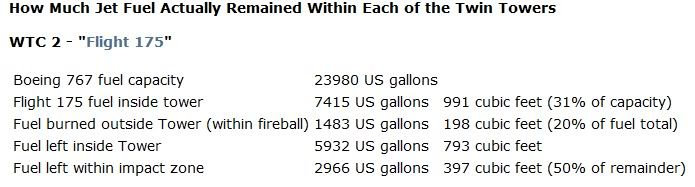
Because a couple of values erroniously were termed impact, rather than remaining. I've added the new table images too ;)
 
Last edited:
I said you were off 18 to 20 percent, you say...
...
Incorrect. ... I've added the new table images too
Like a lie posting tables today to a post made in March 2009. You are doing better than Balsamo, he leaves the failed stuff and newer failed stuff.

http://femr2.ucoz.com/forum/12-11-1 Web page that magically changes, today. (BTW, there are other false claims and misleading statement on your web page, clearly refuted by your own references you cherry-picked and quote-mined to make up your own statements. )
1111Fuelddddddddddd.jpg

Earlier today your web site said 7415 impact fuel, after being told about how you messed up, you tried to cover-up your error, more than Cheney did, he took his buddy to the Hospital to cover-up shooting him.

Then you posted changes and left the date of your post as March 2009.
1111Fuelchanged.jpg

Now you have fuel inside the tower as 7415, and 5932 gallons. Two figures, same thing? And your numbers are 18-20 percent off, plus messed up with two inside the tower numbers. Neat stuff. Yes, you did add tables, and failed to explain you made the changes today. Is this honest, or what?

... Incorrect. I have no problem updating values at all. ...
How did you do it today, in a post dated March 2009? Magic? Sure makes you look bad. Will you fix the date?
 
Last edited:
Web page that magically changes
Because I changed it :rolleyes:

you tried to cover-up
Nonsense. I'm here telling you I've changed it to reflect the additional information I've pieced together between tables 5-4 and 7-7 :rolleyes:

Hark your feeble mind back a couple of days...
I'll freely and gladly admit that in the process of this discussion we have discovered yet another botch in the NIST report...the omission of the fuel outside the tower in Table 5-4, but it has required more than simply reading the report, it has required careful cross-check between two published tables in entirely different sections of the report, along with cross-check of surrounding texts. No great surprise that NIST generate values in one document, then use different values in another location with no explanation as to why. Bit sloppy.

It may mean increasing my original 7415 value to 7555 gallons, leaving a maximum (by NISTs assertions for flow) of 3778 gallons in the impact zone.

"Fire were started on multiple floors with 10,000 gallons of jet fuel" ? No.

Needless to say..."Most of the jet fuel in the fire zones was consumed in the first few minutes after impact".

How many gallons of jet fuel fueled the fires within the impact zone beachnut ?

How long did it take for that fuel to be consumed ?

;)
 
Last edited:
...
Hark your feeble mind back a couple of days...

How many gallons of jet fuel fueled the fires within the impact zone beachnut ?

How long did it take for that fuel to be consumed ?

;)
Best you can do is cover-up your errors, pretend your post is from 2009, post ;), call people names, say "feeble mind" as much as you can, attack NIST, fail to answer your own questions, and fail to fix faulty numbers.

How does downplaying jet fuel numbers by 18 to 20 percent support your Fictional Official Theory claim and Major Toms feature list to help support his inside job claim? Why keep your numbers low? Why do you have two numbers for fuel inside the WTC?
 
How does downplaying jet fuel numbers

How many gallons of jet fuel fueled the fires within the impact zone beachnut ?

How long did it take for that fuel to be consumed ?

Why keep your numbers low?
The values are NISTs.

Why do you have two numbers for fuel inside the WTC?
I don't, though NIST have two (actually 3) fuel distribution tables, each with different values.

How many gallons of jet fuel fueled the fires within the impact zone beachnut ?

How long did it take for that fuel to be consumed ?
 
...
The values are NISTs. ...?

March 2009,
How Much Jet Fuel Actually Entered Each of the Twin Towers
http://i286.photobucket.com/albums/ll116/tjkb/1111Fuelddddddddddd.jpg

Same page...
March 2009,
How Much Jet Fuel Actually Remained Within Each of the Twin Towers
http://i286.photobucket.com/albums/ll116/tjkb/1111Fuelchanged.jpg
Numbers changed magically, so did the title.

Same page...
March 2009, (really changed today)

http://femr2.ucoz.com/forum/12-11-1
Looks like your math is wrong again. Good try, standing by for the fourth change to your web page. Try using 62,000 pounds at impact.


Looking at the impacts appears most of the fuel entered the WTC, and the fireball explanded out. ... , almost three years ago, even before your backing in your NIST numbers, I was using 62,000 pounds at impact, and using joules, oh noes...
Disintegrating in mid air. Lie!
http://www.debunking911.com/freefall.htm
Conservation of momentum was correct. The towers fell exactly with conservation of momentum, I ran the numbers, got 12.08 seconds much slower than the FREE-FALL crap you are pushing like the other lies Jones made up for you who lack knowledge. TAKE PHYSICS NOW.
papasmurf, here is a prepaid cell phone.http://i286.photobucket.com/albums/ll116/tjkb/cellphone.jpg Take it, call your mother, and tell her there is serious doubt about you ever becoming an engineer. (paper chase, 1973)

No multiple plane impacts. Robertson designed it for a 707 flying 180 mph, low of fuel in the fog, with an impact of 187 pounds of TNT. 11 hit at 1300 pounds of TNT KE, and 175 hit at 2093 pounds of TNT. That is 7 to 11 times more than the design! You be wrong again. What is 7 to 11 times in engineering world?

Jones and Ryan ... have false ideas on 9/11, you have been fooled. All their work is worthless, ...
...
The impacts on 9/11 were 7 times and 11 times bigger.

The kinetic energy at impact!
Design - 187 pounds of TNT
Flt 11 - 1300 pounds of TNT
Flt175 - 2093 pounds of TNT
http://i286.photobucket.com/albums/ll116/tjkb/WTCcladdingflying.jpg
It looks like 2093 pounds of TNT impact. 4,380,000,000 joules.
http://i286.photobucket.com/albums/ll116/tjkb/impactenergywtc.jpg

Your ideas on 9/11 are the opposite of all that engineering is.
http://www.internationalskeptics.com/forums/showthread.php?postid=5030047#post5030047 Using 62,000 pounds of jet fuel at impact again.
? features ignored/missed by Major Tom... how many more?
 
Last edited:

Back
Top Bottom