Moderated WTC 1 features list, initiation model / WTC 2 features list, collapse model

Thank you kindly... I will have a look...


8 degrees was the north tower, south tower was 28 degrees... at least those are the maximal figures I've seen as described before the dust obscured the upper sections.


Thanks again for clarifying what it was about.
\

Notes from NIST junk, but you have to read all of NIST to understand the fires, not just the cherry picked junk we are quibblign about, but you knew that.

NIST NCSTAR 1-2B
5.5.2 10,000 gal (page )
Table E-2. Boeing 767-200ER (page 1ii)
11
66,100 lb
175
62,000 lb

NIST NCSTAR 1-5
6.2.1 Assumptions and Fixed Parameters
"40 percent of the jet fuel was available for combustion
on the impact floors. The thermal properties were assumbed
to be similar to JP-4 and JP-5, whose values were obtained
from teh SFPE Handbook."
"Aircraft combustibles: The mass was 12,100 kg (25,800 lb)
for WTC 1, 12,500 kg (27,600 lb) for WTC 2 ."
NIST NCSTAR 1-5F
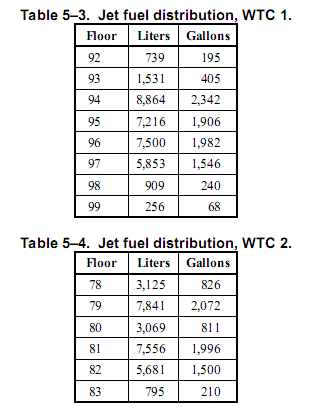
Table 5-3 WTC 1 (8684 gals)
Table 5-4 WTC 2 (7415 gals)
Table 5-5 12,100 kg WTC 1, 12,500 kg WTC 2
We have to read more, to understand why 11 and 175 had 62k to 66k of fuel on board. (pounds)

They used
"Aircraft combustibles: The mass was 12,100 kg (25,800 lb)
for WTC 1, 12,500 kg (27,600 lb) for WTC 2 (Tale 3-7)."
for fuel as combustibles. Means femr2 numbers are wrong, but no big deal, I tried to warn him, as he applies 20 and 50 percent to an 80 percent value. It is ironic he uses NIST values, and failed to come up with independent values. The fuel at impact was about 10,000 gallons, 66,000 pounds. When NIST talks about percent of this and that, it is from the 10,000 gallons, unless it is talking about after the fireball. It is not clear, but even a pilot understand this. The fuel in the 767s was greater than the 757 on 911. Bet the heavier jets use more fuel; oops, they do with jet engines similar in fuel economy. When you hear there was only 7415 gallons total fuel, a flag need to go up, the jets hit the WTC with nearly 10,000 gallons, 7415 is not 10k. 9300, is close enough, and that is where 7415 comes from, unless NIST made a mistake. I looked up a source for 10,000 gallons at impact, and it used takeoff fuel, and correct use of fuel to impact to come up with 10,000 gallons.
 
unless NIST made a mistake
NIST state quite clearly...
NIST said:
Tables 5–3 and 5–4 present the predicted fuel distributions from the impact analysis.

You can quibble as much as you like, and that's fine, critique of NIST inconsistency is really not a problem. Perhaps you should start a new thread though. This is definitely off topic imo.

They then go on to say...
Of the total amount of fuel distributed to each floor, only 40 percent was used in the simulations. The reasoning behind this estimate followed that of the Federal Emergency Management Agency (FEMA) study (McAllister 2002). It has been estimated by various forms of analysis (Zalosh 1995; Baum and Rehm 2002) that roughly 20 percent of the jet fuel was consumed in the fireballs that were observed outside of the buildings within seconds of impact. The authors of the FEMA report suggested that half of the fuel not consumed in the fireballs could have flowed away
Of the total amount of fuel distributed to each floor. Of the values in Table 5-4.

You can also jump over to NCSTAR 1-5A Ch7 and...
The total amount of fuel involved has been estimated as 9,120 gal (Midgett 2003), divided equally between the starboard and port wing tanks (a center fuel tank is believed to have been empty).
Which isn't 10,000 gallons either, but it won't change the fuel distribution chucked out from the impact analysis, will it now ;)

Or howabout...
Baum and Rehm (2005) reported consistent results between two analytical and computational approaches of 10 % to 25 % (roughly 900 gal to 2,300 gal) of the total fuel being consumed. Note that one of the approaches is summarized in Rehm et al. (2002). The consistency of the three calculations is good. Since most of the fuel that formed the fireballs came from the starboard fuel tank, this suggests that 20 % to 50 % of this fuel burned externally, with another few percent consumed inside the building. The remainder of the fuel was presumably left behind in the tower following the
initial fire.
10% roughly 900 gal ? 25% roughly 2300 gal ? Hmmm. Not 10000 gallons there either.

Shall we continue ?

Can do but it won't change the fuel distribution chucked out from the impact analysis, will it now ;)
 
ROFL. 7415 is the simple sum of the per-floor fuel distribution values. NISTs fuel distribution values.


They also say 9120 gallons. They also provide per-floor fuel distribution data totalling 7415 gallons.


Don't shoot the messenger beachnut. They are values derived directly from the report.


It soesn't matter how many times you say it beachnut, the tales 5-3 and 5-4 state the specific per-floor fuel distribution values. NIST state how they then reduced those values to 40% of such.


ROFL. Who is making up numbers beachnut ? 9268.75 gallon estimate eh ? Talk about scrambling around trying to dig yourself out the hole. Priceless. Again, you MUST end up with 7415 at some point, mustn't you ;)


ROFL. You are getting more delusional by the day. It's quite disturbing you know. I think you actually believe what you just wrote. No mention of *math* on my video thread for quite a while beachnut. You alright mate ?
Flt 11 had 66,100 lb of fuel at impact.

Flt 175 62,000 lb of fuel at impact. This leaves 7515 for distrubution to the floors, and 9,393 gallons at impact. What are you using for lb/gal? Do you need helpe with 50 percent of distrubution fuel, or do you want to take 40 percent of the imapct fuel? Why are your numbers different? Too bad you can't erase them.

Your numbers are wrong. You want the best numbers, or was that Major Tom? How is your inside job claim going?

It was not 7,000 gallons at impact, it was near 10,000 gallons, 62,000 lb of fuel.
 
Last edited:
Flt 175 62,000 lb of fuel at impact.
NIST impact analysis results in the stated per-floor fuel distribution ;)

This leaves 7515 for distrubution to the floors, and 9,393 gallons at impact.
How many numbers are you going to pull out your ass beachnut ?

What are you using for lb/gal?
I'm not. No need. NIST used 800 Kg/m3.

Do you need helpe with 50 percent of distrubution fuel, or do you want to take 40 percent of the imapct fuel? Why are your numbers different?
It rather depends upon whether the impact analysis predicted fuel distributions exclude fuel for the fireball. The rest of the text is pretty clear...

Of the total amount of fuel distributed to each floor...roughly 20 percent of the jet fuel was consumed in the fireballs that were observed outside of the buildings...half of the fuel not consumed in the fireballs could have flowed away.

NISTs fuel distribution from their impact analysis totals 7415 gallons for WTC 2...

826 + 2,072 + 811 + 1,996 + 1,500 + 210 = 7415 :)
 
Flt 175 62,000 lb of fuel at impact.

This is over 9,000 gallons of fuel at impact, about 10,000 gallons as NIST says

NIST NCSTAR 1-2B
5.5.2 10,000 gal

The fuel used as combustible in the WTC by NIST is
NIST NCSTAR 1-5
6.2.1 Assumptions and Fixed Parameters
"40 percent of the jet fuel was available for combustion
on the impact floors. The thermal properties were assumed
to be similar to JP-4 and JP-5, whose values were obtained
from the SFPE Handbook."
"Aircraft combustibles: The mass was 12,100 kg (25,800 lb)
for WTC 1, 12,500 kg (27,600 lb) for WTC 2"

This means femr2 numbers are wrong, when he applies NIST percents to a fractional part of the fuel at impact.

Is 7415 gallons the fuel at impact? No, the fuel at impact is, Flt 175 62,000 lb of fuel at impact. NIST says 10,000 gallons at impact, refined to 62,000 lb of fuel at impact for 175.

Why did Major Tom leave this out, and how does femr2 mess up the math?

(hint: femr2 is using the fuel not in the fireball, and one model of the fuel on the floors. cherry picking)
 
Last edited:
This is over 9,000 gallons of fuel at impact, about 10,000 gallons as NIST says
LMAO. NIST say all sorts of things, including...
324922461.png


Which totals 7415 gallons.

Now, you can quibble whether that's pre- or post-fireball, though you'd have to state an error in the report...
Of the total amount of fuel distributed to each floor, only 40 percent was used in the simulations. The reasoning behind this estimate followed that of the Federal Emergency Management Agency (FEMA) study (McAllister 2002). It has been estimated by various forms of analysis (Zalosh 1995; Baum and Rehm 2002) that roughly 20 percent of the jet fuel was consumed in the fireballs that were observed outside of the buildings within seconds of impact. The authors of the FEMA report suggested that half of the fuel not consumed in the fireballs could have flowed away
...and you should most DEFINITELY have a look to see where NIST may have disappeared some fuel within the impact analysis ;)

As I've said, if you wish to critique how NIST got to their published fuel distribution data, fine, I have no problem picking the report apart at all. Again, I suggest you start another thread though, as this is STILL off-topic.
 
LMAO. NIST say all sorts of things, including...
http://femr2.ucoz.com/_ph/2/2/324922461.png

Which totals 7415 gallons.

Now, you can quibble whether that's pre- or post-fireball, though you'd have to state an error in the report...

...and you should most DEFINITELY have a look to see where NIST may have disappeared some fuel within the impact analysis ;)

As I've said, if you wish to critique how NIST got to their published fuel distribution data, fine, I have no problem picking the report apart at all. Again, I suggest you start another thread though, as this is STILL off-topic.
Fuel at impact is over 9,000 gallons, Flt 175 had 62,000 lb of fuel at impact. This can be check with data from Flt 175. If NIST's chart is near being correct, it is minus the fireball fuel.

If you want to cherry pick a chart per floor fuel as your impact fuel, you are wrong, and if you like to say NIST is wrong, good for you, you don't trust NIST anyway, I never needed NIST.

The jet fuel at impact is near 10,000 gallons, not 7415. If you persist at posting wrong numbers - the following are all wrong if you say 7415 is fuel at impact.
...

  • 7415 US gallons according to NIST
  • 1483 US gallons of which burned outside the tower immediately after impact
  • 5932 US gallons remaining inside the tower
  • 2966 US gallons within impact zone ...
All your numbers are wrong if you claim 7415 as your impact fuel. If you are saying NIST is using 7415 as impact fuel, you failed to read and comprehend NIST; I am not surprised.

NIST NCSTAR 1-5
6.2.1 Assumptions and Fixed Parameters
"40 percent of the jet fuel was available for combustion
on the impact floors. The thermal properties were assumed
to be similar to JP-4 and JP-5, whose values were obtained
from the SFPE Handbook."
"Aircraft combustibles: The mass was 12,100 kg (25,800 lb)
for WTC 1, 12,500 kg (27,600 lb) for WTC 2."
It gets worse when you look up lb/gal, what do pilots use, gallons or pounds?

Why does Major Tom leave out impacts, fire, and more?
 
\

Notes from NIST junk, but you have to read all of NIST to understand the fires, not just the cherry picked junk we are quibblign about, but you knew that.


We have to read more, to understand why 11 and 175 had 62k to 66k of fuel on board. (pounds)
I asked him about where the figures are located because although I've seen parts of the report there are significant portions I haven't read. This is one of them. If I find the material he's referring to I'll include any full excerpts that I feel are relevant. I can't contribute much otherwise since I'm not familiar with how the NIST handled the figures you and femr are talking about.
 
If NIST's chart is near being correct, it is minus the fireball fuel.
It is certainly minus *something*, but the preceeding text is quite specific...
Of the total amount of fuel distributed to each floor, only 40 percent was used in the simulations.

I'm sure I don't need to remind you of the 20% 50% combination implication for this statement.

If you want to cherry pick a chart per floor fuel as your impact fuel, you are wrong
Excuse me ? When have I said such ? I've repeatedly highlighted that NIST have several numbers kicking around in there, including 10,000 gal and 9,120 gal.

and if you like to say NIST is wrong, good for you, you don't trust NIST anyway, I never needed NIST.
Calm down dear. You'll do yourself a mischief.

The jet fuel at impact is near 10,000 gallons, not 7415.
Yet again, NIST state varying impact volumes including 10,000 and 9,120, with 9,120 being much more likely as a starting point along the processing chain somewhere. Yet you choose to continnually use the inflated 10,000 gallon figure. Awesome. You likey-like dem big numbers huh ? Va-va-voom. Shock and awe.

Oh, did I mention that NIST state the per-floor fuel distribution values in Table 5-3 of NCSTAR 1-5F ?

Do you actually remember what I was responding to ? I shall remind you...
Fire were started on multiple floors with 10,000 gallons of jet fuel

My response included the NIST 7415 gallon figure.

Fires were started on multiple floors by quite a bit less than 10,000 gallons beachnut.

As I said.... Why do you ignore the fuel consumed in the fireball ? Why do you ignore the fuel that flowed away ? Why do you choose to use inflated fuel volume when both NIST and FEMA agree that the jet fuel served only to start class-a fires and was itself consumed after a few minutes.

The simulations were insensitive to both the amount and the distribution of the jet fuel. Sensitivity studies showed that the amount of fuel spilled in the simulation only influenced the results of the first few minutes; the long-term behavior of the simulated fires was unaffected.

if you claim 7415 as your impact fuel
How have you managed to invent that claim ? I've stated the varying volumes of 10,000, 9,120 and the 7415 total. The claim I have made is that Figure 5-4 contains the total amount of fuel distributed to each floor. If it's not, then NIST have another botch in the preceeding text, which wouldn't surprise me.

If you are saying NIST is using 7415 as impact fuel
ROFL. I spy rapid pulling-in of horns. Back-pedal sharpish eh beachnut ;) If ? You already know the answer to that.
 
It's not "lazy" to ask for you to support a claim you made. That's actually debating 101.
Claim ? What on earth are you talking about ? The values were from the NIST report, and the document ID provided. You'll note I suggested beachnut find the details himself, and in the process he might learn something. I think you can see from his recent truffle-shuffle that he is indeed learning a bit more about the report content. You'll note that I have also specified the table references, quoted passages and even included image copy of the data. Lazy ? Me ? Nope. Bored of others' laziness, absolutely. Folk incapable of having a look at the document they are pointed to. Not even capable of reading the contents page...
LIST OF TABLES
...
Table 5–3. Jet fuel distribution, WTC 1.................................................................................................56
Table 5–4. Jet fuel distribution, WTC 2.................................................................................................56
:rolleyes: Jokers.
 
Claim ? What on earth are you talking about ? The values were from the NIST report, and the document ID provided. You'll note I suggested beachnut find the details himself, and in the process he might learn something. I think you can see from his recent truffle-shuffle that he is indeed learning a bit more about the report content. You'll note that I have also specified the table references, quoted passages and even included image copy of the data. Lazy ? Me ? Nope. Bored of others' laziness, absolutely. Folk incapable of having a look at the document they are pointed to. Not even capable of reading the contents page...

:rolleyes: Jokers.
You seem to have an equine/conveyance sequencing error; Beachnut asked for the page numbers in post 1190. You told him to look them up himself in 1191. My post criticizing that post was 1201. You evaded again in 1205. You cited which PDF in 1207. Beachnut asked for the page numbers, again, in 1208. You finally produced the tables in 1209, and the argument went on about how you derived your numbers from the table you presented.

Note how 1190 is a smaller number than 1209. I don't know if you cited which report in earlier posts, but it took you almost twenty posts after Beachnut asked for them to provide a source for your figures. You only did all that after they were asked for, not before.
 
You only did all that after they were asked for, not before.
So ? I'm not here to hold beachnut's hand while he fails to find details he's accusing me of making up. Forgot about that bit ? Not I ;) I'll summarise a bit later.
 
Beachnut asked for the page numbers, again, in 1208. You finally produced the tables in 1209, and the argument went on about how you derived your numbers from the table you presented.
He gave me the section and I located the page numbers. The tables he's using are from page 45 to 57 of NCSTAR 1-5F. I have to say... that I kinda disagree with beachnuts focus on the amount of fuel put into the building. It's important to remember that the fuel was primarily an accelerant that allowed the fires to ignite simultaneously on multiple floors when the planes impacted. The actual quantities don't matter to me as much other than that the amounts were more than enough on the respective floors to ignite large scale fires. If he wants to quantify the energy involved using TNT equivalents I'm perfectly fine with it; he's been doing it for as long as I can remember after joining here... but dealing with that using the combustibles inside the buildings already would work better IMO.

Femr also talked about not being able to quantify the amount of fire proofing lost from the impact. He may be right, but one has to consider that anything using primarily gypsum board protection likely lost significant portions from the impact effects. That stuff breaks up easily and it doesn't have continuous connection contact with the columns or floors like the spray-on had. So when the NIST states a large portion of the fire proofing was lost in the events, I have few if any problems agreeing with that. The behavior of the building before collapse initiated correlated with that idea more than enough...
 
Last edited:
I have to say... that I kinda disagree with beachnuts focus on the amount of fuel put into the building. It's important to remember that the fuel was primarily an accelerant that allowed the fires to ignite simultaneously on multiple floors when the planes impacted.
Indeed. It is also clear that NIST (and FEMA) repeatedly state that the jet fuel burned out after a very short period (some NIST references suggesting values as low as *10's of seconds*). I have combined the various spread-out observations from NIST and FEMA to suggest the fuel burned off within 10/15 minutes. A more than generous figure. There are a couple of tentative suggestions from NIST for late unexplained *flare-ups* which are very cautiously attributed to possible unignited pools of fuel, but these themselves are stated to burn out a minute or so after ignition.

So yes, the jet fuel served only to start the class-a fires in the few minutes immediately following impact.

The actual quantities don't matter to me as much other than that the amounts were more than enough on the respective floors to ignite large scale fires.
Sure, though I do think the distribution data more useful (and less hype-inducing) than the clearly flawed *10,000 gallons* value being bandied about. NIST actually state 9,120 gallons for WTC2 more times than 10,000, and it is highly probable that the figures between Flight 11 and Flight 175 are being interchanged.

It is still not 100% clear where some of the fuel in the distribution table has dissappeared to, but it's possible NIST erroniously listed post-fireball values, or perhaps their impact simulation just *lost* an amount outside the building that didn't ignite. I'll see if I can find it ;)

Whatever end of the argument you look from, there was much less that 10,000 gallons available to burn within the building. (Which is why I asked beachnut why he was using an inflated figure ;) )

NIST certainly do not suggest MORE than 7415 gallons available inside the building.

If he wants to quantify the energy involved using TNT equivalents I'm perfectly fine with it
Seems a very AE911T type thing to do, but hey-ho, it's beachnut.

Femr also talked about not being able to quantify the amount of fire proofing lost from the impact. He may be right, but one has to consider that anything using primarily gypsum board protection likely lost significant portions from the impact effects.
Simply highlighting that where and how much is unknown.
 
Femr also talked about not being able to quantify the amount of fire proofing lost from the impact. He may be right, but one has to consider that anything using primarily gypsum board protection likely lost significant portions from the impact effects. That stuff breaks up easily and it doesn't have continuous connection contact with the columns or floors like the spray-on had. So when the NIST states a large portion of the fire proofing was lost in the events, I have few if any problems agreeing with that. The behavior of the building before collapse initiated correlated with that idea more than enough...

Grizzly Bear, isn't your own speculation a distinction without a difference to Femr's inability to quantify the amount of fire proofing lost?
 
"Only" would not be a good word. The fuels mass was also a significant factor at impact.
Fair enough.

Just saying.
Hmm.

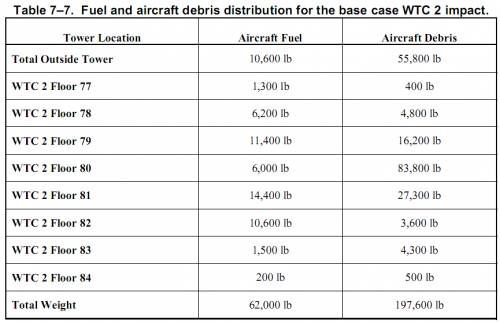
As an aside, I've located some totally different fuel distribution figures an'all..
998583046.jpg


Shall check implications for their alternate Table 5-4.
 
Well that would tend to suggest that NIST did mess up table 5-4 in NCSTAR 1-5F, and include values excluding that ending up *outside the tower*. What is still not clear is whether they add another 20% of the remainder for the fireball. They state repeatedly that the fireball was formed post impact and *pushed* out a volume of fuel. I'm inclined to suggest it's a grey area*.

These figures leave an initial 7555 gallons, rather than 7415. (using a fuel density of 6.83 lb fuel/gal. NCSTAR 1-5A p79)

Assuming* that the 20% subtraction for the fireball is already accounted for, and the NIST assertion that 50% flowed away out of the impact zone, that leaves... 3777 gallons in the impact zone. (9107 gallons total...yet another bleedin' different value :rolleyes:)

* the formation of the fireballs demonstrates that a fraction of the remaining fuel was expelled from the building (mostly likely being forced out of openings as an atomized liquid due to the overpressures generated by internal burning).

If the starred behaviour is separate to fuel simply passing through the building, it does suggest that an additional 20% subtraction as suggested by NIST would be appropriate...reducing the impact zone fuel volume to 3022 gallons. Still a bit up from the 5-4 derived value of 2966...
 
Last edited:
Seems a very AE911T type thing to do, but hey-ho, it's beachnut.

beachnut often uses those figures because the mainstream "truth" movement likes to try and quantify how much "explosives" would have been used in any one of their controlled demolition scenarios... he measures the plane impacts as having the equivalent kinetic energy and as such that there wasn't any need for what the "other truth" camp keeps putting out

Grizzly Bear, isn't your own speculation a distinction without a difference to Femr's inability to quantify the amount of fire proofing lost?

whoops... got carried away with things :o
Truthers usually claim that because the NIST estimates of fireproofing losses are "estimates" they have no proof that a sufficient amount was actually lost for collapse to have been caused by the fires... doesn't look like femrs quite going in that direction...
 
Last edited:

Back
Top Bottom