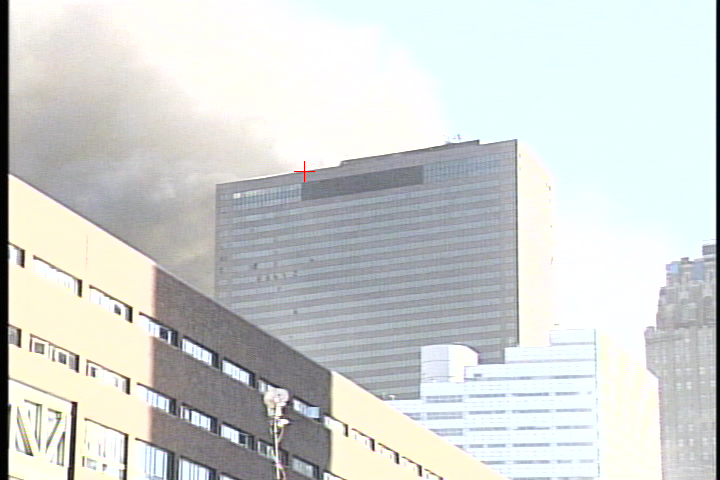
I in fact have measured the descent from the Dan Rather video. It was the first one I used, actually.
Please upload your trace data. (at least the fourth request now)
Last edited:

I in fact have measured the descent from the Dan Rather video. It was the first one I used, actually.
Major_Tom understands what I am asserting and thinking about as well as he understands geometry.
FDNY put a transit on the building in the afternoon. Horizontal motion was detected hours earlier than the videos you are analyzing. That's one of the reasons they cleared the area; they knew it was going to collapse.Motion detectableover 100sHOURS earlier.

FDNY put a transit on the building in the afternoon. Horizontal motion was detected hours earlier than the videos you are analyzing. That's one of the reasons they cleared the area; they knew it was going to collapse.
ETA - surveyor's transit was put on before 2:30 Eastern, and motion detected before 3:00 Eastern.
Horizontal motion was detected hours earlier than the videos you are analyzing.
It's what land surveyors (auf Deutsch - Landvermesser) use. Like a tripod with a telescope on it. If it were trained on a fixed point on the building, and after time, that point had moved, they would know that the building was shifting.I have read this before, but admit I don't know what the word "transit" means in this context. Can someone explain in layman's terms what you do when you "put a transit on the building"? Thanks.
As ever, if you could (at long last!) reveal what other dominos fell due to To being misstated by a second, people might be interested. Believe it or not, most of us think - building shifting, making sounds, burning out of control for hours = building fell down. The building fell in the real world, not cyberspace. We had 3 dimensions and 5 senses to process the event, not just VHS video. Yeah, NIST did some detailed analysis to try and better protect future buildings. Your analysis appears to change none of that.femr2 said:That ~1s shift skewed other results.

You're still defending your claims, several months after basic errors in your "proof" were exposed.Major_Tom understands what I am asserting and thinking about as well as he understands geometry.
A minus sign and a square root sign typed in wrong on a jpeg image months ago.
That is all the "dirt" you have on me in the last year?
And how long did I "cling" to that jpeg image? Not even one post? How long did I defend it?
The simplest domino effect is upon the stated *40% longer than freefall* metric, reducing it to under 20% longer than freefall.As ever, if you could (at long last!) reveal what other dominos fell due to To being misstated by a second, people might be interested.
 )
)
Fair request, I think.
AE?

Ironic really. We know roughly the area they chose. Exact spot, no.
However, and it is a big however...
Neither did NIST. (Kind-of
As I've highlighted many times, they extracted data from a horizontal location in the video image. They did not take account of lateral movement of the building within the frame.
The end result being that NIST tracked the position of a wandering point on the roofline, not a specific point.
No-one is denying a vertical component to the motion.

What is being highlighted is that from the Cam#3 viewpoint what appears to be vertical motion is in fact primarily N-S, and primarily non-vertical.
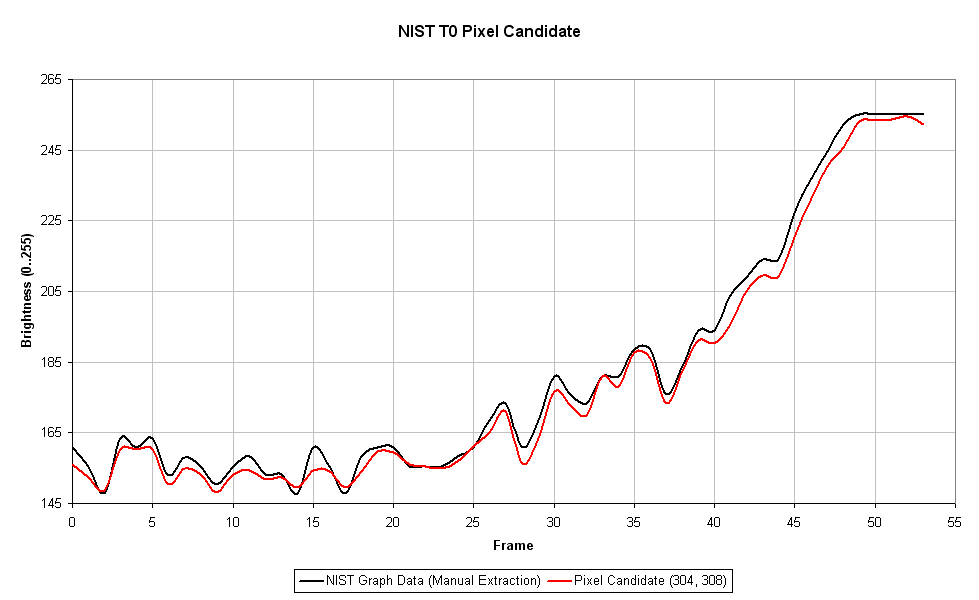
Also of grave issue is that NIST defined T0 using "a single pixel close to the center of the north face roofline"...
[qimg]http://femr2.ucoz.com/_ph/3/2/370825048.jpg[/qimg]
Bit of a problem given those rooftop structures being in the way.

That is not your trace data.I have already published videos with my measurements. They have been available since 2009.
...Femr2 has conflated several ideas together and is looking for something I never claimed to have. I am not going to correct his error, but will let him continue the way he is going. For now.
Your data from the motion tracking software you said you had used would be rather more useful than your assurance .Femr2, we've been over this fallacious argument already: The point where the brightness of the pixel was determined is not stated to be the same point where the horizontal position was tracked from. It is perfectly possible to select a point on the parapet wall somewhere more or less directly above the final point using motion tracking software.
I've done it using a couple of different programs myself so I can assure you.
Correct.NIST knows where they measured.
CorrectYou do not.
Nonsense. NIST state that they use a horizontal position in the frame. Implications are then definite. No subtraction of horizontal motion. No feature with which to do so anywaySupposition. No corroboration from NIST on this point.

Who denied it ? Only an idiot would think it had been deniedThank you for finally admitting this!
ROFL. Where is the visible roofline distortion in the Dan Rather image I showed you ?No. Incorrect. And you've provided thus far ZERO data points to back up this repeated bare assertion.

There you have it folks, both Femr2 and MT now admit that the roofline of the collapsing building was moving in both the vertical and horizontal planes, but they have both failed to quantify the movements (Femr2 has actually dodged this issue claiming you don't need that kind of precision to understand - which itself is a mind-boggling departure from his usual obsession with minutia), and have arbitrarily decided that their shortcomings disqualify the measurements NIST did.
.
No-one said otherwise. No doubt you will take that obvious point (which you are incorrectly suggesting has been denied...aka lying) and use it to support the errant NIST T0, thus providing further indication that you really don't understand the implcations...still.There you have it folks, both Femr2 and MT now admit that the roofline of the collapsing building was moving in both the vertical and horizontal planes
There have been discussions aimed at determining specific N-S movement, but there are not really enough different video viewpoints to gain much accurate z-plane information. The better route is simply to recognise that the Cam#3 viewpoint suffers from the perspective problem and not use the region of flexure to define T0, better still don't use the cam#3 viewopint to define T0 at all. Use the Dan Rather viewpoint instead.but they have both failed to quantify the movements
That's not a dodge, it's ridiculously simple. You'd have to be a total idiot not to realise by now that the initial flexure of the North face as seen from the Cam#3 viewpoint is primarily non-vertical movement in the region near the middle of the roofline at the NIST T0.Femr2 has actually dodged this issue claiming you don't need that kind of precision to understand
Which inconvenient facts ?It's really an elaborate attempt to handwave away inconvenient facts
There have been discussions aimed at determining specific N-S movement, but there are not really enough different video viewpoints to gain much accurate z-plane information. The better route is simply to recognise that the Cam#3 viewpoint suffers from the perspective problem and not use the region of flexure to define T0, better still don't use the cam#3 viewopint to define T0 at all. Use the Dan Rather viewpoint instead.
The value has been spatAs an aside, my PC is currently scanning for which pixel in the original Cam#3 video matches the brightness profile in figure 12-75. It may take some time, but it should eventually spit out the pixel and initial frame used by NIST