Bare assertion. You do not know where they measured the acceleration from.
Ironic really. We know roughly the area they chose. Exact spot, no.
However, and it is a big however...
Neither did NIST. (Kind-of

)
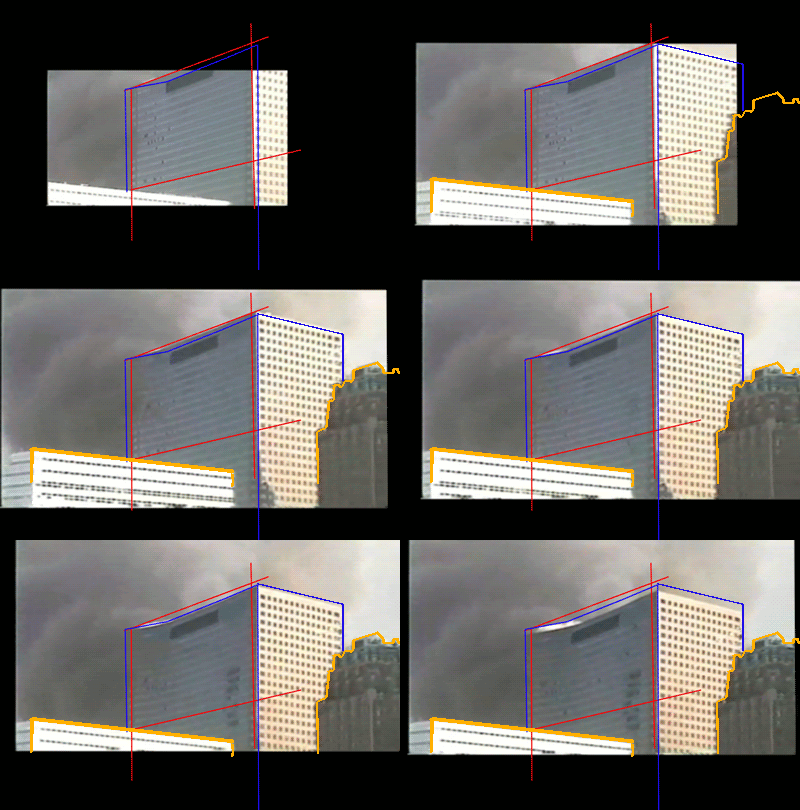
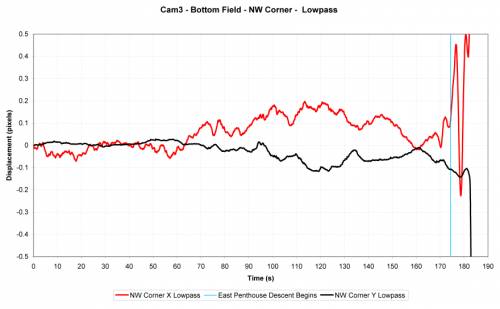
As I've highlighted many times, they extracted data from a horizontal location in the video image. They did not take account of lateral movement of the building within the frame.
The end result being that NIST tracked the position of a wandering point on the roofline, not a specific point.
that's the least of your problems in terms of denying any vertical motion.
No-one is denying a vertical component to the motion.
What is being highlighted is that from the Cam#3 viewpoint what
appears to be vertical motion is in fact primarily N-S, and primarily non-vertical.
Defining T
0 based on that motion was erronious and has skewed the NIST velocity and acceleration data.
If you want the earliest moment of motion, it was over 100s earlier, but that's not the intent.
Small error in T
0 definition has an increasingly amplified effect as you derive velocity and acceleration.
Also of grave issue is that NIST defined T
0 using "
a single pixel close to the center of the north face roofline"...
Bit of a problem given those rooftop structures being in the way.





 Calm down dear.