• Security incident: ISF was recently accessed by intruders. Please change your password, and change it anywhere else you used it. Read more

Superconductivity at room temperature??

I linked to animations of solutions of the SE that show that clearly. You ignored them. Generally, nearly any solution that is the sum of at least two energy eigenstates has that property.
We have not been talking about sums of eigen-state solutions, but about coherent solutions, each of which must have a specific frequency: The wave we are talking about is a single eigenstate moving around a circle.
Complete and utter nonsense. See either of the animations, open any QM text, or simply superpose some free particle stationary solutions. Here's an explicit analytic example in 1D:
I have never seen an animation of a coherent wave (i.e. a wave with a specific frequency) which is moving. And by the way I could not access the webpages you quoted. But that does not matter since you are again misleading this forum by making claims which are irrelevant to what we are discussing. The following is a further example:
[latex]$\psi(x,t) = \int dk e^{i(kx-\omega t) -k^2 + i p_0 x}$[/latex], from which one obtains

[latex]$|\psi(x,t)|^2=\pi \frac{e^{-\frac{(x-2 p_0 t)^2}{2 \left(1+t^2\right)}} }{\sqrt{1+t^2}}$[/latex].
This is a wave packet that only forms within a conductor. It forms by the superposition of delocalised stranding waves when a change in boundary conditions require them to form: For example when there are temperature fluctuations or when applyin an electric-field so that a current is flowing. Each of the standing waves which superpose is on its own "an electron"; or else they will not superpose. You cannot superpose "empty waves"; waves which are on their own not each an electron.

It is wrongly claimed in text books that such a wave packet can form spontaneously within free space from delocalised waves of which only ONE is an electron. This is BS. When waves superpose to form a wave-packet each of the waves that superpose must be an electron. Thus to form a wave packet in free space you will have to have an infinite number of electrons and a reason why they will want to superpose: Within a conductor the reason is that an electric-field is applied to institute an electric current.
That is a moving wave packet with momentum p0, and it solves the free-particle Schrodinger equation.
It is not a moving coherent wavewhich has a single frequency and parallel wave-fronts. So it has NOTHING to do with what we have been discussing.
 
Now I am convinced that you have a screw loose: You differentiate with time while ignoring the fact that a harmonic wave has a frequency (omega).
I am sorry, johanfprins - it is you with the screw loose there :D.
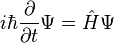
sol invictus quoted the Schrodinger equation where there is a differentiation with time. It was Schrodinger that put that time differentiation there.

Since you seem ignorant enough about quantum mechanics not to recognize this, here it is from wikipedia:
Schrödinger equation
For a general quantum system:[2]


e29ddfcef18d182110adc56344a17967.png
where
  • Ψ is the wave function; the probability amplitude for different configurations of the system at different times,
  • 2d09811160064d27bc14c2ed4cba9a9e.png
    is the energy operator (i is the imaginary unit and
    9dfd055ef1683b053f1b5bf9ed6dbbb4.png
    is the reduced Planck constant),
  • b584b3da8f265f251460b48a89a2e735.png
    is the Hamiltonian operator
The Hamitonian for a free particle is
(sol invictus put some factors to 1 for simplicity)
 
We have not been talking about sums of eigen-state solutions, but about coherent solutions, each of which must have a specific frequency: The wave we are talking about is a single eigenstate moving around a circle.

Actually, Johan, we are discussing your numerous false assertions. Every time one gets proven wrong, you modify it. Since you seem to be incapable of getting anything right, you modify it into something else that's wrong, which gets proven wrong again, ad infinitum.

It is wrongly claimed in text books

Yes, all texts on QM are wrong, and Johan is right.

Enough of this idiocy.
 
Last edited:
This is a wave packet that only forms within a conductor.
Once again you are wrong. sol invictus stated what the example wave function was a solution to. Try reading his post:
Here's an explicit analytic example in 1D:

latex.php
, from which one obtains

latex.php
.

That is a moving wave packet with momentum p0, and it solves the free-particle Schrodinger equation.
(emphasis added)
It applies wherever there is a free particle. There is no conductor mentioned.
 
No Johan, I am not stupid. The wavefunction I posted does not have a time-dependence, and yet as I proved mathematically, it is nevertheless a solution to the time-dependent free-particle SE. The reason for that is obvious to everyone else reading this thread. I picked that solution because it is the simplest counterexample to one of your myriad wrong assertions.
As always, you cannot understand simple facts.
PLEASE go and talk to somebody who knows at least something about waves and differential wave equations. A wave-amplitude without a time dependence and a frequency DOES NOT EXIST SINCE ITS ENERGY IS ZERO!!. Thus to insert an expression for a wave amplitude without any frequency into the time dependent Schroedinger equation is absurdly STUPID.

If your reasoning is "obviously correct" to everyone else reading this thread, then I dispair about the future of physics. To refresh your mind and those people who are so dim-witted to think that you are "obviously correct", you can find the following within ant text book:

The solution PSI(x,y,z,t) of a schroedinger wave can always (unless the potential energy changes with time) be writtent as:

PSI(x,y,z,t)=PSI(x,y,z)*exp[-i(omega)t] where omega CAN NEVER BE ZERO!

By inserting this expression into the time-dependent Schroedinger equation, one obtains the time-independent equation after partially differentiating with time t. The latter equation determines the time-independent amplitude PSI(x,y,z). Thus when you insert your time-independent expression into the time-independent Schroedinger equation, one can immediately see that it does not satisfy this equation. Thus your expression fails for two reasons: It does not have an exponential term of frequency and time as it must have to be a wave-amplitude for the tiem-dependent Schroedinger wave equation: ALL wave functions must have this in order to satisfy the time-dependent Schroedinger equation. AND when inserting it into the time-independent Schroedinger equation which it must satisfy to be a time independent wave function, it does not satify this equation. Thus IT IS NOT A SOLUTION of the Schroedinger equation.

Now we have come to an impasse: If you cannot see that your reasoning is wrong, I will be wasting my time reponding to your assinine posts on this forum. It will be like trying to convince a person who wants to believe that the earth is flat, that the earth is not flat. Or even more difficult, like helping W D Clinger to pass grade 1 in primary school. Thus until you and Ziggurat do not realize that your function is not a solution of the Schroedinger equation, and can never be a solution, I will ignore your posts as I have been ignoring those of the idiot who calls him/herself W D Clinger. I am thus starting off by ignoring the long post by Ziggurat; which is the usual nosensical hogwash which he likes to post.
 
Once again you are wrong. sol invictus stated what the example wave function was a solution to. Try reading his post:
(emphasis added)
I know it is a solution. A differential wave equation can give an infinite number of solutions. The one that is correct is the one that satisfies the boundary conditions. If there are no boundaery conditions that require a wave packet to form, it is not physical solution, even though it mathematically satisfies the differential equation. There are no boundary conditions in free space which mandates wave packets which can only form from many electron waves in space: i.e. a multitude of free electrons. When solving teh Schroedinger equation you only get ONE free electron.. And more importantly you will see that we have been discussing coherent waves having a single frequency. Such waves cannot be wave packets EVER![/quote]
It applies wherever there is a free particle.
I know that this is what is being taught in text books: But it is wrong: Just as wrong as claiming a length contraction of a stick moving past you
There is no conductor mentioned[ /quote] I mention it since it is only under these conditions that wave packets form and can be measured to form.
 
Last edited:
Really, and when you do this you see crests and troughs along the circumference (like wheel spokes turning around the centre of the cup) or do you see crest and troughs along the radial direction (as rings around the centre-point of your cup)? If you are able to do the first and create spokes, there awaits a lucrative career for you as an illusionist.

Why are you woos always so insulting?
 
The solution PSI(x,y,z,t) of a schroedinger wave can always (unless the potential energy changes with time) be writtent as:

PSI(x,y,z,t)=PSI(x,y,z)*exp[-i(omega)t] where omega CAN NEVER BE ZERO!

False on two counts.

1) Such an expression is valid only for a set of measure zero of the solutions. The general solution is not separable (i.e. is not a function of x,y,z times a function of t), but can be written as a sum or integral of such terms (with arbitrary coefficients).

2) omega can of course be zero. For example, given a solution that can be written in the form PSI(x,y,z,t)=PSI(x,y,z)*exp[-i(omega)t] , I can add a (physically irrelevant) constant to the Hamiltonian that sets omega=0, and nothing at all changes in the physics.

Thus when you insert your time-independent expression into the time-independent Schroedinger equation, one can immediately see that it does not satisfy this equation.

Nonsense. As I proved several posts ago, it solves both. Wrong again.

Thus your expression fails for two reasons: It does not have an exponential term of frequency and time as it must have to be a wave-amplitude for the tiem-dependent Schroedinger wave equation: ALL wave functions must have this in order to satisfy the time-dependent Schroedinger equation.

Wrong on both counts, as above.

AND when inserting it into the time-independent Schroedinger equation which it must satisfy to be a time independent wave function, it does not satify this equation. Thus IT IS NOT A SOLUTION of the Schroedinger equation.

Then find the mistake in the math where I showed that is is a solution. You can't, because there isn't one. You're wrong again.

Now we have come to an impasse: If you cannot see that your reasoning is wrong, I will be wasting my time reponding to your assinine posts on this forum. It will be like trying to convince a person who wants to believe that the earth is flat, that the earth is not flat. Or even more difficult, like helping W D Clinger to pass grade 1 in primary school. Thus until you and Ziggurat do not realize that your function is not a solution of the Schroedinger equation, and can never be a solution, I will ignore your posts as I have been ignoring those of the idiot who calls him/herself W D Clinger. I am thus starting off by ignoring the long post by Ziggurat; which is the usual nosensical hogwash which he likes to post.

Isn't it interesting that you cannot communicate with anyone on this forum, Johan? Do you see what the single common factor is in all those attempts?
 
Last edited:
Yes there is. The n=2, l=1, m=1 solution is a wave circling the nucleus.
No it is not since even in this case you have <p>=0. So how can a wave circle the nucleus when its momentum is zero?
I see you're still having trouble with the definition of expected value (aka expectation value, aka weighted average).

Consider a swinging pendulum centered above the origin of an xy plane and swinging along the x axis. The expected value of its x coordinate is zero. Does that mean its x coordinate is always zero? No, it does not.

Now we have come to an impasse: If you cannot see that your reasoning is wrong, I will be wasting my time reponding to your assinine posts on this forum. It will be like trying to convince a person who wants to believe that the earth is flat, that the earth is not flat. Or even more difficult, like helping W D Clinger to pass grade 1 in primary school. Thus until you and Ziggurat do not realize that your function is not a solution of the Schroedinger equation, and can never be a solution, I will ignore your posts as I have been ignoring those of the idiot who calls him/herself W D Clinger. I am thus starting off by ignoring the long post by Ziggurat; which is the usual nosensical hogwash which he likes to post.
May I borrow your goldfish for show and tell?
 
We have not been talking about sums of eigen-state solutions, but about coherent solutions, each of which must have a specific frequency: The wave we are talking about is a single eigenstate moving around a circle.

No we haven't. Just the opposite. You got caught with your foot in your mouth and you're trying to invent your way out of it.

Remember, you've been objecting to classical wave equations in the same terms you've been objecting to Schrodinger's. The tea-cup thing? Vibration of an elastic ring? You had those wrong too, and not in a way you can weasel out of by saying "I was thinking of the eigenstates".
A wave with a specific frequency must always be an energy eigen state. A coherent running wave must thus be an eigen state. A coherent running wave around a ring, if it can form which it cannot, must thus be an eigen state and not a wave packet.

Until you confirm that the solution of Schroedinger's time-dependent wave equation must be time dependent, and that such a solution, to be coherent, must have a single, non-zero, frequency, I will also not respond to your postings anymore. I hope there are people on this forum who are able to understand physics and who will thus post relevant discussion material. I will gladly respond to them: Not anymore to flat-earthers.
 
A wave with a specific frequency must always be an energy eigen state.

Nope. First off, the phase frequency of an eigenstate wave function is never measurable. It is only inferred from the energy, but the energy is always in reference to some reference point, and the reference point (and hence the phase frequency) is always arbitrary. The ONLY measurable frequencies come from superposition states. And for the superposition of two eigenstates with different energies, there is only one measurable frequency.

But one can have more than just two eigenstates in the superposition. The coherent states of a quantum harmonic oscillator involve the superposition of an infinite number of energy eigenstates.

Oh, and here is a nice little article about traveling wave normal modes in a vibrating ring. They do exactly what you claimed they couldn't do.
 
A wave with a specific frequency must always be an energy eigen state. A coherent running wave must thus be an eigen state. A coherent running wave around a ring, if it can form which it cannot, must thus be an eigen state and not a wave packet.

Until you confirm that the solution of Schroedinger's time-dependent wave equation must be time dependent, and that such a solution, to be coherent, must have a single, non-zero, frequency, I will also not respond to your postings anymore. I hope there are people on this forum who are able to understand physics and who will thus post relevant discussion material. I will gladly respond to them: Not anymore to flat-earthers.

I'll make you an offer, Johan. Suppose I write down a solution to the Schrodinger equation in 2 or 3 dimensions (as you prefer). I'll use a simple potential - the harmonic oscillator (in 2 or 3D), and I'll present a solution that

1) is a valid, normalized, finite-energy solution to the full time-dependent SE for a 2 or 3D harmonic potential,

2) maintains perfect coherence at all times (i.e. never changes shape),

3) orbits around a central point, and

4) is not an energy eigenstate (and in fact consists of a sum over an infinite number of frequencies)

According to you, that's impossible for multiple reasons. As such, you should be very happy to make a bet with me, and take my money when I fail to produce such a solution in some proscribed amount of time.

So, how much are you willing to wager? We can submit my solution to an agreed-on third party that will verify whether 1-4 in fact hold for my solution.
 
Oh, and here is a nice little article about traveling wave normal modes in a vibrating ring. They do exactly what you claimed they couldn't do.

"Flexural"! That's the word that was missing from my previous lit searches. Here's another one (with images)

ieeexplore.ieee.org/iel5/58/20244/00935722.pdf?arnumber=935722

Remember, Johan, how this argument started at all.

You asserted that it was simply *impossible* to have a function S with curl x grad(S) nonzero, and that a textbook using such a quantity to describe SQUIDs was wrong.

We pointed out that curl x grad(S) is easily nonzero for (a) phase, where S = S-2pi, and (b) complex numbers, for which S = S*e^(2*pi*i), and that this was the case in the derivation you objected to: i.e., you were wrong.

Then you pivoted to "no function can vary with theta" or something like that. New claim, contradicts old claim, wrong again.

Then you pivoted to "functions that vary in theta are not solutions to Schrodinger's equation." New claim, wrong again.

Then you pivoted to "solutions to Schrodinger's Equation are not *traveling* waves." New claim, wrong AGAIN.

Then you pivoted to "traveling waves are not solutions to the time independent Schrodinger equation". Or possible "traveling wave packets with time-varying expectation values are not solutions to the time independent Schrodinger equation". Hard to tell. It's hard to care what you're wrong about when you don't seem to care yourself.

Let's go back to the original claim.

The phase function S(theta) = a*e^(n*i*theta) is a solution to the time-independent Schrodinger equation for a particle confined to a ring (for any integer n and with a as a normalization constant). It does have the property that you claimed was forbidden, because curl.grad(S) is nonzero. (It does not have any time-dependent observables, but so what?)

You can't state a mathematical or physical objection to that statement, so your objection to the Tilley and Tilley derivation is dead.

You are no longer trying to make that argument, you're trying to obscure the fact that you ever made it. Maybe you're hoping to stumble across some other error in quantum mechanics (since you're so sure they are there.)
 
II know that this is what is being taught in text books: But it is wrong: Just as wrong as claiming a length contraction of a stick moving past you
There is no conductor mentioned[ /quote] I mention it since it is only under these conditions that wave packets form and can be measured to form.
You stating that textbooks are wrong without evidence does not mean anything. Present your evidence that they are wrong.
At what point during the derivation of this free particle solution do the text books get it wring?

Wrong: wave packets do not need a conductor. See the quoted solution or the wave packet solution of Schrodingers equation for a free particle .
 
I know that this is what is being taught in text books: But it is wrong: Just as wrong as claiming a length contraction of a stick moving past you

I missed this gem before. Evidently it isn't just standard quantum mechanics that you object to, but standard special relativity as well. One wonders if there's ANY 20th century physics you actually agree with. Actually, given the violations of energy conservation in your theory, one wonders if there's an 19th century physics you agree with.
 
You stating that textbooks are wrong without evidence does not mean anything.
You are asking reasonable and valid questions and therefore I am willing to share my reasoning with you. At least you do not claim that a wave-field with zero energy is a valid solution for Schroedinger's equation.
Present your evidence that they are wrong. At what point during the derivation of this free particle solution do the text books get it wrong?
I have given my reasons for this conclusion in detail in sections 7 and 34 of my book. But since you do not have a copy of my book, I will try and summarise my reasoning here. Obviously, it is impossible to give all the detail that is in my book on a forum.

Basically a wave-packet can only be a solution of a many-body wave equation: i.e. the superposition of many waves each of which is in essence an electron-wave and thus has a rest-mass. When you solve the single particle wave equation, you do get a spectrum of possible solutions: But only one of them can be a solution for a single particle wave equation. It makes no sense to assume that the other possible solutions can be superposed to obtain a wave-packet since they do not really exist unless they are each representing an additional electron. As I pointed out above, to obtain a superposition of single-electron waves, you must start of with a many-body wave equation not a single electron wave equation. Within a metal you have a many-body wave modelling the valence electrons; thus you have a spectrum of actual waves which allows them to superpose. Therefore they superpose to form wave-packets (pseudo particle) which can be observed by making a Hall measurement. I hope this makes sense to you.
Wrong: wave packets do not need a conductor. See the quoted solution or the wave packet solution of Schrodingers equation for a free particle .
Yes you can find this in any textbook; but it cannot be the solution of a single electron Schroedinger equation. The wave for a single electron in free space must have a definite frequency and concomitant definite energy: A wave-packet does not have this.
 

ISF - Join now!

Every member here is approved by hand. No bots, no spam, just people who care about evidence and honest debate.

Membership is free!

Create your free account

Back
Top Bottom