• Security incident: ISF was recently accessed by intruders. Please change your password, and change it anywhere else you used it. Read more

Merged DDWFTTW in a “Real” Wind

Status
Not open for further replies.
Let's see how well Spork will do when challenged and can't use the O.J. defense.

Your theory predicts a change in net force with velocity. The trial says a constant force. How do you explain that?

How do you explain the fact that you constantly get your facts wrong?

When you are told you are not correct in a good faith effort to educate you, why not say thank you to the poster instead of ignoring them.
 
Last edited:
How do you explain the fact that you constantly get your facts wrong?

When you are told you are not correct in a good faith effort to educate you might try saying thank you to the poster instead of ignoring them.

You have no interest in educating anyone, but to save face for your support for the ailing cart.

The thrust and net force method is outlined in the NALSA submission. Data comes from Javaprop, as posted by Spork.

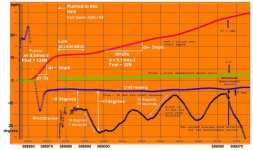
Llyricist and Dodge69 have produced calculations that show a rise in overall force and net force, and increasing velocity. The trial shows a constant net force over the entire run.

How can our calculations show a rise in net force with increasing velocity when we only calculated for one velocity?
 
How can our calculations show a rise in net force with increasing velocity when we only calculated for one velocity?

Then try it. It is obvious from the simple algebra that it must be true, and Dodge69 did at least two calculations.

But now you are left to find a means of explaining the trial data, that says the net force is constant. Now Spork says that trial is proof, remember.
Good luck with that one. And no, massaging the losses against the thrust won't work. I have already anticipated any response you could possibly make.

Actually, my calculations for those two cases revealed almost the same net force, which happened to be too low to account for the actual acceleration in the case for which I have acceleration data.

Timestamp: 589068.0
Cart Speed: 28.01573
Wind Speed: 10.20194
Deviation from DDW: -0.03848
Acceleration: 0.087 m/s2
From your favorite formula, we know the necessary net force is ~25 Newtons, when I got ~10.
 
It seems humber's alexia is getting worse. There are two possible explanations for his mishunderstanding. First the cart accelerated during the time trial. He misinterprets that as a rising force on the object, rather than as a constant force. Second remember the humberverse uses Aristotle's physics. That means it takes a constant force for something to move, for it to accelerate it takes an increasing force. It is probably a strange combination of the two with perhaps a third or fourth consideration too.
 
Actually, my calculations for those two cases revealed almost the same net force, which happened to be too low to account for the actual acceleration in the case for which I have acceleration data.

Timestamp: 589068.0
Cart Speed: 28.01573
Wind Speed: 10.20194
Deviation from DDW: -0.03848
Acceleration: 0.087 m/s2
From your favorite formula, we know the necessary net force is ~25 Newtons, when I got ~10.


F=ma
F = 295kg*1.1ms-2 = 32.4N
Constant, save for when it is some times slightly less as it comes closer to ddw.


attachment.php


Ans Spork's calculation in the submission demands an increasing net force with velocity, because of the changing ratio of vcart to vwind.
 

Attachments

  • jref_chart1.jpg
    jref_chart1.jpg
    45.7 KB · Views: 62
Last edited:
It seems humber's alexia is getting worse. There are two possible explanations for his mishunderstanding. First the cart accelerated during the time trial. He misinterprets that as a rising force on the object, rather than as a constant force.
No a constant net force.


Second remember the humberverse uses Aristotle's physics. That means it takes a constant force for something to move, for it to accelerate it takes an increasing force. It is probably a strange combination of the two with perhaps a third or fourth consideration too.
Sure. And it's turtles all the way down on Planet Oil Barrel. Tiresome and repetitive rhetoric will not help you or Spork.
 
Well if is a constant net force then what are you complaining about? You have not shown any quotes, wait a second, you have been guilty too often in the past of altering quotes, you have not shown any links of spork's equations that you claim require increasing force on the cart. There is nothing wrong with the cart accelerating under a constant, or near constant force.
 
Well if is a constant net force then what are you complaining about? You have not shown any quotes, wait a second, you have been guilty too often in the past of altering quotes, you have not shown any links of spork's equations that you claim require increasing force on the cart. There is nothing wrong with the cart accelerating under a constant, or near constant force.

Oh yes there is. It is in direct contradiction to the supposed theory.
Perhaps you can get Spork to work Javaprop over the entire range of the run and post them; and this time, without the underhanded tricks.
 
Oh yes there is. It is in direct contradiction to the supposed theory.
Perhaps you can get Spork to work Javaprop over the entire range of the run and post them; and this time, without the underhanded tricks.

Ya know what, I have started the necessary learning curve about JavaProp to do just that.

By the way I had to cut my previous post short because real life interrupted, I was going to go on and explain why it is okay to change the efficiency and drag numbers to match the real life results, since they were just guesses to begin with. But I'm pretty sure everyone else already knows that.
 
F=ma
F = 295kg*1.1ms-2 = 32.4N
Constant, save for when it is some times slightly less as it comes closer to ddw.
Wrong again. it changed suddenly when spork changed the pitch of the prop. It increased steadily while directly downwind during the test period.
 
Ya know what, I have started the necessary learning curve about JavaProp to do just that.

By the way I had to cut my previous post short because real life interrupted, I was going to go on and explain why it is okay to change the efficiency and drag numbers to match the real life results, since they were just guesses to begin with. But I'm pretty sure everyone else already knows that.

Sure it is. There is not only the net force problem but the magnitude of the forces too.
 
Wrong again. it changed suddenly when spork changed the pitch of the prop. It increased steadily while directly downwind during the test period.

What a crock. JB manages to push the cart to WS, at four times the later rate of acceleration of the cart.
 
Ya know what, I have started the necessary learning curve about JavaProp to do just that.

By the way I had to cut my previous post short because real life interrupted, I was going to go on and explain why it is okay to change the efficiency and drag numbers to match the real life results, since they were just guesses to begin with. But I'm pretty sure everyone else already knows that.

And the wheel generates more and more power as velocity increases, but the cart's efficiency falls, such the the net force remains the same? And you Carteers have been arguing about high chain efficiency, under those circumstances? Pull the other one.
Also, the submission calculation has fixed losses, and low drag and rolling resistance forces.

You won't match that up with Javaprop or the trial results.
 
Based on the numbers in my posts here and here, I calculated the coefficient of rolling resistance as 0.0070 and the coefficient of drag as 0.51.

Do these coefficients seem reasonable? (In particular, the rolling resistance works out to only 4.6 lbs, which seems a bit low, perhaps.)

I assumed that the Blackbird was at top speed in both cases. In calculating the coefficient of drag I used an area of 2 m2, and in calculating the coefficient of rolling resistance I used a weight of 650 lbs. I didn't take into account any inefficiencies in the chain drive, so the real numbers are presumably somewhat less.

Is it really true that rolling resistance doesn't depend on speed?

Anyway, I'd need figures for a run at a third windspeed to calculate a linear term in addition to the constant and quadratic terms.
 
Drag coefficient looks too high- my old Lotus Europa was 0.29, and I believe some Audis are around this figure nowadays.
BB has very narrow tyres, no radiator cooling intakes, and airfoil sections to the fairings on the pylons and axles; I would guess a Cd of 0.2 or less.
 
Based on the numbers in my posts here and here, I calculated the coefficient of rolling resistance as 0.0070 and the coefficient of drag as 0.51.

Our somewhat educated guesses put rolling resistance at .01 (or maybe a bit higher), and Cd at 0.3 or a bit lower.

I didn't take into account any inefficiencies in the chain drive, so the real numbers are presumably somewhat less.

My recollection is that we concluded the chain drive was upward of 90% efficient.

Is it really true that rolling resistance doesn't depend on speed?

None of these models are ever 100% accurate, but I think it's pretty darn close.
 
Our somewhat educated guesses put rolling resistance at .01 (or maybe a bit higher), and Cd at 0.3 or a bit lower.

My recollection is that we concluded the chain drive was upward of 90% efficient.

I redid the calculation, this time multiplying the backward force of the ground on the wheels by 1.1 (i.e., efficiency of about 91%). Now I get a coefficient of rolling resistance of 0.0059 and a coefficient of drag of 0.27.
 
Status
Not open for further replies.

ISF - Join now!

Every member here is approved by hand. No bots, no spam, just people who care about evidence and honest debate.

Membership is free!

Create your free account

Back
Top Bottom