ThinAirDesigns
Graduate Poster
- Joined
- Nov 10, 2008
- Messages
- 1,058
See.
JB
JB

I assumed NALSA would post it either upon receipt or upon analysis. Is there some reason they wouldn't?
See.
JB
My thought is that humber might send something to NALSA so ridiculous and incoherent that they simply would not bother doing anything with it but throwing it in the trash.
As the record holder, NALSA considers it relevent to share with us any challenge to the record. If they ask us to respond to them regarding any challenge we will.
We will make sure that any challenge to our record is made public.
In the end of course much (or none) of the above will happen because humber couldn't present a coherent challenge if his life depended on it.
JB

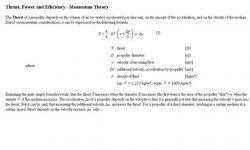
Which is,of course, irrelevant.Here is his simplified formula for thrust, which flatly refutes the idea that a free-wheeling prop can produce thrust.
This is just a guess, but would that be by a circular argument, starting with the assumption that all the thrust pushing the cart forward can only ever be a proportion of the energy fed into the prop from the wheels?Over at TR, Yevgheni has used this formula to show that even if the wheels can be said to drive the prop in the manner of an engine, the idea fails because there is no energy to allow that, without slowing the cart.
Here it is:
http://www.make-digital.com/make/vol11/?pg=60&pm=2&u1=friend#pg60
The prop is funny enough. But when you read his article, you realize that he was completelly clueless how it was supposed to work. He was poking in the dark just like I Ratant. His gearing was wrong so with positive advance ratio the cart went UPwind (ratio > 1).
Recently MAKE corrected his errors:
http://www.make-digital.com/make/vol26?pg=59#pg59
Oh, yeah?
Javaprop, promoted as the design and verification tool that Spork says he used to design the prop - though it seems that Steve Morris thinks he did that - is the work of Dr Martin Herpelle.
http://www.mh-aerotools.de/airfoils/javaprop.htm
"Your virtual propeller design can be analyzed at off-design conditions, i.e. at a different speed or a different velocity of rotation. The analysis is a so called "Blade Element Method" and uses the same airfoil polars as the design procedure. The influence of blade number and tip loss are take into account by the "Prandtl Tip-Loss Factor". More details can be found in references [10] and [11]. It should be noted, that the analysis does not work accurately for high thrust loadings as they occur under static conditions
He cites these references, which are available to those who look, or politely ask for a copy.
(10) Adkins, C. N.: Design of Optimum Propellers, AIAA-83-0190. Also published in the Journal of Propulsion and Power, Vol. 10, No. 5, September-October 1994.
(11) Larrabee, E. E.: Practical Design of Minimum Induced Loss Propellers, SAE paper 790585, Business Aircraft Meeting and Exposition, Wichita, April 1979.
Papers that are cited to this day.
The author, Dr Martin Hepperle, has another site;
http://www.mh-aerotools.de/airfoils/propuls4.htm
Here is his simplified formula for thrust, which flatly refutes the idea that a free-wheeling prop can produce thrust. Over at TR, Yevgheni has used this formula to show that even if the wheels can be said to drive the prop in the manner of an engine, the idea fails because there is no energy to allow that, without slowing the cart.
[qimg]http://www.internationalskeptics.com/forums/attachment.php?attachmentid=22070&stc=1&d=1304635529[/qimg]
Further, this is what he has to say about "screwing props"
[qimg]http://www.internationalskeptics.com/forums/attachment.php?attachmentid=22071&stc=1&d=1304635583[/qimg]
I look forward to seeing Spork's analysis that gets him out of that bind, if he is not being too loftily imperious to "dig it up".
Which is,of course, irrelevant.This is just a guess, but would that be by a circular argument, starting with the assumption that all the thrust pushing the cart forward can only ever be a proportion of the energy fed into the prop from the wheels?
I may be misjudging it, of course. If the analysis is sufficiently accurate that, for example, it shows the cart is capable of self-starting, then by all means let's see it here. (If it doesn't show that, then he would appear to have missed out something important.)
Garbage in. Garbage out.
Imagine a streamline of wind, moving forward at windspeed. As the leading edge of the propeller blade cuts the streamline, that edge is advancing faster than the air but turning fast too, which means that the part of the blade cutting the streamline is a point which moves across the face of the blade. The pitch of the propeller means that as the point moves across the blade, it also moves backward on the blade. In fact it retreats fast enough that it moves backwards relative to the air (though still forwards relative to the ground).
So from the air's point of view, it encounters an "object" (in reality a travelling point on a real object) which is moving backwards.
For those wondering about the whole silly "Volvo" thing that humber is rambling about.
Stan Honey is a friend of ours (and former boss) but completely unrelated to our project. Stan Honey was the winning navigator on a recent Volvo (sponsored) around the world sailing race. From reading about the scheduled tests on our blog, several guys from the Volvo (car) design studios in LA showed up unannounced (we had never heard of or from them) at the El Mirage record runs.
The tests were a sham because of this.
Humberspiracies abound.
JB
I see.
I thought that, by "retreating", you meant "moving away from the air behind the propeller", which is the same as "moving forward relative to the air". But actually you meant "moving backward relative to the air behind the propeller", which is the same as "moving toward that air".
Do I have that right?
Yes. Look at the point where the streamline hits the blade in the animation below. In the air frame that point moves backwards, while the vehicle moves forward.But actually you meant "moving backward relative to the air behind the propeller", which is the same as "moving toward that air".
Yes...I'm an Australian citizen.Even though Platt managed to build an upwind cart, the performance was terrible according to his article. It barely moved when placed right in front of the fan.
For comparison:
Freshman ME students at the University of Technology, Syndey are required to build upwind carts with minimal resources, and they perform much better:
This guy has build upwind boats, that perform better, despite lower efficiency of the water propeller (compared to wheels) and hull water drag:
Sure. All is wrong but the One True Word. The same author debunks the aircrew claim. I would like to hear directly from Spork.
I don't need those references wrt NALSA, because mostly, my arguments are not related to that particular aspect, and I can support them myself.
Some NALSA members drive Volvos, for sure. But you are not fooling humber, tricky Swedes!
This reads like some sort of mystical incantation. Undaunted, I shall interpret it to mean: "Why yes, you're right; what a lucky guess. His analysis takes no account of any force capable of allowing the cart to self-start."
I'd be interested to see them, if it's not too much trouble.
What do you mean by 'theoretical'?
And that reads more like haruspicy.