• Security incident: ISF was recently accessed by intruders. Please change your password, and change it anywhere else you used it. Read more

Merged DDWFTTW in a “Real” Wind

Status
Not open for further replies.
You are correct BillyJoe and Ynot is again wrong.
It's a common misconception that the wind is pushing against the 'exhaust' of the propeller and thus the two "airmasses" are colliding and combining for speed. It's just not true - the interaction between the prop and the air is *exactly* the same as if the propeller were powered and driving the vehicle upwind.
Propellers work by accelerating the air, using power applied at the shaft. The plane or cart moves in the direction opposite to that, as Newton says it will.
There is no "pushing".

For the above 'colliding airmass when downwind' theory to be true, it would mean that one could study the wake behind the vehicle and determine whether the vehicle was going upwind or downwind - and of course that would be the scientific discovery of the century(s) as it would disprove all of Galilean Relativity.
Oh, that "can't tell" nonsense, that is said to be related to absolute motion.
Totally wrong, and irrelevant. Galileo suggested no such thing.
When standing in the wind, you are effectively moving relative to it, because your feet to the ground prevent motion. Instruments can measure that force and say what is what. If there were no friction, and in some idealised world, you would be accelerated until you reached the speed of the wind, and could go no further. To advance from that point ( either way) you need an engine.
You gain a "free ride" downwind, because you have potential in that wind field due to its motion relative to you, for as long as some of that potential remains. There is none at WS.

Think about a swimmer moving downstream -- is the swimmer creating a 'watermass' that is colliding with the 'watermass' of the stream, or is the swimmer merely 'grasping' something that is already moving relative to the shore and 'pulling' on it? (no one needs to point out that "grasping" and "pulling" aren't hydraulic terms -- I attempted there to use simpler, more descriptive but technically incorrect terms)
A swimmer may float downstream, driven by the drag of the water. Using his arms, and his body chemistry to power them, he may swim faster than the river.

Of course we know that the swimmer is simply doing what a swimmer does and the swimmer can't tell without seeing the river bottom or shore or some reference which direction the current is going. We could study the wake of the swimmer all we wanted and still not determine whether the swimmer was going up stream or down.
When moving slower than the water, there will be force driving him in the direction of the flow. The flow is a force field, and so when not at the speed of the water, the swimmer has potential energy relative to that field. Analogous to gravity or an electrostatic field.
 
Last edited:
  1. [FONT=Verdana, sans-serif]When the cart is moving faster than the wind there MUST be some part of the cart or something that interacts with the cart that is moving slower than the wind so the wind can transfer power to it.[/FONT]

Sort of, but that "something" doesn't have to be an actual physical part of the machine, it can be an effective surface, as it is for the BB or for an iceboat outracing the wind.

If there is an actual physical part that moves slower than the wind, it obviously must only do that part of the time, as in the conceptual paddle-wheel and parachute carts or the drfttr cart (for which we would replace "wind" in the quote with "ruler" and "slower" with "not faster").

To do that, "the physical part of the machine" has to move slower than the machine that is said to be traveling faster than the wind, yet remain attached to the machine. Neat trick.
 
To do that, "the physical part of the machine" has to move slower than the machine that is said to be traveling faster than the wind, yet remain attached to the machine. Neat trick.

Not difficult at all. It just has to travel faster than the machine part of the time. That's what the paddle wheel fins and parachutes do on the paddle wheel and parachute carts, and what the driving surface of the top wheel does on the drfttr cart.
 
In simple terms there are two winds in play. There is a driving wind and a propeller wind that pushes backwards against the driving wind. The speed of both winds combined is faster than the speed of the driving wind alone. The driving wind isn’t just pushing against the body of the cart, it’s also pushing against the propeller wind which is also pushing back against it.

This is all just horribly wrong. But at least ynot is explaining it with real certitude.

When the cart reaches and exceeds the speed of the driving wind the propeller wind and the driving wind are still pushing against each other. Does that help?

Nope - you really must stop this.

Think of how a jet boat works. A jet of water coming out the back of the boat pushes on water to move the boat forward.

Nope. Absolutely false. Pushing against water will only make it less efficient.

If the boat is going downstream it will go faster than if it would be in still water because the jet of water is pushing against water that is also pushing against it.

Nope. Science is not mere guess-work stated as fact.

This isn’t a debate about the validity of DDWFTTW. It’s an attempt for those that know (or think they know) how it works to explain in non-technical, simple, plain English how it works for the benifit of those that don't know how it works.

Then please don't further confuse people with all of your completely incorrect explanations.

The only thing that supplies energy to the cart is the driving wind.

Still wrong. Energy is frame dependent. On the treadmill it would be more natural to say the belt is all that's powering the cart. It simply depends on the frame you choose to do your analysis in.

The transfer of energy from the driving wind to the cart when the cart is going faster than the driving wind is only possible if there is something on or interacting with the cart that is going slower than the driving wind for the driving wind to push against.

Not true.

That something is the propeller wind/thrust.

Seriously - please stop telling these lies.

True, water jets work in a “for every action there is a reaction” way but (as I understand it which could be wrong) they work more effectively when they also have something to thrust against.

That is exactly wrong.

I think a rocket works more efficiently in an atmosphere than in space.

Wrong.


[FONT=Verdana, sans-serif]Let's see how many things there are that we can all currently agree on. If anyone disagrees with anything below please say what and why . . . [/FONT]


  1. [FONT=Verdana, sans-serif]The cart is ONLY powered by the wind.[/FONT]
  2. [FONT=Verdana, sans-serif]Wind can't DIRECTLY transfer power to anything that is moving faster than the wind.[/FONT]
  3. [FONT=Verdana, sans-serif]When the cart is moving faster than the wind there MUST be some part of the cart or something that interacts with the cart that is moving slower than the wind so the wind can transfer power to it.[/FONT]

I disagree with all three - because they're all wrong.

Essentially the propeller is creating an air mass that is moving slower than the wind when the cart is going faster than the wind and the wind is pushing against that air mass. Power/energy from the wind is transferred to the cart via the air mass.

That's just entirely wrong.
 
Last edited:
Not difficult at all. It just has to travel faster than the machine part of the time. That's what the paddle wheel fins and parachutes do on the paddle wheel and parachute carts, and what the driving surface of the top wheel does on the drfttr cart.
And soon humber will have to deny basic geometry and claim that a constant distance between two points implies that they have the same speed.

http://talkrational.org/showthread.php?p=883086#post883086
humber said:
Does the distance between the tip and the hub change? No. So the tip travels at the speed of the cart.

:D
 
MacDoc's explanation

how about you just say

The forward motion is the sum of the vectors provided by the constant tacking of the prop.
Summed into the driving wheels by way of the chain.

For anyone that understands how a sailboat or an iceboat can sail into the wind the - the rapid tacking providing forward motion is easily understood. ( even if it is downwind, the prop is tacking providing crosswind vectors )

An iceboat can get downwind extremely fast and this just rapid tacking of that principle tho a rather inefficient one.

There is nothing mysterious except the explanations that go around.

TANSTAAFL

Actually MacDoc I think this explanation is misleading.

The propeller does not put its force into the cart by way of a chain. In fact it has been stated that there is a ratchet in the mechanism that specifically excludes this. This is why so many are confused that the propeller is a wind turbine.

The propeller puts all of its useful force into the cart simply by pushing on the cart. The transfer mechanism isn't the drivetrain.

The energy or force through the drive train transfers strictly from the wheels to the axle of rotation of the prop. This torque turns the prop. The major loss in the prop is the drag of rotation in the geometric plane of the prop. This torque also causes the prop to produce a "lift" perpendicular to the plane of the prop or in the direction of forward motion. This is the force referred to in the paragraph above. It's the same kind of force that makes an airplane with a propeller go.

I believe it is worth noting that the drag loss in the propeller blades ultimately becomes the largest loss in the system which is what limits the top speed of the cart. When the wheels are working against the same amount of force (drivetrain) that they are being turned by (ground), there is no more speed to be had!

Regards,

WindGrins:D
 
Ynot jet description

Think of how a jet boat works. A jet of water coming out the back of the boat pushes on water to move the boat forward. A fluid pushing on a fluid. If the boat is going downstream it will go faster than if it would be in still water because the jet of water is pushing against water that is also pushing against it. I know there's also less forward friction on the boat when it travels downstream so if that’s an issue for you imagine a water jet powered hovercraft instead of a boat. Going upstream if the water was flowing at the same speed as the jet of water the hovercraft wouldn't travel upstream at all.

Ynot,

Actually I don't think that is quite right either and could confuse the issue. The reason a jet boat works is not that the jet is pushing against the water. The jet would work just as well in the air or space. In fact there is an inventor who has built a water jet backpack to "fly" with that works in just this way. One can quickly see it is not working in the water per se. The jet creates a reaction force at the mechanism that is propelling it (this is Newton's "For every action there is an equal and opposite reaction" law at work.) See link below:

http://www.youtube.com/watch?v=0snTqLQLpBA&feature=related

For the cart, with respect to the propeller, the prop is always accelerating air backwards thus producing a forward thrust. From the ground perspective, the original wind is slowed wrt to the ground. This is the source of the energy. These are two different viewpoints of the same event and both are true simultaneously.

Regards,

WindGrins:D
 
Quarky,

You are miserably wrong.

So wrong, in fact, that it is impossible to explain to you why.
Put it this way: if my five year old nephew provided me with an explanation of quantum physics as he understood it, I am not going to attempt to explain to him where he went wrong.

Yes, it's that bad.

:D

Well, since the threads were merged, I'm not sure which post I was so wrong about. I've made several. It would be nice of you to point out which one(s) you refer to.
 
Ynot's Rocket

True, water jets work in a “for every action there is a reaction” way but (as I understand it which could be wrong) they work more effectively when they also have something to thrust against. I think a rocket works more efficiently in an atmosphere than in space. In any event it’s a poor analogy so let’s say the hovercraft is driven by a paddlewheel and apply the same scenarios.

Sorry Ynot,

In general, Rockets are more efficient in space. Also in general, the only real issue is the velocity of the expelled mass from conservation of momentum standpoint. This is why electric rockets are more efficient. Each unit of expelled mass is moving at a much higher velocity than chemical rockets. They don't produce a lot of total thrust in today's technology. This is why they are only used in space over a long period of time. (a small, but efficient, thrust over a long time period.)

Regards,

Windgrins:D
 
Not difficult at all. It just has to travel faster than the machine part of the time. That's what the paddle wheel fins and parachutes do on the paddle wheel and parachute carts, and what the driving surface of the top wheel does on the drfttr cart.

But a paddle moves faster than the boat as the rower moves it forwards and then a bit slower as he moves it backwards, so the average displacement wrt the boat is zero. In addition, the power source is not the wind or water, but the rover. The same applies to a paddle, and its external power source.
The parachute cart does not work. The idea is complete BS.
 
SteamBoat

A bit of a side-track, por favor?

I've played around a lot with small boats and novel propulsion systems. I've moved up this river here with a flagella drive system; a flexible rod with a flipper on the end; powered by a pair of legs; shoving back and forth; sitting side-ways in the boat; mimicking nature's best in our pathetic way. Which btw, was freaking fast! Compared to any paddling crap. And I've paddled for 50 years.

I've rigged aluminum canoes with small wood stoves. no joke. Cumberland River, near the Ky/Tn line. You may have seen me.
(no, there isn't anybody out there.)

So, as per jet propulsion on a boat:

What's the downside of simply blowing the steam out the boat's butt, so to speak?
Direct.
A flexible tube, venting the steam; under water; behind the boat; steer-able; by-passing the normal mechanisms of transfer and all their losses...

I'm pretty sure that I'm wrong about this implication, but I'd feel a lot better about it if someone that knows stuff would come in and explain my wrong-ness.

thanks

Simple answer: The answer is conservation of momentum. Since momentum is conserved, the momentum available to the boat (boat's mass X boat's velocity/unit time)= (expelled mass x expelled mass velocity/unit time). PS: momentum for this discussion is m X v. The /unit time is just to understand we are talking about change in momentum over the same time period (boat vs water/steam expelled in the jet).

(Steam can be expelled at high velocity but it has very low mass so it would take an enormous volume to be much mv)

Of course the reason the boat doesn't continue to accelerate is the drag of the boat through the medium.

WindGrins:D
 
Last edited:
Actually MacDoc I think this explanation is misleading.

The propeller does not put its force into the cart by way of a chain. In fact it has been stated that there is a ratchet in the mechanism that specifically excludes this. This is why so many are confused that the propeller is a wind turbine.
That's right. It was put there to prove that the wheels drove the propeller.
A claim of ground power. Nobody in the real world of was going to accept that the ground can power that cart, as Spork claimed, so a quick change of policy was demanded.

So Spork adopted Steve Smith's ideas, but forgot about that ratchet that would prevent that idea from working. The NALSA data says you have all been had.
 
Last edited:
Thanks. As mentioned, I was pretty sure I was wrong.
But am I also wrong about ddwfttw without prop and wheels?
 
[FONT=Verdana, sans-serif]Let's see how many things there are that we can all currently agree on. If anyone disagrees with anything below please say what and why . . . [/FONT]


  1. [FONT=Verdana, sans-serif]The cart is ONLY powered by the wind.[/FONT]
  2. [FONT=Verdana, sans-serif]Wind can't DIRECTLY transfer power to anything that is moving faster than the wind.[/FONT]
  3. [FONT=Verdana, sans-serif]When the cart is moving faster than the wind there MUST be some part of the cart or something that interacts with the cart that is moving slower than the wind so the wind can transfer power to it.[/FONT]


1. Generally Agree (difference in airmass speed vs groundspeed) If this is what is meant by Wind, I agree.
2. Not a 100% sure either way but I think I agree in general-original . (I changed my mind after reading JB's comment about an iceboat, I disagree also with 2. The thought experiment with two iceboats on opposite tacks is also an example of DDW device getting power from the wind with nothing slower than the wind.)
3. Unless you mean the instantaneous velocity of the bottom of the wheel against the ground, I think everything else is moving faster than the wind when the BlackBird hits its limit velocity. All the prop parts are certainly moving faster than the wind.

Regards,

WindGrins:D
 
Last edited:
Simple answer: The answer is conservation of momentum. Since momentum is conserved, the momentum available to the boat (boat's mass X boat's velocity/unit time)= (expelled mass x expelled mass velocity/unit time).
There is no time in any known physical system, where momentum is not conserved. It's not what the cart has, but what is missing the makes it a phony. No power above WS.


Paddle steamers have a steam engine. The cart has no engine.
I doubt that Quarky's experience of river travel will let him accept that the water can drive a paddle, such that the boat travels faster than the water, which is essentially Spork's claim for the cart. Many cranks from the past have tried things like that, but lacked the internet that allows some to be convinced by a few home-made videos.

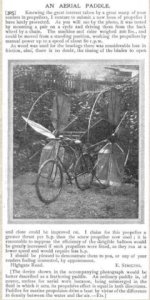
attachment.php
 

Attachments

  • propbike_1882.jpg
    propbike_1882.jpg
    27 KB · Views: 59
Last edited:
Status
Not open for further replies.

ISF - Join now!

Every member here is approved by hand. No bots, no spam, just people who care about evidence and honest debate.

Membership is free!

Create your free account

Back
Top Bottom