'Lost Civilisations'

I wonder how the Egyptians machined the stones in the pyramids at Giza, I spent hours looking at the remarkable precision of the workmanship.

I cannot understand how they could have done it. Even with the most cutting edge technology available now, it would be a monumental challenge.

.

No. Do some research.
 
This place is nothing, is not a bastion of research capability. IF someone somewhere had replicated a PP lego stone, and told someone about it online, the results would be here already.

no one is going to go to the bother of replicating something completely to prove a cutting method works, your request is unreasonable. The ancient egyptians were proficient at cutting granite with copper saws

have you replicated their feats
are you even interested in how they did it, because in this case the method has been replicated, with a copper saw a slot 3 centimeters deep and 95 centimeters long was cut in 14 hours, the copper saw blade was ground down 7.5 millimeters and was so degraded that it had to be discarded, which in ancient egypt meant that the metal would have been recycled which explains why theres no tools to be found.

they proved copper saws can carve granite, there was no need to then build a pyramid just to debunk a lost civilisation for the woos, no one cares what the woos think.

Granite is harder than Andesite
copper is softer than bronze
yet the advanced tool they used to achieve this was quartz sand used as a abrasive between the rock and the saw which rates a 7 on the mohs scale. (the same as diorite)
this information has been available for more than a decade
:rolleyes:
 
Last edited:
I wonder how the Egyptians machined the stones in the pyramids at Giza, I spent hours looking at the remarkable precision of the workmanship.

I cannot understand how they could have done it. Even with the most cutting edge technology available now, it would be a monumental challenge.

I can appreciate this as I am a professional craftsman and have to join and fit pieces of wood together to a perfect fit everyday.

http://watchdocumentary.com/watch/building-the-great-pyramid-video_aaf2e23f3.html
 
KotA said:
Because the results aren't HERE.
Which journal did you read this in? Who were the authors?

You may be 100% right, but you've given us ZERO evidence that you've bothered to even TRY to find out what's known in the field beyond watching the Discovery Channel. So to be blunt, you're too ignorant to say this.

This place is nothing, is not a bastion of research capability. IF someone somewhere had replicated a PP lego stone, and told someone about it online, the results would be here already.
If someone had done it in an archeological journal 50 years ago you'd never know--because you're too lazy or craven to look at the actual literature. Sorry, but those are the two explanations possible: you don't want to take the time to actually learn something about the field (in which case you've excused yourself from holding anything close to an informed opinion on the field), or you're afraid to as it may shatter a pet theory (in which case, again, you've excused yourself from holding anything close ot an informed opinion on the field). DO THE RESEARCH FIRST, and THEN form an opinion. You've got it backwards--you want to form an opnion, then do the research (or, rather, demand that WE do your research for you).
 
Appeal to Perfection fallacies aren't any more convincing than Arguments from Ignorance and Incredulity. This thread could be a logic class case study.
 
Thanks for the video, but I saw this the first time it was shown on the BBC.
It was remarkable in the extent that it ignored how the stones where actually fitted to each other perfectly.

Two cubes with the same dimensions will do that.
 
Thanks for the video, but I saw this the first time it was shown on the BBC.
It was remarkable in the extent that it ignored how the stones where actually fitted to each other perfectly.

Maybe that is because is it not a puzzle.
 
It was remarkable in the extent that it ignored how the stones where actually fitted to each other perfectly.

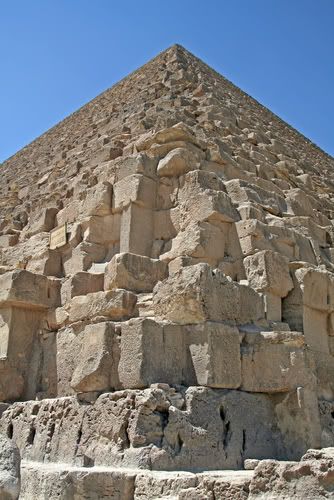
pyramids-of-giza-egy238.jpg
.
????
:p

Mark Lehner said:
A pyramid is basically, most basically, two separate constructions: it's an outer shell of very fine polished limestone with great accuracy in its joints, but most of that's missing; and the other construction is the inner core, which filled in this shell. Since most of the outer casing is missing what you see now is the step-like structure of the core. The core was made with a substantial slop factor, as my friend who is a mechanic likes to say about certain automobiles. That is, they didn't join the stones very accurately. You have great spaces between the stones. And you can actually see where the men were up there and they didn't, you know, they may have like four or five, even six inches between two stones. And so they'd jam down pebbles and cobbles and some broken stones, and slop big quantities of gypsum mortar in there.
http://www.pbs.org/wgbh/nova/pyramid/explore/howold2.html
;)
 
Last edited:
no one is going to go to the bother of replicating something completely to prove a cutting method works, your request is unreasonable. The ancient egyptians were proficient at cutting granite with copper saws

have you replicated their feats
are you even interested in how they did it, because in this case the method has been replicated, with a copper saw a slot 3 centimeters deep and 95 centimeters long was cut in 14 hours, the copper saw blade was ground down 7.5 millimeters and was so degraded that it had to be discarded, which in ancient egypt meant that the metal would have been recycled which explains why theres no tools to be found.

they proved copper saws can carve granite, there was no need to then build a pyramid just to debunk a lost civilisation for the woos, no one cares what the woos think.

Granite is harder than Andesite
copper is softer than bronze
yet the advanced tool they used to achieve this was quartz sand used as a abrasive between the rock and the saw which rates a 7 on the mohs scale. (the same as diorite)
this information has been available for more than a decade

:rolleyes:

I'll concede all that if you'll concede that you can NOT use this method to cut descending square holes...
 
Please explain why you believe that the same metal alloy, for which we have ample hard evidence -- in the form of architectural cramps and other artifacts -- at Puma Puncu and in other sites in the same region, could not or would not have been used to make cutting tools as well.

Notable features at Pumapunku are I-shaped architectural cramps, which are composed of a unique copper-arsenic-nickel bronze alloy. These I-shaped cramps were also used on a section of canal found at the base of the Akapana pyramid at Tiwanaku. These cramps were used to hold the blocks comprising the walls and bottom of stone-lined canals that drain sunken courts. I-cramps of unknown composition were used to hold together the massive slabs that formed Pumapunku's four large platforms. In the south canal of the Pumapunku, the I-shaped cramps were cast in place. In sharp contrast, the cramps used at the Akapana canal were fashioned by the cold hammering of copper-arsenic-nickel bronze ingots. The unique copper-arsenic-nickel bronze alloy is also found in metal artifacts within the region between Tiwanaku and San Pedro de Atacama during the late Middle Horizon around 600-900.

--summarized from: Protzen, Jean-Pierre; Stella Nair, 1997, Who Taught the Inca Stonemasons Their Skills? A Comparison of Tiahuanaco and Inca Cut-Stone Masonry: The Journal of the Society of Architectural Historians. vol. 56, no. 2, pp. 146-167
Robinson, Eugene (1990). In Bolivia, Great Excavations; Tiwanaku Digs Unearthing New History of the New World, The Washington Post. Dec 11, 1990: d.01.
Lechtman, H.N., 1998, Architectural cramps at Tiwanaku: copper-arsenic-nickel bronze. In Metallurgica Andina: In Honour of Hans-Gert Bachmann and Robert Maddin, Deutsches, edited by T. Rehren, A. Hauptmann, and J. D. Muhly, pp. 77-92. Bergbau-Museum, Bochum, Germany.
Lechtman, H.N., 1997, El bronce arsenical y el Horizonte Medio. En Arqueología, antropología e historia en los Andes. in Homenaje a María Rostworowski, edited by R. Varón and J. Flores, pp. 153-186. Instituto de Estudios Peruanos, Lima.
 
...

If someone had done it in an archeological journal 50 years ago you'd never know--because you're too lazy or craven to look at the actual literature. Sorry, but those are the two explanations possible: you don't want to take the time to actually learn something about the field (in which case you've excused yourself from holding anything close to an informed opinion on the field), or you're afraid to as it may shatter a pet theory (in which case, again, you've excused yourself from holding anything close ot an informed opinion on the field). DO THE RESEARCH FIRST, and THEN form an opinion. You've got it backwards--you want to form an opnion, then do the research (or, rather, demand that WE do your research for you).

I HAVE 'researched' carving hard stone. I did it myself, and this is the evidence I used to arrive at my conclusion.

'I' seem to be the ONLY one here seeking to actually test these period tools and what they were capable of.

But if you are too, please feel free to visit the Mythbusters forum and request their help, as I have.
 
KotA said:
I'll concede all that if you'll concede that you can NOT use this method to cut descending square holes...
I've already explained to you how easy it is to turn a small hole into a big one. Use a smaller saw and longer strokes and you can make a square hole. You obviously do not want to listen to anyone's ideas, and prefer to assert in the absance of, and in contradiction of, the evidence that something is impossible.

I'll concede all that if you'll concede that you can NOT use this method to cut descending square holes...
And you admitted that you are an ameture. You cannot assume that experts with generations' worth of experience will bumble around like an ameture.

'I' seem to be the ONLY one here seeking to actually test these period tools and what they were capable of.
Because only you assume that some advanced civilization, which left no complex equipment in evidence, built the stones. The rest of us assume, in the absence of evidence to the contrary (REAL evidence, not the bungling of an ameture), that they simply did something we haven't thought of yet.

But if you are too, please feel free to visit the Mythbusters forum and request their help, as I have.
Your only sources are network television programs. I asked for academic journals. I can assume, therefore, that you haven't bothered to do any real research?
 
Last edited:
I'll concede all that if you'll concede that you can NOT use this method to cut descending square holes...

I'll concede that you are incapable of learning anything new
have you tried cutting andesite with a copper saw and quartz sand ?
if not, all your claims at "knowledge" are worthless
 
dafydd said:
He comes at things the wrong way,he makes his mind up then goes searching for slivers of 'evidence' that bolster his peculiar theories,and ignores the rest.
A disturbingly common trend, it seems....
 
I was going to point this out to punshhh,but why bother? He comes at things the wrong way,he makes his mind up then goes searching for slivers of 'evidence' that bolster his peculiar theories,and ignores the rest.

Your gibbering again, I am aware of how the pyramid was constructed. You can see it with your own eyes.

My question is how the Egyptians were able to cut stones weighing up to 40 tons to fit together to a very high tolerance of accuracy. Especially when many of the joints are not straight, some even have corners.

I am refering specifically to the large foundation stones around the base and forming the chambers inside the pyramids.

I can't see how this could be done today, even with lasers.
 
You can see it with your own eyes.
not unless you have them shut, if you actually had them open you'd see this
pyramids-of-giza-egy238.jpg

My question is how the Egyptians were able to cut stones weighing up to 40 tons to fit together to a very high tolerance of accuracy.
I am refering specifically to the large foundation stones around the base and forming the chambers inside the pyramids.
well they didn't, heres a pyramid experts opinion
A pyramid is basically, most basically, two separate constructions: it's an outer shell of very fine polished limestone with great accuracy in its joints, but most of that's missing; and the other construction is the inner core, which filled in this shell. Since most of the outer casing is missing what you see now is the step-like structure of the core. The core was made with a substantial slop factor, as my friend who is a mechanic likes to say about certain automobiles. That is, they didn't join the stones very accurately. You have great spaces between the stones. And you can actually see where the men were up there and they didn't, you know, they may have like four or five, even six inches between two stones. And so they'd jam down pebbles and cobbles and some broken stones, and slop big quantities of gypsum mortar in there.

The pyramid was constructed of cut and dressed blocks of limestone, basalt, or granite. The core was made mainly of rough blocks of low-quality limestone taken from a quarry at the south of Khufu’s Great Pyramid. These blocks weighed from two to four tons on average, with the heaviest used at the base of the pyramid
youve been reading woo and believing it, perhaps you should do a little more research, this time from credible sources !
might also help if you made an effort to understand the information already posted to you
;)
 

Back
Top Bottom