Merged Continuation - 9/11 CT subforum General Discussion Thread

Status
Not open for further replies.
What is the state of play?
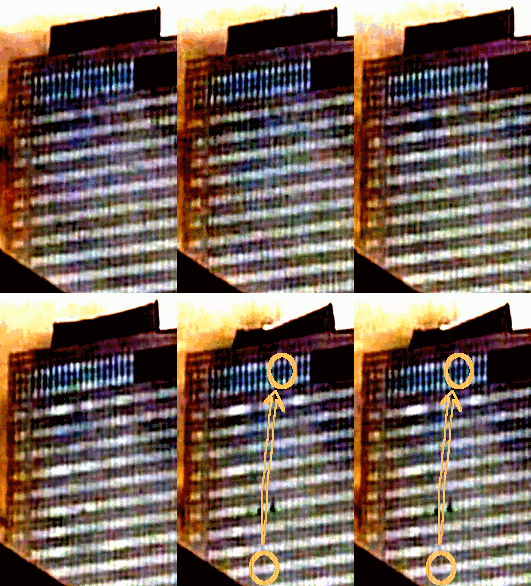
The facade of WTC7 was subject to flexure as the collapse started.
Sunlight reflecting seems to have made detection of the flexure easier.
Flexure is expected in a collapsing building.
Fine so far.

The flexure could indicate that forces were applied to the facade near column 79
That finding supports NIST
AND it is additional evidence to what we had access to previously.
Here I think you're over-interpreting. There appears to be no more video evidence for forces being applied near column 79 than near any other column.

Everyone seems to agree that the shinier patch is shinier because of reflection. If so, then the less shiny patches are likely to be less shiny because of lack of reflection. If you think about the physics of reflection, you'll realize that there's no more reason to focus upon the shinier patches than upon the less shiny patches. So far as I can tell, the attention being given to the shinier patches comes from our species' well-documented fascination with shiny things.

Please note that I am not arguing against NIST's conclusions. I am simply pointing out that no one has yet presented a compelling argument for NIST's conclusions from the shinier patches in these videos.
 
Fine so far.


Here I think you're over-interpreting. There appears to be no more video evidence for forces being applied near column 79 than near any other column...
"could" was a conditional the last time I checked...:)

Everyone seems to agree that the shinier patch is shinier because of reflection. If so, then the less shiny patches are likely to be less shiny because of lack of reflection. If you think about the physics of reflection, you'll realize that there's no more reason to focus upon the shinier patches than upon the less shiny patches. So far as I can tell, the attention being given to the shinier patches comes from our species' well-documented fascination with shiny things....
but separate static reflectivity from moving patterns of same...;)

Please note that I am not arguing against NIST's conclusions. I am simply pointing out that no one has yet presented a compelling argument for NIST's conclusions from the shinier patches in these videos.
Agreed. what we have is potentially more evidence which could (??) support NIST because it seems that it could indicate something near col79. Then again it may not do so at all. Has that got the bases covered? :D
 
femr2, nothing you have said changes my analysis.

The video image is severely degraded from 2001-era broadcast quality. I cannot tell where, in what stage, by you or someone else, the degradation happened. There's nothing wrong with storing the final file as AVI, as it doesn't further degrade it, but it's probably overkill by this time. I have no objection to this part of your process.

Maybe I missed the reason, in 117 pages, of why you would place the interlaced frames side by side. But doing so only degraded the image further, as the best it could be originally (if transferred from broadcast to DVD) would be 720x480. If it came from a bad VHS, probably less. Separating full frames into interlaced frames means the resulting resolution is 320x480 at the very best, so you have cut the vertical detail by half.

And nothing you say changes the fact that the clips are riddled with compression and processing artifacts. Even if they aren't your fault, even if you took the utmost care in every step, they are glaringly obvious.

So you have taken a clip which, by the time it got to you, was probably not equal to broadcast quality, altered it to reduce the resolution by half, and possibly added other artifacts as well. Or maybe you didn't, but the end result is poor no matter who we can blame for it.

To sum up, any conclusions you draw from the final video must be tempered with the knowledge that what you see may not be an accurate record of what happened.
 
As I've said, the last thing I shall do in any of these arenas (by definition) is to add a full-stop to opinion of the *big picture*.

However, I think it's fairly clear that someone providing visual cue evidence (imo) of WTC 7 facade behaviour supporting the NIST hypothesis, and unique early motion trace data with the suggestion that it nullifies MIHOP theories which rely upon *boom* followed by immediate collapse...is certainly not here for *kicks*, nor promotion of *woo*, nor deceit, nor...

I do what I do to clarify, or confirm, or refute details of interest. Simple as that really. If folk want to make silly accusations ad infinitum, or demands I've already given my answer to (whether they like the answer or not), meh.
Ah yes......Back to the boom. :D

Well, we don't want to go there, do we?
 
femr2, nothing you have said changes my analysis.
Who is trying to change your *analysis* ? What is of import is that your conclusions are irrelevant, as the behaviour being highlighted is not caused by video *error*.

There's nothing wrong with storing the final file as AVI, as it doesn't further degrade it, but it's probably overkill by this time.
A statement revealing a non-trivial lack of knowledge. *AVI files* can contain video data in almost unlimited number of different encoding methods from lossless raw RGB data, to data with incredibly lossy high compression.

The final file is stored in H264 format with minimal possible compression factor applied, within an AVI container. Whilst the extreme low compression and large file size could be described as overkill, the intention is, as has been stated, to ensure that I add the absolute minimum of artefacting to the video data, which at all other times I house in lossless formats. Thus I can state to folk such as yourself, with full confidence...I'm not adding any significant noise to the data in the slightest. Does my processing bring out noise that was already there ? Sure, but I didn't cause it ;)

As that is my focus, it is far more important to retain such a low negative effect upon data integrity than concerns about file size. Disk space is cheap. My Sauret clip frame data is about 10GB for a minutes worth ;)

Maybe I missed the reason, in 117 pages, of why you would place the interlaced frames side by side. But doing so only degraded the image further
Another indication of non-trivial issues with your knowledge of video data. Interlaced video frames contain two entirely separate images from two distinct points in time. They should be separated for this kind of analysis.

as the best it could be originally (if transferred from broadcast to DVD) would be 720x480.
Correct ! :)

Separating full frames into interlaced frames
And yet more indication of knowledge problems...

You don't separate *full frames* into *interlaced frames*, it's the other way around. An interlaced frame is separated into its constituent 2 separate fields. (You can call each of the images resulting from each field a frame at a later date if you like, but probably best if I dig you out the several week-long horrifically boring discussion on that point separately)

means the resulting resolution is 320x480 at the very best
No, 720x240.

so you have cut the vertical detail by half.
Vertical image size, yes, but the detail you mean was not really there to begin with. You don't seem to clear at all on interlaced video data implications I'm afraid.

And nothing you say changes the fact that the clips are riddled with compression and processing artifacts.
And nothing you can say will make any amount of compresion artefact result in the facade behaviour being discussed.

Even if they aren't your fault, even if you took the utmost care in every step, they are glaringly obvious.
The video data is noisy. The behaviours being discussed are not data error of any kind. Your point is therefore irrelevant.
 
I know the method that femr2 is using.

SCHOPENHAUER'S 38 STRATAGEMS, OR 38 WAYS TO WIN AN ARGUMENT


1.
Carry your opponent's proposition beyond its natural limits; exaggerate it. The more general your opponent's statement becomes, the more objections you can find against it. The more restricted and narrow his or her propositions remain, the easier they are to defend by him or her.
2.
Use different meanings of your opponent's words to refute his or her argument.
3.
Ignore your opponent's proposition, which was intended to refer to a particular thing. Rather, understand it in some quite different sense, and then refute it. Attack something different than that which was asserted.
4.
Hide your conclusion from your opponent till the end. Mingle your premises here and there in your talk. Get your opponent to agree to them in no definite order. By this circuitious route you conceal your game until you have obtained all the admissions that are necessary to reach your goal.
5.
Use your opponent's beliefs against him. If the opponent refuses to accept your premises, use his own premises to your advantage.
6.
Another plan is to confuse the issue by changing your opponent's words or what he or she seeks to prove.
7.
State your proposition and show the truth of it by asking the opponent many questions. By asking many wide-reaching questions at once, you may hide what you want to get admitted. Then you quickly propound the argument resulting from the opponent's admissions.
8.
Make your opponent angry. An angry person is less capable of using judgement or perceiving where his or her advantage lies.
9.
Use your opponent's answers to your questions to reach different or even opposite conclusions.
10.
If your opponent answers all your questions negatively and refuses to grant any points, ask him or her to concede the opposite of your premises. This may confuse the opponent as to which point you actually seek them to concede.
11.
If the opponent grants you the truth of some of your premises, refrain from asking him or her to agree to your conclusion. Later, introduce your conclusion as a settled and admitted fact. Your opponent may come to believe that your conclusion was admitted.
12.
If the argument turns upon general ideas with no particular names, you must use language or a metaphor that is favorable in your proposition.
13.
To make your opponent accept a proposition, you must give him or her an opposite, counter-proposition as well. If the contrast is glaring, the opponent will accept your proposition to avoid being paradoxical.
14.
Try to bluff your opponent. If he or she has answered several of your questions without the answers turning out in favor of your conclusion, advance your conclusion triumphantly, even if it does not follow. If your opponent is shy or stupid, and you yourself possess a great deal of impudence and a good voice, the trick may easily succeed.
15.
If you wish to advance a proposition that is difficult to prove, put it aside for the moment. Instead, submit for your opponent's acceptance or rejection some true poposition, as thoug you wished to draw your proof from it. Should the opponent reject it because he or she suspects a trick, you can obtain your triumph by showing how absurd the opponent is to reject a true proposition. Should the opponent accept it, you now have reason on your own for the moment. You can either try to prove your original proposition or maintain that your original proposition is proved by what the opponent accepted. For this, an extreme degree of impudence is required.
16.
When your opponent puts forth a proposition, find it inconsistent with his or her other statements, beliefs, actions, or lack of action.
17.
If your opponent presses you with a counter proof, you will often be able to save yourself by advancing some subtle distinction. Try to find a second meaning or an ambiguous sense for your opponent's idea.
18.
If your opponent has taken up a line of argument that will end in your defeat, you must not allow him or her to carry it to its conclusion. Interrupt the dispute, break it off altogether, or lead the opponent to a different subject.
19.
Should your opponent expressly challenge you to produce any objection to some definite point in his or her argument, and you have nothing much to say, try to make the argument less specific.
20.
If your opponent has admitted to all or most of your premises, do not ask him or her directly to accept your conclusion. Rather draw the conclusion yourself as if it too had been admitted.
21.
When your opponent uses an argument that is superficial, refute it by setting forth its superficial character. But it is better to meet the opponent with a counter argument that is just as superficial, and so dispose of him or her. For it is with victory that your are concerned, and not with truth.
22.
If your opponent asks you to admit something from which the point in dispute will immediately follow, you must refuse to do so, declaring that it begs the question.
23.
Contradiction and contention irritate a person into exaggerating his or her statements. By contractiong your opponent you may drive him or her into extending the statement beyond its natural limit. When you then contradict the exaggerated form of it, you look as though you had refuted the orginal statement your opponent tries to extend your own statement further than you intended, redefine your statement's limits.
24.
This trick consists in stating a false syllogism. Your opponent makes a proposition and by false inference and distortion of his or her ideas you force from the proposition other propositions that are not intended and that appear absurd. It then appears the opponent's proposition gave rise to these inconsistencies, and so appears to be indirectly refuted.
25.
If your opponent is making a generalization, find an instance to the contrary. Only one valid contradiciton is needed to overthrow the opponent's proposition.
26.
A brilliant move is to turn the tables and use your opponent's arguments against him or herself.
27.
Should your opponent surprise you by becoming particularly angry at an argument, you must urge it with all the more zeal. Not only will this make the opponent angry, it may be presumed that you put your finger on the weak side of his or her case, and that the opponent is more open to attack on this point than you expected.
28.
This trick is chiefly practicable in a dispute if there is an audience who is not an expert on the subject. You make an invalid objection to your opponent who seems to be defeated in the eyes of the audience. This strategy is particularly effective if your objection makes the opponent look ridiculous or if the audience laughs. If the opponent must make a long, complicated explanation to correct you, the audience will not be disposed to listen.
29.
If you find that you are being beaten, you can create a diversion that is, you can suddenly begin to talk of something else, as though it had bearing on the matter in dispose. This may be done without presumption if the diversion has some general bearing on the matter.
30.
Make an appeal to authority rather than reason. If your opponent respects an authority or an expert, quote that authority to further your case. If needed, quote what the authority said in some other sense or circumstance. Authorities that your opponent fails to understand are those which he or she generally admires the most. You may also, should it be necessary, not only twist your authorities, but actually falsify them, or quote something that you have invented entirely yourself.
31.
If you know that you have no reply to an argument that your opponent advances, you may, by a fine stroke of irony, declare yourself to be an incompetent judge.
32.
A quick way of getting rid of an opponent's assertion, or throwing suspicion on it, is by putting it into some odious category.
33.
You admit your opponent's premises but deny the conclusion.
34.
When you state a question or an argument, and your opponent gives you no direct answer, or evades it with a counter question, or tries to change the subject, it is a sure sign you have touched a weak spot, sometimes without knowing it. You have as it were, reduced the opponent to silence. You must, therefore, urge the point all the more, and not let your opponent evade it, even when you do not know where the weakness that you have hit upon really lies.
35.
This trick makes all unnecessary if it works. Instead of working on an opponent's intellect, work on his or her motive. If you succeed in making your opponent's opinion, should it prove true, seem distinctly to his or her own interest, the opponenent will drop it like a hot potato.
36.
You may also puzzle and bewilder your opponent by mere bombast. If the opponent is weak or does not wish to appear as ife he or she has no idea what you are talking about, you can easily impose upon him or her some argument that sounds very deep or learned, or that sounds indisputable.
37.
Should your opponent be in the right but, luckily for you, choose a faulty proof, you can easily refute it and then claim that you have refuted the whole position. This is the way which bad advocates lose a good case. If no accurate proof occurs to the opponent or the bystanders, you have won the day.
38.
A last trick is to become personal, insulting and rude as soon as you perceive that your opponent has the upper hand. In becoming personal you leave the subject altogether, and turn your attack on the person by remarks of an offensive and spiteful character. This is a very popular trick, because everyone is able to carry it into effect.

 
Question: What impact does all this research have on the findings of the NIST? Can someone please state the impact that these details have on those findings?

Question 2: Do any of these findings have implications on human life and the building codes?

I think the question is pretty straight forward, Instead of nitpicking, categorize the findings and let's see what we get from it.
Seriously, why would something with potentially that kind of impact be reclused because the people finding them were only doing this for personal interest?
 
Last edited:
Agreed. what we have is potentially more evidence which could (??) support NIST because it seems that it could indicate something near col79. Then again it may not do so at all. Has that got the bases covered? :D
I don't think I have much of a problem, knowing more or less where femr's coming from. What I have a problem with is that if adding to those details reveals legitimate problems where the hell does anyone go without knowing about them? Pointing out that NIST's research may have serious errors doesn't require one to support the batpoo crazy controlled demolition camp, but at the same time inaction or lack of direction seems to be an equally serious problem.
 
I don't think I have much of a problem, knowing more or less where femr's coming from. What I have a problem with is that if adding to those details reveals legitimate problems where the hell does anyone go without knowing about them? Pointing out that NIST's research may have serious errors doesn't require one to support the batpoo crazy controlled demolition camp, but at the same time inaction or lack of direction seems to be an equally serious problem.
Too many people reading what they wish femr2 had said so they can "nail him" rather than what he does say. Ditto bringing in other alleged historic femr2 claims which are not under current discussion.

I tend to read like a lawyer what is actually being said and not adding my own inferences which are not there.

The current topic does not detract from NIST and potentially closes the door on some aspects of truther false claims. Similarly femr2's other work on the tower initiation seems to reinforce the official position that there was no boom explosion to initiate collapses.

So the only "problem" I see is in who is saying it. That is no problem to me - the facts should stand or fall independent of the speaker IMNSHO. ;)
 
Last edited:
Ditto bringing in other historic femr2 claims which are not under current discussion.

I tend to read like a lawyer
Just for the record, many of the things I've been accused of doing/claiming are fictional entities born in the minds of those ranting about them.

and femr2 is potentially shutting two of the wider gates
I shall of course continue to clarify/confirm/refute points of interest (to me at least) regardless of which, er, camp may object, both of whom are likely to do so at various times.
 
Last edited:
Just for the record, many of the things I've been accused of doing/claiming are fictional entities born in the minds of those ranting about them...
Sorry - that was the scope of what I intended - I've corrected the wrong inference in my post.
...I shall of course continue to clarify/confirm/refute points of interest (to me at least) regardless of which, er, camp may object, both of whom are likely to do so at various times.
when its trench warfare it can get a bit lonely out in no-mans land. :rolleyes:
 
..and femr2 is potentially shutting two of the wider gates against truther entry.

Or, in this case, the better more acceptable analogy could be putting an extra lock on the gate. :rolleyes:
And leaving the world to wonder why he used so many words (and images) to do so.......


;)
 
And leaving the world to wonder why he used so many words (and images) to do so.......


;)

A lot of those words are in the responding to the technical attacks on his techniques.
Which requires awkward tactical decisions. Do you respond to the derails? Damned if you do and double damned if you don't.

Count the words criticising and responding to the graphics imagery claims in the last couple of days. Not one of those criticising his imagery has said the building didn't flex so all that is sideline stuff. Ditto the other couple of red herring issues. And little progress on the central theme whilst we wait for the noise to abate.
 
Personally, I had a really hard time trying to see what femr was trying to point out in the animated GIF, for quite a while. I finally did see it today, so I knocked together an edited version of his sequence to roughly approximate what to look for, for those (like me) who have a hard time reading tealeaves. Just to help make sure we're at least on the same page FWIW. And I have 15 posts now, so I can.

bloop2-3.gif
There's slightly more complex behaviour there if you watch until your eyes bleed, but yes, that's the basic detail. Thanks. I may produce an animation with overlays during the clip to help highlight the behaviour further.
 
A lot of those words are in the responding to the technical attacks on his techniques.
Which requires awkward tactical decisions. Do you respond to the derails? Damned if you do and double damned if you don't.

Count the words criticising and responding to the graphics imagery claims in the last couple of days. Not one of those criticising his imagery has said the building didn't flex so all that is sideline stuff. Ditto the other couple of red herring issues. And little progress on the central theme whilst we wait for the noise to abate.

And the conclusion is .................lots and lots and lots of techy stuff, a bit of noise and..............wow, back to a terrorist attack that caused the building collapse due to unfaught fires resulting from being struck by parts of another building. :rolleyes: Cool. lol.

Did I read that femr2 confirmed that? lol. ahhhhhhh the booms are a coming. lol.
 
Weird....


No need to call me "Engineer" and use the term as some kind of a derogatory or snide comment.....this discussion has strayed far from the actual topic and I'm content to let you have the last word, because now it's boring and you seem to be getting upset or something by the conversation.

The last word is yours....you can even claim you "won" the exchange if you want to ;)

:)

Hmmmmmmm. Not at all. Again, you presume too much. Many Engineers here. Some don't feel the need to harp on about it. Some would rather use it at work where it matters, rather than using it to form a known conclusion whilst 'serious' debating on a public forum to convince the 'lurkers and fence sitters'.:rolleyes: lol. Not my style. Perhaps you need to chill abit. Relax. See the funny side now and again. Pitching for a clear and unambiguous response was all I was after. Too easy for femr2 to come to the point. Too accustomed to femr2's methodology and techniques having seen the same when discussing 'pods' and 'squibs', regardless of his earlier statement that he didn't. lol. Rather time consuming having to go through reams and reams of the same dont ya think? Got far better things to do. As to claiming who 'won'! Is that what it's all about? Did I really give you that impression? Ah well, perhaps another thread with more techy stuff and noise with the same conclusion awaits. lol.
 
and there is no scientific data to back up the sulfur from drywall is BS. Drywall would not be used for fireproofing if it were possible for the sulfur in the gypsum molecule to be released in a fire.


There's a huge difference between gypsum boards from a building in perfect working, and pulverized gypsum from a collapsed building.
 
There's a huge difference between gypsum boards from a building in perfect working, and pulverized gypsum from a collapsed building.

Not to mention wallboard that had been heated beyond it's fire rating and has lost all it's water. I've covered this before:
Gypsum wallboard is made up of hydrated calcium sulfate (CaSO4 in a crystal with water molecules). And oddly enough because of that, drywall has fire resistant properties due to this bound water; in the event of a fire, the water in the drywall will vaporize and retard heat transfer beyond the drywall. But the problem is, once that water runs out, then what you get is a whole lot of calcium sulfate powder. And burning that can lead to sulfur dioxide, which is a known corrosive agent for steel.
And I think others have pointed it out too; in fact, I think that it was Ryan Mackey who first noted that this was the end result of wallboard being exposed to fires beyond its fire rating (either via excessive temperature or time). Anyway, the point is that drywall's failure mode is known from its chemical/physical properties alone. Arguing against that is either arguing that the rubble pile fires didn't last long enough (and there's Dave Rogers Unevaluated Inequality Fallacy again), or that drywall doesn't have the chemical/physical properties ascribed to it. Either way, arguing against drywall is arguing against either known and undisputed facts regarding the fires, or arguing against physics and chemistry.
 
femr2, I have no complaint about your use of AVI to store data, so there's no point in harping on that any more. However:
I'm not adding any significant noise to the data in the slightest. Does my processing bring out noise that was already there ? Sure, but I didn't cause it.
Actually, yes, it did, and you did. It appears that your "color enhancement" accentuated the color noise. You have enhanced the artifacts, then you are pointing to what you see as evidence of...I'm not sure what, but this is fictitious data. You have made false data more noticeable, then used it to prove your point.
Interlaced video frames contain two entirely separate images from two distinct points in time. They should be separated for this kind of analysis.
I fail to see why you want to separate them. As far as the "points in time," this may or may not be true. It depends on how the original was recorded. If it was recorded as progressive, then the two fields are from exactly the same time. If it was recorded as interlaced, the fields MAY be from as much as 1/60 of a second different in time, or maybe not, depending on how the camera handled the interlace task. Either way, I don't see why it makes any difference.

You don't separate *full frames* into *interlaced frames*, it's the other way around. An interlaced frame is separated into its constituent 2 separate fields. (You can call each of the images resulting from each field a frame at a later date if you like, but probably best if I dig you out the several week-long horrifically boring discussion on that point separately)
YOU have separated full frames into their component fields 1 & 2. Then you put them side by side and created a new file, right?
No, 720x240.
You are correct, and I stand corrected. I divided the wrong number.
... the detail you mean was not really there to begin with. You don't seem to clear at all on interlaced video data implications I'm afraid.
:rolleyes:
 
Status
Not open for further replies.

Back
Top Bottom