What creates the initial downwind motion?
The sail effect, or the prop drag effect?
We all tried to explain it to you when you first showed up, but you weren't interested.

What creates the initial downwind motion?
The sail effect, or the prop drag effect?

.We all tried to explain it to you when you first showed up, but you weren't interested.
Yep; no warranty so I had to fix it myself.You contacted Spork when the magic cart did not work. You posted that you did that.
Oops; fail.so you contacted Spork, who told you how to tinker until it slides,
That's because you seem to think that the prop is acting as a wind turbine below windspeed. It isn't..I'd kinda expect the cart to get to wind speed and no faster.
That it goes faster is obvious.
Why it should.. that ain't so obvious.
Not even close. You are making the same mistake as those who said the plane could not take off from the belt. Seeing the belt move, and then thinking that the plane must "advance up the belt" to take off. No, it's only about force. Wheels provide low rolling force, so little retarding force upon the plane. The TM contains that same former folksy notion, but hilariously, Spork did not see that.Extensive "wind tunnel" tests have already been performed using a treadmill, which exactly simulates the situation where an object is traveling downwind at the speed of the wind.
And you are here to give nothing but your unsupported opinion.But nothing will solve Humber's objections. Humber is a troll and is only here to incite people's reactions.
Yep; no warranty so I had to fix it myself.
Oops; fail.
The problem was that the wheels were sliding; his suggestion was to increase traction by using rubber bands on the plastic wheels. I used the rubber-tired wheels that I requested instead with the same result; with sufficient traction, the cart works.
Traction = cart works; sliding = cart fails.
But you knew that.
Try again, but this time, use the facts, don't revise them.
I have to go, but think of the prop blade as a wing.
.
I know that.
But others (see image) say that is either "No", "Wrong" or "Lie".. your choice.
.When the cart is stopped, the wing is stalled and the angle of attack is almost perpendicular. As the cart moves, ...
What moves the cart?
The wing as sail, or something else?
.
.the wing cuts across the air, which changes the angle of attack towards a more normal range. The faster the cart goes, the faster the wing cuts across the air, reducing the angle of attack as a result of the relative motion.
At some point, if the cart were being towed,
Cart is not being towed, its motion is due to...????
.
.the relative motion of the rotating prop would reduce that angle of attack to zero. The speed that happens at is dependent on a few things, but for a DDW cart, that speed is well above the speed of the wind.
I've noted the speed/prop rpm relation, as applies to airplanes..
Props can be rotated by the incoming airstream along, when that can overcome the internal resistance of the motor.
Depending on the pitch of the prop, that rotational rpm can be slow or fast.
And can limit the forward of the airplane, with the rotating drag the prop develops balancing what thrust there may be from other operating motors, or just the flight path; mentioned diving to get a prop to re-windmill after stopping rotation in flight.
The airspeed/rpm relation is easily calculated. Advance distance of the prop at any pitch angle v airspeed.
Something... adding power to the prop, or diving can get the aircraft faster.

What creates the initial downwind motion?
The sail effect, or the prop drag effect?
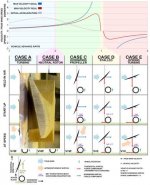
The initial acceleration, due to a net downwind force on the cart.What creates the initial downwind motion?

.The initial acceleration, due to a net downwind force on the cart.
See CASE C, START UP
The initial acceleration, due to a net downwind force on the cart.
See CASE C, START UP
[qimg]http://i54.tinypic.com/2gv0kew.png[/qimg]
It does.The propellor in C does not reflect the propellor on the carts.
.
I asked for apples, not oranges.
.
The propellor in C does not reflect the propellor on the carts.
.It does.
.
Does not.
This is so convoluted as to come close to qualifying as "not even wrong", but, the basic idea of the treadmill is to use a treadmill belt moving relative to still air in place of air moving relative to ground. The cart requires relative motion between the surface the wheels run on and the air, i.e. wind. Now, the treadmill test of the cart does bear a superficial similarity to the plane on a treadmill, in that both involve wheels, a propeller (unless the plane is a jet, of course) and a treadmill, but there are some important differences: In the plane, the propeller is driven by an engine and the wheels are free. In the cart, the propeller and wheels are geared together, so if the wheels turn, so does the propeller, and vice versa of course. Oh yes, and the cart has no wings, so, unlike the plane, it ain't never gonna take off. So, when the cart is stationary relative to the room, it is equivalent to a cart in the "real wind" moving at exactly wind speed. You can transform the frame of reference that easily, or not, it just doesn't matter. Choose the frame of reference that makes the most sense to you, but don't make humber's mistake of mixing them up. You'll get just as confused as humber, and you certainly don't want that to happen.Not even close. You are making the same mistake as those who said the plane could not take off from the belt. Seeing the belt move, and then thinking that the plane must "advance up the belt" to take off. No, it's only about force. Wheels provide low rolling force, so little retarding force upon the plane. The TM contains that same former folksy notion, but hilariously, Spork did not see that.
Pure speculation here: I think possibly, at some point in his life, humber lost a whole lot of money to a shell game or a three card monte game, and forever after, whenever he sees a lot of motion and doesn't quite understand what's going on, he thinks he's being scammed.It's a simple parlor trick, where knaves are fooled, because they don't see the difference between angular and linear kinetic energy.
Here humber invokes something impossible to explain away the clearly possible ddwfttw cart. For "none to go into the chassis", the wheel must spin on it's bearing with zero friction. In the real world, of course, the cart, if it has no propeller, won't take very long to start moving with the belt.The wheel turns and stores the energy from the belt, and none goes into the chassis.
So, is it A. A whole lot spurious. B. Just kinda spurious, or, C. Depends on your frame of reference?When at "windspeed" the cart is not moving, but staying in place while the wheels drive the angular components. The forwards motion is more or less spurious.
Okay, here's the real story. In some of the treadmill tests, the treadmill was inclined, to prove that the cart could generate excess power at wind speed, and therefore should be capable accelerating beyond windspeed. Also, on a level belt, the silly things just kept moving right off the end of the belt (the "upstream" end), or the tester had to keep pushing it backwards to keep it from doing so. Humber, ever the contrarian, earlier called this "an embarrassing failure". But, he also calls the successful downwind cart a "failed upwind cart" so it appears that he's also a bit confused about success and failure.When the TM is angled, the normal force of gravity moves to the rear of the axle, so the cart moves better than when level, and is more stable. That angle is always there. Constant "proof" or necessary?
Yep, humber's not the only one who doesn't get relative motion or frames of reference.It's a variation on this:
[qimg]http://www.internationalskeptics.com/forums/attachment.php?attachmentid=21740&stc=1&d=1302378211[/qimg]
Translation: humber has no freakin' clue what he's talking about. Besides, if he went into detail, he'd make a whole lot of dumb mistakes, and everybody would start making fun of him again. Worse than usual, I mean.Stability is the major problem. Make the friction low, and feedback from the prop will stabilise the cart. The precise mechanism, and how it is regulated, is more complex than a stick, so best not expounded.
Here's humber trying to convince everybody he's an expert. If only he didn't keep saying really dumb stuff, somebody might believe it.However, even the layman
What was your first clue, Sherlock?should be able to see that the belt can not drive the wheel in the way an axle does.
Oh yes, I remember from the thread a few years ago: Humber has some truly bizarre notions about how wheels work. He thinks that the wheel has to distort enough to make a bump that gets behind it and pushes it. I'm not making this up, folks. Now, of course, the wheel does deform, quite a bit if it's a pneumatic tire, almost none, if it's a steel railroad wheel, when it's driving or being driven, but the distortion is a side effect not necessary for the wheel to work.To apply force from the axle, the wheel or tyre must distort even if only a little. Like this:
[qimg]http://www.internationalskeptics.com/forums/attachment.php?attachmentid=21741&stc=1&d=1302378818[/qimg]
There is no means by which the tyre can impress the frontal compression on the wheel,
Humber get's really confused about the difference between traction and rolling resistance. It's that relative motion thing again. I have no idea what humber means by "point-contact spinning", and neither does humber.so it takes up point-contact spinning with the minimum contact patch, resulting in the lowest possible drag from the belt.
Of course, with a longer belt, pretty soon the cart would be traveling exactly as fast as the belt. It's exactly the same as if you push it on a flat surface: It will roll for a bit, slowing down until it stops, but from a different frame of reference. But anybody but humber can figure that out.Even without the prop, the cart does not race down the belt, but is slowly dragged. The belt will have traveled much further than the cart.
And here all my life, I've been using fans to move air around, and now I find out that their real purpose is to produce static thrust. I guess I've been doing it wrong. It's this kind of howler that makes it worth feeding this troll. He's much more entertaining than your run of the mill troll. I'd ask how static thrust is different from regular thrust, but it all comes down to humber not understanding relative motion or frames of reference again.http://img130.imageshack.us/img130/5302/smnq.mp4
By exploiting angular momentum, the cart can readily gain the necessary thrust. A 5", 4-blade fan, does much better than the prop, because fans are designed to produce static thrust, whereas propellers are not.
And you are here to give nothing but your unsupported opinion.