• Security incident: ISF was recently accessed by intruders. Please change your password, and change it anywhere else you used it. Read more

Merged DDWFTTW in a “Real” Wind

Status
Not open for further replies.
..
Has nothing to do with my statement about freewheeling prop carts.So if his experiments are about benchmarking tacking speed of a geared vs non-geared prop cart, they are not relevant to the BB result, nor indeed the TM cart, since neither of these carts have a dirty-great triangular sail area supporting the propellor - as I Ratant's carts do.

...
.
The reason for that. Aesthetics and communciations with R. Hood, from Sherwood Forest, who opined that arrows need the feathers at the back, with the back in this case being the pointy end of these carts.(My aero prof mentioned the same thing.:) )
With the pointy end facing into the wind, the things want to swap ends before moving.
That stabilizing area can be removed with a quick slice... Done.
 
Can I ask you, I Ratant, to compare a two geared carts. One with the prop as normal, and the other set at 45 degrees as you did with the "tacking" props?
.
You may ask, but I won't do that until I can get the aligned thrust cart to move at all, and probably not even after that.
I observed on your reduced data the wind offsets weren't as large as the prop offsets I was using, and which gave me no deviations in the path the cart moved, so I tend to discount the effect of those wind effects on that cart on that day.
The larger offsets may have some effect, but only the freewheeling propellor cart is capable of moving right now in the winds I have access to.
 
Yes, but why did you want to do it? What are you trying to achieve, test, or demonstrate?
.
Why not?
Is there a license I should have requested?
I do (and most of us also) do things for amusement which have no practical or useable end use, but fill in the time, and are intellectually stimulating.
 
...

If not - he is not benchmarking a BB-style cart and the results are not comparable.

If, indeed, benchmarking was his aim - I'll wait for I Ratant to reply with on-topic responses to my questions rather than obfuscations from you.Well, your responses to my post are not, but my questions to I Ratant are.
...
.
No benchmarking implied. :)
I started with the bare minimum, to build up to the end test.
Cart with no prop. No motion.
Cart with fixed prop. Motion. Conclusion. The prop is acting as a sail.
Cart with freewheeling prop. More motion. Conclusion. The rotating prop is still a sail.
Cart with prop connected to wheels. No motion of any consequence. Conclusions... Friction in the drive train needs work. And the wind gradient is a bummer.
 
.
Why not?
Is there a license I should have requested?
I do (and most of us also) do things for amusement which have no practical or useable end use, but fill in the time, and are intellectually stimulating.

Yes, so do I. But you still haven't answered my question. What is the point of the tests you're doing? Are you hoping to prove or disprove a hypothesis about the ddwfttw cart? Or is it something else?
 
Yes, so do I. But you still haven't answered my question. What is the point of the tests you're doing? Are you hoping to prove or disprove a hypothesis about the ddwfttw cart? Or is it something else?
.
The point?
Keeps me out of the bars and the chance meetings with loose women?
It's too windy/cold/hot uncomfortable outside?
I'm bored?
I have lots of time to do nothing and entertain myself?
 
.
No benchmarking implied. :)
Ah. OK, thanks for that.
So really just testing the wheels-drive-the-prop premise with your own cart design.

A favourite maxim of mine, "The pleasurement of measurement outweighs the stimulation of simulation."
I started with the bare minimum, to build up to the end test.
Cart with no prop. No motion.
Cart with fixed prop. Motion. Conclusion. The prop is acting as a sail.
Cart with freewheeling prop. More motion. Conclusion. The rotating prop is still a sail.
Cart with prop connected to wheels. No motion of any consequence. Conclusions... Friction in the drive train needs work. And the wind gradient is a bummer.
Conclusions are pretty much as expected by most of us then - it's now just a matter of you overcoming the internal friction/forces and getting the geared cart to work, and then work as proposed by the FTTW guys.
 
Ah. OK, thanks for that.
So really just testing the wheels-drive-the-prop premise with your own cart design.

A favourite maxim of mine, "The pleasurement of measurement outweighs the stimulation of simulation."Conclusions are pretty much as expected by most of us then - it's now just a matter of you overcoming the internal friction/forces and getting the geared cart to work, and then work as proposed by the FTTW guys.
.
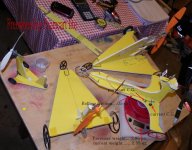
Foam cart lite.
 

Attachments

  • jrFoamWindCart-Fchange.jpg
    jrFoamWindCart-Fchange.jpg
    134.3 KB · Views: 1
.
The point?
Keeps me out of the bars and the chance meetings with loose women?
It's too windy/cold/hot uncomfortable outside?
I'm bored?
I have lots of time to do nothing and entertain myself?

So it has nothing to do with testing a hypothesis or finding out how the ddwfttw cart works?
 
.
The reason for that. Aesthetics and communciations with R. Hood, from Sherwood Forest, who opined that arrows need the feathers at the back, with the back in this case being the pointy end of these carts.(My aero prof mentioned the same thing.:) )
With the pointy end facing into the wind, the things want to swap ends before moving.
That stabilizing area can be removed with a quick slice... Done.
Does the front wheel pivot, i.e., steer?

What you could do is attach a "weathervane" to the front wheel and use it to keep the front wheel pointing downwind? That way you could remove as much of the "sail" as possible from the prop support in order to remove the possibility of "tacking force" being a component of the forward force on the cart.

If the above is too obtuse, here's a yachting example of self-steering on a rudder. On your cart it would not need to be as complex as that, of course.
 
Strawman and non sequitur.
ad homimen for the trifeca.

The small model was a perfect tool to demonstrate that the concept of a prop/gear cart could travel DDWFTTW on a treadmill.
It was fit for purpose and achieved exactly what it set out to achieve.
And in the wind...twice.

I was asking I Ratant what he set out to achieve with his carts, as I'd forgotten his reason, and asked, was it for benchmarking a geared prop cart against a freewheeling prop cart.Strawman and non sequitur.
E pluribus cartnum.
 
.
You may ask, but I won't do that until I can get the aligned thrust cart to move at all, and probably not even after that.
I observed on your reduced data the wind offsets weren't as large as the prop offsets I was using, and which gave me no deviations in the path the cart moved, so I tend to discount the effect of those wind effects on that cart on that day.
The larger offsets may have some effect, but only the freewheeling propellor cart is capable of moving right now in the winds I have access to.

The "Robin Hood" effect also applies to the (BB) cart. Mass at the rear will be unstable. I reckon that it largely runs with the front wheel all but useless.
It can turn on the axle. The GPS will be none the wiser,
Your cart may be restricted because the front wheel keeps the cart on the same path.
But, I wanted to see if the angle reduced the opposing turbine force to the point where is would move.

BTW, what did the fliers say about the above WS idea?
 
Last edited:
Ah. OK, thanks for that.
So really just testing the wheels-drive-the-prop premise with your own cart design.
Conclusions are pretty much as expected by most of us then - it's now just a matter of you overcoming the internal friction/forces and getting the geared cart to work, and then work as proposed by the FTTW guys.

Oh, that's good. The gearing impedes the cart "as expected". If the losses are in the gear chain, that increases the chance that it may go backwards.
 
So it has nothing to do with testing a hypothesis or finding out how the ddwfttw cart works?
.
I'm hoping to get firm answer from my rigorous :) test protocol on that, independently of accepting any of those I've seen put forward.
After all, using a propellor "backwards" as this one does, isn't something that's been investigated seriously, as the need to power something this way is probably never going to show up.
One of the observers at the airfield mentioned seeing a Flettner rotor type toy boat which drove a prop for forward propulsion, as Mark examined in his paper.
I've seen rotating wing kites, and those vertical vane wind turbines at the wind farm on Tehachapi mountain north of here.
More candidates for propulsion. :)
 
Well so far he has shown that it is not that difficult to make a cart that goes slower than the wind:rolleyes:
.
Yup.
Been there, done that.
Baby steps.
I keep in mind the disaster at Lockheed Georgia which killed the entire flight crew on the HTTB C-130, due to overly ambitious testing, which didn't build up to the end testing conditions.
My last boss at ADP Instrumentation had signed himself off that flight crew after working with them when the plane was here doing record flights, as he was not impressed with their caution in testing.
Did himself a disfavor at work, but he's still alive.
 
.
I'm hoping to get firm answer from my rigorous :) test protocol on that, independently of accepting any of those I've seen put forward.
After all, using a propellor "backwards" as this one does, isn't something that's been investigated seriously, as the need to power something this way is probably never going to show up.
One of the observers at the airfield mentioned seeing a Flettner rotor type toy boat which drove a prop for forward propulsion, as Mark examined in his paper.
I've seen rotating wing kites, and those vertical vane wind turbines at the wind farm on Tehachapi mountain north of here.
More candidates for propulsion. :)

The only peer-reviewed paper is Blackford's. He concludes <WS up and down wind. It was disputed by Ruina on the basis that the prop parameters were pesimistic, and argued ( through analogy) >2WS each way. But not a lot has changed about props since 1980, and current upwind carts do no better than 65%WS.
The water-boat appeared in Scientific American, circa 1975.
It's all here.
http://ruina.tam.cornell.edu/research/topics/miscellaneous/push-me_pull-you.pdf

The cart will go backwards. I have done it, and so has Platt, and the man who made that rickety cart video. It's down to the gear ratio which determines the "torque/sail" ratio. Whatever the case, gearing the rotor to the wheels inhibits the cart.
 
Last edited:
Does the front wheel pivot, i.e., steer?

What you could do is attach a "weathervane" to the front wheel and use it to keep the front wheel pointing downwind? That way you could remove as much of the "sail" as possible from the prop support in order to remove the possibility of "tacking force" being a component of the forward force on the cart.

If the above is too obtuse, here's a yachting example of self-steering on a rudder. On your cart it would not need to be as complex as that, of course.
.
I'm just "trusting" in the stability of the 3-wheeler configurations, which go straight when pushed in no-wind conditions.
Working with the miniscule forces I have to, I don't wanna get too complex.
Too many things to make move with as little friction as possible. :)
 
...
BTW, what did the fliers say about the above WS idea?
.
Most of them were interested, if non-committal.
One was a bit noisy about all the things that were wrong on the carts yesterday, as if they could be fixed right then and there.
But I perservered... needed to see how they worked, wrong or not. :)
I did change from the fraying Kevlar drive cord to monofilament, per his suggestion.
Don't have any results outside yet.
Looked at the hobby shop for gears useable to replace the cord.
The only ones available are about the size of those I have from the slot cars, and are too small.
 
Status
Not open for further replies.

ISF - Join now!

Every member here is approved by hand. No bots, no spam, just people who care about evidence and honest debate.

Membership is free!

Create your free account

Back
Top Bottom