Nah....good at it. Written Matlab scripts 'n all.I have no doubt that humber is fully capable of misinterpreting the data in a manner that he will claim shows that ddwftw didn't really happen. Whether he will actually make that effort remains to be seen. I got the impression from his earlier posts that he was overwhelmed by the sheer volume of data.

-
Security incident: ISF was recently accessed by intruders. Please change your password, and change it anywhere else you used it. Read more
You are using an out of date browser. It may not display this or other websites correctly.
You should upgrade or use an alternative browser.
You should upgrade or use an alternative browser.
Merged DDWFTTW in a “Real” Wind
- Thread starter ynot
- Start date
- Status
- Not open for further replies.
ThinAirDesigns
Graduate Poster
- Joined
- Nov 10, 2008
- Messages
- 1,058
If I could be bothered, I would find the posts where you said otherwise.
It's a lie and thus you can't and thus you won't.
JB
I Ratant
Penultimate Amazing

- Joined
- Apr 8, 2008
- Messages
- 19,258
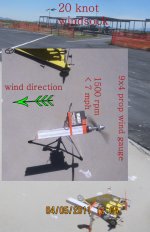
Went to a desert test location with unrestricted access to a runway.
Results...
The gradient effect is a bummer.
20 knot wind at 20 feet, <5 at 1 foot. image-25.
The freewheeling prop cart just took off and ran every time it was released.
The driven prop cart never moved, until the drive cord tension lessened a bit, and the prop could rotate in the "wrong" direction. Then the cart moved downwind like the freewheeler.
With the prop offset to either side, just as yesterday, the freewheeler went in the same direction. image_3 and image_6.
When it would run long enough to get sideways to the wind, prop rotation would stop and so would it.
Attachments


ThinAirDesigns
Graduate Poster
- Joined
- Nov 10, 2008
- Messages
- 1,058
"Bummer" -- a rigorous technical term.
I can't wait till all the rigorously collected data is released.
JB
I can't wait till all the rigorously collected data is released.
JB
ThinAirDesigns
Graduate Poster
- Joined
- Nov 10, 2008
- Messages
- 1,058
I see pretty pictures with crap written on them. Woopeedo. You're claim is scientific 'rigor' -- show some.
Need data monitored and collected by a independent and unbiased third party along with certificates of accuracy of instruments verified by same.
Rigorous science dictates it.
JB
Need data monitored and collected by a independent and unbiased third party along with certificates of accuracy of instruments verified by same.
Rigorous science dictates it.
JB
I Ratant
Penultimate Amazing
- Joined
- Apr 8, 2008
- Messages
- 19,258
.I see pretty pictures with crap written on them. Woopeedo. You're claim is scientific 'rigor' -- show some.
Need data monitored and collected by a independent and unbiased third party along with certificates of accuracy of instruments verified by same.
Rigorous science dictates it.
JB
I've shown you mine.
Yer up.
Some of what is apparent in mine.
The gradient effect can have an effect on the motion.
The freewheeling prop and the prop/drive wheel with the drive slipping had no trouble moving in the modest amount of wind at the level of the propellors. Both propellors turned the "wrong way" to be driving the carts, which moved downwind anyway.
At the open field location, the prop/drive wheel connection cart never moved on its own, as it had at the location with the wind "tunneling" between two buildings, somewhat negating the gradient problem.
And at the open field location, the results with offsetting the prop to simulate tacking duplicated that at the other location, which would negate the effect of the tacking prop, except at extreme winds-off the heading of the vehicle.
The response of the fliers at the field varied, from mild interest to the "that's all wrong" which needed a "No ****, Sherlock" response (but was withheld), when the layout, the mechanization with its attendant friction and basic concept were discussed.
Even the tachometer using the propellor and digital tach were "all wrong".. but, the comments were presented in a friendly and lively manner, which is missing here many times.
ThinAirDesigns
Graduate Poster
- Joined
- Nov 10, 2008
- Messages
- 1,058
I've shown you mine.
Yes you have shown us your 'rigor'. To say it's lacking in comparison to ours would be an understatement.
Yer up.
No, we're not "up", we're done. Ask the independent and inbiased third party (NALSA) for their rigorously collected data.
JB
ThinAirDesigns
Graduate Poster
- Joined
- Nov 10, 2008
- Messages
- 1,058
Are you disputing any of the conclusions I've drawn?
Your conclusions are nothing more than personal narative without collected data. I'm pointing out your glaring lack of the very scientific rigor that you crowed about.
Get an independent and unbiased third party to set a task and approve an instrumentation. Provide said party with certifications for the instruments. Have them collect and custody chain the data during the task and then ask them to share the data with anyone who wishes to see it.
From the data we'll see if your conclusions are of any value.
JB
EHocking
Penultimate Amazing

But did any of your configurations run DDWFTTW?Went to a desert test location with unrestricted access to a runway.
Results...
The gradient effect is a bummer.
20 knot wind at 20 feet, <5 at 1 foot. image-25.
The freewheeling prop cart just took off and ran every time it was released.
The driven prop cart never moved, until the drive cord tension lessened a bit, and the prop could rotate in the "wrong" direction. Then the cart moved downwind like the freewheeler.
With the prop offset to either side, just as yesterday, the freewheeler went in the same direction. image_3 and image_6.
When it would run long enough to get sideways to the wind, prop rotation would stop and so would it.
I admit I've lost the plot on why you started doing this.
Benchmarking? A bit difficult unless a scale model of the Blackbird (or at least representative of component parts such as prop pitch and wheel/prop shaft gearing).
I don't think that anyone posting here has said that a freewheeling prop can't act as a sail - but it certainly can't travel DDWFTTW.
Michael C
Graduate Poster

But did any of your configurations run DDWFTTW?
I admit I've lost the plot on why you started doing this.
Benchmarking? A bit difficult unless a scale model of the Blackbird (or at least representative of component parts such as prop pitch and wheel/prop shaft gearing).
I don't think that anyone posting here has said that a freewheeling prop can't act as a sail - but it certainly can't travel DDWFTTW.
I've no idea what I Ratant is trying to achieve. He seems to attach great importance to the freewheeling prop, but hasn't explained why. Does he think that the prop of the ddwfttw cart should be turning in the same direction as a freewheeling one? He's written incorrect analyses of the ddwfttw cart and later contradicted some of them, but I've never seen him actually retract anything he said so it's hard to say what his position is.
Went to a desert test location with unrestricted access to a runway.
Results...
The gradient effect is a bummer.
20 knot wind at 20 feet, <5 at 1 foot. image-25.
The freewheeling prop cart just took off and ran every time it was released.
The driven prop cart never moved, until the drive cord tension lessened a bit, and the prop could rotate in the "wrong" direction. Then the cart moved downwind like the freewheeler.
With the prop offset to either side, just as yesterday, the freewheeler went in the same direction. image_3 and image_6.
When it would run long enough to get sideways to the wind, prop rotation would stop and so would it.
Can I ask you, I Ratant, to compare a two geared carts. One with the prop as normal, and the other set at 45 degrees as you did with the "tacking" props?
1) The wind instruments carry a NIST certificate, but that does no mean that any given vane or anemometer is correctly calibrated.I see pretty pictures with crap written on them. Woopeedo. You're claim is scientific 'rigor' -- show some.
Need data monitored and collected by a independent and unbiased third party along with certificates of accuracy of instruments verified by same.
2) To meet the NIST certificate, the instruments must be used according to NIST environmental conditions. You have not even come close.
3) NALSA are not a registered test lab, and cannot issue certificates of calibration. Many companies employ "in house" calibration, but they are inspected by the body issuing the license to authorize calibration.
All instruments must follow a schedule of calibration, carry a dated label, and be sealed in a way that would indicate tampering.
Rigorous science dictates it.
JB
When the data is analysed, you are going to see what "rigorous" means.
ETA:
NALSA broke the chain of custody when they gave you access to the data.Have them collect and custody chain the data during the task and then ask them to share the data with anyone who wishes to see it.
But it's good to know that you acknowledge that NALSA should allow free access to the data.
Last edited:
A small model was good enough for you.Benchmarking? A bit difficult unless a scale model of the Blackbird (or at least representative of component parts such as prop pitch and wheel/prop shaft gearing).
It suggests that the gearing inhibits the cart, as has been claimed. There is no reason to think that would change above WS.I don't think that anyone posting here has said that a freewheeling prop can't act as a sail - but it certainly can't travel DDWFTTW.
Tacking allows >WS for sails, and explains all, whereas the other claim has many contradictory anomalies.
It's not about the cart, nor curiosity, nor science, but getting "the record"
Subduction Zone
Muse

- Joined
- Dec 23, 2008
- Messages
- 999
Sometimes all it takes to get humber to shut up for a while is to ask him the right, very simple question. For example:
Hey humber, what is the velocity of a cloud of dust as a fraction of wind speed?
Hey humber, what is the velocity of a cloud of dust as a fraction of wind speed?
Sometimes all it takes to get humber to shut up for a while is to ask him the right, very simple question. For example:
Hey humber, what is the velocity of a cloud of dust as a fraction of wind speed?
Oh, only a statistical answer applies. Small particles take a random walk, but it can be approximated by finding the force on a sphere. A = effective area of the sphere.
[latex] F_x = U_b (m_a) + U_f ( p*A + m_a) = U_f*p*A + m_a ( U_f - U_b)[/latex]
Happy?
And one for you. Why did TAD test in knowingly unsteady winds and a very short runway, that would conveniently not allow steady-state?
Answer: Copy Goodman. It worked for him .
EHocking
Penultimate Amazing
Strawman and non sequitur.A small model was good enough for you.
The small model was a perfect tool to demonstrate that the concept of a prop/gear cart could travel DDWFTTW on a treadmill.
It was fit for purpose and achieved exactly what it set out to achieve.
I was asking I Ratant what he set out to achieve with his carts, as I'd forgotten his reason, and asked, was it for benchmarking a geared prop cart against a freewheeling prop cart.
Strawman and non sequitur.It suggests that the gearing inhibits the cart, as has been claimed. There is no reason to think that would change above WS.
Has nothing to do with my statement about freewheeling prop carts.
So if his experiments are about benchmarking tacking speed of a geared vs non-geared prop cart, they are not relevant to the BB result, nor indeed the TM cart, since neither of these carts have a dirty-great triangular sail area supporting the propellor - as I Ratant's carts do.Tacking allows >WS for sails, and explains all, whereas the other claim has many contradictory anomalies.
His models are not indicative of what is being tested - the BB design.
Also, are his gearing ratios the same as the BB?
Are the prop pitches the same as the BB?
If not - he is not benchmarking a BB-style cart and the results are not comparable.
If, indeed, benchmarking was his aim - I'll wait for I Ratant to reply with on-topic responses to my questions rather than obfuscations from you.
Well, your responses to my post are not, but my questions to I Ratant are.It's not about the cart, nor curiosity, nor science, but getting "the record"
Not my problem if you continue to try to muddy the water by interrupting the discussion with obfuscation such as this post I'm having to reply to.
Subduction Zone
Muse
- Joined
- Dec 23, 2008
- Messages
- 999
Oh, only a statistical answer applies. Small particles take a random walk, but it can be approximated by finding the force on a sphere. A = effective area of the sphere.
[latex] F_x = U_b (m_a) + U_f ( p*A + m_a) = U_f*p*A + m_a ( U_f - U_b)[/latex]
Happy?
And one for you. Why did TAD test in knowingly unsteady winds and a very short runway, that would conveniently not allow steady-state?
Answer: Copy Goodman. It worked for him .
Of course not, since you dodged the question. A bunch of undefined latex does not support your claim in any way. You know what answer I want, what is a reasonable estimate of the velocity of a cloud of dust as a fraction of wind velocity?
I Ratant
Penultimate Amazing
- Joined
- Apr 8, 2008
- Messages
- 19,258
.But did any of your configurations run DDWFTTW?
I admit I've lost the plot on why you started doing this.
Benchmarking? A bit difficult unless a scale model of the Blackbird (or at least representative of component parts such as prop pitch and wheel/prop shaft gearing).
I don't think that anyone posting here has said that a freewheeling prop can't act as a sail - but it certainly can't travel DDWFTTW.
Why'd I start doing this?
I wanted to do it!
No, the driven cart never moved at all.
The freewheeling prop cart couldn't be constrained.
 (except by invoking my hold-back fixture.)
As shown earlier the wind at distances higher than my carts got to a healthy number, but without the constriction I get at home with the wind going between buildings, wasn't high enough at the height of the carts for the driven cart to move, except when the tension in the drive cord was relaxed.
Then it would move, with the propellor rotating -against- the direction it has to rotate when driven.. just like the freewheeling propellor cart, performing the same. Goes downwind.
Here's the problem...
The gradient effect.
But I also confirmed the tacking-prop situation is of little concern, as the freewheeler with the offset prop always traveled the same path, regardless of the direction of offset as shown earlier.
Attachments

- Status
- Not open for further replies.