• Security incident: ISF was recently accessed by intruders. Please change your password, and change it anywhere else you used it. Read more

Merged DDWFTTW in a “Real” Wind

Status
Not open for further replies.
.
Didn't have to be.
It was apparently the first.
That's what would count in a record book.
Faster, longer, higher, just takes tossing lots of cash at the thing, as with everything.
The principle has promise, for what it could do.
Who was the next man to top Everest after Hillary and Norkay? Don't goggle.

There we differ. Neither succeded. Transient performance is possible, and quite readily so. The number of contradictory "explanations" suggest they are ad-hoc.

A steady-state >ws ddw cart is not possible.


[latex] T = \Pi/4.D^2. ( v + \Delta v/2).p. \Delta v [/latex]
T thrust [N]
D propeller diameter [m]
v velocity of incoming flow [m/s]
delta v additional velocity, acceleration by propeller [m/s]
p density of fluid [kg/m³]
(air: = 1.225 kg/m³, water: = 1000 kg/m³)

The first term is the area of the prop. V and p are mass flow and density.
It is derived from Newton's impact theorem, which when modified as Rayliegh
did, becomes the familiar drag equation -F = 1/2.Cd.A.p.V^2

The product [latex] \Delta V^2/2 [/latex] is the thrust component over and above the drag component, and is not possible without an engine.
The wind is 100% drag, and the only source of energy is the cart's KE, which if imparted to the prop, will slow the cart as it exhausts itself.
 
Last edited:
Now humber believes that something can be true without being in a text book!?

Theres' more to electronics than may be found in "Electronics for Dummies", Chief. The point is that you can't even begin to tell my what that is, nor why the highschool book may be a simplification.
You can gossip with the bro's while I get on with taking your cart to bits.
And you cast runes to wish away I Ratant's results.
 
Theres' more to electronics than may be found in "Electronics for Dummies"

I bet humber can't show us where in the text book it says that there's more to it than what is in the text book.

And if he can, then he has his answer as to how DDWFTTW can be possible without appearing in a text book.

Sadly, he is impervious to this logic.
 
I bet humber can't show us where in the text book it says that there's more to it than what is in the text book.
"for a more detailed analysis see...." Quite common. References, citations.

And if he can, then he has his answer as to how DDWFTTW can be possible without appearing in a text book.
But if I can? But you said I can't. Err...if it were possible, it would be in the text books.
It's the complete absence in the light of the fact that sails are certainly known not to go ddw.
An exemption would be noteworthy, Chief.

Sadly, he is impervious to this logic.


No need to appeal to the hypothetical, Chief, when it can be done here and now. Your comments, if you please.


[latex]T = \Pi/4.D^2. ( v + \Delta v/2).p. \Delta v [/latex]
T thrust [N]
D propeller diameter [m]
v velocity of incoming flow [m/s]
delta v additional velocity, acceleration by propeller [m/s]
p density of fluid [kg/m³]
(air: = 1.225 kg/m³, water: = 1000 kg/m³)

The first term is the area of the prop. V and p are mass flow and density.
It is derived from Newton's impact theorem, which when modified as Rayliegh
did, becomes the familiar drag equation -F = 1/2.Cd.A.p.V^2

The product [latex] \Delta V^2/2 [/latex] is the thrust component over and above the drag component, and is not possible without an engine.
The wind is 100% drag, and the only source of energy is the cart's KE, which if imparted to the prop, will slow the cart as it exhausts itself.
 
Last edited:
You tell me how it can't. There's more to the topic than what a simple text book says.
It's not wrong, but incomplete.

How it can't? I don't understand the question. Do you think non-zero acceleration implies non-zero velocity?
 
"for a more detailed analysis see...." Quite common. References, citations.


But if I can? But you said I can't. Err...if it were possible, it would be in the text books.
It's the complete absence in the light of the fact that sails are certainly known not to go ddw.
An exemption would be noteworthy, Chief.


No need to appeal to the hypothetical, Chief, when it can be done here and now. Your comments, if you please.


[latex]T = \Pi/4.D^2. ( v + \Delta v/2).p. \Delta v [/latex]
T thrust [N]
D propeller diameter [m]
v velocity of incoming flow [m/s]
delta v additional velocity, acceleration by propeller [m/s]
p density of fluid [kg/m³]
(air: = 1.225 kg/m³, water: = 1000 kg/m³)

The first term is the area of the prop. V and p are mass flow and density.
It is derived from Newton's impact theorem, which when modified as Rayliegh
did, becomes the familiar drag equation -F = 1/2.Cd.A.p.V^2

The product [latex] \Delta V^2/2 [/latex] is the thrust component over and above the drag component, and is not possible without an engine.
The wind is 100% drag, and the only source of energy is the cart's KE, which if imparted to the prop, will slow the cart as it exhausts itself.

LOL, couldn't pick the winner of a one horse race was written for Humber. Wind is 100% drag. Its almost too funny. Prop produces thrust. Thrust > drag. Cart accelerates. Humber confused.
 
LOL, couldn't pick the winner of a one horse race was written for Humber. Wind is 100% drag. Its almost too funny. Prop produces thrust. Thrust > drag. Cart accelerates. Humber confused.

I think you kind of buried the headline there. His entire rant was somehow supposed to be a response to my pointing out his broken logic. He says you can't find everything in a text book, but he won't believe that objects fall until we show him that in a text book.
 
LOL, couldn't pick the winner of a one horse race was written for Humber. Wind is 100% drag. Its almost too funny. Prop produces thrust. Thrust > drag. Cart accelerates. Humber confused.

All those planes have a superfluous engine, is that right? Windmilling props are often used as brakes. Some are reversible, so the engine can provide opposing thrust, rather than rely on the drag alone. Nice of you to step in for the Chief, but it is his direct answer to the equation that is of interest. I can get "opinions" by the cubic meter.
 
Not that much that same day...
More fiddling ingenious adaptations of found materials (slot car parts from 45 years ago)...
There's on 27 cents left in the budget.
I can get 17 to 19 M&Ms at the Mall from the candy machine for 25 cents.
 

Attachments

  • jrTackingProp-04.jpg
    jrTackingProp-04.jpg
    117.5 KB · Views: 5
  • jrTackingProp-05.jpg
    jrTackingProp-05.jpg
    79.5 KB · Views: 4
I think you kind of buried the headline there. His entire rant was somehow supposed to be a response to my pointing out his broken logic. He says you can't find everything in a text book, but he won't believe that objects fall until we show him that in a text book.

Rather than the stuff you simply make up. As a graduate in Aerodynamics, the formula should be familiar to you. I can provide the derivation if you need a refresher or primer.

No need to appeal to the hypothetical, Chief, when it can be done here and now. Your comments, if you please.


[latex]T = \Pi/4.D^2. ( v + \Delta v/2).p. \Delta v[/latex]
T thrust [N]
D propeller diameter [m]
v velocity of incoming flow [m/s]
delta v additional velocity, acceleration by propeller [m/s]
p density of fluid [kg/m³]
(air: = 1.225 kg/m³, water: = 1000 kg/m³)

The first term is the area of the prop. V and p are mass flow and density.
It is derived from Newton's impact theorem, which when modified as Rayliegh
did, becomes the familiar drag equation -F = 1/2.Cd.A.p.V^2

The product [latex] \Delta V^2/2 [/latex] is the thrust component over and above the drag component, and is not possible without an engine.
Above WS, the headwind is 100% drag, and the only source of energy is the cart's KE, which if imparted to the prop, will slow the cart as it exhausts itself.

ETA:
That headwind is so often called drag. In fact, you have it as a term opposing the cart when the headwind is against the chassis, but somehow powers the prop. If it's a matter of not understanding the math, perhaps you can explain your own logic on that score, Chief
 
Last edited:
All those planes have a superfluous engine, is that right? Windmilling props are often used as brakes. Some are reversible, so the engine can provide opposing thrust, rather than rely on the drag alone. Nice of you to step in for the Chief, but it is his direct answer to the equation that is of interest. I can get "opinions" by the cubic meter.

News flash for Humber: Planes fly in the air.
 
Your comments, if you please.


[latex]T = \Pi/4.D^2. ( v + \Delta v/2).p. \Delta v[/latex]


The product [latex] \Delta V^2/2 [/latex] is the thrust component over and above the drag component, and is not possible without an engine.

My comment is that, as mentioned a couple of pages back, your maths may well tell you the truth, but you asked it the wrong question.

The above equation does not tell you postive thrust "is not possible without an engine". You may say that it tells you positive thrust may only be obtained if the propeller is driven by something, but that is not the same thing, and it's very sloppy thinking for you to declare an engine is required, particularly when it's been explained to you uncounted times over the years that the wheels drive the prop round, the energy to turn the wheels comes from the cart's KE and the KE is provided by the forward component of the thrust of the wind on the prop.
 
News flash for Humber: Planes fly in the air.

And have an engine that produces the thrust that allows that to happen.
The cart needs thrust too. You gambit is to force a difference based on the idea that the ground is not "special", except when it's not there.
 
And have an engine that produces the thrust that allows that to happen.
The cart needs thrust too. You gambit is to force a difference based on the idea that the ground is not "special", except when it's not there.

I had toy airplanes when I was a kid whose props were not driven by an engine. They used a rubber band. They flew.
 
I had toy airplanes when I was a kid whose props were not driven by an engine. They used a rubber band. They flew.

Doh. There is energy stored in the rubber. You need to wind them up.
When that energy is depleted, no more powered plane...
You can take it as read that Spork will not answer to the math. It's a "vision thing". you see.
 
You can take it as read that Spork will not answer to the math.

The equation you posted does not show that an engine is required. You asked maths the wrong question.

Do you perhaps have another one which does, though? Maybe you can demonstrate that the power derived from the forward thrust on the propeller cannot exceed the power consumed by turning the propeller by a sufficient margin to overcome all other losses. Or maybe you can't. Either way, that would be the right question.
 
Last edited:
Is this gibberish your summary of how you think we think the BB works?

What does it mean?
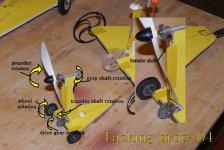
It means, as gibberish from Humber usually does, that he knows he is wrong and the jig is up with a certain line of his silliness. He knows that comparing a plane in the air to the cart is foolish, since the plane cannot leverage the wind ground speed differential, so he resorts to gibberish.
 
Status
Not open for further replies.

ISF - Join now!

Every member here is approved by hand. No bots, no spam, just people who care about evidence and honest debate.

Membership is free!

Create your free account

Back
Top Bottom