• Security incident: ISF was recently accessed by intruders. Please change your password, and change it anywhere else you used it. Read more

Merged DDWFTTW in a “Real” Wind

Status
Not open for further replies.
For the Humber neophytes; you have just witnessed a perfect example of Humber in action. He is caught in a complete lie. He then posts the proof that he was lying as if it helps his case. By the way Humber, your quote from the NALSA observer above is trying to tell you how silly you are being about your quote below.

Noah's Ark has taken in more than water.

"One of the reviewers of this report pointed out that the true wind speed (black line in separation graph) was 4-5 mph faster a few seconds before the measurement period(MP) than the speeds during the period
yet it continued to accelerate in the lighter winds present in the MP . This brings up the question if there is some way the energy associated with the higher wind can provide acceleration during the measurement
period. The observers see no meaningful way this could happen without using stored energy. Blackbird has no such capability"

I added that there was a subsequent Voodoo apologia (an obvious case of bias and special-pleading), claiming that somehow, the "memory" of the earlier faster wind, allowed the cart to accelerate in the slower wind. I am not sure they have the "right stuff" for this trial.


Wrong again Humber. By far the highest rate of acceleration was when it was being towed to the test site. Fortunately for those of us who play baseball objects do not become easier to accelerate the more they have been accelerated in the past.

Then why did you not remark that NALSA are claiming that the preceding wind, allowed it to later accelerate?

You imputed your nesceint ideas to me, but I was merely pointing out that the cart is such a slug in the wind, that pushing it results in 4 times the acceleration it achieves in the wind. It was pushed >WS. A wonder.

Well ok I guess; but there are some differences. One of the sails is huge and visible and its on a cart with a huge stabilizer so the cart doesn't tip over in the high 60 degree winds it requires to do its thing. The other has a big opposing turbine and the sails are invisible as well as magic. They are both relatively solid so you're only mostly wrong on this one.

Greenbird does not claim to go ddw, but if we use NALSA's technique of averaging the cart's deviation from ddw,it looks like the average deviation will meet the 10 degree limit, and so hold the ddw record at the same time. 127mph.
 
Lets see, a couple of quick Humber lies to point out.
Yes it does.
What Duffy says is whatever he feels will fill the void.
But the chart says the cart accelerates when the wind is 25 degrees off ddw. If does not worsen away from the ddw path. It is never ddw. Always tacking for every second of the Kindergarten trial.
 
Last edited:
What Duffy says is whatever he feels will fill the void.
But the chart says the cart accelerates when the wind is 25 degrees off ddw. If does not worsen away from the ddw path. It is never ddw. Always tacking for every second of the Kindergarten trial.

Let's see 4 outright lies in 20 words. Alas I only wish that was a record.

The cart was never 25 degrees off the wind so of course it would be impossible for the chart to say it accelerates in that scenario. It does worsen away from the ddw path. It was ddw for a time. It is never tacking; as it has no sails, unless we stretch the definition of tacking to include the prop.

It is interesting that Humber even talks about it accelerating while not ddw as if it means something. If it was 25 degrees off the wind (which it wasn't) and it did accelerate, there would be nothing wrong or surprising about that. It will perform best 0 degrees off the wind but why would it come to a screeching halt otherwise? Of course NALSA would not have ratified a ddw world record though.

At this point I will just say that anyone who wishes should look at the chart themselves. Keep in mind that Humber cannot understand the difference between averaged and instantaneous data points. The black line includes data from outside the measurement period as it is a rolling 10 second average. Although this fact has been pointed out to Humber many, many times, as well as explicitly mentioned in the report it is taken from, he will not acknowledge it.
 
Last edited:
Noah's Ark has taken in more than water.

"One of the reviewers of this report pointed out that the true wind speed (black line in separation graph) was 4-5 mph faster a few seconds before the measurement period(MP) than the speeds during the period
yet it continued to accelerate in the lighter winds present in the MP . This brings up the question if there is some way the energy associated with the higher wind can provide acceleration during the measurement
period. The observers see no meaningful way this could happen without using stored energy. Blackbird has no such capability"

I added that there was a subsequent Voodoo apologia (an obvious case of bias and special-pleading), claiming that somehow, the "memory" of the earlier faster wind, allowed the cart to accelerate in the slower wind. I am not sure they have the "right stuff" for this trial.

They claim no such thing. In fact their conclusion is the exact opposite of yours. I went and got the actual quote so you will have to find somewhere else to post lies about it. Sorry.

Excerpt from NALSA observers report which Humber is misquoting and misunderstanding/lying about:

One of the reviewers of this report pointed out that the true wind speed (black line in separation graph) was 4-5 mph faster a few seconds before the measurement period(MP) than the speeds during the period yet it continued to accelerate in the lighter winds present in the MP . This brings up the question if there is some way the energy associated with the higher wind can provide acceleration during the measurement period. The observers see no meaningful way this could happen without using stored energy. Blackbird has no such capability. In effect the higher wind speed before the measurement period got the craft close to its equilibrium speed more quickly but it would have gotten there if the wind had stayed at exactly 10 mph for the entire run. T ability to accelerate is proof that it is more than able to sustain its speed in the wind it is sailing through at the time and, therefore, is an appropriate basis for calculating a craft speed to wind speed ratio. On this run the Blackbird accelerated from well before to well after the measurement period. As noted on Appendix A the equilibrium speed ratio for Black Bird appears to be a little over 3.0 to1 in a 10 mph wind (based on shorter measurement times and the amount of acceleration occurring at different wind speeds).
 
Funny how you pick at words, but bought Planet Oil Barrel without question.
What?

But to nail the coffin lid shut real tight.

Spork NALSA Submission Report

Proof that the vehicle performs best Dead Downwind

As can readily be seen from the above analysis, the vehicle performance is
driven significantly by the prop efficiency. This of course is primarily a function of the Lift/Drag ratio of the propeller airfoil at its operating angle of attack. The propeller on the Blackbird is based on the NACA 6412 airfoil which has it’s maximum L/D at 4.0 degrees, and has a twist such that the airfoil at each panwise station is presented at that angle of attack (AOA). When the relative flow is aligned with the propeller axis, that AOA can be maintained at all spanwise stations throughout the complete rotation. As the prop rotates counter-clockwise when viewed from in front of the vehicle, any cross-wind component from the right will cause the AOA for the top blade to increase while the angle of attack of the bottom blade is decreased. A cross wind component from the left will have the same effect in the opposite direction. In both cases the AOA will depart from its optimum value to varying degrees over the full rotation of the prop in this case – reducing the propeller performance – and thus the overall performance of the cart. The cart employs no other aerodynamic surfaces that can take advantage of a cross-wind component.
Nowhere in there is a mention of wind speed. Why are you trying to change the subject, don't want to admit you're full of it?
1) Cart performance reduces when not ddw. IT DOES NOT
Proof? Your previous quote seems to say the opposite.
2) If you then say "it's the best tacking cart ever", then you have to agree
that has no reason to be in the ddw class, and should compete against the likes of Greenbird. There the rules are a tougher, and not made to pander to the special-guys of TAD.
The cart doesn't 'tack', the blades do. When it's not DDW, the rotor blades performance varies at different points of their rotation. When DDW, they are fixed at the optimal angle at all points in their rotation. So just because the blades are 'tacking' doesn't mean they work equally well in any orientation to the wind, or better when not DDW.

3) The trail report say the cart continues to accelerate in lighter winds. There is not reason "theoretical" or otherwise to suggest that the cart should not slow when that happens. To claim that it accelerates as the wind falls in speed, leads to absurdity and a contradiction of the cart's claims.

Uhm, there's a simple reason. Let's say it can do 2x the wind speed, to make the math easy. It's in a 20mph wind, slowly accelerating towards its max speed of 40mph. When it gets to 50% of its max speed the wind suddenly drops to 15mph. Its new max speed is now 30mph. But that is still higher than its current speed of 20mph. So it continues to accelerate despite the drop in wind speed!
 
Last edited:
What?
Uhm, there's a simple reason. Let's say it can do 2x the wind speed, to make the math easy. It's in a 20mph wind, slowly accelerating towards its max speed of 40mph. When it gets to 50% of its max speed the wind suddenly drops to 15mph. Its new max speed is now 30mph. But that is still higher than its current speed of 20mph. So it continues to accelerate despite the drop in wind speed!

Of course, and that is exactly what the report said in the real quote which I just posted. It is amazing how he tries to twist a few words taken out of context from a quote which utterly contradicts his point; and make it into something which supports his wacky theories.
 
.
I was thinking about that yesterday... :)
Downhill skiing... BFD!!!
Done that.
Now, uphill skiing... Wow!
Talk about the need to tack!
I thought up waffle-bottomed skies.. the waffling permits traction when going uphill, and lies flat on the bottom for the downhill. A ratcheting effect, as it were.
Like the free-wheeler in a bike wheel hub.
Would it work?

Definitely. As I recall, the original (native) cross-country skis had layers of shaved animal hide attached to the contact surface, grain lying backwards.
Gliding downhill the bristles would lie flat, going uphill they would stand up and give grip so the skier could climb the snow/ice. Ain't science fascinating?

beauty.png


:p
 
Last edited:
On the cart..
I've found that a propellor (10x6 APC electric prop) loose on a shaft, free to rotate in a wind, goes faster rpm wise with the wind coming from the rear of the prop. Maybe 15% or so.
Turning the cart around might need some alteration to the prop pitch, to get the same grunt forward, unless it's merely the inefficency of the prop in the downwind situation.
 

Attachments

  • DownwindCart-02.jpg
    DownwindCart-02.jpg
    44.9 KB · Views: 3
  • DownwindCart-03.jpg
    DownwindCart-03.jpg
    46.5 KB · Views: 3
Definitely. As I recall, the original (native) cross-country skis had layers of shaved animal hide attached to the contact surface, grain lying backwards.
Gliding downhill the bristles would lie flat, going uphill they would stand up and give grip so the skier could climb the snow/ice. Ain't science fascinating?

[qimg]http://imgs.xkcd.com/comics/beauty.png[/qimg]
.
As mentioned in the thread... "Ain't Philosophers just the greatest thing since sliced bread"... were it not for engineers, we'd still be in caves waiting for the learned thinkers to decide which rocks were edible.
 
Let's see 4 outright lies in 20 words. Alas I only wish that was a record.
The cart was never 25 degrees off the wind so of course it would be impossible for the chart to say it accelerates in that scenario. It does worsen away from the ddw path. It was ddw for a time. It is never tacking; as it has no sails, unless we stretch the definition of tacking to include the prop.

You will have to accept that it WAS. Please do not continue to deny the obvious.

attachment.php


...and if it did accelerate, there would be nothing wrong or surprising about that.
Then why are you objecting? Is it that it behaves more like a tacking cart than you would like to admit? If it's not specifically a ddw cart, then it has no reason to be in that class of trial.

It will perform best 0 degrees off the wind but why would it come to a screeching halt otherwise? Of course NALSA would not have ratified a ddw world record though.

Hyperbole does not work. It does not come to a "screeching halt" but thrives. It always does. The acceleration falls when close to ddw.
That can be seen by the small changes in the acceleration. This trail was a job for the boys. A loose and uncontrolled buddy-fest.

.
attachment.php


At this point I will just say that anyone who wishes should look at the chart themselves. Keep in mind that Humber cannot understand the difference between averaged and instantaneous data points. The black line includes data from outside the measurement period as it is a rolling 10 second average.
A rolling 10 second average does not produce a single data point of 4 degrees. The mean is 4 degrees. The normal "average". The correct processing is RMS, not averaging. You have no justification for deviating from what is the accepted norm.

Although this fact has been pointed out to Humber many, many times, as well as explicitly mentioned in the report it is taken from, he will not acknowledge it.

Because it's nonsense. I have already produced rolling averages, and posted them. None of them fit the chart produced for public consumption.
The data has been low pass filtered to remove all those incriminating wind changes.

I wonder why Spork will not provide the raw data to refute an accusation of outright fraud ?
 

Attachments

  • wind_direction.jpg
    wind_direction.jpg
    27.9 KB · Views: 85
  • sb_1.jpg
    sb_1.jpg
    39.1 KB · Views: 86
ontinues to accelerate despite the drop in wind speed!

I am not interested in your "opinion". Produce a text reference for the claim of tacking props.
It is highly unlikely that such behavior would go unrecorded
 
Last edited:
Of course, and that is exactly what the report said in the real quote which I just posted. It is amazing how he tries to twist a few words taken out of context from a quote which utterly contradicts his point; and make it into something which supports his wacky theories.

The mighty cart has you grasping at straws. You are forgetting that the cotton reel is a joke, and that is the basis of the cart's Harrypothesis.
The math on the power calculation, shows the cart to be a PM machine.

When someone tries to sell me something and begins with "most people don't get this..but", I tend to think of flim-flam
 
On the cart..
I've found that a propellor (10x6 APC electric prop) loose on a shaft, free to rotate in a wind, goes faster rpm wise with the wind coming from the rear of the prop. Maybe 15% or so.
Turning the cart around might need some alteration to the prop pitch, to get the same grunt forward, unless it's merely the inefficency of the prop in the downwind situation.

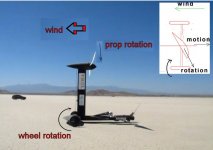
The prop of the DDWFTTW vehicle is not freewheeling. It's actively thrusting its way through the air, just like the prop of a plane. It is indeed turning in the opposite direction to the way most people initially think it would.

A purely mechanical cart gives a good analogy to the "contrary" behaviour of the prop. Look at the way the blue wheel turns here:


Most people think that the wheel will be turned by the ruler, so that when I move the ruler to the right, the wheel should turn clockwise. This would be similar to a turbine, or a freewheeling prop.

In fact the gearing of the cart (coupled to the wheels that move along the ground) forces the blue wheel to turn against the direction in which the ruler is moving. This wheel is working like the wheels of a powered car, pushing backwards on the ruler just as the wheels of the car push backwards on the road. The reactive force from the ruler pushes the cart along the ruler, so the cart ends up moving faster than the ruler.

This is similar to a propeller thrusting against the air to propel a plane (or cart) forwards. The gearing of the DDWFTTW cart also forces the propeller to turn against the direction of the wind: it pushes backwards against the air and the reactive force from the air pushes it forwards.

In both cases, the ground is pushing backwards against the wheels running over it. The machines work because the gearing is chosen to ensure that the forward thrust provided by the blue wheel, or the propeller, is greater than the retarding force at ground level.
 
In fact the gearing of the cart (coupled to the wheels that move along the ground) forces the blue wheel to turn against the direction in which the ruler is moving. This wheel is working like the wheels of a powered car, pushing backwards on the ruler just as the wheels of the car push backwards on the road. The reactive force from the ruler pushes the cart along the ruler, so the cart ends up moving faster than the ruler.
A more rational explanation is required. If the cart is pushed forwards by means of the frame of the little cart, then Newton says there will be an equal an opposite force. Let's say that is 1N
The large idler wheel is used to reverse the direction of the IN force applied by the ruler.
But you now need a net force in the the direction oppoiste to the hand. The large wheel reverses that, so the net force will be zero. To get a 1N force in the opposite direction, then 2N must be applied. 2N -1N = 1N. That is not unexpected, because the smaller wheels have a ratio of 2:1.
If simply pushed the other way, then you would need only 1N. We really do need engineers to sort the rocks from the edible.

"most people" are right.
 
Last edited:
For the more technically minded carteers here .... might it be correct to think that - prior to reaching steady-state - the whole cart mechanism can be likened to a 'slipping clutch' on a car? That is, the expected speed cannot yet be calculated simply by multiplying rpm x gear ratio?

Just curious.
 
The prop of the DDWFTTW vehicle is not freewheeling. It's actively thrusting its way through the air, just like the prop of a plane. It is indeed turning in the opposite direction to the way most people initially think it would.

...
.
No.
A prop with the typical pitch twist (as seen on the black cart) when windmilling in an airstream, or being turned by a motor, rotates CW viewed from the rear.
Most props rotate in that direction.
As in these... (had to use a flash to get a decent image of the prop. The direction of the rotation was marked on the blades before taking the photos.)
.
 

Attachments

  • PropRotation-01.jpg
    PropRotation-01.jpg
    145.6 KB · Views: 3
  • PropRotation-02.jpg
    PropRotation-02.jpg
    109.3 KB · Views: 3

You're missing something important. The prop is geared to the wheels. At a vehicle speed of x, the prop speed is some constant times x, and it is turning in the direction that provides thrust. As long as the wheels aren't slipping, it can do nothing else. For it to turn in the opposite direction, the cart would have to be moving in reverse.
 
Can you please clarify which of Michael C's statements you are saying "No" too?

1. The prop of the DDWFTTW vehicle is not freewheeling.
2. It's actively thrusting its way through the air, just like the prop of a plane.
3. It is indeed turning in the opposite direction to the way most people initially think it would.

Or is it...

4. All of the above.

Thank you.
 
You're missing something important. The prop is geared to the wheels. At a vehicle speed of x, the prop speed is some constant times x, and it is turning in the direction that provides thrust. As long as the wheels aren't slipping, it can do nothing else. For it to turn in the opposite direction, the cart would have to be moving in reverse.
.
I'm missing diddly.
Starting with square one... which way does the prop rotate?
Finger out that.
Then square two.
Which way must the wheels turn for the direction of motion?
Any gearing between the two can't oppose this, or it can't move at all!
There is a wind speed relative to the pitch of the prop where the prop will rotate in the wind with zero slip... and also zero thrust.
At the start, with the prop barely rotating, it's acting more like a sail, but rotates.
This rotation goes to the wheels, which begin to move the thing through the gearing. The thing will speed up because the prop is between the sail stage and the zero slip stage.
The zero slip rpm will be at some speed other than stopped, for the whole thing.
Past the zero slip speed, when the prop would then retard the speed, like a windmilling prop on an airplane creating drag.
Because the prop is moving downwind, getting to the point/speed at which it has zero slip moves with the cart's motion. It's dangling like a carrot ahead of the cart, which may not get to that point for other reasons.
I've used props on freewheeling hubs to measure wind speed.
The faster the wind, the faster the prop turns, but it always find the zero slip speed and stabilizes there.
On the cart, the drive from the wheels probably results in the zero slip being faster than a fixed prop would get to.
I think. :)
 

Attachments

  • Windspeed-rpm7x8prop.jpg
    Windspeed-rpm7x8prop.jpg
    91.3 KB · Views: 4
  • Windspeed-rpm10x6prop.jpg
    Windspeed-rpm10x6prop.jpg
    76.5 KB · Views: 3
.
I'm missing diddly.
Starting with square one... which way does the prop rotate?
Finger out that.
Then square two.
Which way must the wheels turn for the direction of motion?
Any gearing between the two can't oppose this, or it can't move at all!
There is a wind speed relative to the pitch of the prop where the prop will rotate in the wind with zero slip... and also zero thrust.
At the start, with the prop barely rotating, it's acting more like a sail, but rotates.
This rotation goes to the wheels, which begin to move the thing through the gearing. The thing will speed up because the prop is between the sail stage and the zero slip stage.
The zero slip rpm will be at some speed other than stopped, for the whole thing.
Past the zero slip speed, when the prop would then retard the speed, like a windmilling prop on an airplane creating drag.
Because the prop is moving downwind, getting to the point/speed at which it has zero slip moves with the cart's motion. It's dangling like a carrot ahead of the cart, which may not get to that point for other reasons.
I've used props on freewheeling hubs to measure wind speed.
The faster the wind, the faster the prop turns, but it always find the zero slip speed and stabilizes there.
On the cart, the drive from the wheels probably results in the zero slip being faster than a fixed prop would get to.
I think. :)
Christ, you're stubborn. There are a range of people from barely above ignorant (me) to highly knowledgeable folks including the designer and creator of the cart (Spork) who have tried to explain this to you. Why won't you listen?

Request @ Spork: Please correct this one time without acrimony.
 
Status
Not open for further replies.

ISF - Join now!

Every member here is approved by hand. No bots, no spam, just people who care about evidence and honest debate.

Membership is free!

Create your free account

Back
Top Bottom