• Security incident: ISF was recently accessed by intruders. Please change your password, and change it anywhere else you used it. Read more

Merged DDWFTTW in a “Real” Wind

Status
Not open for further replies.
How's this?
The smaller wheel the pulling string works on is 1/2 the diameter of the larger wheel. (As before) Therefore the circumference is 1/2 the larger wheel's.
The wheel is pulled for one revolution along the ruler.
The pulling string is held tensioned by the dangling clamp.
When the wheel has moved 14 inches along the ruler, the dangler has moved up 7 inches.
The rate at which the apparatus moves has no bearing on the geometry.
1/2 inch on the string moves the large wheel 1 inch.
Other diameter/circumference ratios will differ.
 

Attachments

  • jrChainWheel-II-01.jpg
    jrChainWheel-II-01.jpg
    54.7 KB · Views: 3
  • jrChainWheel-II-02.jpg
    jrChainWheel-II-02.jpg
    60.2 KB · Views: 2
  • jrChainWheel-II-03.jpg
    jrChainWheel-II-03.jpg
    44.2 KB · Views: 3
If the string goes underneath, the reel will turn CCW, unless the friction works the other way and then it moves to the right.
But, only if the reel rolls along the thread. The thread can't pull it, unless it slides - a condition where there is no angular KE.

When it rolls to the right is does so because impulse has added angular momentum. There is no other way.

No, it rolls to the right because the pivot is the ground, not the center of the wheel, and the string is above that.
 
Wrong. No sliding required. The reel moves in the direction the string is pulling. The friction of the reel on the surface prevents it from turning in the direction that would move it in the opposite direction. The reel is free to roll on the surface and along the string.
Math

I think everyone here understands perfectly well that the reel has to accelerate to go from stationary to moving. It hasn't been explicitly stated because it's obvious, and because it's pretty much irrelevant to the point they are trying to make.
Math.

There is one person in this discussion trying to "prove" at all costs that he is right, even though he is wrong nearly all the time. That person is humber. Despite humber's claimed dedication to math, he has frequently gotten the math wrong. His utter inability to understand basic physical principles has rendered him incapable of using math correctly.
Math

This folks, is just about as close as humber appears to be capable of getting to admitting that he's wrong.
Math.
 
How's this?
The smaller wheel the pulling string works on is 1/2 the diameter of the larger wheel. (As before) Therefore the circumference is 1/2 the larger wheel's.
The wheel is pulled for one revolution along the ruler.
The pulling string is held tensioned by the dangling clamp.
When the wheel has moved 14 inches along the ruler, the dangler has moved up 7 inches.
The rate at which the apparatus moves has no bearing on the geometry.
1/2 inch on the string moves the large wheel 1 inch.
Other diameter/circumference ratios will differ.

But you turned it by hand to make it move to the right, correct?
So what did you expect? The wheel circumferences would change?
It rolls in the direction of the thread, because of dynamic behavior. Try drawing that.
That is, why you can force the reel to move to the right, and not roll to the left. Can a drawing show you that?
Then why do you think that your experiment will?

There is no doubt that one circumference is twice the other, so it's a bit obvious that the string will be less
than the reel's motion. But Work = F*d. Force is doubled, distance is halved so back to F*d,
Some time this Century, the penny may drop for the Carteers.
 
Last edited:
No, it rolls to the right because the pivot is the ground, not the center of the wheel, and the string is above that.
A reel can be rolled towards the hand which is applying F, but may also turn counter-clockwise (CCW), and roll away from the hand.
Assuming that the force is applied parallel to the floor ( no lifting of the reel), which way will it go?

a = inner radius
b = outer radius
Fd = Friction
F = Applied force
m= reel mass
I = reel moment of inertia
v= linear velocity
w = angular velocity (radians/sec)

Linear component:
Net force to the right = F - Fd
Acceleration dv/dt = F - Fd/m

Angular Component:
Net clockwise (CW) moment = b*Fd - a*F
Angular Acceleration dw/dt = (b*Fd - a*F/)I

When a wheel rolls with out sliding (pure rolling) the axle of the reel moves a distance equal to the circumference. So the linear velocity (the speed the axle moves) and the angular velocity ( the speed it turns) are related by

v = b*w

Meaning it travels 2pi*r with each turn.

The linear and angular accelerations are related as:

dv/dt = b*dw/dt

From a = f/m

(F - Fd)/m = b(b*Fd - a*F)/I

Rearranging to relate Fd in terms of F

Fd( I + mb^2) = F( I + mab)

Fd = F(I + mab)/(I + mb^2)

Solve the last two equations to see which way it turns.


Net force to the right
F - Fd = F*m*b( b-a)/ I + m*b^2

Net clockwise moment
b*Fd - a*F = I*F ( b-a)/I + m*b^2

When both are positive, the reel moves to the right ( positive meaning applied force to the right)
 
Last edited:
Then you will accept from the evidence of the streamer attached to the front, that the cart has exceeded WS, before it started the run. The proof is in the pudding, right?
And no, it stays that way. You can see it in Jenkin's video. Other evidence that the claim is BS, is the vane that turns 90 degrees in a fraction of a second and even shows a true >WS headwind, but that is not the evidence you are looking for is it?
Strawman.

That is obviously not the videos that I referred to in my post.
Which video do you take this from and at what time stamp?

As per my previous post,
Then, of course, if you view the videos of the record cart runs [linked to] at the start of this thread,
, the streamers in the 2nd video linked stay in the direction of "downwind" before the start of the run (0:18 to 1:23 mins) and remain so until about the 3:03min mark where the call from the pursuit car sounds like they're saying cart(?) speed is 13.9mph, then 15, then 19mph.
 
But you turned it by hand to make it move to the right, correct?
.
No!
I pull on the string that's wrapped around the smaller wheel.
.
[/quote]
So what did you expect? The wheel circumferences would change?
It rolls in the direction of the thread, because of dynamic behavior. Try drawing that.
That is, why you can force the reel to move to the right, and not roll to the left. Can a drawing show you that?
Then why do you think that your experiment will?

There is no doubt that one circumference is twice the other, so it's a bit obvious that the string will be less
than the reel's motion. But Work = F*d. Force is doubled, distance is halved so back to F*d,

Some time this Century, the penny may drop for the Carteers.[/QUOTE]
.
And then, with the string pulling on the upper side of the smaller wheel, the
results look like this:
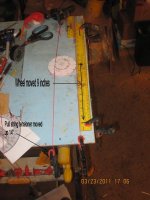
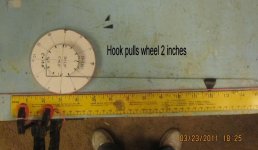
The wheel has moved 9 inches. The pull string tensioner has moved 14 inches.
Prolly has to do with the greater lever arm from the ruler to the top of the smaller wheel. :)
.
The setup:
There is a string in lieu of a rack and gear, the large wheel rolls along. This is fixed at the ends. Doesn't move except to go around the wheel as the wheel moves along it.
The pulling string can move as the wheel itself moves.
 

Attachments

  • jrChainWheel-III-01.jpg
    jrChainWheel-III-01.jpg
    61.3 KB · Views: 5
  • jrChainWheel-III-02.jpg
    jrChainWheel-III-02.jpg
    56.2 KB · Views: 3
  • jrChainWheel-III-03.jpg
    jrChainWheel-III-03.jpg
    92.7 KB · Views: 4
Last edited:
A reel can be rolled towards the hand which is applying F, but may also turn counter-clockwise (CCW), and roll away from the hand.
Assuming that the force is applied parallel to the floor ( no lifting of the reel), which way will it go?

I don't need the math, I have one right here, and it rolls towards me, every time.
 
Strawman.

That is obviously not the videos that I referred to in my post.
Which video do you take this from and at what time stamp?

As per my previous post, , the streamers in the 2nd video linked stay in the direction of "downwind" before the start of the run (0:18 to 1:23 mins) and remain so until about the 3:03min mark where the call from the pursuit car sounds like they're saying cart(?) speed is 13.9mph, then 15, then 19mph.

Yeah, sure.
 
Well Golly!, I done guess that settles it. You are omnipotent.

It does settle it. You are now denying something that everyone can easily try at home and that very clearly works.

Do the test again. Put something on the spool to give it some grip. Roll it on a surface with some grip (not a glass table). Put some tension on the string so it doesn't slip.
 
.
No!
I pull on the string that's wrapped around the smaller wheel.
.
So what did you expect? The wheel circumferences would change?
It rolls in the direction of the thread, because of dynamic behavior. Try drawing that.
That is, why you can force the reel to move to the right, and not roll to the left. Can a drawing show you that?
Then why do you think that your experiment will?

There is no doubt that one circumference is twice the other, so it's a bit obvious that the string will be less
than the reel's motion. But Work = F*d. Force is doubled, distance is halved so back to F*d,

Some time this Century, the penny may drop for the Carteers.
.
And then, with the string pulling on the upper side of the smaller wheel, the
results look like this:
The wheel has moved 9 inches. The pull string tensioner has moved 14 inches.

Prolly has to do with the greater lever arm from the ruler to the top of the smaller wheel. :)
[/quote]

Probably not?

Diameter of small = 1.9" Circ = 5.96"
Total should be 3*5.96 = 17.9"

Diameter of large is 3.8" Circ = 11.93", but moves 9"
Less than one turn?

9/11.93 = 0.75 ( of a turn)

.75*17.9 = 13.42"
 
It does settle it. You are now denying something that everyone can easily try at home and that very clearly works.

Do the test again. Put something on the spool to give it some grip. Roll it on a surface with some grip (not a glass table). Put some tension on the string so it doesn't slip.

Err... all that it means is that F is large enough. Still no magic.
LOOK AT THE MATH WHERE DO I SAY IT CAN"T MOVE TO THE RIGHT

The problem is that you ascribe some meaning to that. It's a cotton reel.
No change in work, no magical doubling of anything.
 
Well A cotton reel moves to the right so that proves ddw is possible.
But it can also slide or roll the to the left. So all 3 prove it's possible?

To hell with engineering, cotton reels say it all!
Power, who needs it!!!

Oh, and streamers and vanes can point where they will and show ddwftw no matter what
Steady state.... so yesterday.
The distance covered is a mere 0.41miles and is pushed to 40% of the record speed.
It still manages to accelerate at the same rate when 25 degrees off the wind, that is said to "prove" it's ddw

Why not simply write to Franklin Mint for another "record"?
I will have to increase the level of parody in the video. Way too low.
 
Last edited:
It proves that an object can move faster than the medium that supplies the power in a non transient state.
 
Err... all that it means is that F is large enough. Still no magic.
LOOK AT THE MATH WHERE DO I SAY IT CAN"T MOVE TO THE RIGHT

The problem is that you ascribe some meaning to that. It's a cotton reel.
No change in work, no magical doubling of anything.

That's right. Just like the cart.
 
The center of the spool is not attached to anything. It will pivot around the point where the spool touches the ground. So which way do you supposed that would make it move?
 
large diameter = 2 circumference = 6pi
Small Diameter = 1 circumference = 3p1

"over the top" Total motion of hand or ruler = 6pi + 3pi = 9pi
"under" Total motion of hand or ruler = 6pi - 3pi = 3pi double speed!

No. The only difference is the amount of string that winds on or off the reel.

ETA:
Are you serious?
When you pull over the top, the string winds off the reel as the hand moves, but when underneath, it winds on to the reel...other than that, they are both the same.
 
Last edited:
Not the hook!!!!
 

Attachments

  • jrChainWheel-IV-01.jpg
    jrChainWheel-IV-01.jpg
    79.4 KB · Views: 8
  • jrChainWheel-IV-02.jpg
    jrChainWheel-IV-02.jpg
    64 KB · Views: 8
  • jrChainWheel-IV-03.jpg
    jrChainWheel-IV-03.jpg
    63.9 KB · Views: 8
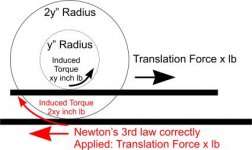
This has been described already, but a picture is worth 1,000 words, even more-so when it has some correctly applied math in it ;)

attachment.php
 

Attachments

  • Reel Drive3.jpg
    Reel Drive3.jpg
    19.2 KB · Views: 95
Last edited:
Status
Not open for further replies.

ISF - Join now!

Every member here is approved by hand. No bots, no spam, just people who care about evidence and honest debate.

Membership is free!

Create your free account

Back
Top Bottom