TJM
Potsing Whiled Runk

Yup.
That would be WTC 7 falling into it's own footprint while heading for Vessey Street.

And that would be WTC 7 on Vessey and WTC 6.
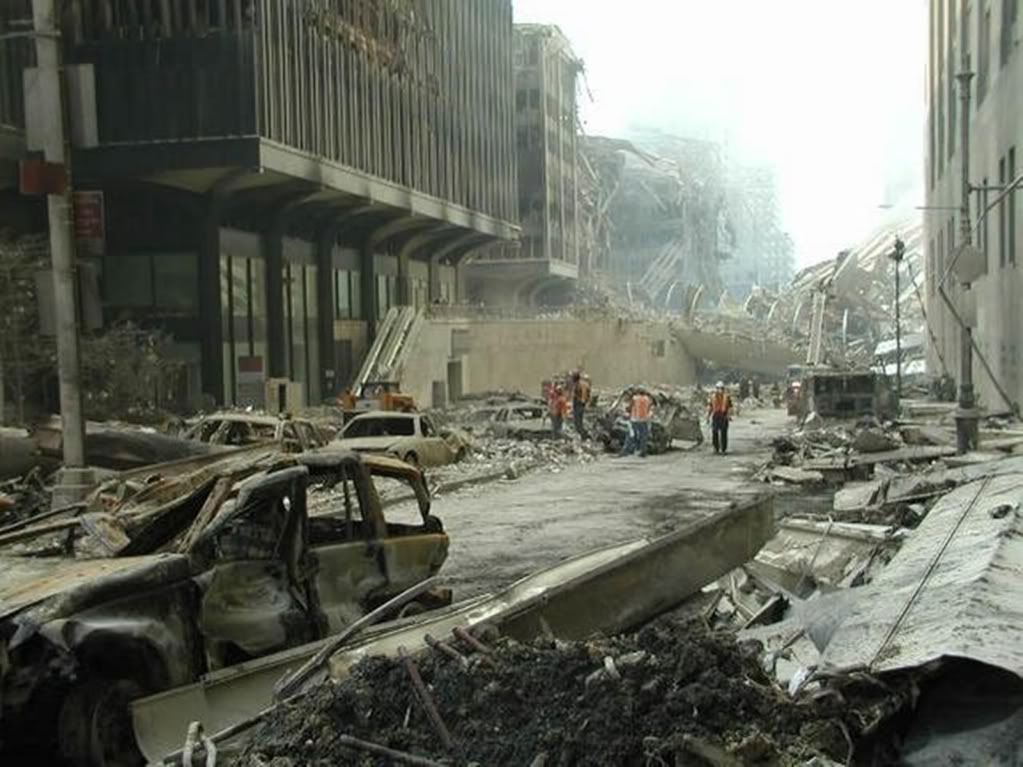

Yup.
That would be WTC 7 falling into it's own footprint while heading for Vessey Street.


You are welcome of course.I will agree. Thanks for the pics gentleman!!
I've seen no hard evidence that it did otherwise. I've seen no videos of WTC 7 falling on other buildings, .damage.
[qimg]http://curezone.com/upload/_C_Forums/Conspiracy/13.jpg[/qimg]
Shows pretty clearly that a large part of WTC 7 fell to the south towards #6
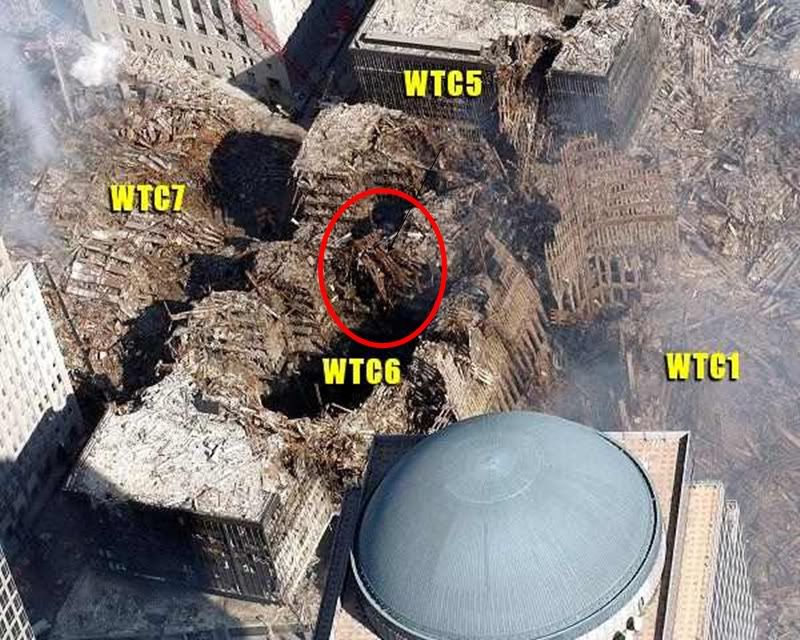

Wonderful.
Here is another tidbit of info you missed.
Well, get on it!!

Really? I'd love to see some calcs to back up this claim.The fires moved from fuel source to fuel source, burning themselves out as they moved to other areas, Once the fire moves on, the steel returns to normal temperatures rapidly, as steel is an excellent conductor of heat. No fire burned in one spot long enough to elevate the steel to anywhere near failure mode.
Probably a chunk of WTC 7 right there.
The ENTIRE building did not fall at FFA. This is a lie.
Only a PORTION of the North Face did.
About 1/3rd the way down the page.
I never said it fell 100% at free fall, I quoted NIST’s report that 105 feet, or 8 stories of the total 47 stories collapsed at pure free fall – that’s 20% of the building’s height that fell at the speed of an object dropped over the side of a building and falling through nothing but air!
As you can see, NIST has admitted to real, honest to goodness free fall of the massive WTC7 to the tune of 8 full stories, an incredible amount equal to over 17% of the total height of the 47 story structure. You can read it for yourself at - whoops I can't post links yet, training wheels and all that, maybe you can Google NCSTAR1 1-9 Vol 2.pdf
Really? I'd love to see some calcs to back up this claim.
That's a chunk of WTC1
And please notice, that even though WTC5 stood even closer to the collapse of WTC1 that WTC7 did, it did not collapse. There is a massive hole in the middle, but the side walls are still intact, all the way to the roof.
Unlike the tragic, ill-fated, over-insured WTC7, which completely collapsed from 47 to 3 stories in 7 seconds.
No, but you implied it and triforcharity corrected you on it. You'll have to do better than word games here. And it seems that the height grew 3% from last night. Have you found new data?

<Snip>
The fires moved from fuel source to fuel source, burning themselves out as they moved to other areas, Once the fire moves on, the steel returns to normal temperatures rapidly, as steel is an excellent conductor of heat. No fire burned in one spot long enough to elevate the steel to anywhere near failure mode.
Sorry, but I never implied it.
And the 3% discrepancy? NIST has used generalities to describe this event, so I take a wee bit of license from them.
I know, let's say it was 15%, just for fun... How do you explain 15% of this massive building falling at absolute free fall speed?
So where are your calculations? Please post them. And your assumptions - we'd be lost without them.Me too, I just love to get into a debate over mathematical calculations.
It's in the nist report that you mentioned in your first post. Surely you've read it?
The only thing you got right in that entire statement is highlighted.
Lets the rest of it down.
You seem to believe that the only form of heat transfer that can occur in a fire is direct contact, when in fact you will find conduction, convection, and radiation. All of which can raise the temperature of steel. As the fire spreads to one source of fuel to another, this will produce superheated gases that will eventually build up in a improperly ventilated room and cause a flashover or backdraft (but in the case of the WTC, most likely flashover). You can have an entire room on fire in the matter of minutes and raise the air temperature to 1000*F easily.
What is normal temperatures you are referring to? Room temperature? Because once this steel cools after being heated, it will NOT retain its original strength. Not only does the steel member expand, it also weakens welds and bolts to the point of failure.
So where are your calculations? Please post them. And your assumptions - we'd be lost without them.