• Quick note - the problem with Youtube videos not embedding on the forum appears to have been fixed, thanks to ZiprHead. If you do still see problems let me know.

OK, so how do thermite demolitions work again?

http://www.youtube.com/watch?v=8Mz0_x7313I

This video shows the South Tower just moments before it collapses and through collapse. Only when zoomed in fully do you see any fire. There are two small fires. That's it. This building collapsed first and even its crash damage was less direct than that of the North Tower.
 
,, and I'll explain this to you once again. Your personal incredulity and misunderstanding (and continued misuse of the word 'decellerate' ) do not form a cojent scientific arguement.

In post 346 I gave a somewhat detailed break down of how the collapse proceeded. One that you have ignored, uet had you bothered with it you would have noted that the columns are basically out of the picture once the initial collapse has taken place.

Go back and re-read it. Get back to me.

Then perhaps you will deign to put in a post your description of how the collapse took place. You do have some vision of this don't you?

The falling mass is NOT significantly impacting the load carrying columns lower down.

Here's what you wrote. You're claiming the upper sections aren't even impacting the core to any significant degree. This is ridiculous. Where is the evidence for this claim? First, the upper sections pass directly through the cores of these buildings. You claim that the failure of lateral support causes the core to fail. Evidence? Why do we see pulverized concrete then if the upper section isn't doing it? Not only does what you describe not make sense there is no evidence for it.
 
Are you comparing the upper section collapsing on the lower section of the Twin Towers to 1000 lbs of force on a wire with a 10 lb capacity? This was an obscene amount of steel and concrete. The only way that acceleration could remain constant is if resistance and therefore damage were constant from the top crash zone to the ground. If there were plane crashes and fire all the way down, then perhaps we would see a constant rate of acceleration, but we are told that there is a massive discrepancy in resistance between the crash zone and the undamaged structure. There should be a decrease in the rate of acceleration and there is not.

Once again it is explained to you that the upper mass impacted primarily the floor span area of the next level down. The floor spaces were never, ever intended to be able to support the mass of 10+ storeys. That however is not the extent of the force on that floor space. It has been explained to you what a dynamic force is and in this case we have a moving mass of 10+ storeys impacting a floor space.
The floor pans transfered the forces on them to the columns via their truss seats. The truss seats were designed for the loads that could be expected to be on ONE FLOOR. The truss seats would have failed akin to the failure of a styrofoam cup failing under you foot - no noticable decrease in acelleration.
Thus these forces DO NOT get transfered to the columns.

Next floor down is getting even more mass much of which is by then moving even faster.


I'm tired of explaining this to you. I never claimed the upper sections fell at the rate of gravity. I'm referring to deceleration as a decrease in the rate of acceleration. There is no such decrease, therefore the upper sections are not destroying the lower.

It is simple physics. A concept that any first year student would grasp.
The acelleration of the collapse was less than that of gravity and that means that some force(s) were opposing the collapse. A decrease in acelleration CAN ONLY occur if the opposing forces at some point exceed the forces driving collapse. Since the collapse was destroying floor pans first, thus removing column bracing, the only forces opposing collapse were the transfer of momentum (explained very well to you in prior posts), and the truss seats which were vastly overwhelmed at each level by the mass and dynamic loading of the falling mass.

The columns simply don't enter into it much at all mate and the floors were essentially the same all the way down.
 
Here's what you wrote. You're claiming the upper sections aren't even impacting the core to any significant degree.

Correct, and I fail to see why you do not understand this. Once the columns fail initially at the fire/impact level how do you propose that the force of gravity and the dynamic forces of impact on the upper block would be transfered to the columns of the lower portion of the building?

It can't be except if it is possible for the floor pan of the next floor down to carrying all of the load of 10+ storeys and transfer that load via the truss seats, to the columns.
Bazant demonstrated that at best the forces on the floor pans was 30X greater than their failure point

This is ridiculous.

Only to you and your personal incredulity born of a political world view and a complete and utter lack of physics education.

Where is the evidence for this claim?

Explained many times now. However if you could answer the above question
how do you propose that the force of gravity and the dynamic forces of impact on the upper block would be transfered to the columns of the lower portion of the building?
then perhaps you might understand that this question of evidence is about as damning as asking me for evidence that 2+2=4

First, the upper sections pass directly through the cores of these buildings.
Basically yes. It destroys the floor pan.

You claim that the failure of lateral support causes the core to fail. Evidence?

well its a basic engineering principle, again akin to asking me for evidence that 2+2=4
However it can be noted that the columns did fail most commonly at their section connections. In a bending long column the most brittle point would be at these connections. They would resist bending at that point meaning that stresses would be concentrated at the connections and that is the likely location of fracture and just above them would be the most likely location of buckling. It would be a toss up , I believe, which would occur first, but others could speak to this better than I can as I am not an engineer.

Why do we see pulverized concrete then if the upper section isn't doing it? Not only does what you describe not make sense there is no evidence for it.

Why would you not see pulverised concrete in the senario I posited? Because I did not include the obvious, that the upper section is also being destroyed by this contact? The whole collapse is, I have metaphorically described, a giant , high speed, rock crusher.
You have upper columns spearing through concrete pans initially. That would break concrete. You also have the first upper floor pan impacting the lower floor pan and they would cause fracturing of each other. Later, as collapse progresses you also have heavy steel column sections churning in the mix, concrete hitting concrete.

Now if you are asking why so much dust at initial failure need I remind you that each floor contained thousans of square yards of drywall that offers next to no resistance to being broken up and creates a vast amount of dust. there is also the fact that at initial collapse most of the smoke is forced from the level being crushed.

If, as I have, you had ever seen an actual rock crusher in action you would know what it does. The one that I worked around as a teenager used large steel balls on heavy chains to pound chunks of granite(much tougher than concrete let alone lightweight concrete) into gravel. A screen separates out all particles 7/8ths of an inch or smaller and passes the rest back into the crusher. It was fed stones about twice the size of a softball. Its REALLY noisy but can turn out many dozens of cubic yards of gravel every day. It was about the size of a large concrete delivery truck.

Recently(several times in the past 2 years) I have had cause to purchase yards of crushed rock. It sits in piles at the construction company yard, out in the elements and being rained on. Despite this constant washing it always is very dusty. When you throw a shovel full it lands with a puff of dust.
 
Last edited:
I cited it. Read.
Your cite didn't mention the effects of fire at all... once again, making your point moot.

Remember that the buildings withstood the impacts. It was the subsequent fire added to the impacts what made them collapse.

Show me the severity of the fire then. You can't even see fire on the outside of the South Tower by the time it collapses. And about 20 people did walk right through the crash zone. If the rest had followed them then everyone above the crash zone would have made it out.
Let me quote from my earlier post for you. Have you read it at all?

How many is many?

Only 14 people escaped from the impact zone of the South Tower after it was hit, and only four people from the floors above it. They escaped via Stairwell A, the only stairwell which had been left intact after the impact.​
http://en.wikipedia.org/wiki/Collapse_of_the_World_Trade_Center#Collapse_of_the_South_Tower

No one was able to escape from above the impact zone in the North Tower after it was hit, as all stairwells and elevator shafts on those floors were destroyed.​
http://en.wikipedia.org/wiki/Collapse_of_the_World_Trade_Center#Collapse_of_the_North_Tower

Does that mean that the fire was not so intense? To me, it means instead that it grew in intensity so soon, that just 4 people had the time to escape from above the impact zone.

Except, it was not exactly the "crash zone". It was just the lowest floor that had been affected by the impact, and the one that was affected the least. The inferno was in the upper floors. NIST's observations confirm these of Palmer: they register just two isolated pockets of fire in that floor, while in the upper floors the photographs reveal much more intense fires.

Could you believe that? That quote is in agreement with NIST's observations!

Now what's the cause to reject the rest of said observations, again?
:duck:


Not only is the South Tower's fire externally invisible, but the damage is isolated to one half of the building, yet the upper section collapses across the length and width of the building, not toward the damage, in the path of greatest resistance. Is your BS detector broken or something?
You're kidding, right?

Or do you really expect something like this to happen?

rebote-wtc.gif
 
I've given evidence to support my claim that the South Tower fire wasn't severe. If you want to counter that argument, then do more than call me a liar. It typically takes a little more.

Really? Where? Oh, black smoke? Yeah, that's ************.

http://www.youtube.com/watch?v=GQ7B542OSF8

This guy is Dave Dodson, and is one of the best fire science guys you will ever meet. Maybe you will understand him?

What else? Oh, it "didn't spread".

That's ************ too.

See here
http://wtc.nist.gov/NCSTAR1/NCSTAR1-5index.htm

Specifically
http://wtc.nist.gov/NCSTAR1/PDF/NCSTAR 1-5A Ch 1-8.pdf

and

http://wtc.nist.gov/NCSTAR1/PDF/NCSTAR 1-5A Chap 9_Appx C.pdf

Now, what were you saying?
 
You don't need qualifications in metallurgy to identify a steel beam that is melting.

You do if one is to claim that there were "rivers of molten steel".

Hey, did you ever find any reports from the FBI, ATF, FEMA, etc. about this melted beam?


What is there to rebut? I don't want to hear your personal stories anymore.

Ok champ.

So you admit they weren't involved in a forensic investigation. Fresh Kills is a landfill.

Fresh Kills was a landfill.

And yes, they were involved in a forensic investigation.

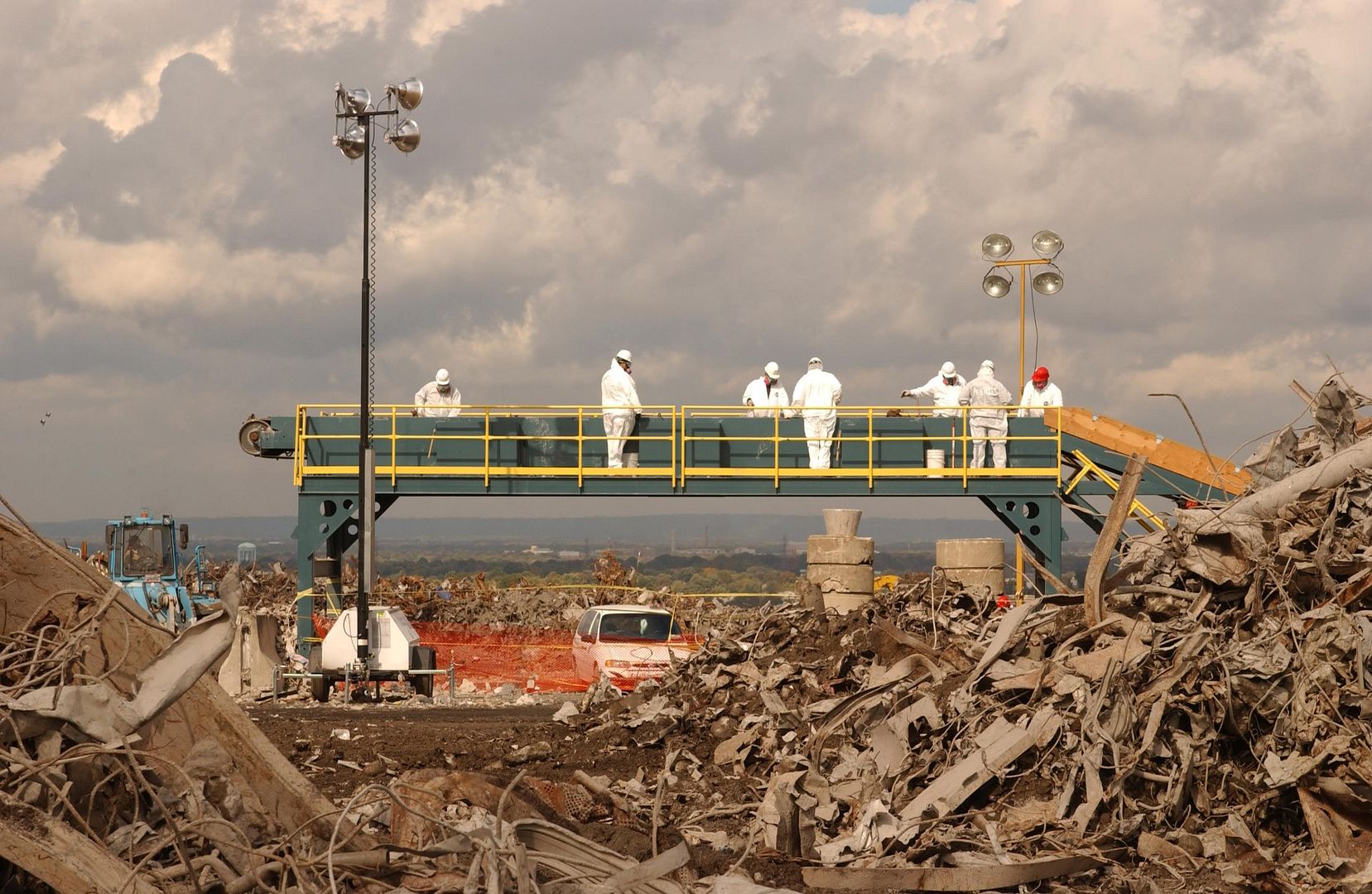
What are these guys doing?
FEMAphoto_WTC-162.jpg


How bout them?

http://www.nysm.nysed.gov/exhibits/longterm/documents/recovery.pdf

page 4.

What are those guys doing?

Humm....sorting through the rubble with "a fine toothed comb" sure seems pretty forensic.
 
Show me the severity of the fire then. You can't even see fire on the outside of the South Tower by the time it collapses.

I already have. You ignored it.

And about 20 people did walk right through the crash zone.

Yep. One egress route was available.

If the rest had followed them then everyone above the crash zone would have made it out.

Speculation.

Not only is the South Tower's fire externally invisible, but the damage is isolated to one half of the building, yet the upper section collapses across the length and width of the building, not toward the damage, in the path of greatest resistance.

So, now your an damage analist? How cool!! Where did you find this degree?


Is your BS detector broken or something?

Nope, everytime you post, it goes into overdrive.
 
Pardon me.

[qimg]http://911research.wtc7.net/wtc/attack/docs/wtc_on_fire5_c.jpg[/qimg]

Then again, I see no fire here.

CONTEXT my friend. When was that picture taken?

And because you don't see any fire, what might be producing all the black, billowing smoke?


Oh, and hotlinking isn't allowed. Just FYI.
 
http://www.youtube.com/watch?v=8Mz0_x7313I

This video shows the South Tower just moments before it collapses and through collapse. Only when zoomed in fully do you see any fire. There are two small fires. That's it. This building collapsed first and even its crash damage was less direct than that of the North Tower.

Well, two "small" fires, and tons of billowing black smoke. I mean, can you see through the smoke and exterior walls to see what is going on? I can't. But, my knowledge of fires tells me that there is something burning inside the building.

Yes, the S. Tower was hit off-center and second. It also was hit lower down, which put more pressure on the rest of the undamaged columns.

Please, do try to understand physics. It would help you tremendously.
 
Truther logic. They tell these dramatic stories of fires burning for days despite being fought the entire time, which are started by an electrical malfunction or something, but think that a tremendous fire started by an airplane collission and unable to be fought by anyone should just burn itself out in a matter of minutes.
 
Truther logic. They tell these dramatic stories of fires burning for days despite being fought the entire time, which are started by an electrical malfunction or something, but think that a tremendous fire started by an airplane collission and unable to be fought by anyone should just burn itself out in a matter of minutes.

isn't it funny how he falls into the special pleading logical fallacy?
 
The fact that any man of adequate intelligence can, with a straight face, tell another man that steel and concrete that is so badly damaged that it causes this kind of epic failure will provide negligibly less resistance than structure untouched by any weakening agents--the fact that someone can peddle this garbage and mean it is just sad.
 
The fact that any man of adequate intelligence can, with a straight face, tell another man that steel and concrete that is so badly damaged that it causes this kind of epic failure will provide negligibly less resistance than structure untouched by any weakening agents--the fact that someone can peddle this garbage and mean it is just sad.

Ladies and Gentlemen - this is the very face of the 'truth movement'.
 
Overall, a figure of 15% looks like a reasonable one for the weakening of the damaged section.

Oh does it? A 15% percent reduction in load bearing capacity of the crash zone caused a sudden collapse did it? This building was way over-engineered. Are you implying that a 15% increase in load would have caused this building to just collapse on itself?

And then I could point out how unscientific your "reasonable" assessment is, but that seems unnecessary.
 
Oh does it? A 15% percent reduction in load bearing capacity of the crash zone caused a sudden collapse did it? This building was way over-engineered. Are you implying that a 15% increase in load would have caused this building to just collapse on itself?

And then I could point out how unscientific your "reasonable" assessment is, but that seems unnecessary impossible for me.
fixed that for ya sport

It should be easy for you to use math to prove your point, I had already given you the tools days ago.
http://www.tutor4physics.com/workenergy.htm
 
Last edited:
Oh does it? A 15% percent reduction in load bearing capacity of the crash zone caused a sudden collapse did it? This building was way over-engineered.

Um...he's talking about "deceleration" (negative acceleration). Let me guess, you read it, but didn't undestand any of it, right? He wasn't talking about collapse initiation.

Are you implying that a 15% increase in load would have caused this building to just collapse on itself?

And then I could point out how unscientific your "reasonable" assessment is, but that seems unnecessary.

LOL, you don't see the problem with what you just asked? He's talking about retardation of an accelerating portion of the building. This isn't a static load, this isn't about collapse initiation.
 
Last edited:

Back
Top Bottom