Moderated WTC 1 features list, initiation model / WTC 2 features list, collapse model

From Bazant and Verdure, the capacity of a column to resist being contracted:

buckle_phases.gif


Elastic contraction in yellow. After a short contraction, the ability to resist drops dramatically. This sharp drop in an upward resistance force allows the beginning of downward acceleration at a significant fraction of g.

This will be seen as a sharp transition in the velocity. The slope of the velocity curve is the acceleration, so we would expect a clear change in slope from near zero to anywhere between 0.5g to 1.0g.

image00029.png


The blue curve is the position of the NW corner in each frame. The purple curve is the slope of the blue curve, the downward velocity. The transition of the slope of the velocity curve is obvious. Acceleration obviously changes from zero to o.5g to 1.0 g around frame 224.

Geometrically, this transition point must happen just as the NW corner starts to deform into a buckle. This means that it happens at the first moments of downward displacement at the velocity transition point, around frame 224.


So guys, any way you look at it, as a sharp drop in resistive force just after the yellow-pink transition point in the Bazant load-displacement diagram or as the velocity and acceleration take-off point in the drop curve, your moment of failure of the NW corner happens at the same time.

I don't see any way to argue that the downward velocity transition point is not the point of failure. Sharp drop in upward force means accleration takes off. The shape of the graphs show this is the only natural transition and it is so noticable, it will hit you in the nose if you are not careful.
 
It is very important to understand how small the width of the yellow rectangle actually is.

buckle_phases.gif


It requires very little downward displacement to destroy it's capacity. Bazant calls the downward displacement of the floor slab above "delta u". Very little downward displacement of the floor slab above is required to destroy the columns cpapcity to handle load. Please estimate how much delta u is required between the 99th and 98th floor slabs to completely destroy the columns capacity (so little you cannot see it).

Very little movement is required to pass over the spike in restorative force potential and destroy the column's strength (in the pink region).

Bazant's own load-displacement curve tells us the column is toast after only a small downward movement.

If you look at the drawing of the column undergoing 3 point buckling on the right of the graph, this means that theta is very small when sufficient delta u destroys the columns capacity, It doesn't take much buckle deformation to destroy it's strength. A little over half way between u(o) and u(c) and you can kiss that column goodbye. Over the hump, what is going to stop it from falling?
 
Last edited:
It is very important to understand how small the width of the yellow rectangle actually is.

[qimg]http://www.sharpprintinginc.com/911/images/photoalbum/13/buckle_phases.gif[/qimg]

It requires very little downward displacement to destroy it's capacity. Bazant calls the downward displacement of the floor slab above "delta u". Very little downward displacement of the floor slab above is required to destroy the columns cpapcity to handle load. Please estimate how much delta u is required between the 99th and 98th floor slabs to completely destroy the columns capacity (so little you cannot see it).

Very little movement is required to pass over the spike in restorative force potential and destroy the column's strength (in the pink region).

Bazant's own load-displacement curve tells us the column is toast after only a small downward movement.

If you look at the drawing of the column undergoing 3 point buckling on the right of the graph, this means that theta is very small when sufficient delta u destroys the columns capacity, It doesn't take much buckle deformation to destroy it's strength. A little over half way between u(o) and u(c) and you can kiss that column goodbye. Over the hump, what is going to stop it from falling?
So you agree that the pull-in force from the sagging floor system is enough to cause global collapse?

Maybe you're learning.
 
Last edited:
LOL

Myriad said:
femr2 said:
Are you describing......air from WTC2 upper floors travelling, via C6, 7 & 50, 1000 feet down WTC2, bypassing any available venting, especially that around the lobby, increased pressure in the whole basement complex, which then traversed through openings in C6, 7 & 50 in WTC1...in order to push fire out up-top ? Is that what you are describing ?

Are you suggesting that the above phrasing does not, and was not intended to, express incredulity about the scenario described? Is that what you are suggesting? Really?
Wow. Allow me to express my incredulity. Gobsmacked.

Quoting for truth here:
Reality is, apparently, a grainy jumpy animated GIF, almost entirely obscured by white pixel noise, that slows my browser to a crawl.

Yeah, I suppose it is. Thanks for the cool metaphor.
 
Asking simple, direct questions is "entrapment".
Come now tfk. The question you asked was, as you well know, this...
How about a statement of the frame in which you think that the drop transitions from rotation to pure descent.
Your intention was to draw out an answer which included the stating of a specific frame number, and so a specific time (which you would then jump upon as being impossible to determine to whatever accuracy), along with the attempt to draw that statement out on a process (rotation to pure descent) that you know did not occur.

In short it was a question intended to provoke an answer with which you would be able to make derisory response.
 
In short it was a question intended to provoke an answer with which you would be able to make derisory response.

Actually, I saw it as an attempt to get you guy's to justify your results in a 3-D world (multiple views).
 
Last edited:
Actually, I saw it as an attempt to get you guy's to justify your results in a 3-D world (multiple views).

Perhaps it'll help if you see the progression...

tfk said:
How about a statement of the frame in which you think that the drop transitions from rotation to pure descent.
femr2 said:
Inept question.
Which video ?
Why attempt to create the trap of stating a singular frame, which you'll then whine about ?
Pure descent ? You one of those folks who think rotation stopped suddenly ?
tfk said:
Major_Tom said:
Tom, how many times have I mentioned frame 224 and the failure of the NW corner?? The last columns to fail are along the NW corner, around Sauret frame 224. I have been posting the same graph and explanation for a few months now.
tfk said:
So, MT, frame 224 is the frame in which "you think that the drop transitions from rotation to pure descent."

Really?

What stops the rotation?

In my view tfk's intention is clear, as I stated in my previous post.
 
Perhaps it'll help if you see the progression...

.

"Rotation" and "pure decent" are two entirely different things depending on if you are viewing in 2-D or 3-D (at least your ability to discern between the two).

ETA:
tfk: Feel free to correct me if I see your argument wrong.
 
Last edited:
This will be seen as a sharp transition in the velocity. The slope of the velocity curve is the acceleration, so we would expect a clear change in slope from near zero to anywhere between 0.5g to 1.0g.

[qimg]http://img101.imageshack.us/img101/4753/image00029.png[/qimg]

The blue curve is the position of the NW corner in each frame. The purple curve is the slope of the blue curve, the downward velocity. The transition of the slope of the velocity curve is obvious. Acceleration obviously changes from zero to o.5g to 1.0 g around frame 224.

Geometrically, this transition point must happen just as the NW corner starts to deform into a buckle. This means that it happens at the first moments of downward displacement at the velocity transition point, around frame 224.


So guys, any way you look at it, as a sharp drop in resistive force just after the yellow-pink transition point in the Bazant load-displacement diagram or as the velocity and acceleration take-off point in the drop curve, your moment of failure of the NW corner happens at the same time.

I don't see any way to argue that the downward velocity transition point is not the point of failure. Sharp drop in upward force means accleration takes off. The shape of the graphs show this is the only natural transition and it is so noticable, it will hit you in the nose if you are not careful.

If you look at the vertical displacement on that graph, you're saying that as soon as the NW corner started to descend that indicates a failure of the hinge and the beginning of the vertical descent but with a pure rotation about the north face though you'd expect the NW corner to drop 2ft in 1/3 second, which your graph shows. In Fact your curve matches a pure rotation pretty well over the first 6-7 feet of descent (or slightly more than the depth of the white window washer feature).

Your frame 224 is closer to the beginning of south side collapse than the point where pure vertical descent of the NW corner is more noticeable than descent from rotation.
 
If you look at the vertical displacement on that graph, you're saying that as soon as the NW corner started to descend that indicates a failure of the hinge and the beginning of the vertical descent but with a pure rotation about the north face though you'd expect the NW corner to drop 2ft in 1/3 second, which your graph shows.
What angle did you decide that 1/3 second rotation was through ?
Why 1/3 second ?

In Fact your curve matches a pure rotation pretty well over the first 6-7 feet of descent (or slightly more than the depth of the white window washer feature).

Your frame 224 is closer to the beginning of south side collapse than the point where pure vertical descent of the NW corner is more noticeable than descent from rotation.

The details have been analysed via multiple viewpoints.

Do you think your views match the behaviour seen in the following view, and associated feature drop curves ?

dreh.gif


437537321.png


http://femr2.ucoz.com/WTC1_NBC_911_1752_northb-new.gif
 
Last edited:
Reactor Drone post 431: "If you look at the vertical displacement on that graph, you're saying that as soon as the NW corner started to descend that indicates a failure of the hinge and the beginning of the vertical descent but with a pure rotation about the north face though you'd expect the NW corner to drop 2ft in 1/3 second, which your graph shows. In Fact your curve matches a pure rotation pretty well over the first 6-7 feet of descent (or slightly more than the depth of the white window washer feature).

Your frame 224 is closer to the beginning of south side collapse than the point where pure vertical descent of the NW corner is more noticeable than descent from rotation. "

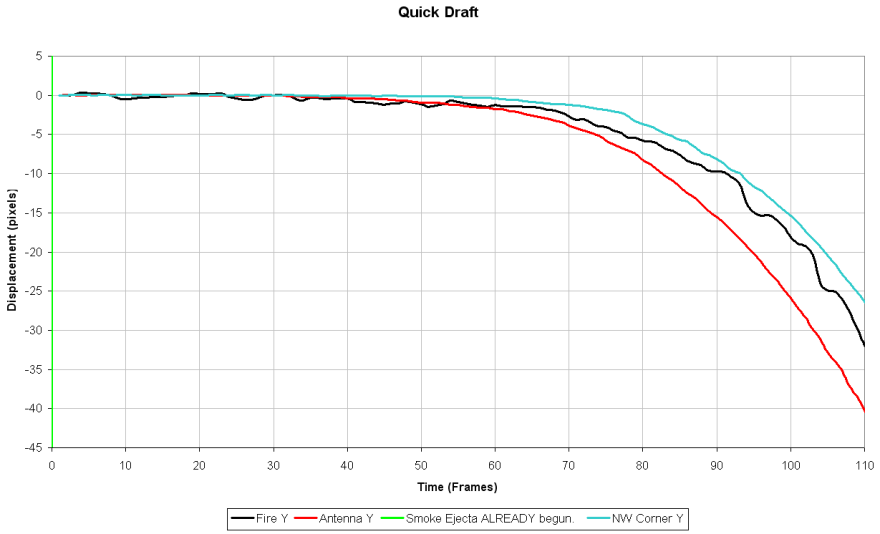
No. The data is much more accurate than our eyes. The slope of the velocity curve remains relatively constant. Here is another tracing of just the NW corner and velocity:

378476413.png


The slope of the velocity curve is the acceleration. The object is clearly falling at an acceleration which remains constant until the first "speed-bump". After the speed bump it reverts to the same constant acceleration, same slope as just before the speed-bump.

There is no doubt that the slope of the velocity curve between speed-bumps is an object falling at between 0.5 and 0.8g.

You have absolutely no evidence for a gradual acceleration transition like your tilting demands.
>>>>>>>>>>>>>>>>>>>>.

You are also ignoring gradual downward displacement of the antenna from frame 130. The antenna and north face must tilt together. Your antenna cannot lead by almost 1.5 seconds.

Once again, the slope of the velocity graph (which is the curvature of the positional data) tells you exactly what is going on. Tilt accelerations cannot match the 0.5 to 0.8g constant slope of the velocity graph. Constant slope over a region in the velocity graph means constant acceleration much too high for your early tilt.

That puppy is falling with a high, constant acceleration until the first mini-jolt from frame 224.

Reactor Drone, any observations on slope transitions to support your idea? Any characteristic signatures of north wall tilt after frame 224 in the drop data?
 
Here is an example of how the Sauret drop data is much better than our eyes:

700566080.gif


This gif covers from about frame 240 to 275. But the drop data tells us a downward relatively constant acceleration between 0.5 to 0.8g begins around frame 224.

Your eyes, using frame by frame viewing, can first see the damage on the NW corner from about frame 255. Any contradiction? No, if you look at the downward displacement around frame 255, you can see that it is quite consistent with the first visible damage occurring after about a 2 or 3 ft drop.

You will not even notice the downward acceleration from frame 225 to 255 using your eyes, but it is there and accelerations within the range of 0.5 to 0.8g tell us the NW corner had already failed or such accelerations are impossible.

There is a latency period when the NW corner has significant acceleration but you still cannot see the NW corner damage because the initial downward velocity is basically zero and the NW corner must build up some speed. About 30 frames, or 0.5 seconds is needed for the NW corner to fall it's first 2 or 3 ft.


Femr: "Do you think your views match the behaviour seen in the following view, and associated feature drop curves ?"

dreh.gif


It is painfully obvious that the NW corner starts to fall with only minimal tilt from this angle.
 
Last edited:
It is painfully obvious that the NW corner starts to fall with only minimal tilt from this angle.
Indeed.

I'm pretty sure your references relate to the 59.94fps Sauret data, but just in case, for clarity, the two animations above are 29.97fps.
 
1 - I will reiterate a general objection to the multi-gig, animated gifs. My laptop does not like these.

2 - Does anyone familiar with the material find these gifs indicative of ... anything? They remind me of bigfoot or ufo "evidence." Columns appear to be jumping sideways, and video "analysts" are telling me that this means something that I cannot see. Am I wrong?
 
In my view tfk's intention is clear, as I stated in my previous post.

Your view is, like so many times previously, laughably (& provably) wrong.

You don't know facts.
You haven't a clue about my intentions.

tfk
 
You haven't a clue about my intentions.
I'm sure you are capable of clarifying your intent then...

tfk said:
1. Where are femr's & MT's graphs of the tilt angle vs. time?
2. How about drop distance (in feet, not pixels) vs. time.
3. How about a statement of the frame in which you think that the drop transitions from rotation to pure descent.

a) You have made multiple requests for tilt angle/time graphs, have been directed to their location multiple times, have refused to read the contextual details provided with them, and have done nothing with the information provided.
b) You were provided two separate graphs in response to your request #2, which had both already been posted in this thread, and have done nothing with the information provided.
c) You received a number of responses from myself relating to your #3 request, in which I highlighted the leading nature of your question and the resulting discussion earlier ensued.

So, for your #3 question above...

i) Do you think that drop transitions from rotation to pure descent ?
ii) Assuming you do, do you think that it is possible to determine that transition accurate to a single frame number ?
iii) Which copy of which video are you referring to ?
 
Last edited:
No. The data is much more accurate than our eyes. The slope of the velocity curve remains relatively constant. Here is another tracing of just the NW corner and velocity:

[qimg]http://femr2.ucoz.com/_ph/6/378476413.png[/qimg]

The slope of the velocity curve is the acceleration. The object is clearly falling at an acceleration which remains constant until the first "speed-bump". After the speed bump it reverts to the same constant acceleration, same slope as just before the speed-bump.

There is no doubt that the slope of the velocity curve between speed-bumps is an object falling at between 0.5 and 0.8g.

You have absolutely no evidence for a gradual acceleration transition like your tilting demands.
>>>>>>>>>>>>>>>>>>>>.

You are also ignoring gradual downward displacement of the antenna from frame 130. The antenna and north face must tilt together. Your antenna cannot lead by almost 1.5 seconds.

You claim that antenna drop wasn't due to rotation. Are you dropping your claim of a 2ft antenna drop and saying that was due to rotation now?

You might also want to label the axes on that graph.


Once again, the slope of the velocity graph (which is the curvature of the positional data) tells you exactly what is going on. Tilt accelerations cannot match the 0.5 to 0.8g constant slope of the velocity graph. Constant slope over a region in the velocity graph means constant acceleration much too high for your early tilt.

That puppy is falling with a high, constant acceleration until the first mini-jolt from frame 224.

Reactor Drone, any observations on slope transitions to support your idea? Any characteristic signatures of north wall tilt after frame 224 in the drop data?

Why do you think your measured drop wouldn't accelerate like that if it was due to rotation?

It is painfully obvious that the NW corner starts to fall with only minimal tilt from this angle.

It is also painfully obvious that that view is next to useless for seeing tilt.

timeangles.jpg


The obvious tilt from the west is imperceptible in the NW low angle view.
 
It is also painfully obvious that that view is next to useless for seeing tilt.
For *measuring* tilt, you couldn't be more wrong.

See my previous posts: #371, #372, #374

[qimg]http://img.photobucket.com/albums/v499/swampmonster/september%2011/timeangles.jpg[/qimg]

The obvious tilt from the west is imperceptible in the NW low angle view.
You have not correctly synchronised the videos. You're a good secound out of whack.

For your initial pair, you have frame 80 of my GIF (which has clearly already begun vertical descent given the detail in the synchronised graph overlay) matched with the wrong frame of:
.\NIST Cumulus Video\WNBC NIST Dub #7 - StJohn, Heath, Spell, RM\WNBC Dub7 14.avi

Frame 80 of my GIF matches with frame 626 of the video referenced above.

You have also not appeared to take account of the camera movement. See discussion with BasqueArch #384 and #393

Regardless, if you have read the posts I indicated above within which I provide the basic method to determine angular change using the NW Corner and SW Fire vertical displacement values, you should realise your mistakes.

If there's doubt or objection of any kind to my synchronisation details, I shall, of course, provide resources to confirm. It shouldn't be necessary as I've provided enough detail above for you to check them for yourself.
 
It is interesting that in the attempts by regular JREF posters to measure north face and antenna tilt angles over which all columns had failed, they repeatedly make the same mistake the NIST had made. They overestimate the angle by ignoring when the NW corner fails.

The measurements by TFK, BasqueArch and Reactor Drone ignore the fact that the NW corner has already visibly failed in the images they use. The NIST does the same: They take a frame from a video seemingly at random, totally ignoring the fact that the NW corner had clearly already failed in the frame they had chosen.

It is like people feel free to chose any frame that justifies their opinion.

The NW corner begins to descend downwards with an acceleration between 0.5 and 0.8g in Sauret frame 224. Drop curves show this without a doubt. The NW corner damage first becomes visible in Sauret frame 255, 0.5 seconds after the release point.

This reality is totally ignored in every effort to measure by either the NIST or yourselves.
>>>>>>>>>>>>>


Guys, you can't just measure in any frame that makes you feel good. You will obviously overestimate the tilt angles if you choose a frame well after the NW corner had failed. You are just duplicating the NIST mistakes.


TFK: "3. How about a statement of the frame in which you think that the drop transitions from rotation to pure descent. "

Can TFK read?


TFK post 407: "So, MT, frame 224 is the frame in which "you think that the drop transitions from rotation to pure descent."

Really?

What stops the rotation?"

What a stupid question!
 
Last edited:
It is interesting that in the attempts by regular JREF posters to measure north face and antenna tilt angles over which all columns had failed, they repeatedly make the same mistake the NIST had made. They overestimate the angle by ignoring when the NW corner fails.


What has NIST had to say about this? Surly you have brought it to their attention.

You have, right?
 

Back
Top Bottom